Crypto Miners' Big AI Gamble: Valuations Enter Differentiation Stage, Comeback Fight Proves Tough

链捕手Published on 2026-06-20Last updated on 2026-06-20

Abstract

Crypto Mining Firms' AI Bet: Valuation Divergence and a Challenging Transformation Facing declining profitability in crypto mining, mining companies are pivoting to AI infrastructure, capitalizing on their existing power resources, land, and data center expertise to offer GPU compute power. This transition narrative has boosted their stock prices significantly, with firms like Hut 8 and Bitfarms seeing gains over 100% year-to-date, far outpacing Bitcoin. This has led to a market valuation split, with pioneers like CoreWeave reaching a $62.8B market cap, while others remain below $5B. The market currently prioritizes growth potential over short-term profits, which remain under pressure due to heavy capital expenditures for AI build-outs and crypto asset volatility. However, the transformation is a high-stakes gamble. Bitcoin mining profitability is shrinking, with the average production cost around $63,707 and miner margins contracting. While AI offers a more lucrative long-term path, it requires massive investment—estimated at a $500B near-term funding gap. Success now hinges on execution: delivering on contracted power capacity, securing quality tenants like major cloud providers, and managing the immense financial burden. The valuation focus is shifting from mere power capacity to project delivery, future cash flows, and tenant quality, making this a difficult but critical turnaround attempt.

Author: Nancy, PANews

As crypto assets continue to slump, crypto mining companies are facing increasing pressure to survive. To find new growth curves, more and more miners are accelerating their shift into the AI track. This transformation narrative quickly gained favor in the capital markets, with many miners' stock prices surging significantly, even hitting record highs.

However, while the AI business injects new growth potential into miners, the massive capital expenditures, continuous funding requirements, and long return cycles behind it are pushing miners into another war of financial attrition. At a time when the profitability of their core mining business remains under pressure, this high-stakes gamble of transitioning to AI is testing miners' financial strength and execution capabilities.

Stock Prices Outperform Bitcoin Significantly, Miner Valuations Enter a Phase of Differentiation

Mining companies are transforming into the landlords of computing power in the AI era.

As Bitcoin mining profit margins continue to shrink, with some miners even falling into losses, the AI boom has driven a sharp increase in global demand for data centers, power resources, and GPU computing power. More miners are accelerating their transformation into AI infrastructure, seeking new growth curves.

For miners, this transition offers natural advantages. Over the long term, to meet large-scale mining demands, miners have amassed key assets such as abundant power resources, land reserves, substation access capabilities, and mature cooling systems. Compared to data center operators starting from scratch, miners can quickly enter the AI infrastructure market by upgrading existing facilities, meeting AI computing power demands at lower costs and in shorter timeframes.

Since last year, the pace of miners' transformation to AI has noticeably accelerated. Some miners decisively downplay or even exit traditional mining to fully pivot to AI computing and data center operations; others retain part of their mining business but gradually shift the focus of resource allocation and capital expenditure to the AI field. Today, several miners have become key players in AI infrastructure construction.
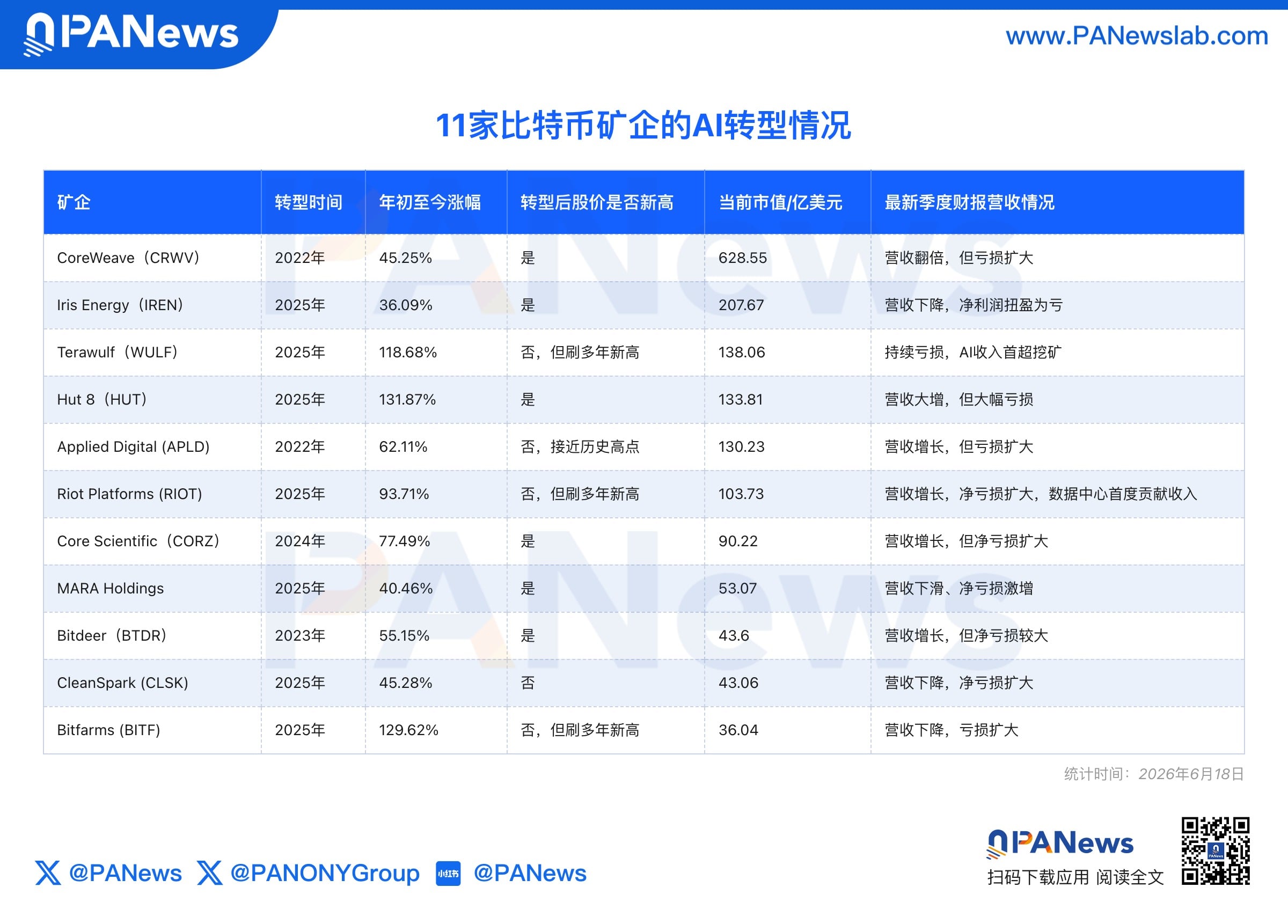
Looking at the timing of transformation, CoreWeave, Applied Digital, and Bitdeer began deploying AI computing and data center businesses as early as 2022-2023, among the industry's early movers; while miners like Iris Energy, Terawulf, Hut 8, Riot Platforms, and Bitfarms started fully ramping up AI infrastructure construction in 2025, coinciding with the AI industry's rapid expansion cycle.

In terms of stock performance, the market has shown high recognition for the AI transformation narrative. The 11 miners have achieved an average year-to-date gain of 75.97%, significantly outperforming Bitcoin over the same period, with most hitting new highs post-transition. Among them, Bitfarms (129.62%), Hut 8 (131.87%), Terawulf (118.68%), and Riot Platforms (93.71%) have stood out, benefiting from this round of AI infrastructure revaluation.

In terms of market capitalization, miners have clearly differentiated. As a successful transformation representative, CoreWeave's market cap has reached $62.855 billion, far exceeding other miners and becoming the industry's new valuation benchmark; Iris Energy, Terawulf, Hut 8, Applied Digital, and Riot Platforms form a tier with market caps between $10 billion and $20 billion; companies like MARA Holdings, Core Scientific, Bitdeer, CleanSpark, and Bitfarms remain in the sub-$5 billion range. This differentiation stems not only from first-mover advantage but also reflects the market's differentiated pricing of each miner's AI strategy execution capability, customer resources, and data center deployment progress.

However, from a fundamental perspective, most miners remain in the heavy-investment phase of AI transformation. Although many miners' latest quarterly reports show revenue growth, overall profitability remains under pressure. On one hand, fluctuations in the value of crypto asset portfolios drag down profit performance; on the other hand, AI data center construction requires massive capital expenditures, with increasing investments in power expansion, infrastructure, and GPU procurement driving continuous operational cost increases, keeping most miners in a loss-making state.

Notably, despite generally pressured earnings, these miners' stock prices have surged significantly, indicating that the current market focus is not on short-term profitability but on the growth potential of miners as new-generation computing power infrastructure operators.

Miners' Survival Battle Escalates, AI Transformation Must Overcome Multiple Hurdles

The downturn in the Bitcoin market is making the survival environment for miners increasingly severe.
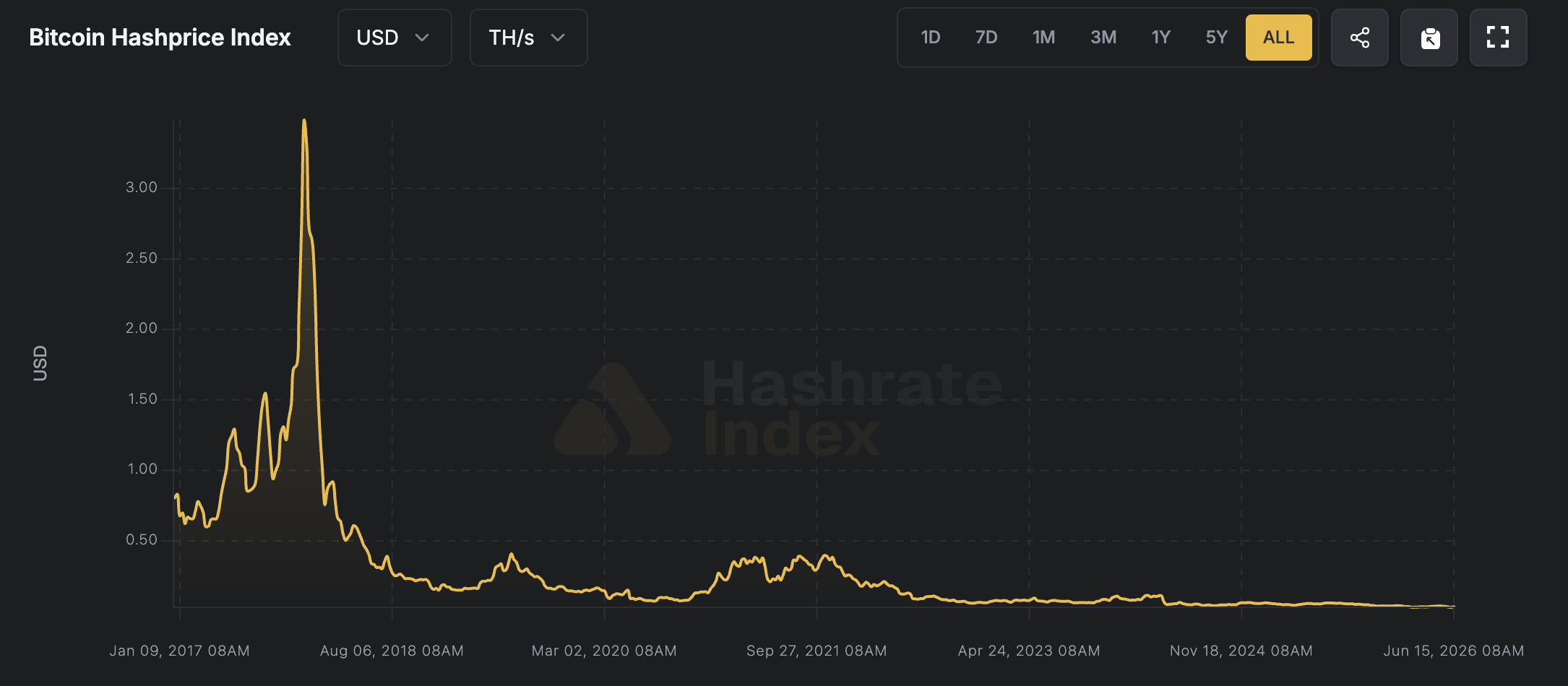
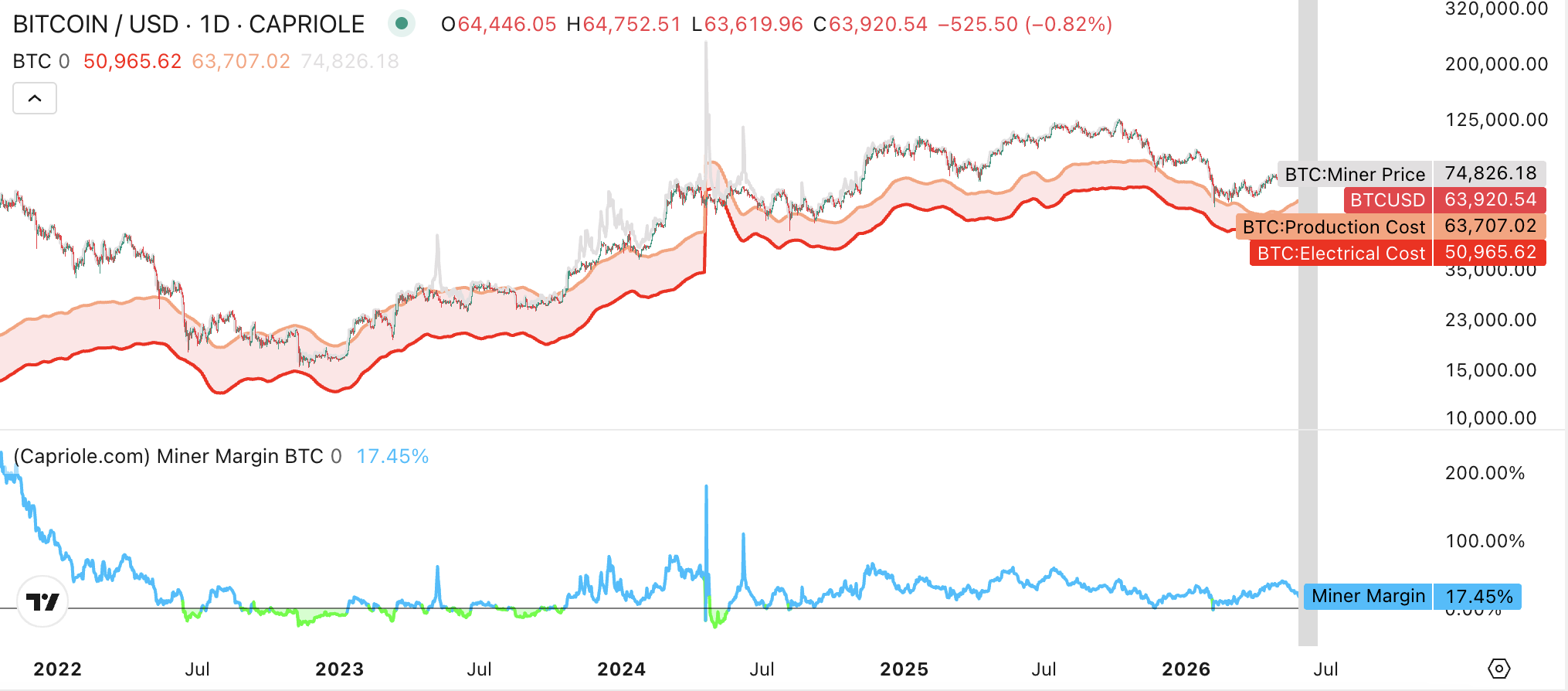
According to Capriole Investments data, as of June 18th, the average Bitcoin production cost was approximately $63,707, with electricity costs around $50,965, resulting in a miner profit margin of just 17.45%. Over the past 30 days, miner profit margins have contracted by 47.8%. Meanwhile, Luxor Hashrate Index data shows that as of June 18th, the daily revenue per 1 TH/s of hashrate has dropped to $0.032, a significant decline from $0.053 a year ago.
With mining revenues continuously shrinking, many miners have had to sell Bitcoin to maintain cash flow, further intensifying survival pressure for small and medium-sized miners, and accelerating the concentration of mining resources towards leading players. Currently, the three largest mining pools—Foundry USA, AntPool, and F2Pool—collectively hold 59% of the network's total hashrate share. In comparison, in 2022, the top three Bitcoin mining pools held only 44% of the hashrate market share.

Although the traditional mining business is struggling, the explosive growth in AI data center demand is also prompting a market revaluation of miners. VanEck's latest research report points out that miners' most valuable assets are not mining rigs, but power resources, substation access capabilities, land reserves, and data center infrastructure—precisely the scarce core resources the AI industry needs most today. Because AI customers are willing to pay electricity rates and rents far higher than those in traditional mining, AI infrastructure is expected to become miners' primary growth engine for the next decade.

A Bernstein report reveals that hyperscale cloud providers, AI cloud service providers, and chip companies have already announced over $90 billion in AI infrastructure collaborations, involving about 3.7 GW of power capacity. Currently, chasing power resources has become the core of AI infrastructure competition, with Bitcoin miners collectively controlling over 27 GW of planned power capacity. In some parts of the US, the timeline for new 1 GW power connections can be as long as 50 months, making existing mining sites key locations for AI data center expansion.

However, the AI transformation is far from an easy path. VanEck notes that the market is still in the early stages of AI transformation, with company valuations primarily based on Gross Energized Power. Miners with signed AI leases generally receive higher valuation premiums, while projects still in the planning stage struggle to gain market recognition. Future industry valuation logic will gradually shift from "power capacity" to "project delivery capability," ultimately returning to core metrics like cash flow, return on capital, and tenant quality. Currently, the industry has only delivered about 25% of its signed capacity. The ability to complete AI data center construction on time and on budget will become a key factor determining company valuations.

VanEck also emphasizes that AI tenant quality will directly impact miner valuation levels. Clients like Microsoft, Amazon, and Google (hyperscale cloud providers) bring more stable cash flows and lower financing costs, while smaller GPU cloud service providers correspond to higher operational risks and capital costs.

The enormous funding required for transformation is also testing miners' financial strength. VanEck estimates that miners' transition to AI infrastructure still faces massive capital expenditure needs, with a short-term funding gap of about $50 billion and long-term capital requirements potentially reaching $221 billion.

Under immense financial pressure, many miners have already started raising funds through various means. For example, miners like Iris Energy, TeraWulf, Bitfarms, and CleanSpark have raised funds by issuing convertible bonds, attracting investors with lower coupon rates and future equity conversion potential; while companies like Core Scientific, Terawulf, MARA, Bitdeer, and Riot Platforms have chosen to sell or even liquidate part of their Bitcoin reserves to continuously fund the AI transition.

Additionally, many miners are beginning to lock in future revenue by signing long-term AI or High-Performance Computing (HPC) contracts, using them to secure project financing and reduce overall operational risk. For instance, CoreWeave signed a $6 billion AI cloud service cooperation agreement with Jane Street; IREN secured a $9.7 billion AI cloud computing contract with Microsoft; Hut 8 signed data center leasing agreements totaling $9.8 billion; and Bitdeer partnered with Norway's DCI to build the country's largest AI data center project, among others.

For miners, AI undoubtedly offers a far more imaginative development path than traditional mining at this stage. However, this transformation is not simply a switch from mining to selling computing power; it is, in essence, a long-term competition centered on capital, resources, and execution capability.


Trending Cryptos

Related Questions

QWhy are cryptocurrency mining companies accelerating their shift towards the AI infrastructure sector?

ACryptocurrency mining companies are accelerating their shift to AI infrastructure due to declining profitability in Bitcoin mining and the explosive growth in global demand for data centers, power resources, and GPU computing power. The AI boom offers a new potential growth curve. Miners also possess natural advantages for this transition, such as existing access to power resources, land, substation connections, and mature cooling systems, allowing them to enter the AI infrastructure market at a lower cost and shorter timeline.

QHow has the market valuation of mining companies changed following their AI transformation narrative?

AThe market valuation of mining companies has entered a differentiated stage following their AI transformation. Their stock prices have significantly outperformed Bitcoin, with many hitting new highs. Companies are now valued based on their progress in AI infrastructure. Leaders like CoreWeave have achieved multi-billion dollar valuations, forming distinct market cap tiers. Valuation is shifting from a focus on short-term mining profitability to the future growth potential as next-generation computing infrastructure operators, with differentiation based on execution capability, customer base, and project delivery.

QWhat are the major challenges mining companies face in their transition to AI businesses?

AThe major challenges include immense capital expenditures, sustained funding needs, and long payback periods for AI data center construction. Companies face a funding gap estimated at $500 billion short-term and up to $2.21 trillion long-term. Other hurdles involve escalating operational costs, the need to secure high-quality AI tenants (like major cloud providers), the ability to deliver projects on time and on budget, and managing the financial pressure while their core mining business remains under profitability strain.

QAccording to the article, what are the key assets of a mining company that are valuable for AI infrastructure development?

AAccording to the article, the most valuable assets of a mining company for AI development are not the mining rigs, but the underlying infrastructure: power resources, substation interconnection capacity, land reserves, and data center facilities. These are scarce core resources crucial for the AI industry. Miners' existing access to significant planned power capacity (over 27 GW collectively) and their ability to repurpose sites give them a strategic advantage in the race for AI infrastructure.

QHow are mining companies financing their expensive transition into AI infrastructure?

AMining companies are employing several methods to finance their AI transition: 1) Issuing convertible notes (e.g., Iris Energy, TeraWulf). 2) Selling or liquidating portions of their Bitcoin reserves (e.g., Core Scientific, Riot Platforms). 3) Securing project financing by signing long-term AI or High-Performance Computing (HPC) contracts with major clients, which lock in future revenue and reduce operational risk. Examples include multi-billion dollar deals with companies like Microsoft, Jane Street, and others.

Related Reads

1996 or 1999? Walsh's First Test is 'How to View AI'

"1996 or 1999? Wall's First Big Test Is 'How to View AI'" Federal Reserve Chairman Wall's initial challenge is not whether to raise or cut rates, but a more fundamental judgment: what kind of boom is the current AI boom? This will determine the Fed's policy path and define his legacy. Economics is split between two opposing views, according to reporter Nick Timiraos. One sees imminent productivity gains that will increase supply and cool inflation, allowing the Fed to hold steady. The other argues that while productivity benefits are distant, demand shocks are here now, and waiting for data confirmation risks missing the intervention window, forcing sharper rate hikes later. Wall has signaled a leaning toward the first view, echoing 1996-era Alan Greenspan, who embraced strong, productivity-driven growth without fear of inflation. However, Wall faces a different macro environment than Greenspan did, with tariff pressures, expanding fiscal deficits, and diminishing globalization benefits, which could force more significant inflation pressures even if AI benefits materialize. Wall's logic, expressed before taking office, is that AI-driven productivity gains won't show in official data for years. If the Fed waits for confirmation, it might mistakenly tighten policy and choke off the very growth that could suppress inflation. This argues for using forward-looking narratives over lagging data. Chicago Fed President Austan Goolsbee presents a key counter-argument. He distinguishes between expected and unexpected productivity booms. A widely anticipated boom, like the current AI wave, can cause people to spend future wealth gains in advance, overheating the economy before productivity actually rises, thus requiring preemptive rate hikes. He cites rising costs for AI data centers as evidence of such overheating. Fed Governor Christopher Waller offers a rebuttal to Goolsbee, noting the "expected spending" mechanism only works if people can borrow against future income, which many households cannot do due to borrowing constraints. Wall also faces a paradox related to his desire to reduce the Fed's use of "forward guidance" (pre-announcing policy moves). This practice was established in 1999 when Greenspan began signaling hikes to avoid market shocks. If the economy follows a less optimistic path, Wall may be forced to choose between using the guidance he wants to abolish or risking market volatility by staying silent. The ultimate question defining Wall's first major test remains: Is this 1996 or 1999?

marsbit22m ago

1996 or 1999? Walsh's First Test is 'How to View AI'

marsbit22m ago

Ethereum Q1 2026 Report: Fees Decline, Users and Transaction Volume Hit New Highs

Ethereum Q1 2026 Report: Fees Down, Users & Transactions Hit New Highs Token Terminal's Q1 2026 report on Ethereum presents a pivotal development: the network achieved record highs in monthly active users (13.2M, +85.9% YoY), total transactions (200.4M, +81.5% YoY), and throughput (25.78 TPS), while transaction fees on the mainnet plummeted by 47.9% quarter-over-quarter. This shift is attributed to the network's strategic move into a "low fees for scale" phase, exemplified by the Fusaka upgrade which increased data capacity and lowered block space costs, releasing pent-up demand (a manifestation of Jevons's Paradox). The report highlights a core narrative shift for Ethereum: from a DeFi-centric blockchain to a global financial settlement layer. It maintains a dominant position in tokenized assets, holding majority market shares among top chains in stablecoins (61.8%), tokenized funds (73.0%), and tokenized commodities (84.0%). Growth in tokenized funds (+73.1% YoY) and commodities (+325.9% YoY) was particularly strong, driven by institutions like BlackRock and JPMorgan entering the space. Contrasting these usage gains, several USD-denominated value metrics declined in Q1: fully diluted market cap fell 30.3% QoQ, total value locked (TVL) dropped 11.0%, and ecosystem transaction volume decreased 24.0%. The report interprets this as Ethereum prioritizing long-term network expansion and cementing its role as the default settlement layer for finance over short-term fee capture. The commentary from Etherealize argues that, much like the early internet, Ethereum's open, permissionless model is poised to win over closed alternatives as institutional tokenization accelerates.

marsbit2h ago

Ethereum Q1 2026 Report: Fees Decline, Users and Transaction Volume Hit New Highs

marsbit2h ago

He Just Raised 2.7 Billion, and Li Fei-Fei Also Invested

Pete Florence, a former senior research scientist at Google DeepMind and a key contributor to the Vision-Language-Action (VLA) model architecture, is deliberately distancing his startup, Generalist AI, from the trendy "world model" label. He argues that the industry should prioritize concrete goals over buzzwords. His goal is to create robots that can perform a vast range of unseen tasks with high speed and success rates, without needing task-specific training data. Recently, his company raised $400 million (¥2.7 billion) at a $2 billion valuation. Notable investors include NVIDIA's NVentures, Bezos Expeditions, NFDG, as well as Xiaomi co-founder Lin Bin, Zoom founder Eric Yuan, and renowned AI scientist Fei-Fei Li. Florence's approach stems from his academic background at MIT under Professor Russ Tedrake, focusing on understanding the physical world. After joining DeepMind, he developed models like Transporter Network and co-created the VLA framework. He left in 2025 to found Generalist AI. The company has launched two models: GEN-0, which demonstrated that scaling laws apply to physical motion, and GEN-1. GEN-1 was trained on over 500,000 hours of physical interaction data collected via a specialized wearable device. It achieves a 99% success rate on precise mechanical tasks like folding boxes and maintains performance three times faster than its predecessor. Florence believes GEN-1 is reaching a commercial utility threshold similar to the GPT-3 inflection point. The substantial funding round, following GEN-1's release, signifies strong investor confidence in Generalist AI's practical, goal-driven path to creating versatile, useful robots, regardless of the "world model" terminology.

marsbit2h ago

He Just Raised 2.7 Billion, and Li Fei-Fei Also Invested

marsbit2h ago

Two Legends Lost in Three Days: Is Google's AI Talent Dam Cracking?

In three days, Google lost two AI legends. On June 18, Noam Shazeer, co-author of the seminal "Attention is All You Need" paper and Gemini co-lead, left for OpenAI. Just 48 hours later, John Jumper, 2024 Nobel laureate and AlphaFold lead, departed DeepMind for Anthropic. This follows Andrej Karpathy joining Anthropic in May. These moves highlight a structural trend: top AI talent is concentrating at mission-driven, pre-IPO firms like OpenAI and Anthropic, while Google becomes a primary source. The exodus stems from a core mission mismatch. Google's ad-centric model often subordinates AI research to product and revenue goals, creating friction for pioneers like Shazeer, who returned in 2024 only to leave again. In contrast, OpenAI and Anthropic offer singular focus on pushing AI boundaries, whether towards AGI or safety-aligned models, which deeply appeals to top researchers like Jumper. Financial incentives amplify the pull. With both OpenAI and Anthropic nearing IPO, employees stand to gain immensely from equity, an upside Google's mature stock cannot match. Furthermore, the 2023 merger of Google Brain and DeepMind, intended to consolidate strength, has instead created cultural tension and slowed the path from research to product, as evidenced by Gemini's pace. This talent redistribution is reshaping the AI landscape. While Google retains vast data and compute resources, its true crisis is the quiet, continuous loss of the people who define the field's future. The real moat in AI is not infrastructure, but the concentration of brilliant minds—a battle Google is currently losing.

marsbit4h ago

Two Legends Lost in Three Days: Is Google's AI Talent Dam Cracking?

marsbit4h ago

Trading

Spot
Futures

Hot Articles

Discussions

Welcome to the HTX Community. Here, you can stay informed about the latest platform developments and gain access to professional market insights. Users' opinions on the price of AI (AI) are presented below.

活动图片