Deciphering the Ethereum Foundation's New Structure: Reaffirming Self-Sovereignty Amid Institutionalization Trends

marsbitPublished on 2026-06-25Last updated on 2026-06-25

Abstract

Summary: The Ethereum Foundation (EF) has announced a major restructuring, laying off 20% of its staff and introducing a new five-layer operational framework. This move aims to clarify the EF's mission and reaffirm Ethereum's core principle of self-sovereignty amidst growing institutionalization in the crypto space. The five layers are: 1. **Protocol Layer**: Focuses on maintaining Ethereum's foundational "CROPS" values—Censorship-resistant, Robust, Open, Private, and Secure. This involves core technical work like secure hard forks and mitigating toxic MEV. 2. **Access Layer**: Ensures users can practically exercise self-sovereignty through actions like reading the chain and making transactions. A key principle is the "zero option," meaning a trusted, non-intermediated path must always exist as an alternative to any centralized service. 3. **User Layer**: Bridges the protocol and access layers by grounding EF's work in the real needs of users and organizations. This is seen as crucial for moving beyond a purely research-driven approach and ensuring development effectively serves the ecosystem. 4. **Community Layer**: Responsible for building and maintaining consensus around Ethereum's core values both internally and externally. This involves guarding against centralization, upholding technological neutrality, and preventing short-term commercial interests from undermining CROPS principles. 5. **Institutional Layer**: Manages EF's engagement with institutions, but with t...

Author:CM

The EF is proposing a new structure, using this opportunity to reinterpret the worldview of Ethereum. Crypto is in a massive wave—where is Ethereum headed?

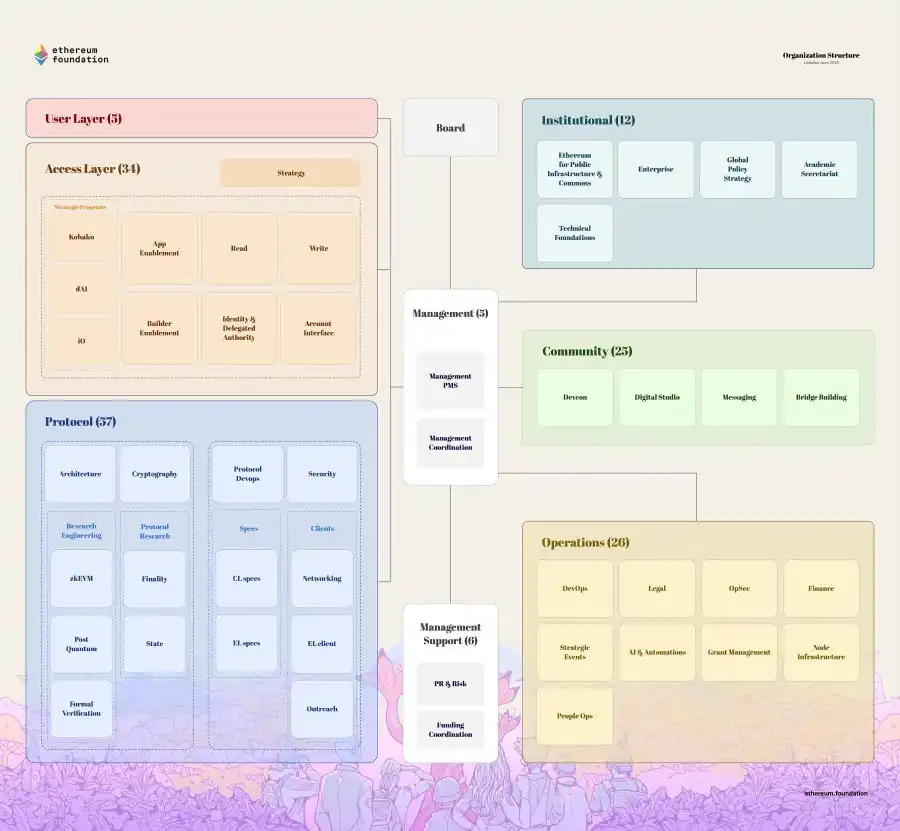
The EF has laid off 20% of its staff and announced a brand-new structure—5 Working Layers. Compared to the previously loose foundation structure, the EF will now clearly define what it should focus on in the coming years. These 5 working layers are:

  • Protocol Layer

  • Access Layer

  • User Layer

  • Community Layer

  • Institutional Layer

We can think of this as the division of work responsibilities within the EF.
1/5 · Protocol Layer

Maintains Ethereum's core properties, which is what Vitalik has been emphasizing: CROPS:

  • Censorship-resistant

  • Robust

  • Open

  • Private

  • Secure

The specific work is more focused on underlying technology, such as safely advancing hard forks, reducing trust dependencies, resisting quantum threats, combating toxic MEV, etc. This part is the EF's foundational task and represents Ethereum's core value. It has always advocated not sacrificing Ethereum's self-sovereign properties for short-term financialization, institutionalization, or market narratives.

Of course, this is difficult in the current environment because, from a user's perspective, embracing institutions and the market is always a safe choice. In reality, I believe decentralization is not an excuse for laziness or evasion in marketing. If we consider Ethereum as a brand-new world, with CROPS as the bottom line of the world order, then actively meeting the needs of various roles in this new world without crossing that line is the only way to give this world its value and quickly escape the utopia of the geek world. This is absolutely the right thing to do. It doesn't necessarily have to be done by the EF, and the EF has repeatedly expressed its position and role. I hope more organizations will do this in the future.

2/5 · Access Layer

The Access Layer focuses on whether users can practically use Ethereum's self-sovereign capabilities. The EF mentions several key actions: reading the chain, transacting, proving, authorizing, exiting. Users, and the agents that will act on their behalf in the future, should be able to perform these operations without relying on unverifiable intermediaries.

There is an important principle here called zero option, which means that for every intermediary path, there must exist a credible, intermediary-free alternative path, and this path must remain consistently available.

I think this is crucial. The most direct example is if one day a frontend goes down or a server fails, you should still be able to operate your funds by directly interacting with the contract. If you've ever been trapped once, you'll deeply understand its significance.

3/5 · User Layer

The task of the User Layer is to ground the EF's work in the real needs of real users and organizations. It will focus on user segmentation and user profiles. Its purpose is to connect the Protocol Layer and the Access Layer, ensuring that development truly reaches users and that these decisions are effective rather than existing in a vacuum.

This is something the EF has been lacking in the past, as many discussions tended to be overly research-oriented or infrastructure-focused. We can clearly see that Ethereum's past prosperity, DeFi summer, NFT summer, basically came from community innovation. There was no intersection between the application end and the technical end, nor was there feedback of needs from the application end to the technical end. Ethereum thus entered an unexpected boom period in a fragmented way.

Some attribute it to luck, others say it was the inevitable result of Ethereum's technical accumulation. In fact, the Ethereum ecosystem did guide the explosion of on-chain applications, and crypto entered a new era, but back then developers and users didn't have many choices, so the smart people and smart money gathered on Ethereum.

Today's situation is quite different. L1s and L2s are everywhere, the cost of launching a chain has dropped rapidly. Although Ethereum still takes security and stability as its biggest moat, when other competitors haven't exposed problems, this value is not easily recognized by users and developers. (I personally agree that security is the biggest moat for a public chain.)

Therefore, the User Layer is the work the EF should pay the most attention to. A new world needs to understand what its inhabitants want.

4/5 · Community Layer

Its purpose is to maintain and disseminate the value consensus of Ethereum.

  • Within the ecosystem: Help the community understand why Ethereum exists, what should be upheld, and what narratives should not lead it astray.

  • Outside the ecosystem: Help the EF connect with adjacent fields such as open source, privacy, civil liberties, and public interest technology.

So what consensus does it aim to establish? Based on the EF's article and my understanding of Ethereum, it can be summarized into the following points:

  1. Not to be hijacked by centralized interests.

  2. Maintain technological neutrality, not be swayed or influenced by any cultural, political, or other factors.

  3. Adhere to the CROPS-based values and not sacrifice any of them for short-term commercial interests.

The loosening of consensus in this cycle is, I think, the most severe in history. In the past, crypto had not entered the mainstream view, the user base was small, there were no applications, and prices were sluggish. None of these problems caused users to lose confidence that decentralization was the future. However, in this cycle, with the launch of spot ETFs for BTC and ETH, the emergence of DAT companies, the U.S. stablecoin bill, and institutions starting to develop L1s, more people have come into contact with crypto, which is a huge success from this perspective. But the impact it brings is slowly becoming apparent. These influences are subtle but are gradually changing the underlying logic of this market.

For example, the massive on-chain issuance of stablecoins has brought TVL but simultaneously replaced the monetary properties of BTC and ETH. How long has it been since we heard the term 'coin-based'? Before USDT was born, exchanges mostly used coin-to-coin trading, often with BTC as the trading pair. During DeFi summer, on-chain LPs mostly used ETH as the trading pair, and NFT summer was priced in ETH. Today, these things are gradually disappearing. The long arm of dollar hegemony has reached the blockchain. DAT companies have even packaged crypto into something they themselves once most despised.

Regarding decentralization, the angle of thinking has shifted from combating the opacity, corruption, and inefficiency of traditional finance to questioning whether institutions need decentralization. Actually, this question doesn't require much thought; institutions' need for decentralization is definitely limited or applicable only in certain special scenarios. The term 'decentralization' is being discussed less and less and is even somewhat mocked.

Of course, I believe crypto has no reason to reject the needs of institutions; it is permissionless, and both institutions and individual users should be accepted. However, if we change the underlying consensus of public chains and the consensus based on decentralization just to welcome the entry of institutions, we cannot define it as wrong. But the final outcome of this move is actually no different from a second internet—a few authoritative institutions control the network nodes. If this situation continues to develop, these chains will quickly become some 'national chain' or 'institutional chain.' Wouldn't it be easy to cut off business with Iran on a U.S. chain? Here, many people compare neutral and decentralized public chains to the high seas, which seems somewhat reasonable.

5/5 · Institutional Layer

Responsible for the EF's interactions with institutions but premised on self-sovereignty. The EF's expression toward institutions is not 'making it easier for institutions to control users' but emphasizes using Ethereum and cryptographic technology to create better integration cases.

This statement is very clear, similar to what we discussed above. Those truly universal, globally serving businesses are still most suitable to be placed on the Ethereum public chain because it will never be interfered with by certain coercive means or factors. Ecosystems with centralized control power find it increasingly difficult to achieve this over time.

A final note: we are in a massive wave and cannot change it. But Bitcoin and Ethereum have experienced countless market changes. Whether the outside world is dawn or darkness, the next block is always produced.


Trending Cryptos

Related Questions

QWhat are the five new working layers introduced in the Ethereum Foundation's new organizational structure, as described in the article?

AThe five new working layers are: 1. Protocol Layer, 2. Access Layer, 3. User Layer, 4. Community Layer, and 5. Institutional Layer.

QAccording to the article, what does the acronym CROPS stand for in the context of the Protocol Layer's core mission?

ACROPS stands for Censorship-resistant, Robust, Open, Private, and Secure. These are the core properties of Ethereum that the Protocol Layer aims to maintain.

QWhat is the 'zero option' principle mentioned in relation to the Access Layer, and why is it considered crucial?

AThe 'zero option' principle states that for every mediated path (e.g., relying on a server), there must be a credible, unmediated alternative path that remains continuously available. It is crucial because it ensures users can still access and control their assets (e.g., by interacting directly with a smart contract) even if centralized intermediaries like front-end interfaces or servers fail.

QHow does the author describe the historical relationship between Ethereum's application development and its technical foundation, and what role is the new User Layer meant to play?

AThe author describes a historical disconnect where past Ethereum booms (DeFi Summer, NFT Summer) stemmed from community innovation, with little feedback loop between application developers/users and the technical/core protocol development. The User Layer is meant to bridge this gap by ensuring EF's work is based on real user and organizational needs, connecting the Protocol and Access Layers to make development decisions effective and grounded in reality.

QWhat major shift in the crypto landscape's 'underlying logic' does the article suggest is being driven by institutional adoption, and what potential risk does this pose according to the author's analysis?

AThe article suggests institutional adoption (e.g., BTC/ETH ETFs, DAT companies, stablecoin dominance) is shifting the underlying logic away from core decentralization principles and 'coin-based' valuation. The potential risk is that if public chains alter their foundational decentralized consensus to accommodate institutions, they could become controlled by specific nations or corporations ('a U.S. chain,' 'an institutional chain'), undermining their censorship-resistant, neutral nature and replicating the centralized control of the traditional internet.

Related Reads

Micron Shuts Up the Bears, Makes India's 'Buffett' Regret: Sold Too Early, Missed Out on $2 Billion

Indian value investor Mohnish Pabrai, a disciple of Warren Buffett, revealed his costly mistake of selling shares in Micron Technology too early. He initially invested in 2017, holding it for six years and building a position as large as 77% of his portfolio, based on a thesis that the memory chip industry would consolidate into a stable oligopoly of Samsung, SK Hynix, and Micron. However, he sold his entire stake in September 2023, fearing oversupply after Samsung announced production expansion. Shortly after his exit, demand for high-bandwidth memory (HBM) surged with the rise of AI, and Micron's stock price skyrocketed over 15 times in two years. Pabrai estimates this premature sale cost him roughly $20 billion in potential gains. He expressed similar regret over selling his investment in SK Hynix too soon, stating he violated his own principle of holding companies forever. Reflecting on these errors, Pabrai emphasized his core investment checklist principles: avoiding leverage, focusing on the durability of a company's competitive moat, and assessing management's character. Despite these personal trading missteps, his long-term view on the remaining memory chip leaders remains bullish, advising current holders not to sell as "the party is just getting started." He concluded by sharing his philosophical outlook, prioritizing character over wealth, and his goal to donate his entire fortune before his passing.

marsbit43m ago

Micron Shuts Up the Bears, Makes India's 'Buffett' Regret: Sold Too Early, Missed Out on $2 Billion

marsbit43m ago

Mihoyo's Next Protagonist Is Her, Who Plays the Piano

Mihoyo, widely recognized for its hit game Genshin Impact, has long harbored a grander ambition: creating a virtual world where one billion people would want to live. While its character design is unparalleled, the company recognizes a fundamental limitation—these beloved virtual characters are not truly "alive." Their dialogue and actions are pre-scripted. This drive for authentic "living" characters has guided Mihoyo's strategic investments in cutting-edge fields like brain-computer interfaces, AI (including an early investment in MiniMax), and nuclear fusion. Following the release of ChatGPT in late 2022, co-founder Cai Haoyu stepped down from management to lead a new overseas AI venture, Anuttacon, focused on creating AI-driven virtual beings. Mihoyo's path has involved experimentation and iteration. Anuttacon's early project, *Whisper of the Stars*, showcased real-time AI conversation but revealed limitations in underlying language models. The team subsequently focused its resources on developing a sophisticated "emotional" large language model, distinct from purely utilitarian AI. Co-founder Liu Wei (Dawei) announced plans to invest up to 100 billion RMB in this AI pursuit. The first tangible product of this vision is *BSide: Olivia Lin*, a free Steam application featuring a piano-playing virtual companion. Unlike typical AI chatbots demanding constant interaction, Olivia Lin operates on a slower, more deliberate rhythm—responding to letters, playing user-submitted melodies, and serving as a desktop presence. This design emphasizes "lifelikeness" over exhaustive conversation, strategically working around current technological constraints while building a sense of authentic connection. The company's journey traces back to its name, "miHoYo," where "mi" pays homage to the virtual singer Hatsune Miku. For nearly two decades, fans have loved Miku, a character unaware of their devotion. Mihoyo's ultimate goal, now backed by massive investment and AI research, is to bridge that gap—to create virtual beings that can truly know they are loved.

marsbit1h ago

Mihoyo's Next Protagonist Is Her, Who Plays the Piano

marsbit1h ago

Citrini Research: Taking Stock of 5 Major Investment Themes Overshadowed by the AI Trade

Citrini Research identifies five under-the-radar investment themes potentially overshadowed by the dominant AI trade. With capital and analyst attention overwhelmingly focused on AI infrastructure, these overlooked areas present alpha opportunities as market dynamics shift. **Theme 1: Airlines** – Despite strong fundamentals, stocks like Delta and United have been penalized for 18 months due to macro concerns (tariff-inflation, oil prices), not profitability. A rebound is expected as these headwinds fade, aided by trends like premiumization and the 2026 World Cup. **Theme 2: Senior Housing** – A pure demographic play. The U.S. population over 80 is projected to grow 56% in the next decade, drastically outpacing supply. This creates a compelling need for facilities, benefiting REITs like Welltower and operators like Brookdale. **Theme 3: Live Events & Entertainment** – "Being there" is becoming a luxury. This sector has outperformed even tech over the past decade. Companies like TKO Group (WWE/UFC), Cinemark, and IMAX are capitalizing on demand for premium, in-person experiences. **Theme 4: Exchange Competition** – CME Group's ~98% monopoly in U.S. interest rate derivatives faces its first real challenge from FMX Futures Exchange. Backed by major Wall Street banks, FMX offers lower fees and margin savings. While CME's deep liquidity remains an advantage, FMX provides a competitive alternative. **Theme 5: Fintech Recovery** – Heavily sold off in 2026, fintech stocks like SoFi, Robinhood, and Upstart are showing signs of a rebound based on improving fundamentals—SoFi's stablecoin launch, Robinhood's transformation into a "financial super app," and Upstart's renewed AI lending narrative—rather than a change in sector outlook. The report advises maintaining some AI exposure but diversifying into these neglected "small themes" where mispricing exists due to a simple shortage of investor attention.

marsbit1h ago

Citrini Research: Taking Stock of 5 Major Investment Themes Overshadowed by the AI Trade

marsbit1h ago

21Shares Mid-Year Key Report: Bitcoin's Four-Year Cycle Remains Intact, Stablecoins and Tokenization Emerge as New Growth Engines

21Shares Mid-Year Report 2026: Bitcoin Cycle Intact, Stablecoins & Tokenization Emerge as New Engines This mid-year review assesses progress against 21Shares' ten predictions for 2026. While the overarching shift from narrative to fundamentals holds, performance varies. Key findings show Bitcoin's four-year cycle remains evident despite market maturation. Global crypto ETP AUM has declined to ~$140B, lagging the $400B target, though product innovation continues. Stablecoin supply surpassed $320B, demonstrating non-cyclical demand but falling short of the $1T forecast due to slower regulatory clarity. DeFi TVL, stalled at ~$140B, was hindered by major security incidents. Corporate crypto treasuries hold ~1.28M BTC ($100B), with consolidation pressuring weaker players. Prediction markets are on track, with $57.5B volume already surpassing half the $100B annual target. AI agent infrastructure is ready, but adoption is early. Ethereum L2 consolidation is underway, with the top 5 capturing nearly 90% of activity. Compliant token launches have a platform but lack mainstream volume. Tokenized RWAs total ~$31B on public chains, but institutional pipeline growth is strong. In summary, fundamentals like stablecoins, tokenization, and prediction markets are advancing, but targets require faster adoption or price appreciation. The market is maturing, yet cyclical patterns persist.

marsbit1h ago

21Shares Mid-Year Key Report: Bitcoin's Four-Year Cycle Remains Intact, Stablecoins and Tokenization Emerge as New Growth Engines

marsbit1h ago

Trading

Spot
Futures

Hot Articles

Discussions

Welcome to the HTX Community. Here, you can stay informed about the latest platform developments and gain access to professional market insights. Users' opinions on the price of ETH (ETH) are presented below.

活动图片