Ethereum shows early accumulation signals – Can ETH’s demand sustain a breakout?

ambcryptoPublished on 2026-04-01Last updated on 2026-04-01

Abstract

Ethereum is showing early signs of accumulation as it trades near $2,130, approximately 11% below its Realized Price of $2,349. This narrow gap reduces loss-driven selling, with the NUPL at -0.04 indicating mild unrealized losses rather than full capitulation. The MVRV Ratio of 0.86 suggests the average holder remains about 14% underwater, limiting panic selling and signaling a late-stage correction. A rising Taker Buy/Sell Ratio near 1.13 across exchanges points to increasing buyer aggression, reminiscent of the pre-rally conditions in April-May 2025. While short-term price action shows low conviction, the convergence of these metrics suggests accumulation is underway, with limited downside risk barring new shocks, setting the stage for a potential sustained recovery.

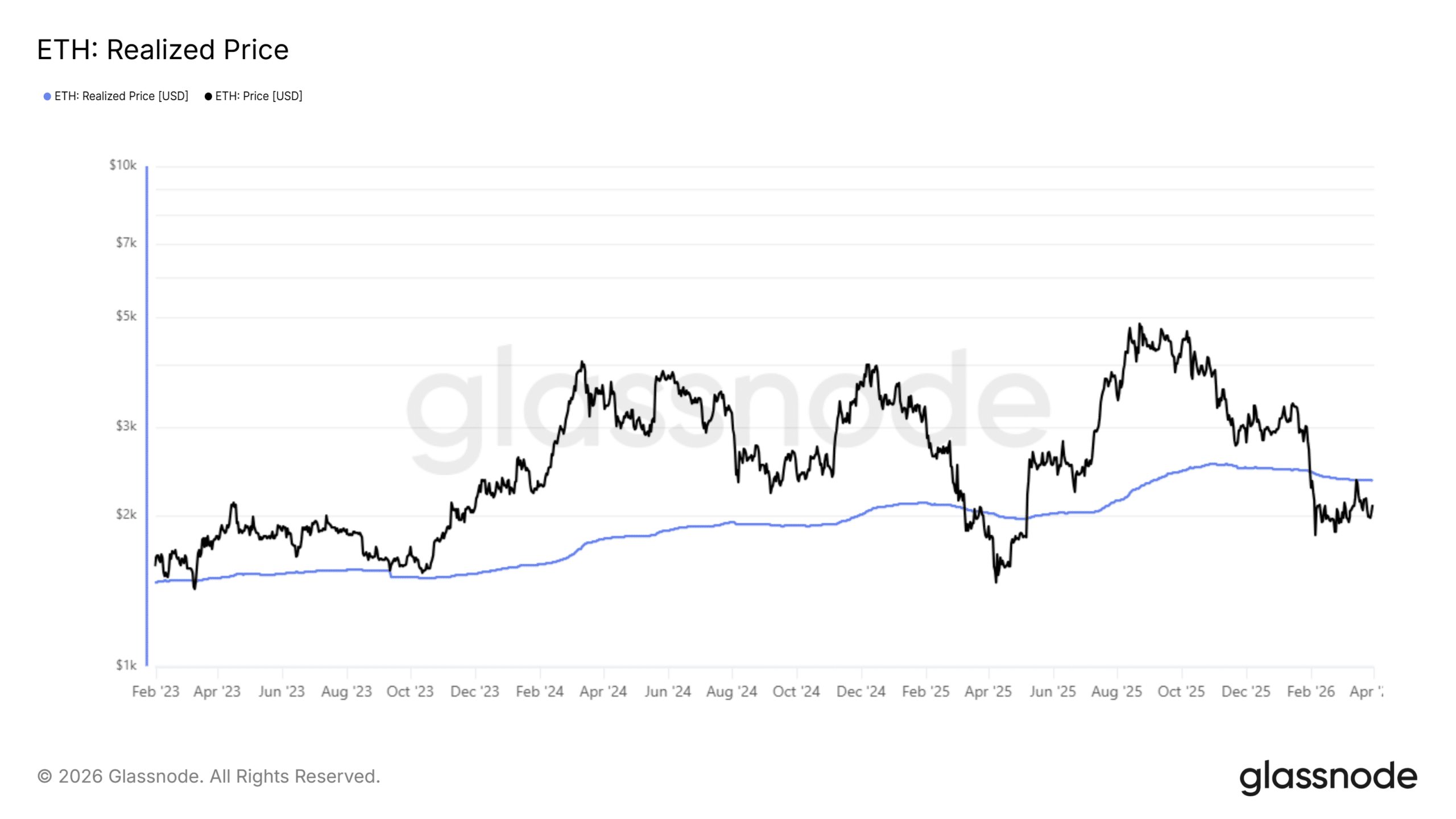
Ethereum [ETH] is moving through a quiet but decisive phase, where price and holder behavior begin to converge. At the time of writing, ETH traded near $2,130, about 11% below its $2,349 Realized Price, placing most holders close to breakeven.
Source: Glassnode

This narrowing gap reduces loss-driven selling, since fewer participants face pressure to exit at a loss. Meanwhile, the NUPL at -0.04 confirms mild Unrealized Losses rather than full capitulation.

Selling pressure is easing, while the market enters a decision phase between accumulation and further decline.

Short-term moves, with a +0.55% daily gain and a -3.13% weekly drop, reflect low conviction. This implies Ethereum is stabilizing, where holding this level may attract buyers, while failure risks renewed downside pressure.

Ethereum MVRV signals late-stage correction zone

As Ethereum holds near breakeven levels, valuation metrics begin to explain why selling pressure is fading and what may come next.

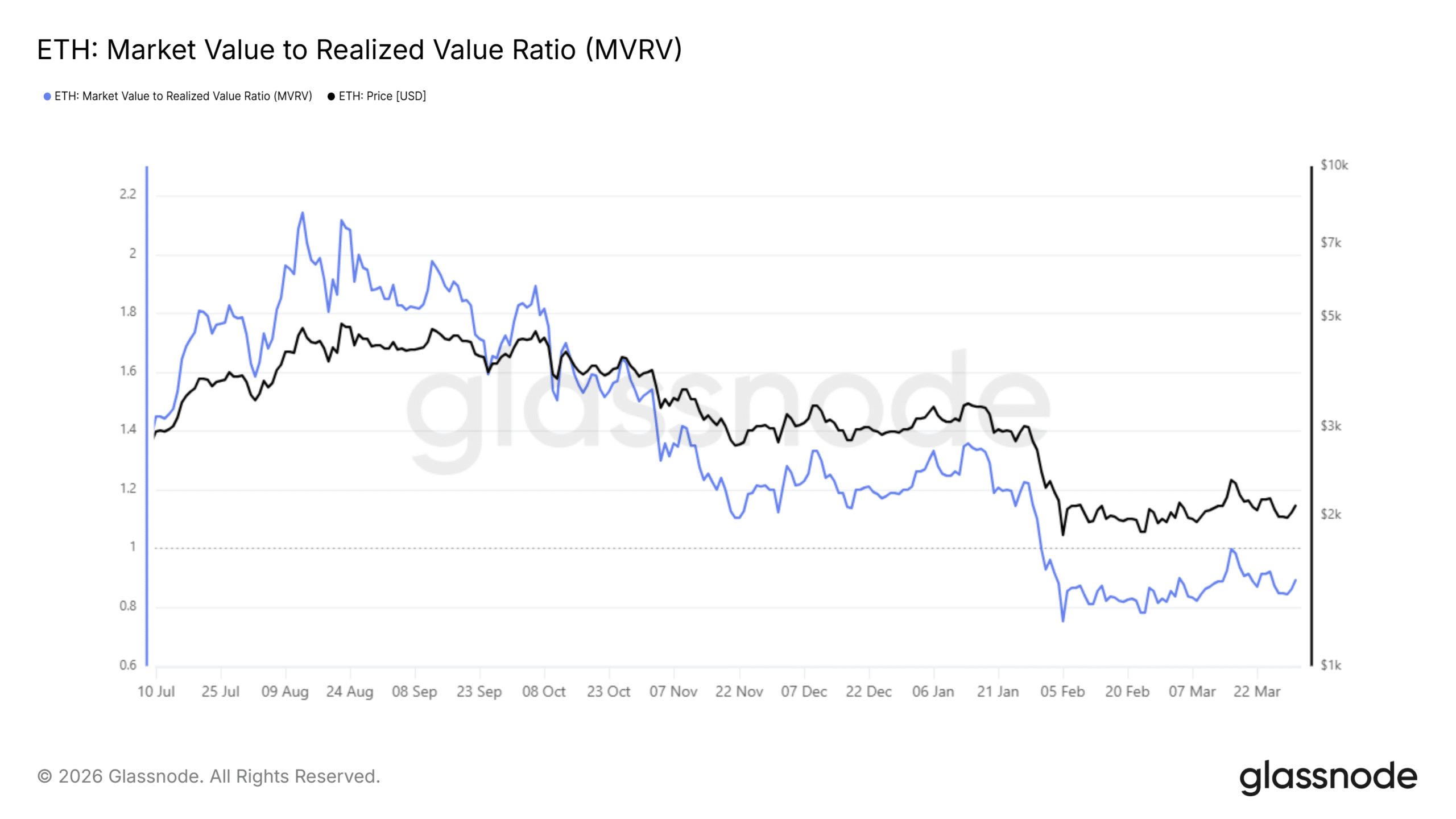
The MVRV Ratio sits around 0.86, meaning the average holder remains roughly 14% underwater, which keeps sentiment cautious but reduces panic selling.
Source: Glassnode

This happens because most losses have already been realized, leaving fewer weak hands to exit. Meanwhile, the MVRV Z-Score stays slightly negative, near -0.25 to -0.30, reinforcing that price trades below fair value.
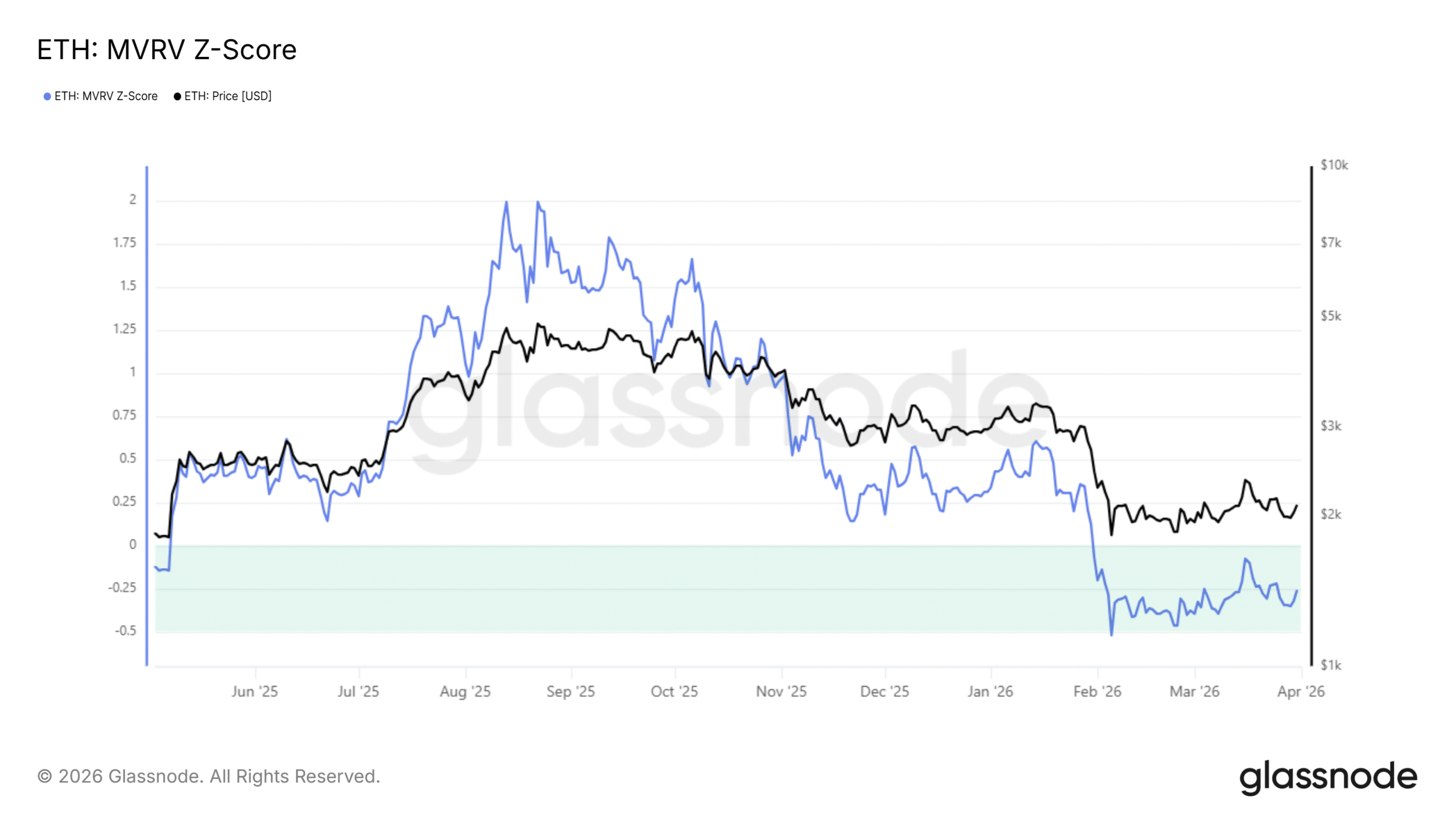
Source: Glassnode

This shift changes market behavior, as sellers lose urgency while buyers start positioning gradually. The market is no longer driven by forced exits but by selective accumulation.

In fact, this implies that the downside is limited without new shocks, while slow demand rebuild can support a base before any sustained recovery.

ETH taker flow signals early accumulation

As Ethereum’s undervaluation limits further downside, order flow now reveals how demand is rebuilding beneath the surface.

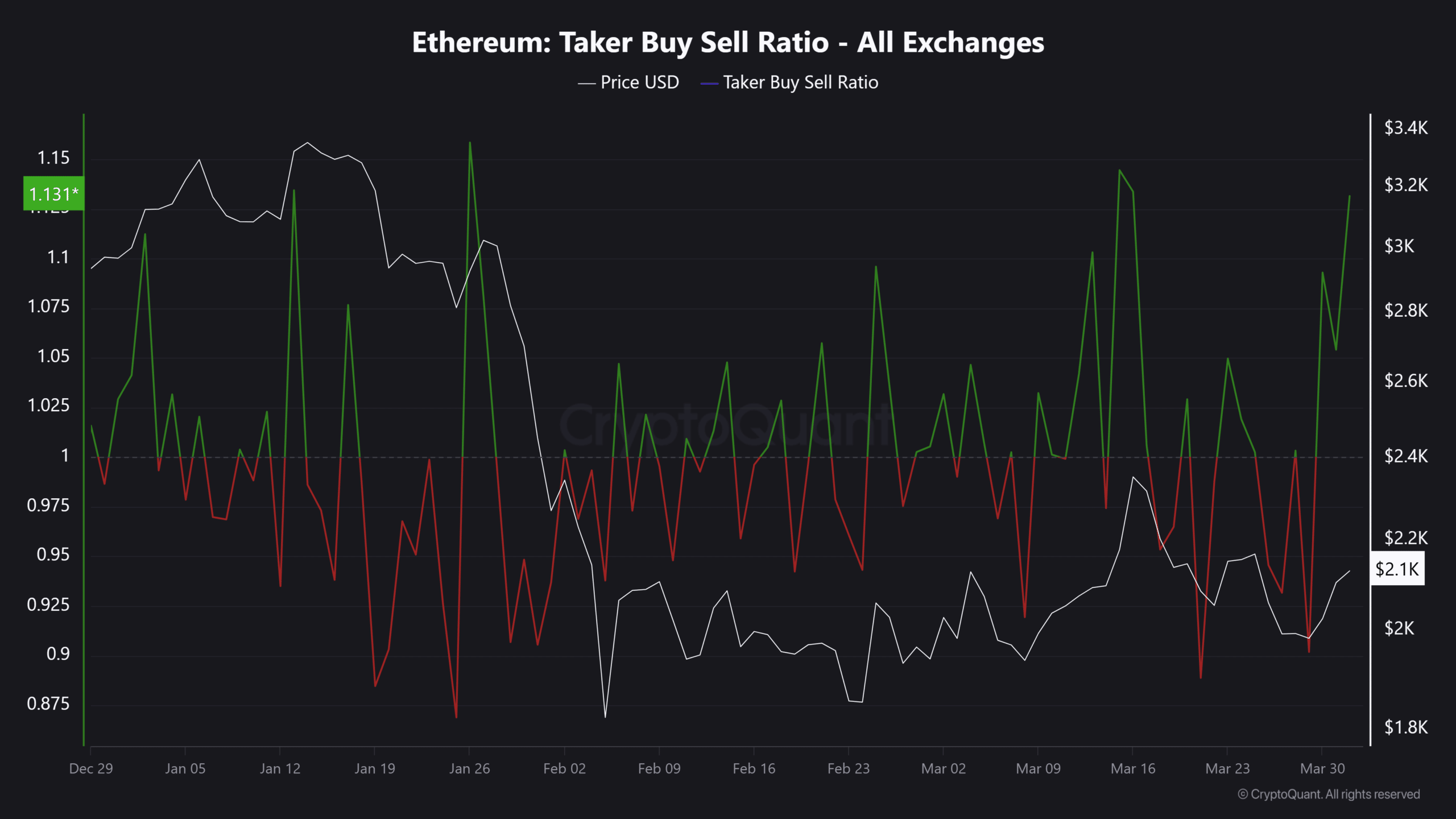
The Taker Buy/Sell Ratio is trending upward across all exchanges, recently pushing near 1.13, which shows buyers are increasingly lifting offers.
Source: CryptoQuant

This structure mirrors the setup seen before the April–May 2025 rally, hinting at early demand buildup. As this develops, repeated spikes above 1.0 confirm sustained taker-side aggression rather than passive positioning.

Meanwhile, price remains near $2,100, showing demand is emerging without immediate expansion. This shift occurs while MVRV holds near 0.86, keeping ETH undervalued.

This interaction signals accumulation in progress, where consistent buying pressure may gradually translate into a stronger directional move.


Final Summary

  • Ethereum’s compression near Realized Price and MVRV at 0.86 signals reduced selling pressure and early-stage accumulation conditions.
  • The rising Taker Buy Ratio above 1.0 shows growing demand, but the price remains range-bound until stronger conviction emerges.


Related Questions

QWhat is Ethereum's current trading price and how does it compare to its Realized Price?

AEthereum is currently trading near $2,130, which is approximately 11% below its Realized Price of $2,349.

QWhat does the NUPL value of -0.04 indicate about the market?

AThe NUPL (Net Unrealized Profit/Loss) value of -0.04 confirms that the market is experiencing mild Unrealized Losses rather than full capitulation.

QWhat is the significance of the MVRV Ratio sitting at 0.86 for Ethereum?

AAn MVRV Ratio of 0.86 means the average holder is roughly 14% underwater, which keeps market sentiment cautious but reduces panic selling, indicating the asset is undervalued.

QWhat does a Taker Buy/Sell Ratio above 1.0, specifically near 1.13, signal for ETH?

AA Taker Buy/Sell Ratio trending upward and near 1.13 indicates that buyers are increasingly lifting offers, showing early demand buildup and accumulation.

QAccording to the article, what are the two key conditions signaling reduced selling pressure and early accumulation for Ethereum?

AThe two key conditions are: 1) Ethereum's price compression near its Realized Price with an MVRV of 0.86, and 2) a rising Taker Buy Ratio consistently above 1.0.

Related Reads

The Art of Saving in the AI Era: How to Spend Every Token Wisely

In the AI era, tokens are the new currency, and efficiency is paramount. This article outlines strategies to minimize token usage while maximizing value. Key principles include prioritizing high signal-to-noise ratio inputs by removing unnecessary content like greetings, repetitive context, or verbose instructions before processing. Converting files (e.g., PDFs to clean Markdown) and compressing images drastically reduce token consumption. Avoid conversational, multi-turn interactions; instead, provide clear, concise, and complete instructions upfront to prevent costly back-and-forth. Output costs are higher than input, so eliminate AI pleasantries and enforce structured responses (e.g., JSON) over verbose explanations. Use system prompts to mandate direct answers and disable unnecessary features like "extended thinking" for simple tasks. Manage context efficiently: start new conversations for new tasks, compress long histories, and leverage prompt caching to reuse fixed instructions at lower costs. Employ model tiering—assigning complex tasks to premium models (e.g., Claude Opus) and simpler subtasks to cheaper ones (e.g., Claude Haiku)—to optimize cost and performance. Ultimately, the most effective saving is questioning whether a task requires AI at all. Human judgment remains a critical filter to avoid unnecessary token expenditure, ensuring that AI complements rather than replaces human efficiency.

marsbit26m ago

The Art of Saving in the AI Era: How to Spend Every Token Wisely

marsbit26m ago

Trading

Spot
Futures

Hot Articles

Discussions

Welcome to the HTX Community. Here, you can stay informed about the latest platform developments and gain access to professional market insights. Users' opinions on the price of ETH (ETH) are presented below.

活动图片