Ethereum Leaving Cryptocurrency Exchanges At Historic Rate, Are Traders Preparing For A Potential Rally?

bitcoinistPublished on 2026-04-03Last updated on 2026-04-03

Abstract

Ethereum is experiencing a historic outflow from cryptocurrency exchanges, with its exchange balance hitting an all-time low of 11% of the total supply. This significant withdrawal suggests investors are moving their ETH into long-term storage, indicating growing confidence and reduced selling pressure. Despite trading around $2,100, holders are accumulating rather than selling, hinting at bullish sentiment. Analysts note this trend, combined with a key support level holding at $2,100, could set the stage for a potential major rally. If the current structure holds, ETH might be poised for a significant upward move.

The Ethereum price temporarily flipped bullish on Wednesday and has moved back above the $2,100 level, but underlying signals are hinting at a potential continuation of the upward move. During this renewed upside strength, investors across cryptocurrency exchanges are demonstrating positive sentiment toward ETH as they have withdrawn a massive portion of the altcoin from these platforms.

A Massive Ethereum Outflow From Exchanges

With the cryptocurrency market slightly recovering, Ethereum is starting to showcase upside potential again. Meanwhile, a striking trend is emerging across the ETH market as investors are choosing to hold on to their coins rather than trade them off.

Leon Waidmann, a market expert and head of research at Lisk, has outlined a notable shift in investors’ sentiment and behavior, especially across cryptocurrency exchanges in the space. Even with persistent drawdowns in price, ETH is leaving trading platforms at a substantial rate not seen in years.

In the report shared on the X platform, Waidmann stated that the ETH balance on crypto exchanges has recently hit an all-time low after examining the Ethereum Percent Balance on Exchanges metric. The significant wave of withdrawal implies that more holders are shifting their holdings into long-term storage or private wallets, effectively decreasing the amount of ETH that is available for trading on these platforms.

When coins are leaving exchanges, it often points to growing confidence among investors. While also tightening market liquidity, this development could play a key role in shaping and determining the next major price move for ETH.
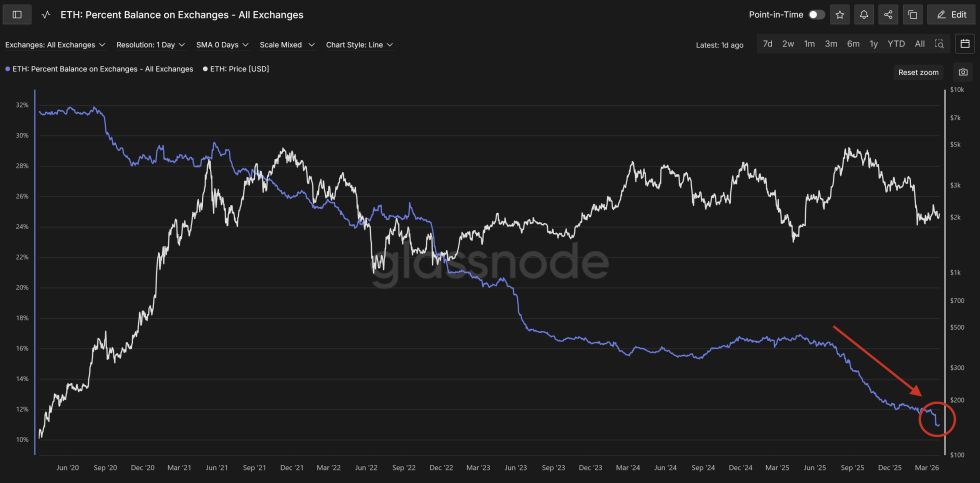
Source: Chart from Leon Waidmann on X

As of Wednesday, only 11% of ETH’s total supply is present on crypto exchanges, which is significant compared to past cycles. In 2023, about 32% of the entire supply was available on exchanges. The decline continued into 2022 and 2024, but in a slow and steady pattern. Meanwhile, by March 2026, the exchange balance had dropped to 11%.

When there is less ETH available on trading platforms, it typically leads to reduced selling pressure as holders pull their holdings and store them in anticipation of a rally. Even as ETH is trading at $2,000, investors are not selling; instead, they are accumulating, which hints at growing bullish sentiment.

ETH Is Setting Up For A Strong Bounce

After a prolonged period of downside performance, Ethereum’s price may be setting up for a major rally. According to Merlin The Trader, ETH is experiencing maximum doubt and minimum attention, which is exactly the period when the altcoin builds up for a notable upward move.

On the 3-week time frame chart, ETH has formed a 3-year trend line, and it is still holding. The $2,100 mark is acting as the support trendline, and the $4,100 level remains the key resistance, acting as the upper line. If the altcoin loses this level, which marks its first since 2022, the structure will undergo a reset. Meanwhile, in the event that ETH holds this structure, it will result in a 339% move.

ETH trading at $2,047 on the 1D chart | Source: ETHUSDT on Tradingview.com

Related Questions

QWhat is the current percentage of Ethereum's total supply on crypto exchanges as mentioned in the article?

AAs of the time of the article, only 11% of Ethereum's total supply is present on crypto exchanges.

QAccording to Leon Waidmann, what does the massive outflow of Ethereum from exchanges indicate about investor sentiment?

AThe massive outflow indicates growing confidence among investors, as they are choosing to hold onto their coins in long-term storage or private wallets in anticipation of a potential price rally.

QWhat are the key support and resistance levels for Ethereum's price on the 3-week timeframe chart as described by Merlin The Trader?

AThe key support level is at $2,100, acting as the support trendline, and the key resistance level is at $4,100, acting as the upper line.

QWhat potential price move could Ethereum experience if it holds its current structure according to the chart analysis?

AIf Ethereum holds its current structure, it could result in a 339% price move.

QHow does a decrease in the amount of ETH available on trading platforms affect the market?

AA decrease in ETH on exchanges typically leads to reduced selling pressure, as holders withdraw their holdings, which tightens market liquidity and can be a bullish signal for a potential price increase.

Related Reads

Worried about AI's Self-Evolution, Anthropic Intends to Stop Training?

In early 2026, Anthropic signaled a significant shift in its public narrative regarding AI development timelines and safety. In June, its Anthropic Institute published a detailed article, "When AI builds itself," presenting internal data suggesting accelerating AI self-improvement. Key figures included over 80% of merged code being written by Claude and a 52x speedup in certain optimization tasks. The article outlined three future scenarios, with the most speculative being full recursive self-improvement (RSI), where AI autonomously builds better successors. Anthropic stated RSI is "possible" and may arrive faster than most institutions are prepared for. This narrative pivot followed a series of strategic moves. In January, CEO Dario Amodei wrote about a powerful self-improvement feedback loop. In February, Anthropic revised its Responsible Scaling Policy, removing a core commitment to pause training if capabilities outstripped safety controls, citing the risk of falling behind competitors. This change coincided with reported pressure from the US Department of Defense. By May, Anthropic's valuation had soared to $965 billion. Anthropic's stance was mirrored by other industry leaders. DeepMind CEO Demis Hassabis adjusted his AGI timeline to "by 2029" and admitted to using provocative language like "foothills of the singularity" to create urgency. OpenAI also released a model claiming a key role in its own creation process. The article's carefully calibrated tone—presenting dramatic data alongside qualifying footnotes—exemplifies a balancing act between signaling technological acceleration and managing commercial, regulatory, and safety imperatives. External experts offered contrasting interpretations of the same data, from warnings of catastrophic risk akin to Chernobyl to skepticism that current automation merely handles "grunt work," not genius. The coordinated narrative shift among top labs highlights the complex interplay between perceived technical inflection points and strategic communication aimed at investors, regulators, and the public.

marsbit2m ago

Worried about AI's Self-Evolution, Anthropic Intends to Stop Training?

marsbit2m ago

The Macroeconomic Underpinnings of Africa's Payment Market Landscape

The African payments market, characterized by the world's highest mobile money penetration and fastest-growing cryptocurrency adoption, is not a coincidence but a macroeconomic necessity driven by deep structural factors. Two key drivers create this landscape: (1) Africa's heavy reliance on commodity exports, trade, and remittances, generating massive cross-border settlement and remittance demand; and (2) chronically underdeveloped financial infrastructure, exacerbated by international bank de-risking, foreign exchange mismanagement, and persistent inflation. This vacuum has allowed mobile money and crypto to thrive. Mobile money platforms replace banks for domestic payments, while cryptocurrencies serve as a store of value against local currency depreciation and a low-cost medium for cross-border exchange. A crucial division lies along the Sahara Desert. North Africa is integrated into the oil-anchored MENA framework, while Sub-Saharan Africa (SSA), plagued by dollar shortages and fragmented currencies, has become a natural, massive market for mobile money and crypto. Nigeria, Kenya, and South Africa are global leaders in adoption. The SSA economy is deeply dollarized due to currency instability, yet suffers from a severe "dollar shortage" caused by trade deficits and limited export capacity. This creates parallel forex markets and high remittance costs. Cryptocurrencies, particularly stablecoins, fill this gap by providing access to dollar liquidity, cheaper cross-border transfers, and an inflation-resistant store of value, primarily driven by retail users for small-value transactions. While regional initiatives like PAPSS aim to reduce dollar dependence, the fundamental constraints of commodity reliance, trade imbalances, and shallow financial markets persist. Therefore, mobile money and cryptocurrencies are not niche trends but essential financial infrastructure filling a structural void, and they are likely to remain central to Africa's economic landscape for the foreseeable future.

链捕手12m ago

The Macroeconomic Underpinnings of Africa's Payment Market Landscape

链捕手12m ago

Is the Sharp Decline Over? Let the Data Speak

**Has the Sharp Decline Ended? Let Data Speak** Bitcoin's recent significant drop has placed short sellers in a precarious position. Three concurrent pressures—sustained outflows from ETFs, miners offloading coins to exchanges, and short-term holders capitulating—pushed the price near $63k. The asset fell 13% this week and 21% this month, roughly halving from its all-time high. A critical data point is the extremely crowded short positioning, with a short-to-long ratio reaching 8:1, representing nearly $100 billion in short interest overhead. This creates conditions for a potential short squeeze if selling pressure merely pauses, similar to the event in November 2022 which triggered a 24% rally. The selling pressures are real: spot Bitcoin ETFs have seen a record $5.4 billion outflow over 20 days. Short-term holders moved 53k loss-held BTC to exchanges in a day, and miners sent 24k BTC to Binance, a six-month high. Capital is also rotating towards AI and tech stocks like SpaceX, with $400 billion invested in AI infrastructure recently. However, on-chain data shows accumulation by long-term holders, who added 200k BTC in a month, and institutions/miners have absorbed 1.24 million BTC since 2023. This indicates strong buying beneath the surface. Key levels to watch are the $67k-$70k zone (2021 high & 2024 breakout point). A swift recovery above it suggests a leverage washout; failure could test $60k-$55k. The direction also hinges on ETF flow reversal. Currently, the S&P 500 hits new highs driven by AI, while Bitcoin and DeFi (TVL down from $173b to $73.9b) lag. The most probable path is a grinding basing process between $60k-$58k with continued ETF outflows. A less likely but explosive scenario involves a sudden flow reversal, a surge above $70k triggering a short squeeze, and a rally back above $76k. The immediate trigger depends on when the relentless selling pauses. A final cautionary note questions Bitcoin's correlation: if the high-flying U.S. stock market corrects, will Bitcoin once again miss the rally but not the decline?

foresightnews_api26m ago

Is the Sharp Decline Over? Let the Data Speak

foresightnews_api26m ago

Trading

Spot
Futures

Hot Articles

Discussions

Welcome to the HTX Community. Here, you can stay informed about the latest platform developments and gain access to professional market insights. Users' opinions on the price of ETH (ETH) are presented below.

活动图片