Is a Super IPO Wave Coming? Will It Drain and Crash the U.S. Stock Market?

marsbitОпубликовано 2026-05-26Обновлено 2026-05-26

Введение

The article discusses concerns about a potential "super IPO wave" hitting the U.S. stock market, with major companies like SpaceX, OpenAI, and Anthropic preparing to go public. While these large IPOs could collectively raise hundreds of billions, raising fears of a market "blood drain," analysis suggests the impact may be limited. Key points include: * Historical data shows IPO waves often coincide with strong market returns, as they typically occur during periods of high investor demand. * Model estimates suggest even the largest IPOs might only cause a market dip of around 1%. They are more likely to trigger a routine market pullback rather than end a bull market. * The current demand side remains supportive due to high household cash balances, strong corporate earnings growth, continued stock fund inflows, and robust share buyback announcements. * The main risk lies in concentrated investor positions, particularly in large-cap tech stocks, which are at elevated levels. A shift in funds towards new issuances could pressure these crowded sectors. * Recent fund flows show strength concentrated in U.S. and tech stocks, while other regions like Europe and Japan are experiencing outflows. The conclusion is that the IPO wave itself is unlikely to crash the market unless it coincides with a weakening in underlying demand factors like earnings or fund inflows into U.S. equities. The focus should be on whether demand can continue to absorb the new supply.

Author: Zhao Ying

Source: Wall Street Insights

U.S. equity capital raising has been recovering from its 2023 low, and may accelerate significantly in the coming months: a batch of mega IPOs are lining up, with individual fundraising sizes potentially reaching tens of billions of dollars. The most direct market concern is that these new listings will 'drain' capital from existing U.S. stocks, especially when index holdings and large-cap positions are already high.

Super IPOs from SpaceX, OpenAI, and Anthropic are queuing up to list in the U.S. SpaceX's registration statement (S-1) was formally disclosed last week, with its IPO expected to be scheduled for the second week of June, making it the first of the three companies to complete a public offering. OpenAI plans to go public as soon as September this year, significantly earlier than previous market expectations, and Anthropic may seek an IPO as early as October this year.

According to Wind Trading Desk, Deutsche Bank Securities strategist Parag Thatte wrote in a report on May 22: 'Under our demand-supply framework, an increase in issuance itself could indeed have a negative impact on stocks, but the effect is only moderate; both past academic literature and empirical evidence from issuance waves clearly show that issuance waves are usually accompanied by strong stock market returns, as they occur during periods of strong stock demand.'

The core judgment of this research is not that 'issuance is harmless', but that 'issuance is not the main cause'. Increased supply can cause short-term disturbances; the largest IPO alone, when put into the model, might drag the market down by about 1%. If the listing schedule is concentrated and these new listings squeeze out other stocks from index benchmarks, the impact could be greater. However, this still looks more like a trigger for a common pullback rather than a sufficient condition for the end of a bull market. The U.S. stock market experiences a pullback of over 3% on average every 1 to 2 months, with many potential triggers, IPOs being just one of them.

What truly supports this judgment is that the demand side hasn't collapsed yet. The household sector still holds high cash balances, corporate profit growth is strong, equity funds are still seeing inflows, and buyback announcements remain at high levels. The issue isn't 'whether there is enough money to buy new shares', but whether demand can continue to outpace supply. Another boundary condition is that large-cap stocks, especially large-cap tech stocks, already have elevated positioning; that is where sensitivity is higher.

This issuance wave seems large, but it's not excessive within the context of the entire U.S. stock market.

The quarterly pace of U.S. equity issuance has risen from a low of about $30 billion in early 2023 to the current level of about $120 billion. In the coming months, a batch of mega IPOs could push the pace up another notch.
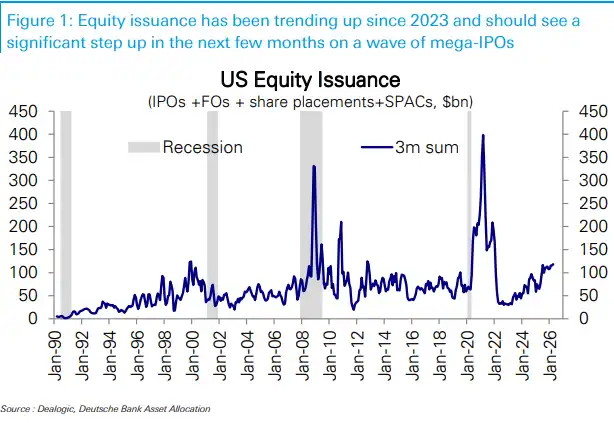
Looking at IPOs alone, some of the upcoming large projects could have fundraising sizes equivalent to the total amount raised by all U.S. listings in the past nine months. Expanding the scope to all U.S. equity issuance, including secondary offerings, this would be equivalent to about two months of issuance volume.

But from a different perspective, the pressure is much smaller. Even the largest anticipated IPO's fundraising amount is just slightly above 0.1% of the current total market capitalization of the S&P 500. This is also why 'increased supply' alone is insufficient to conclude 'the U.S. stock market will inevitably fall': the absolute amount is eye-catching, but relative to the market size, it's not extreme.

Historically, issuance waves have been more like companions to bull markets.

Over the past 30+ years, the U.S. stock market has experienced several cycles of rising equity issuance. In historical samples, the stock market typically performed strongly during these phases: the median return for the S&P 500 in the first 3 months after an issuance wave began was about 8%; extending to 12 months, returns exceeded 20%.

Exceptions are clear: during the 2008–2009 global financial crisis, entities like financial institutions were forced to raise capital, and rising issuance occurred amid heavy selling. This type of 'forced capital replenishment' issuance is not the same as companies raising capital during normal market conditions when valuations and demand are favorable.

Academic literature also leans towards this direction of causality: stronger stock markets and higher expected profitability tend to appear first, followed by issuance waves; the issuance itself has limited negative impact on the concurrent market. The more troublesome part comes later – following an issuance wave, stock market returns eventually weaken, but this 'eventually' can be delayed for a long time and cannot be simply used as a short-term sell signal.

Models suggest an impact of about 1%, but concentrated listings could amplify the perceived effect.

The demand-supply framework considers several forces together: investor positioning changes, equity fund flows, buybacks, and issuance. Issuance, being an increase in supply, is naturally a negative factor, all else being equal.

Calculations show that the largest IPO alone might cause a market decline of about 1%. If listing times are highly concentrated, or if new listings squeeze out allocations to other constituent stocks after entering index benchmarks, the actual pressure could be somewhat greater.

But it's important to distinguish between 'downside risk' and 'systematic selling pressure'. Pullbacks of over 3% occur in the U.S. stock market on average every 1 to 2 months. An IPO wave could become the catalyst for one such pullback, but it doesn't necessarily change the market's direction. Unless the demand side weakens simultaneously, supply shocks alone are unlikely to bring down the index.

The demand side is still holding up for now: cash, profits, and buybacks are all providing support.

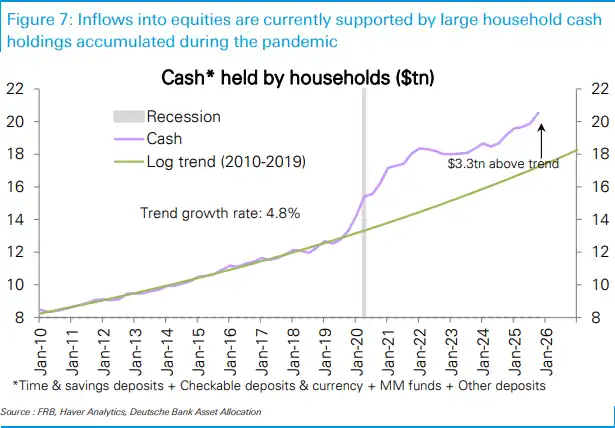
The household sector remains a key buffer. Cash balances accumulated during the pandemic are still very high; household cash holdings are about $3.3 trillion above the 2010–2019 trend level. Relative to personal income, cash holdings are also at elevated levels, giving households the capacity to direct a larger portion of new savings into financial assets, including stocks.
Profits are another pillar of support. The correlation between equity fund inflows and S&P 500 profit growth since 2003 is about 54%. First-quarter profit growth has been described as one of the strongest in over two decades, explaining why capital is still willing to chase equity assets.

Buybacks are also a significant component of demand. S&P 500 buyback announcements remain strong, meaning companies themselves are still providing buying power. Increased issuance brings supply, while buybacks and fund inflows provide absorption capacity; the current balance hasn't clearly tilted towards the supply side yet.

Positioning is not uniformly overheated; crowding is mainly in large-cap tech.

Overall equity positioning is only slightly overweight, at the 53rd percentile since 2010. Active investor positioning is lower, around the 47th percentile, close to neutral; systematic strategy positioning is somewhat higher, around the 64th percentile.

The real crowding is in large-cap stocks, especially large-cap tech. Large-cap positioning is at the 85th percentile, and large-cap tech is at the 93rd percentile. This means that if an IPO wave triggers capital rebalancing, the most likely targets for market focus would not be 'all stocks', but the already heavily held sectors.

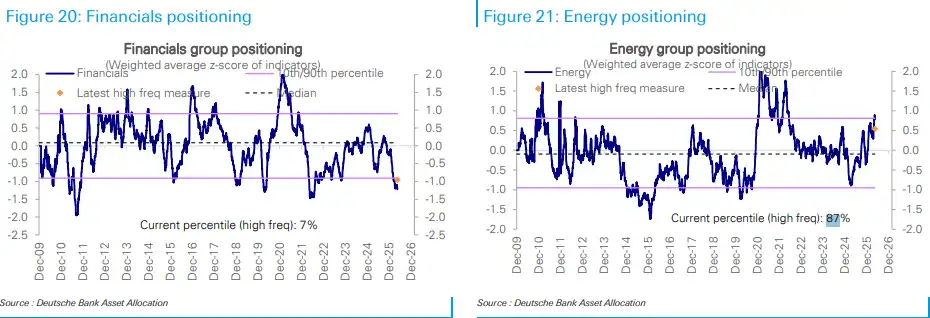
The sector distribution is also uneven. Energy positioning is high, at the 87th percentile; large-cap growth and tech overall are slightly overweight. Financials are significantly underweight, at the 7th percentile; Materials is even more extreme, at the 0th percentile. The U.S. stock market is not uniformly positioned, and supply shocks won't land evenly in every corner.
Fund flows are not uniformly optimistic; strength is concentrated in the U.S. and tech.

In the most recent week, equity fund inflows slowed significantly to $2.4 billion. U.S. equity funds still saw inflows of $9.5 billion, and broad global funds had inflows of $10.3 billion, but regions outside the U.S. experienced significant outflows.

Japanese equity funds saw outflows of $4.4 billion, the largest in five weeks; European funds saw outflows of $2.3 billion, marking the sixth consecutive week of outflows; Emerging markets had outflows of $7.9 billion, also for the sixth straight week. Among these, China-related funds saw outflows of $9.7 billion, while South Korea and Taiwan saw inflows of $3 billion and $1.7 billion respectively.

Sectoral flows were even more concentrated. Tech funds saw inflows of $9 billion, the largest in seven months. Meanwhile, bond fund inflows reached $30.5 billion, rising to a five-month high. Capital is not unidirectionally pouring into risk assets but is flowing divergently among U.S. equities, tech, and bonds.

This is also the most crucial area to watch under the IPO wave: not the number of new listings itself, but whether demand continues to concentrate in a few strong assets. If profits, buybacks, and U.S. equity inflows continue to provide support, the issuance wave will likely be just short-term noise; if crowded tech positioning loosens and equity inflows cool, then supply pressure could transform from a 'modeled disturbance of about 1%' into a harder-to-digest problem.


Связанные с этим вопросы

QAccording to the article, will a wave of super IPOs definitely cause the US stock market to collapse?

ANo, the article argues that a wave of IPOs alone is unlikely to cause a market collapse. While it may trigger a short-term pullback of around 1%, it is not a sufficient condition for ending a bull market. Historical evidence shows IPO waves often accompany strong market returns due to concurrent high demand. The key factor is whether demand (from cash balances, earnings, fund inflows, buybacks) continues to outpace the new supply.

QWhat are the key demand-side factors supporting the US stock market mentioned in the analysis?

AThe key demand-side factors supporting the market are: 1) High cash balances in the household sector, 2) Strong corporate earnings growth, 3) Continued inflows into equity funds, and 4) High levels of share buyback announcements. These factors collectively provide a buffer to absorb the increased supply from new stock issuance.

QWhich specific companies are highlighted as part of the upcoming 'super IPO' wave?

AThe article highlights three companies: SpaceX (with its S-1 filed and an IPO expected in the second week of June), OpenAI (planning an IPO as early as September), and Anthropic (potentially seeking an IPO as early as October).

QAccording to the Deutsche Bank strategist's model, what is the estimated direct impact of the largest IPOs on the market?

AAccording to the Deutsche Bank strategist's demand-supply framework model, the largest IPOs alone could potentially drag the market down by approximately 1%. However, the impact could be amplified if the listings are highly concentrated or if they crowd out other stocks in major indices.

QWhere is investor positioning most crowded, making it potentially more sensitive to market shifts?

AInvestor positioning is most crowded in large-cap stocks, particularly large-cap technology. The article states that large-cap tech positioning is at the 93rd percentile. This sector is therefore more sensitive to potential fund rebalancing or shifts in market sentiment compared to the overall market, which is only modestly overweight.

Похожее

Metrics Ventures Market Watch: The Brewing Storm

In the past month, the market has been actively trading contrasting expectations, balancing global supply chain disruptions fueling re-inflation against both actual and anticipated (Walsh) interest rate hikes. This volatility has impacted commodities and most equities, though tech has temporarily benefited from concentrated short-term liquidity. Fundamentally, as previously analyzed regarding the Strait of Hormuz situation, the US faces deep-seated balance sheet issues beyond what any single Fed chair can resolve. Hypotheses around a figure like Walsh could only materialize if AI fundamentally reshapes production relations. Until then, most non-AI-leading nations (effectively all except the US and China) risk fiscal and monetary policy collapse, rendering the identity of the Fed chair ultimately irrelevant. For crypto assets, there is currently no clear role in these dominant narratives. The market remains strongly capped by the 200-day moving average. While trends may shift from "anything but AI" to "anything but mines," this phase is dominated by the silicon vs. carbon (AI vs. traditional) dichotomy, leaving little room for crypto—though its time will come. **Market Overview & Commentary** The crypto market lacks significant catalysts beyond hype, plagued by low volume and scarce innovation, with clear technical resistance. Currently, crypto struggles for attention as global focus lies elsewhere. Assets like gold, oil, and grains are more direct hedges against supply-chain-driven inflation/stagflation. Bitcoin needs more time for capitulation and consolidation; this reset is expected to last until at least Q4 2026. Looking ahead, three factors will likely drive future market volatility: 1. Whether Walsh repeats the patterns of predecessors like Bassant or Musk, shifting stance into a new policy cycle. 2. The market underestimates the severity of global supply chain damage and the prolonged time needed for repair, which will eventually lead to recognition of acute resource shortages and price swings. 3. AI non-beneficiary, high-inflation nations (e.g., UK, Japan) will face severe fiscal and monetary crises. Rapid AI-driven displacement could trigger a collapse of existing credit and welfare systems. Ultimately, the market may realize that an AI bubble burst could spark contagious sovereign credit crises. The monetary and fiscal responses to such a scenario could serve as the ultimate catalyst for Bitcoin's next major bull run.

marsbit15 мин. назад

Metrics Ventures Market Watch: The Brewing Storm

marsbit15 мин. назад

Insiders Betting on Musk Are Reaping 'Historic Returns'

The largest IPO in history is imminent as SpaceX, led by Elon Musk, is set to price its offering on June 12. At a targeted valuation near $2 trillion, this event will mint new billionaires from Musk's inner circle of long-time allies, rewarding their loyalty with unprecedented returns. Key beneficiaries include Antonio Gracias, Musk's close friend and confidant, who holds a 7.3% stake potentially worth over $140 billion, making him the second-largest individual shareholder. Gwynne Shotwell, President and COO since 2002, holds shares valued at roughly $2 billion. Bret Johnsen, the CFO, holds stock worth approximately $1.4 billion. Luke Nosek, a PayPal co-founder and early investor, stands to gain about $5.3 billion. The IPO filing also reveals complex and controversial financial arrangements. SpaceX has guaranteed nearly $20 billion in payments from xAI's subsidiary to Gracias's Valor Equity Partners for AI hardware leases—deals auditors flagged as "failed sale-leaseback" transactions, forcing SpaceX to record them as debt. Despite rapid revenue growth, SpaceX is not profitable, posting a $49 billion loss in 2025 and a $4.3 billion loss in Q1 2026. Capital expenditures are soaring, with over 60% directed toward AI. Public investors will inherit these losses, significant debts, and a governance structure heavily controlled by insiders, including a provision granting Musk up to a billion additional shares if one million people live on Mars.

链捕手17 мин. назад

Insiders Betting on Musk Are Reaping 'Historic Returns'

链捕手17 мин. назад

Ethereum Reduced to a Chinese Concept Stock

The article titled "Ethereum Becomes a Chinese Concept Stock" presents a critical analysis of Ethereum's perceived decline in market confidence and its structural parallels to Chinese companies listed on US stock exchanges. It begins by noting significant sell-offs by early investors like Wanxiang and key figures like Bankless's Hoffman in 2026, despite Ethereum's strong fundamental activity. The piece questions the erosion of trust in Vitalik Buterin and the Ethereum Foundation (EF), arguing that while other ecosystems have faced founder controversies, Ethereum's issues stem from its internal governance model. The author draws a direct comparison to "China concept stocks," which are Chinese businesses operating globally but reliant on foreign capital and listings. Similarly, Ethereum, funded early by Chinese capital like Wanxiang, developed a strong institutional framework from its IXO to its PoS transition. The core problem, according to the article, is a leadership vacuum regarding price and direction. Vitalik's move to make the EF smaller and less active is framed as a mistake. While he advocates for ETH as a "commodity," the ecosystem lacks a clear entity to steward its price stability, creating tension within the PoS system, as seen with Lido's challenges. The narrative suggests that excessive abstraction and a hands-off approach from the EF have left the community adrift, contrasting with more proactive foundations like Solana's. The article then examines emerging technical narratives for Ethereum: privacy (ZK-proofs), AI integration, and a refocus on Layer-1. However, it observes a shift from Ethereum leading as a "world computer" to merely adapting to trends like AI, where crypto-native projects are finding success independently of Ethereum. The piece posits that Ethereum's unique value in an increasingly fragmented world may be as a permissionless, global financial testing ground—a neutral platform amid geopolitical tensions. In conclusion, it asserts that Ethereum's fate mirrors that of China concept stocks: an asset born from one region (conceptually "A"), funded by another ("B"), and dependent on "B" for exit liquidity. While Ethereum's "golden age" may be over, and selling pressure from early backers will continue, it remains positioned as a critical linkage point in a divided global landscape, standing at a new, albeit uncertain, starting point.

marsbit41 мин. назад

Ethereum Reduced to a Chinese Concept Stock

marsbit41 мин. назад

AI Agents Fundamentally Transform Web3 Gaming: From the Rugpull Bakery Bot Controversy to the New Agent Paradigm in 2026

AI Agents Are Redefining Web3 Gaming: From the Rugpull Bakery Bot Controversy to the 2026 Agentic Paradigm The recent controversy in Rugpull Bakery, a competitive baking game on Abstract chain, highlighted a pivotal shift. Player complaints about unfair bot automation in Season 2 led developers to not ban them, but instead formally integrate AI agents as core gameplay in Season 3, providing official guides (skill.md, agent.json). This move signals Web3 gaming's transition into the "Agentic Gaming" era, where AI agents are sovereign entities with independent strategy and economic rights, moving beyond simple automation. By 2026, AI agent integration has evolved into three core models reshaping the ecosystem: 1. **Autonomous Competitors & Economic Entities:** Agents act as independent players. Examples include TEN Protocol's poker-playing agents, AI Arena's trainable NFT fighters, Satoshi Strike Force's "Digital Athletes" trained on player data, and Somnia's "Agentic L1" blockchain providing native infrastructure for millions of autonomous agents. 2. **Modular Infrastructure & Programmable Environments:** Games like EVE Frontier enable "server-side modding," allowing AI agents to program game world logic directly into structures like smart storage, turrets, and stargates via Smart Assemblies. Coupled with standards like ERC-8183, which enables autonomous job creation and payment between agents, in-game infrastructure gains a "commercial soul." 3. **Hybrid Companions & Dynamic Adaptive Worlds:** This model focuses on human-AI collaboration. In Parallel Colony, players guide highly autonomous AI Avatars with unique personalities and goals. Illuvium plans to use AI to transform NPCs into dynamic, context-aware entities that create personalized, emergent narratives. The conclusion is clear: blocking automation is futile. The future lies in leveraging blockchain's transparency and programmability to empower AI agents as first-class citizens. Web3 gaming is shifting from inefficient human labor to efficient algorithmic interplay and emergent intelligence, creating a "post-human" digital frontier where players become commanders and symbiotic partners in a new socioeconomic experiment.

marsbit41 мин. назад

AI Agents Fundamentally Transform Web3 Gaming: From the Rugpull Bakery Bot Controversy to the New Agent Paradigm in 2026

marsbit41 мин. назад

Торговля

Спот
Фьючерсы
活动图片