Qualcomm Chip Price Hike Deals a Blow to Android Phones

marsbitPublished on 2026-07-31Last updated on 2026-07-31

Abstract

Qualcomm has officially announced a new round of price increases for its entire chip portfolio, effective September 1. The hikes, reaching up to 18% for the flagship Snapdragon 8 Elite Gen 6 Pro, follow similar moves by MediaTek, intensifying cost pressures on the already strained smartphone industry. CEO Cristiano Amon confirmed the plan, citing the need to offset rising industry-wide costs and restore declining profit margins. Qualcomm's Q3 FY2026 results showed a 25% drop in net profit, with mobile revenue plunging 20% year-over-year, hitting its lowest level since 2021. The surge in AI computing demand has led memory manufacturers to prioritize HBM production, creating a shortage in general-purpose DRAM and NAND Flash chips. Their prices soared by 93%-98% and 55%-60% respectively in Q1 2026, causing the memory cost share in smartphones to jump from 10%-15% to over 30%. Coupled with the soaring cost of advanced nodes like TSMC's 2nm and packaging, overall chip costs have reached historic highs. These upstream pressures are forcing downstream smartphone brands like Xiaomi, OPPO, and vivo to cut orders for mid-to-low-end models by up to 20% and use cost-saving measures like older chipsets. Reportedly, the Snapdragon 8E5 will be repurposed as a "long-lasting" chip for sub-brand phones in H2 2026. Amid this cost crisis, the Android market remains sluggish. Q2 2026 smartphone shipments in China fell 4.3% year-over-year, marking five consecutive quarters of decline. Major An...

Recently, global chip giant Qualcomm officially announced a new round of price adjustments for its product line. Effective September 1st, the entire series of chip products will see double-digit percentage price increases, with the new flagship Snapdragon 8 Elite Gen 6 Pro seeing the highest increase of up to 18%.

Following MediaTek's announcement of price hikes for its Dimensity series chips in late June, Qualcomm has now followed suit. This brings a new wave of cost pressure to the already strained mobile terminal industry.

It is reported that Qualcomm issued price increase notifications to global customers on July 24th local time. The new prices will uniformly apply to all chip products shipped after September 1st, covering multiple product lines including smartphones, tablets, wearables, and automotive chips. Qualcomm CEO Cristiano Amon confirmed the adjustment plan during the earnings call, stating that the core reason for the price increase is to hedge against rising costs across the entire industry chain, repair the company's declining gross margin, and drive profitability back to historical normal levels.
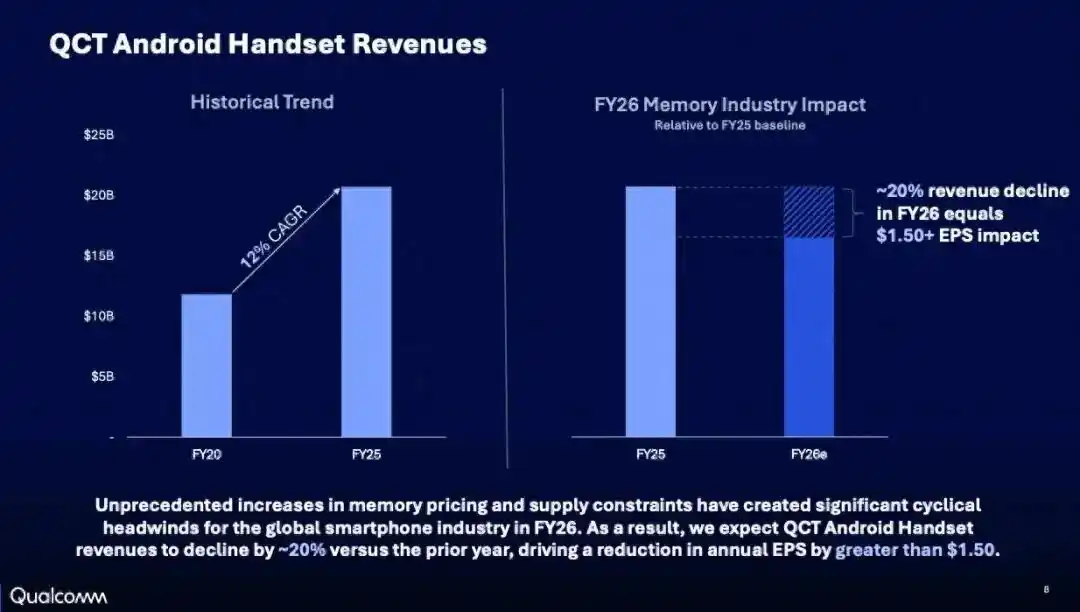
Data shows that Qualcomm's Q3 FY2026 revenue was $9.947 billion, a year-over-year increase of 4%, but net profit plummeted by 25% YoY. Revenue from the mobile handset business plunged by 20% YoY, hitting the lowest record since 2021. The main reason cited is industry-wide price increases triggered by the AI boom.

As demand for AI computing power surges, memory manufacturers like Samsung and SK Hynix have significantly increased production capacity for HBM memory, leading to an imbalance in the supply and demand for general-purpose memory chips.

According to data from TrendForce, general-purpose DRAM contract prices increased by 93%-98% quarter-over-quarter in Q1 2026, while NAND Flash contract prices rose by 55%-60% QoQ. The share of memory costs in mobile phone material costs has skyrocketed from 10%-15% to over 30%. At the same time, the wafer cost for TSMC's 2nm advanced process has exceeded $30,000, coupled with a price increase of over 20% for advanced packaging, pushing chip costs to a historical high.

The cost pressures on chip giants have ultimately been passed down to downstream smartphone manufacturers, trapping the industry in a vicious cycle.

Previously, continuous price increases for memory chips had already squeezed the profit margins of terminal manufacturers. To control costs, brands like Xiaomi, OPPO, and vivo have significantly reduced orders for mid-range and low-end models in 2026, with cuts up to 20%. Some manufacturers are also compressing costs by simplifying hardware configurations and even resorting to using older-generation chips.

Reportedly, the Snapdragon 8 Gen 5 Ultimate Edition (SD 8E5) released last September has "been forced" to become a long-lasting workhorse chip. Qualcomm is set to release a downclocked version specifically for sub-brand iterative new models in the second half of this year, offering performance not inferior to the standard SD 8E5 but at a price significantly lower than the concurrently released SD 8E6.

Under heavy cost pressure, the Android smartphone market continues to be sluggish. IDC data shows that domestic smartphone shipments in Q2 2026 fell by 4.3% year-over-year, marking five consecutive quarters of decline. The market shares of major Android brands like OPPO, vivo, Xiaomi, and Honor have all dropped significantly. In contrast, Huawei and Apple, which do not rely on external high-end SoC chips, have seen noticeable growth in market share, leveraging their advantages in self-developed chips and stable pricing.

Compared to smartphone manufacturers, Qualcomm could potentially pass on cost pressures even without raising prices.

Currently, Qualcomm is accelerating its business diversification transformation, focusing on new sectors like automotive, IoT, and data centers. Its automotive business has achieved 23 consecutive quarters of double-digit year-over-year growth, and it recently secured a ten-year chip supply agreement with BMW. However, the scale of these new businesses is still limited and cannot fully offset the gap left by the handset business.

Industry insiders predict that as the rising costs of chips and memory are fully reflected in the second half of the year, price increases for new Android flagship models may exceed market expectations. The decline in domestic smartphone market shipments in 2026 could further widen.

This article is sourced from the WeChat public account "镁客网", author: 镁客网

Trending Cryptos

Related Questions

QAccording to the article, what is the main reason for Qualcomm's decision to increase the prices of its chips across the board?

AThe main reason for Qualcomm's price increase is to hedge against rising costs across the entire industry supply chain, repair the company's declining gross margin, and restore profitability to historically normal levels.

QWhich specific Qualcomm chip model is mentioned as seeing the highest price increase, and what is the percentage?

AThe new flagship chip, the Snapdragon 8 Elite Gen 6 Pro, is mentioned as having the highest price increase, reaching up to 18%.

QHow did the surge in AI computing power indirectly affect smartphone material costs, specifically regarding memory?

AThe surge in AI computing power led memory manufacturers like Samsung and SK Hynix to significantly increase production of HBM memory. This created an imbalance in supply and demand for general-purpose memory chips, causing DRAM and NAND Flash contract prices to soar. As a result, the proportion of memory costs in smartphone material costs surged from 10-15% to over 30%.

QWhat contrasting trend in market share is highlighted between brands like OPPO, vivo, and Xiaomi compared to Huawei and Apple?

AThe article highlights that mainstream Android brands like OPPO, vivo, Xiaomi, and Honor have all seen significant declines in market share. In contrast, Huawei and Apple, which do not rely on external high-end SoC chips and benefit from their in-house chip advantages and stable pricing, have shown noticeable growth in market share.

QWhat strategy did Qualcomm adopt regarding the Snapdragon 8E5 chip to help smartphone manufacturers cope with cost pressures?

ATo help smartphone manufacturers cope with cost pressures, Qualcomm is planning to release a down-clocked version of the Snapdragon 8E5 chip in the second half of the year. This version will offer performance comparable to the standard Snapdragon 8E5 but at a significantly lower price than the concurrently released Snapdragon 8E6, making it suitable for sub-brand iterative new models.

Related Reads

Wall Street Rushes into Ethereum, but Has It Become a Castoff for Investors?

Wall Street Embraces Ethereum, But Investors Remain Wary Ethereum is gaining significant institutional adoption from major financial firms like JPMorgan Chase, Robinhood, and Morgan Stanley, which are launching products and building on the network. A new non-profit, Ethereum Institutional, has also been formed to accelerate enterprise use. Technically, Ethereum co-founder Vitalik Buterin has unveiled a major multi-year upgrade plan called "Lean Ethereum," aiming to enhance privacy, security, and quantum resistance. Despite these positive fundamentals, the market reaction has been negative. ETH's price remains around $1,900, down over 60% from its all-time high. Analysts cite weak investor demand and persistent outflows from spot Ethereum ETFs. Citi has downgraded its 12-month price target to $2,240. A key challenge is the decoupling of network activity from ETH's value accrual. While Layer 2 scaling solutions have successfully reduced costs and increased throughput, most transactions now occur off the mainchain. This reduces the fee revenue and ETH burn on Ethereum itself, benefiting users but creating uncertainty for ETH holders. Price predictions are highly divergent, ranging from Citi's conservative $2,000+ outlook to StanChart's $4,000 by 2026 and even a long-term $25,000 forecast from Tom Lee. The consensus is that while Ethereum is increasingly likely to become core financial infrastructure, the extent to which ETH token holders will benefit remains unclear.

marsbit21m ago

Wall Street Rushes into Ethereum, but Has It Become a Castoff for Investors?

marsbit21m ago

Trading

Spot

Hot Articles

How to Buy CHIP

Welcome to HTX.com! We've made purchasing USD.AI (CHIP) simple and convenient. Follow our step-by-step guide to embark on your crypto journey.Step 1: Create Your HTX AccountUse your email or phone number to sign up for a free account on HTX. Experience a hassle-free registration journey and unlock all features.Get My AccountStep 2: Go to Buy Crypto and Choose Your Payment MethodCredit/Debit Card: Use your Visa or Mastercard to buy USD.AI (CHIP) instantly.Balance: Use funds from your HTX account balance to trade seamlessly.Third Parties: We've added popular payment methods such as Google Pay and Apple Pay to enhance convenience.P2P: Trade directly with other users on HTX.Over-the-Counter (OTC): We offer tailor-made services and competitive exchange rates for traders.Step 3: Store Your USD.AI (CHIP)After purchasing your USD.AI (CHIP), store it in your HTX account. Alternatively, you can send it elsewhere via blockchain transfer or use it to trade other cryptocurrencies.Step 4: Trade USD.AI (CHIP)Easily trade USD.AI (CHIP) on HTX's spot market. Simply access your account, select your trading pair, execute your trades, and monitor in real-time. We offer a user-friendly experience for both beginners and seasoned traders.

3.4k Total ViewsPublished 2026.04.21Updated 2026.06.02

How to Buy CHIP

Discussions

Welcome to the HTX Community. Here, you can stay informed about the latest platform developments and gain access to professional market insights. Users' opinions on the price of CHIP (CHIP) are presented below.

活动图片