Bitcoin first, crypto at scale: Inside the UAE’s layered digital asset strategy

cointelegraphPublished on 2025-12-12Last updated on 2025-12-12

Abstract

The United Arab Emirates is implementing a dual-track digital asset strategy, with Abu Dhabi and Dubai playing complementary roles. Abu Dhabi is positioning itself as a hub for institutional Bitcoin infrastructure, focusing on custody, OTC liquidity, mining, and regulated capital markets. In contrast, Dubai is building a broader crypto economy that includes payments, stablecoins, Web3 apps, gaming, and tokenization. Industry experts describe this as a layered approach: Abu Dhabi serves as a "crypto Wall Street," while Dubai drives real-world adoption and daily usage. Stablecoins are emerging as a key adoption driver in Dubai, with growing use cases in payments, remittances, and services. Regulatory clarity in both emirates has been a major enabler, though challenges remain in banking integration and decentralized finance frameworks.

The United Arab Emirates is not trying to choose between Bitcoin and broader crypto. Instead, it is deliberately building both in different cities and for different stages of adoption.

Abu Dhabi, the capital of the UAE, has positioned itself as a hub for Bitcoin (BTC)-focused institutional infrastructure, emphasizing custody, over-the-counter (OTC) liquidity, mining and regulated capital markets. Dubai, by contrast, has built a broader crypto economy that spans payments, stablecoins, Web3 apps, gaming, tokenization and consumer-facing products.

While this shows a distinction, industry participants noted that it reflects a layered strategy and not fragmentation. “The two approaches are complementary,” said Gregg Davis, producer of Bitcoin MENA, the largest Bitcoin-focused event in the UAE.

“A broad digital-asset ecosystem naturally directs attention toward the most secure and time-tested asset — Bitcoin. Together, they create a diverse and dynamic market across the UAE,” Davis told Cointelegraph.

On the other hand, Dubai’s ecosystem maximizes participation and real-world usage, according to Matthias Mende, the co-founder of the Dubai Blockchain Center and the founder of the Web3 social verification platform Bonuz.

“In simple terms, Abu Dhabi is building ‘crypto Wall Street,’ while Dubai is building the place where people actually use this technology every day,” Mende said.
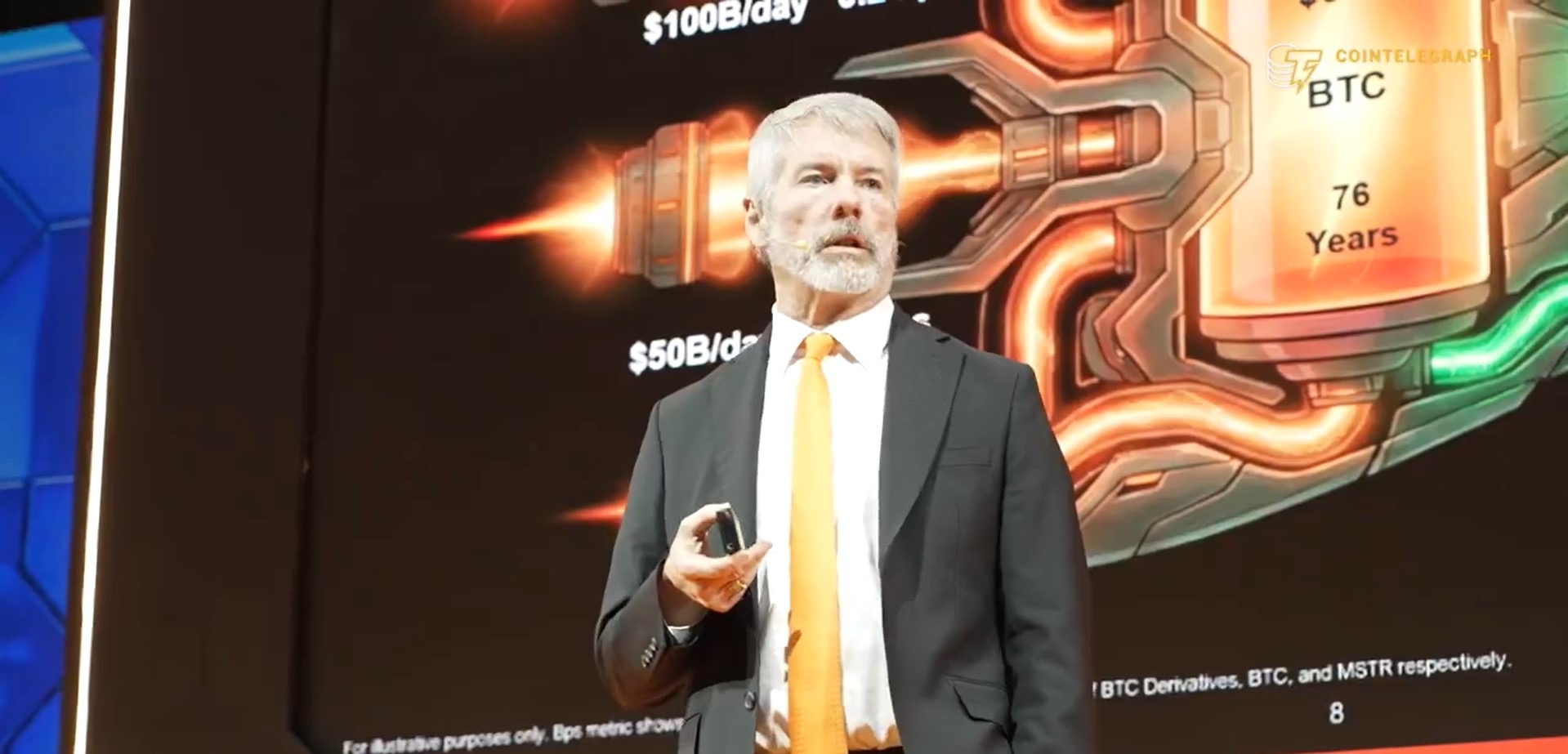
Michael Saylor at the Bitcoin MENA event. Source: Cointelegraph

Abu Dhabi’s Bitcoin-first institutional thesis

Davis argued that Abu Dhabi’s strategy is rooted in a clear distinction between Bitcoin and the broader crypto landscape.

“Abu Dhabi has done the work to understand that Bitcoin stands apart from the broader digital-asset landscape,” Davis said. “Much of what falls under ‘Web3’ remains speculative or built around problems that may not need solving.”

According to Davis, the intent to position Abu Dhabi as a center for institutional Bitcoin is already visible.

“Major entities in Abu Dhabi gaining exposure to Bitcoin is a strong signal of long-term conviction,” he told Cointelegraph. He added that clearer regulatory pathways and public-sector support have made the emirate attractive for Bitcoin-native firms.

Recent developments back up this institutional Bitcoin thesis. Abu Dhabi has emerged as a focal point for large-scale, regulated Bitcoin activity, underscored by the launch of the Bitcoin MENA 2025 event, which brought institutional investors, miners and infrastructure providers in the emirate to discuss custody, mining and treasury strategies.

Global companies, such as Galaxy Digital, have expanded into Abu Dhabi under the ADGM framework, citing regulatory clarity and institutional demand. Meanwhile, crypto exchange Binance secured full regulatory approvals covering trading, clearing and custody.

Dubai builds the crypto economy layer

While Abu Dhabi focuses on institutional rails, Dubai has taken a broader approach, designing a regulatory environment intended to support entire industries built on top of digital assets.

“Dubai is trying to build the full crypto economy around that,” Mende told Cointelegraph. “Consumer apps, brands, payments, gaming, creators and tokenization.”

He told Cointelegraph that the convergence of stablecoins, tokenized real-world assets (RWAs) and consumer-facing apps created a new economic layer that goes beyond trading.

“Stablecoins will be the visible part — simple ‘scan, tap, pay’ flows — while RWAs bring serious institutional capital onchain,” Mende said, adding that blockchain-based digital IDs, non-fungible tokens (NFTs), vouchers and tickets make the whole system human-centric and “useful for daily life.”

Dubai’s regulatory clarity has been a major enabler of the crypto economy vision. “The biggest enabler is clarity,” Mende said. “Founders know which activities are regulated, what license they need and which rulebook they fall under, so they can design products and token models with a clear path.”

That clarity, however, does not eliminate all friction. Mende told Cointelegraph that challenges remain at the interface with traditional finance, particularly banking and fiat on- and off-ramps, and in more experimental areas such as decentralized finance and DAOs, where frameworks are still evolving.

Related: State Street, Galaxy and Ondo join tokenized cash race with 24/7 sweep fund

Stablecoins emerge as the first mass-use rail

As Dubai’s crypto economy develops, multiple industry leaders point to payments and stablecoins as the first area of durable, real-world adoption.

“Payments and stablecoin infrastructure will lead because they solve a universal and urgent problem: cross-border settlement that is slow, expensive and fragmented,” Patrick Ngan, the chief investment officer at Zeta Network Group, told Cointelegraph.

According to Ngan, regulatory clarity provides financial institutions with the confidence to integrate digital settlement rails directly into commerce. “Once those rails are in place, volume follows,” he said. “That is where the first durable, real-world adoption will appear.”

SingularityDAO founder Marcello Mari echoed the sentiment. He said that stablecoins are already more embedded in everyday activity than many outside the region realize.

“In Dubai, USDT and USDC are actually used more than you think — for rent, remittances, real estate and service payments,” Mari said. “Gaming and Web3 creators will follow, but stablecoins are the first bridge to real-world utility.”

Apart from crypto-native companies, stablecoins have caught the attention of mainstream companies in the UAE. On Thursday, state-owned telecom giant e& announced that it’s preparing to test a dirham-backed stablecoin for bill payments.

However, both Ngan and Mari expressed that while regulatory clarity exists, operational timelines and banking relationships remain the biggest bottlenecks. “The rules are clear, but the process requires patience and strong operational discipline,” Ngan said.

Magazine: Bitcoin $200K soon or 2029? Scott Bessent hangs at Bitcoin bar: Hodler’s Digest
Related Reads

Anthropic Major Release: "The Founder's Playbook" - All 4 Stages of Entrepreneurship, Completely Reimagined with AI

**Anthropic Releases "The Founder's Playbook," Reimagining the Four Stages of Startups with AI** The logic of entrepreneurship is being fundamentally reshaped by AI. Anthropic's new handbook, "The Founder's Playbook: Building an AI-Native Startup," defines the AI-native startup as a new species: not a traditional company with AI tools, but a venture driven by AI from day one. The founder's role is transforming from a hands-on builder to a conductor or architect, orchestrating AI agents for execution while focusing on high-level judgment and strategy. Anthropic outlines a product matrix of Claude tools for different tasks: Claude Chat for interactive research, Claude Code for generating production-ready code, and Claude Cowork for automating knowledge-intensive workflows. The handbook structures the startup lifecycle into four stages, detailing core goals, pitfalls, and AI applications for each: 1. **Idea Stage**: Focuses on validating a real problem. The core challenge is avoiding confirmation bias. AI practices include using Claude as a "structured devil's advocate" to challenge assumptions and for automated market/competitor research. 2. **MVP Stage**: Aims to gather early signals of Product-Market Fit (PMF). Key risks are technical debt and scope creep due to rapid AI-assisted development. Recommended AI uses include maintaining project memory documents (e.g., CLAUDE.md), using Claude Code for structured coding, and automating user feedback analysis. 3. **Launch Stage**: Centers on establishing scalable growth, operations, and compliance. Challenges include accelerating technical debt and founders becoming bottlenecks. AI should be used to build an "operating system" for launch—automating routine tasks (scheduling, reporting, content) and code audits—freeing founders for critical decisions. 4. **Scale Stage**: Focuses on achieving sustainable business operations. The main challenge is delegating operational control. AI should be leveraged for differentiated marketing, operational optimization, and building competitive moats through data network effects. The handbook concludes that in the AI era, "Can we build it?" is no longer the primary constraint. The advantage shifts back to foundational strengths: **insight, judgment, and a deep understanding of a specific problem and audience.**

marsbit1h ago

Anthropic Major Release: "The Founder's Playbook" - All 4 Stages of Entrepreneurship, Completely Reimagined with AI

marsbit1h ago

Eight Departments Launch Severe Crackdown on Cross-Border Securities Firms, How to Interpret This?

China's top financial regulators, including the CSRC and seven other ministries, have launched a sweeping crackdown on unlicensed cross-border securities operations. The core action involves a joint enforcement plan and the issuance of administrative penalties against major offshore internet brokers like Futu and Tiger Brokers for conducting unauthorized securities business in mainland China without a domestic license. The primary legal basis is China's requirement for securities businesses to operate with proper, locally issued licenses. The crackdown aims to eliminate a major regulatory gray area, plugging channels that allowed massive, unmonitored capital outflows which posed risks to financial stability, currency controls, and foreign exchange reserves. It also seeks to protect mainland investors who previously lacked legal recourse when dealing with offshore platforms and to secure sensitive financial data. The immediate impact is severe for the targeted brokers, including a complete ban on new mainland business, forced liquidation of existing mainland client positions over two years, and the confiscation of illegal profits estimated in the billions. Their U.S.-listed shares plummeted in response. Market analysts warn that the forced sell-off of an estimated 250-280 billion RMB in assets, concentrated in U.S. tech stocks, Chinese ADRs, and Hong Kong equities, could create sustained selling pressure on these markets over the next two years, potentially lowering valuations. For mainland investors, legal cross-border investment channels will become extremely constrained. The high asset threshold for the Stock Connect program and the severe shortage of QDII fund quotas—leading to chronic high premiums on popular U.S.-focused ETFs—mean retail access to overseas markets like the U.S. will be sharply limited. Conversely, some of the returning capital may flow into domestic A-share sectors like AI, semiconductors, and advanced manufacturing. However, this could further inflate valuations in these already elevated sectors. In conclusion, regulators frame this move not as closing off cross-border investment, but as a necessary step to enforce compliance, manage systemic risk, and steer investors toward regulated, protected channels like QDII and Stock Connect for the long-term health of the financial system.

链捕手1h ago

Eight Departments Launch Severe Crackdown on Cross-Border Securities Firms, How to Interpret This?

链捕手1h ago

Trading

Spot
Futures

Hot Articles

Discussions

Welcome to the HTX Community. Here, you can stay informed about the latest platform developments and gain access to professional market insights. Users' opinions on the price of S (S) are presented below.

活动图片