Author: The Block
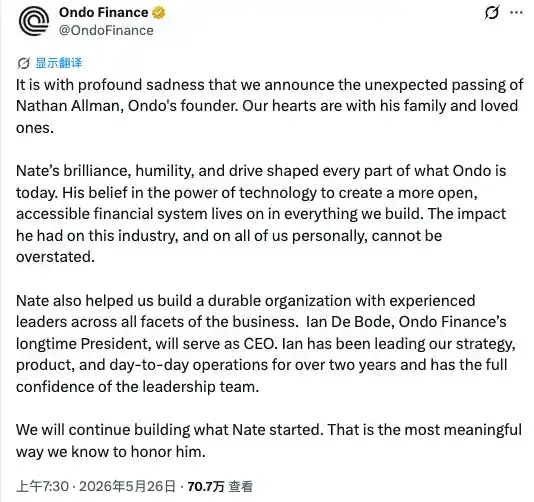
Nathan Allman, the founder and CEO of Ondo Finance, has passed away unexpectedly.
For the RWA (Real World Assets) sector, Nathan Allman was not just a front-facing founder spinning stories. He was one of the core drivers who propelled Ondo from DeFi structured yield products towards the tokenization of US treasuries, dollar-denominated yield assets, stocks, and ETFs. In a sense, when the market today discusses ONDO as the "first tokenization target," a significant part of that narrative stems from the product roadmap and institutional story that Nathan Allman consistently built over the past few years.
According to Ondo Finance's official announcement, Nathan Allman passed away unexpectedly, with the specific cause of death not yet disclosed. Ondo also stated that the company's President, Ian De Bode, will assume the role of CEO. The official announcement specifically mentioned that Nathan's talent, humility, and execution shaped today's Ondo, and the company will continue to advance the work he pioneered.
Nathan Allman was not a typical pure-crypto entrepreneur. He graduated from Brown University, had early experience in private credit investing, and later worked in Goldman Sachs's digital asset team. It was precisely this background that gave Ondo a strong traditional finance DNA from the start: its goal was not to create a DeFi protocol completely detached from the real-world financial system, but rather to repackage the most mature and liquid assets from traditional finance into products that can be held, transferred, combined, and settled on-chain.
In its early days, Ondo was not the RWA leader as we know it today. Back in 2021, Ondo was more like a DeFi structured yield protocol, designing different yield tiers for users with varying risk appetites.
Later, as the on-chain yield environment changed and the demand for stablecoin and US treasury yields grew, Ondo's path became clearer: instead of recreating high-risk yields on-chain, it was better to bring the most stable, largest, and most institutionally acceptable assets from the off-chain world on-chain.
This strategic pivot marked the true beginning of Ondo's entry into the mainstream spotlight.
OUSG, USDY, and Ondo Global Markets essentially constitute the three main pillars of Ondo today. OUSG targets accredited investors, providing on-chain exposure to short-term US treasuries and money market-type assets. USDY is more akin to a US dollar yield product for non-US investors. Ondo Global Markets further tokenizes US stocks and ETFs, allowing investors outside the US to gain exposure to traditional securities markets on-chain.
In other words, Ondo's narrative is not simply about "putting US treasuries on-chain." What it truly aims to do is transform Wall Street assets into foundational building blocks that the crypto world can utilize. Stablecoins solve the problem of US dollar circulation on-chain, while Ondo seeks to address how US dollar assets, US treasury yields, and securities exposure can enter the on-chain financial system.
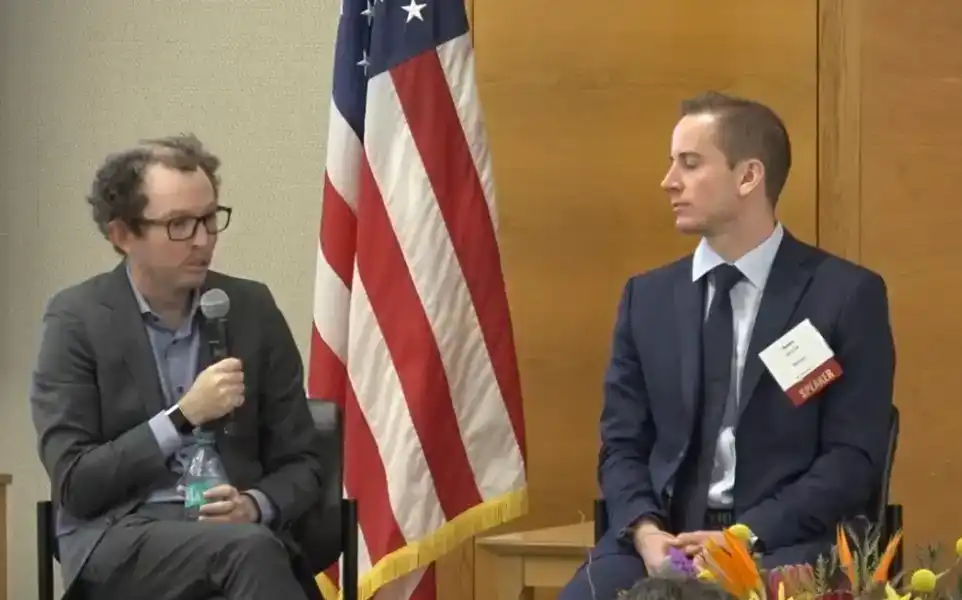
Nathan Allman speaking at the 9th Annual FinTech Conference in Philadelphia in November. Source: YouTube
This also defines Nathan Allman's position within the RWA sector. He did not represent the most aggressive crypto-native route, but rather another path: enabling traditional financial assets to accept on-chain settlement, and allowing on-chain markets to access traditional financial assets. Over the past two years, RWA has been able to re-emerge from an old concept into a mainline narrative, not by empty slogans of "tokenizing everything," but because products like US treasury yields, money market fund tokens, and stock tokenization began to have genuine demand, scale, and compliant pathways. Ondo is one of the most typical projects in this regard.
So, will Nathan Allman's passing affect Ondo?
In the short term, the impact is inevitable. The sudden loss of a founder is a significant event for any project, especially one like Ondo, which heavily relies on institutional partnerships, regulatory communication, and long-term product roadmaps. The market's immediate concerns will likely revolve around three questions: First, whether the founder's vision can still be continued. Second, whether institutional partners will reassess their collaboration pace. Third, whether ONDO, as a tokenization narrative asset, will be re-priced due to the departure of its key figure.
However, in the medium to long term, Ondo is not a project sustained solely by the personal brand of a single founder. Over the past few years, it has built a relatively comprehensive product matrix and assembled a management team with strong traditional finance backgrounds. Particularly, the new CEO, Ian De Bode, is not an unfamiliar outsider parachuted in temporarily, but a key figure within Ondo who has long been responsible for strategy, products, and daily operations.
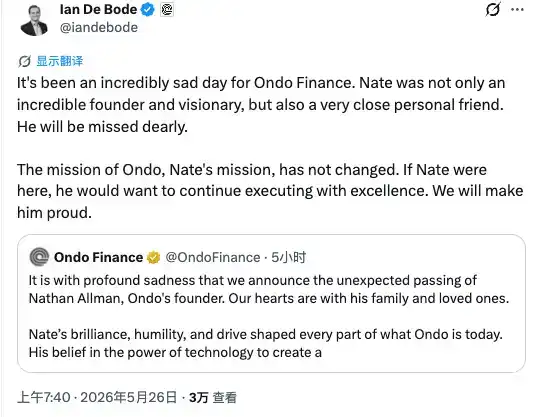
New CEO Ian De Bode posted in remembrance of Nathan Allman
Ian De Bode was previously a partner at McKinsey & Company, where he led its digital assets-related business. After joining Ondo in 2024, he first served as Chief Strategy Officer before becoming President. Ondo's announcement also noted that Ian has led the company's strategy, products, and daily operations for over two years and has the full support of the management team.
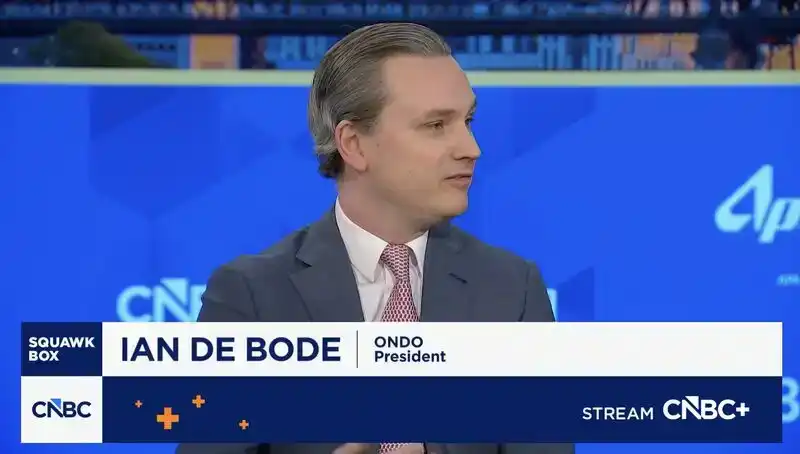
Lan De Bode introduces ONDO on CNBC
Based on their profiles, Ian De Bode and Nathan Allman share similarities: neither came from a purely crypto background; both entered the digital asset industry from traditional finance, consulting, and institutional service systems. Nathan was more of a product and vision-oriented founder, responsible for building Ondo from zero to its current position. Ian leans more towards institutional strategy and execution, familiar with the real demands of large corporations, financial institutions, and senior executives regarding tokenization.
This might be particularly crucial for the next phase of Ondo's journey. The first half of RWA was about narrative and product validation; the second half will inevitably focus on compliance, distribution, liquidity, and institutional partnerships. Whoever can scale asset size, connect brokers, custodians, market makers, public chains, wallets, and trading scenarios, has a chance to turn "tokenization" from a concept into market infrastructure. Ian De Bode's background aligns more closely with the requirements of this phase.
Of course, this doesn't mean Ondo is without risks. ONDO holders need to clearly distinguish one thing: the growth of Ondo's product scale does not automatically equate to the ONDO token receiving direct revenue share. ONDO primarily carries governance, ecosystem, and RWA narrative premium, not the US treasury yields themselves. When the market labels it the "first tokenization target," what's being bought is Ondo's representativeness and growth expectations within the RWA sector, not a direct claim on the cash flows of assets under Ondo's management.
Therefore, Nathan Allman's passing is also a stress test for Ondo. It tests whether this project is merely a founder-driven narrative or has evolved into a set of financial infrastructure capable of sustainable operation.
If Ian De Bode can maintain the product momentum, sustain institutional partnerships, and continue to drive the expansion of Ondo Global Markets, USDY, and OUSG, then the short-term emotional impact may gradually be absorbed by business continuity.
However, if subsequent product development slows down, institutional collaboration voices weaken, or the market begins to question ONDO's value capture capabilities, then this event could also become a node for re-evaluating valuations and the narrative.
For the RWA sector, Nathan Allman's passing is a loss. What he truly leaves behind is not just the Ondo project itself, but a clearer path: the crypto industry doesn't necessarily have to create new assets on-chain; it can also bring the world's largest and most mature financial asset markets into the on-chain world. Whether ONDO can continue to hold the position of the "first tokenization target" will depend not on words of mourning, but on whether the new team can continue to deliver products, asset scale, and genuine demand.