Solana network validators narrowly approved a proposal to double the annual rate of disinflation on the network.
After Kraken changed its position from 'for' to 'against' in the final hours, it managed to surpass the two-thirds vote threshold, edging out the closest competitor by just 0.33 percentage points.
Supply Issuance Will Reach Its Minimum of 1.5% in 2.8 Years
Bill SGP-0002 "Double Disinflation" was passed with 67% votes in favor, against 25.16% opposed, and 7.84% abstaining, with a turnout of 60.7% of eligible voters. Support was just above the required 66.67% threshold for the bill to pass.
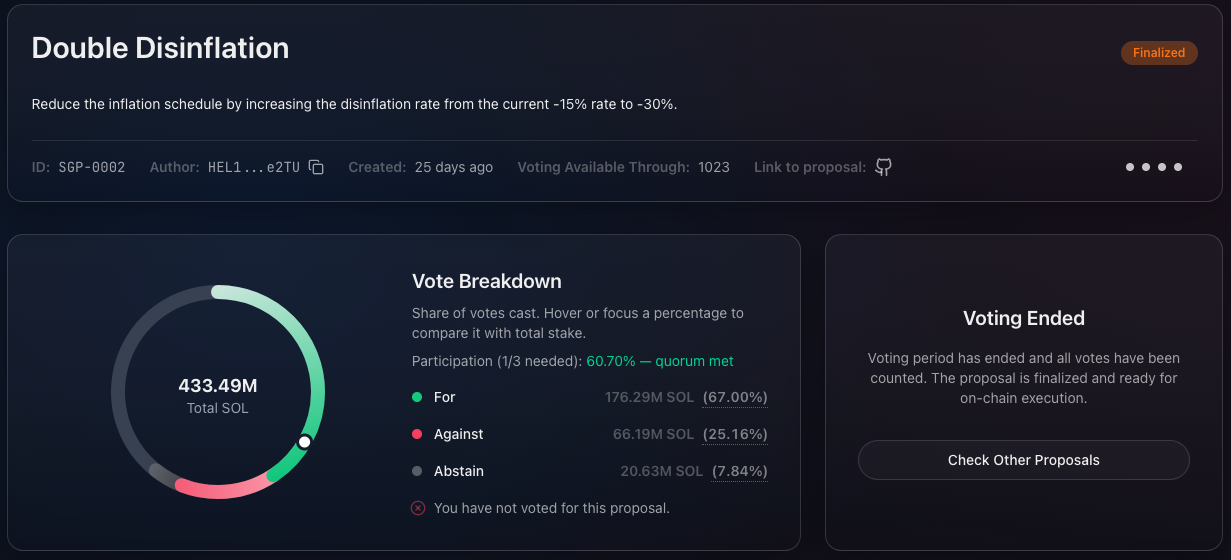
Both supply proposals were rejected by Kraken at 12:33 UTC on August 28. This pushed SGP-0002 below the supermajority threshold less than three hours before the vote tally closure at 15:00 UTC for epoch 1024.
Earlier that morning, support stood at 68.77%, with about 47.72% of eligible voters having participated. Kraken's vote against dropped support to roughly 65%.
Kraken then switched its position again. By the close, the proposal received support from over 90% of the US exchange's participants, who hold approximately 8.9 million $SOL voting shares.
The plan, related to SIMD-0550, involves doubling Solana's annual disinflation rate from 15% to 30%, while keeping the network's long-term target inflation rate at 1.5%.
Under the old scenario, Solana would have reached its final level of 1.5% in about 5.7 years, but now it will happen in about 2.8 years. This means that over the next six years, 18.9 million fewer $SOL will enter circulation from bond issuance.
The upside is less dilution for $SOL holders, but the downside is lower staking rewards for validators and delegators.
Figment Staked 17.1 Million $SOL Solely Against SGP-0002
Figment, which had 17.1 million $SOL in the final governance data, voted against the proposal, while Helius and Jupiter voted in favor. Other notable custody and staking firms opposed at least SGP-0002, including Everstake and P2P Validator.
Since depository operations are paid from the issuance of new $SOL, faster disinflation means a quicker decline in annual percentage yield (APY) and less cash flow.
"This logic is nonsense," said Mert Mumtaz, CEO of Helius and co-author of the proposals, in a post on X. He said any price increase due to slower supply growth would outweigh the foregone profits.
Solana , listed on Nasdaq under the ticker HSDT, stated support for the Solana Constitution on August 21 but opposed both supply increase proposals. In the firm's view, revising the inflation schedule undermines the multi-year models used by institutional investors.
SGP-0002 was part of Solana's first mandatory governance process. The Solana Constitution, SGP-0001, was passed with support from 85.97% of voters.
SGP-0003 did not garner support at 53.90%. The fee change under SIMD-0553 would have resulted in transactions paying for reserved compute power, with a portion of those funds being burned.
Rejection of the proposal means the $SOL burn rate will remain at around 650 $SOL per day. This contrasts with the 7,500–9,000 $SOL – roughly $800,000 daily at current prices – that could have been burned under the fee change.
According to CoinGecko, the price of $SOL was around $104, down about 5.2% for the day.
Both rejected supply proposals can be resubmitted without any waiting period. However, proponents will have to convince stakeholders who have already publicly voiced their objections.
end-content