Bitcoin Outperforms Stocks and Correlates with Gold Precisely When It Matters Most

cryptonews.ruPublished on 2026-08-29Last updated on 2026-08-29

Abstract

The price of Bitcoin surged 26% this month to around $79,200, outperforming gold (up 13.8%) and major stock indices. More importantly, its 30-day correlation with gold has risen to +0.81, indicating strong tandem movement, while its correlation with the US Dollar Index has deepened to -0.86, showing it moves opposite to the dollar. This highlights Bitcoin's appeal as a store of value and a hedge against fiscal and monetary concerns. Amid worries over the U.S. budget situation, which pushed long-term Treasury yields to multi-decade highs, traders anticipate the Federal Reserve may need to intervene by buying bonds. Bitcoin's price chart shows a bullish shift, with the 50-day moving average rising above the 100-day line and approaching a potential "golden cross" with the 200-day average. This suggests further price gains, though immediate resistance is seen around $82,814. The inability to sustainably hold above $80,000 this week indicates a possible deeper pullback before the next upward move.

The price of the cryptocurrency rose 26% this month, recently standing around $79,200. Meanwhile, gold gained 13.8%, while the Nasdaq 100 and S&P 500 indices added 4.8% and 3.2% respectively. Both hard assets lagged earlier this year but are now rising faster than stocks, which already hit record highs following strong gains in 2026.

More importantly, TradingView data shows the 30-day correlation of $BTC with gold has risen to +0.81, indicating a strong tendency for these two to move in tandem. Conversely, its link with the dollar index has deepened to -0.86, a sign it's moving opposite the US dollar. At the same time, $BTC's connection to the Nasdaq has weakened.

The leading price action combined with positive correlation to gold and negative correlation to the DXY highlights bitcoin's appeal as a store of value and a hedge against fiscal and monetary recklessness.

Concerns about the US budget situation recently pushed long-term Treasury yields, which influence borrowing costs across the economy, to their highest since 2007. Last week, the US Treasury announced a bond buyback plan aimed at taming yields, an approach best described as a half-measure that avoids taking real steps like spending restraint.

As a result, market expectations have emerged that the Fed will have to intervene and buy tons of bonds to cap yields.

Traders will listen for comments from [Warsh - presumably a Fed official's name based on context, but transliterated from Russian 'Уорша'. The original likely refers to Kevin Warsh. It's left transliterated here as per translation instruction.] regarding inflation and interest rates. However, his preference for minimal forecasting makes any significant statements unlikely.

Stay alert!

Today's Signal
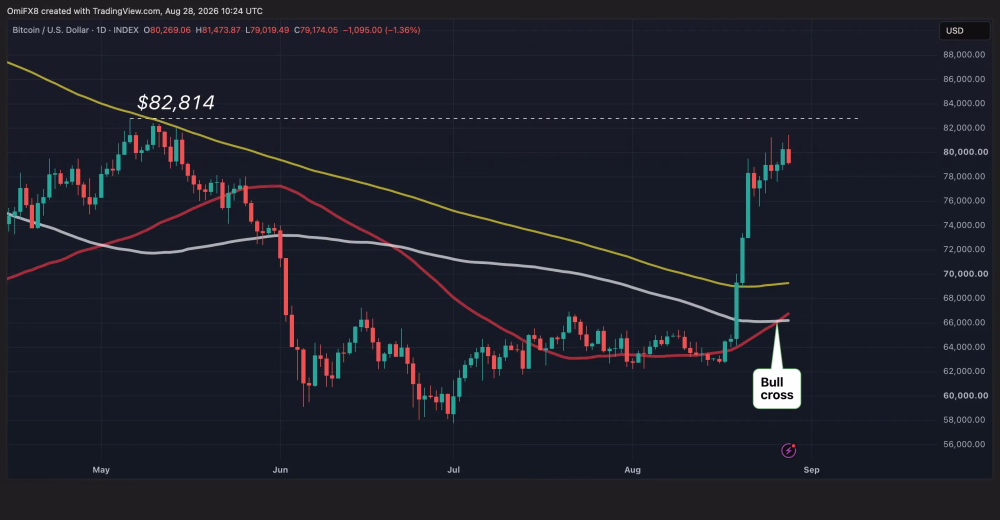
Chart of $BTC price with key moving averages. Source: TradingView.

The chart shows daily bitcoin price fluctuations in candlestick format. The red, white, and yellow lines represent the 50, 100, and 200-day simple moving averages.

The 50-day average has risen above the 100-day line, confirming a bullish shift in short-term momentum. More importantly, the 50-day SMA is rising and could soon cross the 200-day level, forming a Golden Cross, a widely-watched indicator of a long-term bullish trend.

These patterns suggest a continuation of price growth ahead. The chart also shows that the next major resistance is at the $82,814 peak reached in May. However, prices have repeatedly failed to hold above $80,000 this week. This indicates the possibility of a deeper pullback before the next leg up.


Related Questions

QWhat assets are specifically mentioned in the article as performing better than stocks in the current period?

ABitcoin and gold are mentioned as performing better than the stock indices (Nasdaq 100 and S&P 500) in the current period, with Bitcoin up 26% and gold up 13.8% for the month.

QAccording to the TradingView data cited, what is the current correlation between Bitcoin and gold, and what does this figure indicate?

AThe 30-day correlation between Bitcoin and gold has risen to +0.81. This indicates a strong tendency for the two assets to move in tandem or in the same direction.

QWhat does the article suggest is a key factor driving Bitcoin's appeal as highlighted by its performance correlations?

AThe article suggests Bitcoin's appeal is driven by its performance as a store of value and a hedge against fiscal and monetary recklessness, particularly in the U.S., as indicated by its positive correlation with gold and negative correlation with the U.S. Dollar Index (DXY).

QWhat upcoming technical price pattern is the chart analysis expecting for Bitcoin, and what is a potential near-term price obstacle?

AThe analysis expects a potential "golden cross" where the 50-day SMA rises above the 200-day SMA, indicating a long-term bullish trend. A near-term obstacle is the resistance at $82,814, with prices struggling to sustain above $80,000, suggesting a possible deeper pullback.

QWhat U.S. economic concern is linked to the recent surge in long-term Treasury yields, and what market expectation has this created regarding the Federal Reserve?

AConcerns about the U.S. budget situation are linked to the surge in long-term Treasury yields to their highest since 2007. This has created market expectations that the Federal Reserve may have to intervene and buy bonds to limit these yields.

Related Reads

How Can Bitcoin Resist Quantum Computers? A Comparative Analysis of Three Lattice-Based Signature Schemes

This report from Blockstream Research analyzes three lattice-based signature schemes as quantum-resistant candidates for Bitcoin, focusing on Dilithium, Falcon, and the now-withdrawn Hawk. Core evaluation criteria include on-chain costs (combined size of public key and signature), implementation complexity, deployment risks, and potential for integration with Bitcoin's existing infrastructure like BIP-32 hierarchical deterministic wallets. Key Findings: * **Dilithium** is praised for its design simplicity, using only integer operations, making secure implementation easier. However, it has the largest size (5,261 bytes for security level 3). * **Falcon** offers the most compact signatures and the fastest verification. Its main drawback—platform-dependent floating-point operations in signing—can be mitigated with a slower, deterministic integer-based implementation. The report recommends **Falcon-1024** (security level 5) for its safety margin. * **Hawk**, which aimed for a better balance, was withdrawn after a cryptographic attack revealed a structural flaw that halved its estimated security. The report concludes that Falcon-1024 is the most suitable lattice-based choice for Bitcoin, pending the finalization of its NIST FN-DSA standard. In the short term, it still recommends hash-based signatures (like SPHINCS+) as a lower-risk transitional solution, with future hybrid deployments as a possibility.

marsbit3m ago

How Can Bitcoin Resist Quantum Computers? A Comparative Analysis of Three Lattice-Based Signature Schemes

marsbit3m ago

Ripple (XRP) Company Announces Plans for Major Future Update

Ripple (XRP) has announced a four-phase plan to prepare the XRP Ledger (XRPL) for future security threats posed by quantum computers. The company's senior director of engineering stated the goal is to build necessary infrastructure before quantum computers become a direct threat, aiming to minimize impact on existing systems, user assets, and network operations. The plan begins with identifying potential quantum vulnerabilities within XRPL, followed by testing quantum-resistant cryptographic methods. The next phase involves parallel testing of existing security mechanisms and new quantum-resistant solutions to ensure reliability and prevent disruption for users and applications. The final phase would involve transitioning the XRPL to more comprehensive, quantum-resistant security standards if the technology matures. Ripple is also developing contingency plans for a faster-than-expected advancement of quantum computing, which could accelerate the transition timeline. A current XRPL feature allowing users to change the keys controlling their accounts without altering the accounts themselves is seen as a potential advantage in any future migration. However, Ripple cannot unilaterally change transaction validation rules or network-wide cryptographic standards; such updates require coordination and approval from independent validators via XRPL's governance process. While quantum computers are not yet capable of breaking the cryptography used by major blockchains like Bitcoin or XRPL, developers across the industry are already evaluating transition scenarios to quantum-resistant algorithms due to the long-term risks they pose to public-key cryptography.

cryptonews.ru1h ago

Ripple (XRP) Company Announces Plans for Major Future Update

cryptonews.ru1h ago

Trading

Spot
活动图片