With 300 Million Financing to Accumulate ETH, the Hidden Concerns Behind BitMine's High-Yield Preferred Shares

Foresight NewsPublished on 2026-06-05Last updated on 2026-06-05

Abstract

BitMine, led by Thomas Lee, plans to raise up to $300 million through an initial public offering of 3 million shares of perpetual Series A preferred stock on the NYSE (ticker: BMNP). The stock offers a fixed 9.5% annual dividend. The funds are intended to further the company's accumulation of Ethereum, expand its staking node operations, and for general corporate purposes. This move comes as BitMine faces significant challenges. Its massive Ethereum holdings, over 5.3 million ETH (roughly 4.5% of circulating supply), are currently at an unrealized loss exceeding $8.5 billion due to the crypto market downturn. The company's core business model relies on staking these ETH holdings to generate yield, which it presents as the primary means to cover the new, substantial annual dividend obligation of approximately $28.5 million if the offering is fully subscribed. While the model is similar to MicroStrategy's bitcoin-focused strategy of using capital markets to fund crypto acquisitions, BitMine's product differs with its fixed, non-adjustable dividend rate. The company acknowledges risks, stating dividend payments could also come from cash reserves, asset sales, or future financing, and warns that staking yields may underperform or be illiquid during market stress. The 9.5% fixed rate reflects the higher risk premium demanded from investors for a company heavily exposed to Ethereum's volatility.


Written by: Oluwapelumi Adejumo

Compiled by: Saoirse, Foresight News


Key Points at a Glance


  • BitMine plans to issue 3 million perpetual Class A preferred shares to raise up to $300 million for Ethereum position deployment.
  • The 9.5% annualized dividend will provide the company with new funds for token purchases and staking node expansion, but will also incur approximately $28.5 million in annual new dividend costs.
  • The company's unrealized loss on its Ethereum holdings exceeds $8.5 billion; if staking yields fall short of expectations, dividend payments may rely on internal cash, asset sales, or subsequent refinancing.


Led by Thomas Lee, BitMine intends to raise funds through the preferred stock market, leveraging a fixed 9.5% annualized dividend to attract capital for increasing its Ethereum exposure. The company disclosed the plan on June 3rd: issuing 3 million Class A perpetual preferred shares with a face value of $100 and a fixed annual dividend of 9.5%, aiming to raise up to $300 million. Once approved, the securities will be listed on the New York Stock Exchange under the ticker BMNP, with Moelis & Company and Cantor acting as joint book-running managers.


If all shares are sold, the company's annual dividend obligation will increase by $28.5 million, payable weekly following board approval. This fundraising comes at a time when this heavily Ethereum-weighted company faces a severe test for its business model: dragged down by persistently low token prices, Ethereum's market price is far below the company's average cost basis, with BitMine's unrealized losses on related holdings exceeding $8.5 billion.
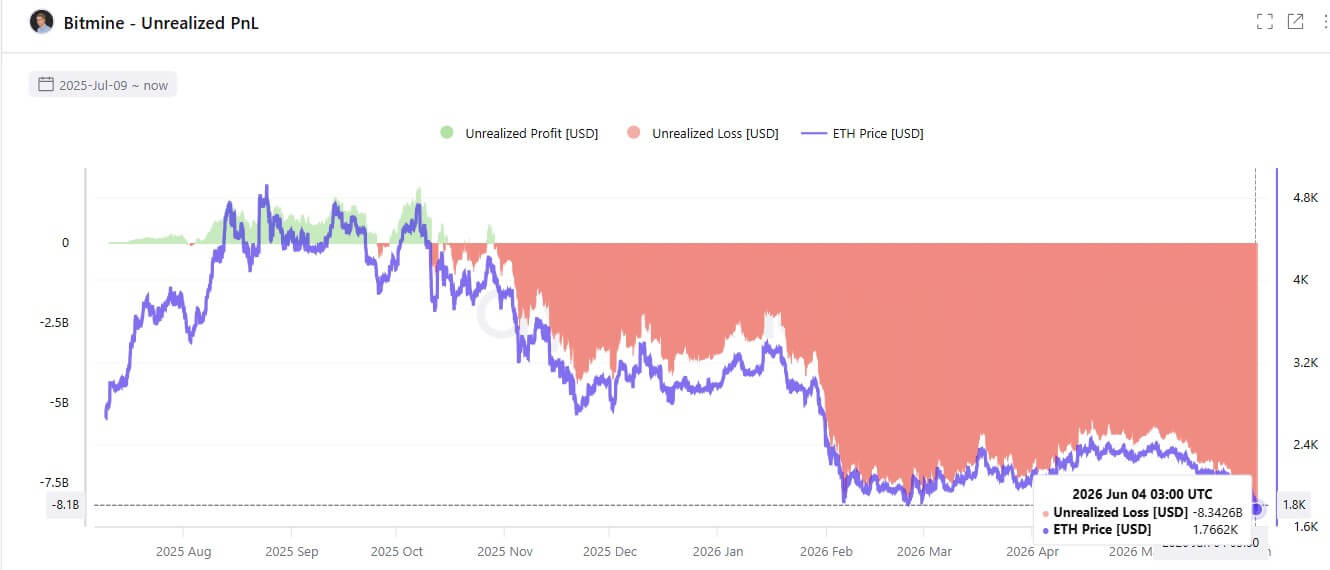

Unrealized Loss on Ethereum Assets Held by BitMine (Data Source: CryptoQuant)


This financing will further tie the company's balance sheet, staking operations, and public market investors, helping the company continue accumulating Ethereum at low prices.


Relying on Ethereum Staking Yields to Support the Dividend Logic


BitMine stated that the proceeds can be used for general corporate purposes: increasing holdings of Ethereum and other digital assets, expanding staking validator nodes, supplementing operational working capital, making strategic investments in the Ethereum ecosystem, and repurchasing its own common stock. This fundraising is not only for patching up book losses but also aids the company in continuously accumulating tokens during the bear market, solidifying its position as a leading publicly listed Ethereum treasury company globally.


Over the past year, the company has consistently made large-scale purchases of Ethereum, currently holding over 5.3 million tokens, accounting for approximately 4.5% of Ethereum's circulating supply; the vast majority of these holdings are in a staked state, continuously earning on-chain block rewards.
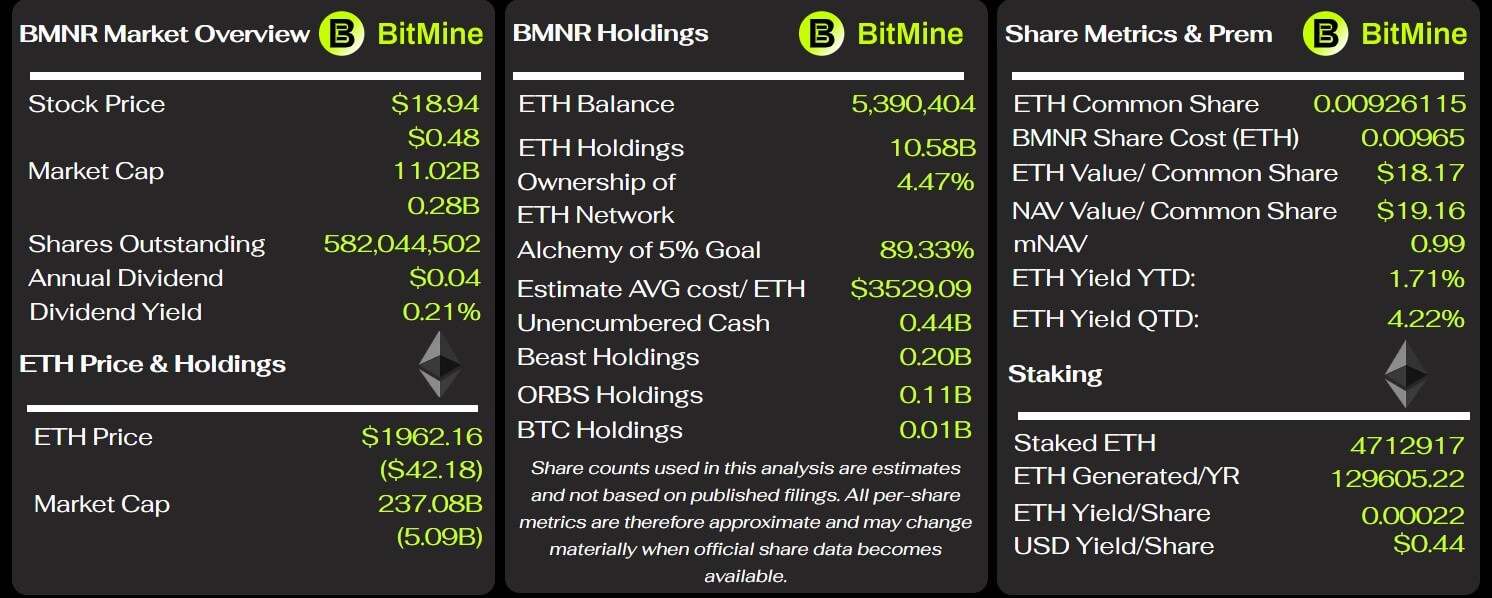

BitMine Key Metrics (Data Source: BitMineTracker)


Chairman Thomas Lee posited that yield generation through staking is the core advantage of Ethereum treasury companies compared to Bitcoin-heavy counterparts. Bitcoin cannot generate passive income, but Ethereum can continuously profit through staking, allowing holders to obtain cash flow without selling the principal. This income logic forms the fundamental support for this preferred share issuance: with the full $300 million raised, weekly dividend expenses amount to approximately $548,000. BitMine disclosed its annualized staking yield reaches hundreds of millions of dollars; under normal market conditions, the dividend cost is far lower than the income generated from staking.


Research by staking service provider Everstake shows: in 2025, among all publicly listed Ethereum treasury companies in the industry, staking income accounted for 60% of total disclosed revenue, indicating that monetizing staking has become the mainstream profit model in the sector. Industry data corroborates that BitMine's business model of using Ethereum-generated yield to cover fixed dividends shares common industry characteristics.


The company is not merely hoarding and locking tokens but is transforming its massive Ethereum reserves into sustainable cash flow to access capital market financing. However, as seen in the offering documents, this model is not without risks.


BitMine has not established a dedicated staking yield fund pool for preferred share dividends. The document states that dividend payments may be sourced from the company's internal cash, staking profits, sales of held securities, subsequent refinancing, or other channels. The company also warns of extreme market risks: staked Ethereum cannot be instantly redeemed and liquidated during market stress periods, and staking yields may fall short of expectations. Essentially, the preferred share issuance converts BitMine's Ethereum investment position into a rigid, regular cash payment obligation.


Benchmarked Against the Strategy Model, but Product Terms Show Significant Differences


BitMine's financing approach is benchmarked against Michael Saylor's Bitcoin-heavy Strategy: both companies rely on issuing listed preferred shares to raise funds, using public market capital to continuously accumulate tokens and optimize capital structure; by creating income-generating securities, they allow ordinary investors to gain exposure to the crypto treasury sector without directly holding the tokens. Both face the market risk of severe underlying asset price volatility and the rigid payment obligation of fixed dividends.


However, the rules of the two preferred share products differ markedly: Strategy's issued STRC preferred shares are floating-rate products, with dividends adjusted monthly to stabilize the share price close to the $100 face value; BitMine's Class A preferred shares feature a fixed 9.5% annualized rate, payable weekly upon resolution, lacking a floating rate adjustment mechanism to stabilize the share price. If BitMine fails to pay dividends on time, unpaid interest accrues weekly on a compound basis, with a penalty interest cap of 15% per annum.
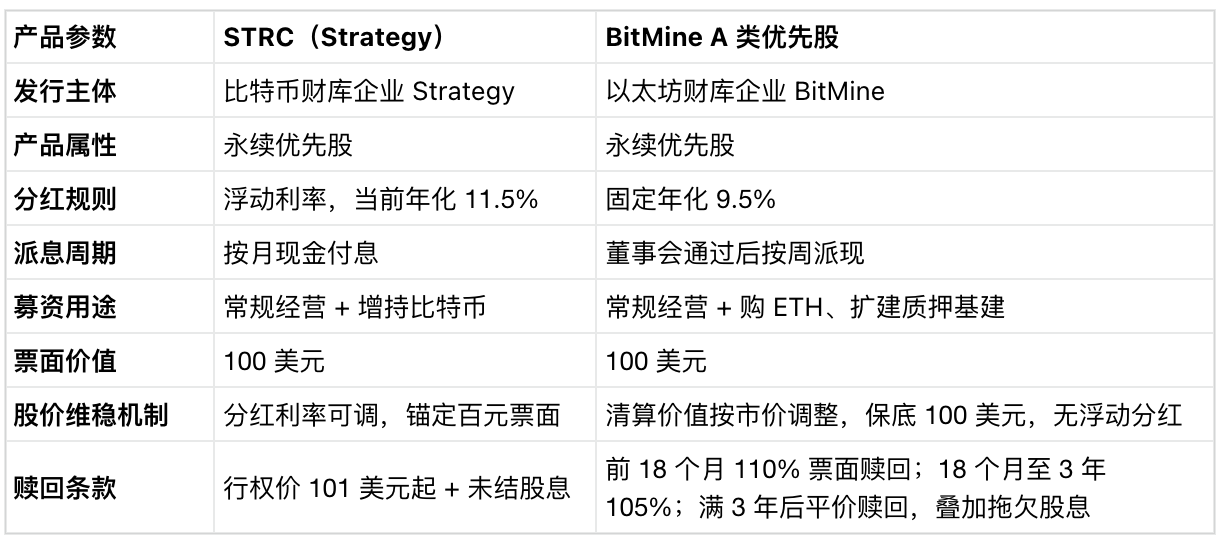


The liquidation reference price for these preferred shares is initially $100, dynamically adjusted according to a market price formula, with a floor not lower than the face value; redemption includes investor put rights triggered by change of control events.


The fixed 9.5% annualized dividend payout can attract fixed-income investors but also reflects the higher risk premium required for financing by companies heavily exposed to Ethereum assets in a bear market environment.


Related Questions

QWhat is BitMine's main purpose in issuing up to $300 million in perpetual preferred stock?

ABitMine aims to raise capital to further expand its Ethereum holdings, scale its staking node operations, and reinforce its position as a leading public Ethereum treasury company.

QWhat is the key risk associated with BitMine's preferred stock offering according to the article?

AThe key risk is the company's obligation to make fixed 9.5% annual dividend payments. If staking yields are insufficient, BitMine may need to cover the payments using its own cash, selling assets, or seeking further financing, creating a rigid cash outflow burden.

QHow does BitMine's business model for the preferred stock differ from MicroStrategy's approach with Bitcoin?

AWhile both use preferred stock to fund crypto acquisitions, MicroStrategy's STRC stock has a floating dividend rate adjusted monthly to stabilize its price. BitMine's offering has a fixed 9.5% annual dividend paid weekly, without a similar price-stabilizing mechanism.

QWhat is the current financial challenge BitMine faces with its Ethereum holdings mentioned in the article?

ABitMine is facing significant unrealized losses on its Ethereum holdings, exceeding $8.5 billion, as the current market price is substantially below its average purchase cost.

QWhat is the primary source of revenue that BitMine plans to use to support the dividend payments for the preferred stock?

AThe primary planned source is the staking rewards generated from its massive Ethereum holdings, which it states generates hundreds of millions in annual yield. However, dividends can also be paid from other sources like cash, asset sales, or future financing.

Related Reads

How Risky is the "Death Spiral" of MSTR and STRC?

Summary: This article explores the perceived "death spiral" risk between MicroStrategy (MSTR), its Bitcoin holdings, and its perpetual preferred stock (STRC), drawing comparisons to the LUNA-UST collapse. While both systems feature price anchors, high yields for holders, and potential feedback loops, their core mechanisms differ fundamentally. The MSTR-STRC structure relies on continuous financing to sustain its high dividend payouts, primarily through stock ATM offerings. A negative feedback cycle could occur: falling MSTR stock price makes raising equity capital harder, increasing pressure to sell Bitcoin, which undermines STRC confidence and further depresses MSTR. However, unlike LUNA-UST's automated, direct linkage, the MSTR-STRC loop is weaker and has brakes: STRC dividends can be deferred or rates lowered, and STRC holders have a $100/share liquidation preference in bankruptcy, providing a price floor. The company's sustainability hinges on its ability to continue financing. Its current ~$900 million USD reserves cover only about 6.3 months of its ~$1.71 billion annual interest/dividend burden. The next six months are critical, aligning with both the potential bottom in Bitcoin's four-year cycle and the depletion timeline of its reserves. While a LUNA-style catastrophic collapse is deemed highly unlikely due to structural differences, the key question is whether MicroStrategy can navigate this period through healthy deleveraging to restart its capital engine.

Foresight News8m ago

How Risky is the "Death Spiral" of MSTR and STRC?

Foresight News8m ago

How Much Debt Does Strategy Really Have? Is There a Risk of Implosion?

MicroStrategy's Debt Risk: A Turning Point in the "Never Sell" Strategy As of June 3, 2026, MicroStrategy holds 843,706 bitcoins (valued at ~$53.1B) but faces significant financial obligations. Its capital structure includes $6.75B in convertible notes and $15.48B in perpetual preferred stock (led by the $8.5B STRC series), creating an annual payout burden of ~$1.71B. With software revenue at only ~$500M, interest and dividend obligations far exceed operating income. A critical shift occurred in late May 2026 when the company sold 32 bitcoins for ~$2.5M to cover dividends, breaking CEO Michael Saylor's long-standing "never sell" pledge. This symbolic move triggered a sharp decline in both Bitcoin's price and MSTR stock, reflecting market fears about cash flow sustainability. The core of the strain is the STRC perpetual preferred stock, designed as a "permanent loan" with no maturity date but requiring high monthly dividends (currently 11.5%). Its business model relies on a three-part cycle: issuing new STRC shares, using proceeds to buy more Bitcoin and fund a USD reserve, and using that reserve to pay dividends. This cycle depends on continuous investor demand for STRC and Bitcoin's price appreciation. Analysis shows Bitcoin needs to appreciate at least 2.3% annually to cover the $1.71B in yearly obligations at current holdings. With Bitcoin price down ~22% from March 2026 highs, this pressure has intensified. The company's $900M USD reserve can only cover about 7 months of payments if STRC issuance stalls. Key risks are not immediate bankruptcy or forced Bitcoin liquidation (as BTC is not collateral), but rather: 1) The erosion of MSTR's premium to its Bitcoin holdings (mNAV), which would cripple its ability to raise cheap capital; 2) A vicious cycle where stagnant Bitcoin prices reduce STRC demand, draining the USD reserve and forcing BTC sales, further depressing prices. The period from February 2027 to September 2028 is a crucial test, with over $5.9B in convertible notes facing put options or maturity. In essence, MicroStrategy has evolved from a simple Bitcoin holder into a complex financial entity acting like a "private Bitcoin bank," leveraging its BTC holdings to create layered financial products. Its survival depends on maintaining Bitcoin's price trend, its stock premium, and market appetite for its preferred shares. The recent token sale marks not a betrayal of its Bitcoin thesis, but an admission that the leveraged strategy must eventually be paid for.

marsbit19m ago

How Much Debt Does Strategy Really Have? Is There a Risk of Implosion?

marsbit19m ago

Anthropic Cries Wolf: Is the AGI Threat Real, or Just an IPO Story?

Anthropic has published an article titled "When AI builds itself," discussing the emerging concept of "recursive self-improvement," where AI begins to actively participate in designing, training, testing, and optimizing its own subsequent versions. The company presents internal data showing that by May 2026, over 80% of code merged into its codebase was written by Claude, its AI model. Claude's capabilities have expanded to handling complex, open-ended engineering tasks, achieving a 76% success rate in such areas, and even contributing to research processes, such as optimizing code performance and conducting AI safety experiments. Anthropic outlines an evolution from human-driven development to AI-assisted workflows, culminating in the current stage where AI agents can autonomously write, run, and delegate code. The company cautions that the path toward a "closed loop," where AI continuously improves itself, is becoming visible. It calls for coordinated global mechanisms to potentially slow or pause frontier AI development to allow safety research and societal structures to catch up. However, the timing of this warning coincides with Anthropic's preparations for an IPO, framing the narrative not just as a safety concern but also as a demonstration of Claude's advanced capabilities and its integral role in accelerating Anthropic's own R&D—creating a potential "flywheel" effect for competitive advantage. This contrasts with OpenAI's recent, more policy-oriented discussion of the same risks, highlighting the competitive dynamics in the AI industry as companies position themselves in both the technological and regulatory landscape.

marsbit1h ago

Anthropic Cries Wolf: Is the AGI Threat Real, or Just an IPO Story?

marsbit1h ago

Trading

Spot
Futures

Hot Articles

Discussions

Welcome to the HTX Community. Here, you can stay informed about the latest platform developments and gain access to professional market insights. Users' opinions on the price of S (S) are presented below.

活动图片