Franklin Templeton brings ETFs on-chain as Ethereum hosts over $13B in tokenized assets

ambcryptoPublished on 2026-03-25Last updated on 2026-03-25

Abstract

Franklin Templeton is launching two ETFs that can be traded directly through crypto wallets 24/7, marking a shift in how traditional financial products are accessed. One fund tracks the S&P 500, while the other focuses on short-term U.S. Treasuries. Both will be issued on Ethereum, enabling peer-to-peer trading without relying on traditional brokers or market hours. The move aligns with the growing tokenized real-world asset market on Ethereum, which has reached approximately $13.6 billion in value, with U.S. Treasury products making up the majority at $11.8 billion. The firm is collaborating with Ondo Finance to support the tokenized distribution of the funds.

Franklin Templeton is launching two exchange-traded funds that can be traded directly through crypto wallets around the clock. It marks a shift in how traditional financial products are accessed and settled.

The move brings equity and bond exposure onto blockchain rails, at a time when tokenized assets on Ethereum alone are approaching $13.6 billion.

The asset manager said the funds — one tracking the S&P 500 and another focused on short-term U.S. Treasuries — will be issued on Ethereum and available for trading 24/7.

Investors will be able to buy, sell, and hold shares using self-custody wallets, removing the need for traditional brokerage accounts and standard market hours.

Franklin Templeton is also working with Ondo Finance to support the tokenized distribution of the funds.

According to Bloomberg, the collaboration will allow the ETFs to trade in crypto wallets continuously, bypassing the brokerage infrastructure that has traditionally defined ETF access.

Franklin Templeton launches ETFs that trade directly in crypto wallets

The two ETFs are designed as fully on-chain products, allowing peer-to-peer trading without relying on centralized intermediaries.

While access through traditional brokers will still be supported, the core functionality shifts toward wallet-based ownership and transfer.

Franklin Templeton said the funds will operate under a hybrid structure, allowing shares to be created or redeemed in both fiat currency and stablecoins. This model is intended to bridge conventional financial systems with blockchain-based settlement.

The firm has already expanded its digital asset footprint in recent years. This includes the launch of an on-chain money market fund and is now extending that approach to broader asset classes.

How the funds work without brokers or market hours

Unlike traditional ETFs, which are limited by exchange trading hours and settlement timelines, the new funds are designed to function continuously. Transactions can occur at any time, with ownership recorded directly on-chain.

This setup reduces reliance on intermediaries and shortens settlement cycles, while giving investors direct control over their holdings through self-custody wallets.

The funds will also be compatible with platforms that support on-chain settlement, allowing participation from both crypto-native users and traditional investors.

Tokenized assets on Ethereum near $13.6B as Treasuries dominate growth

Franklin Templeton’s move comes as tokenized real-world assets continue to expand on Ethereum.

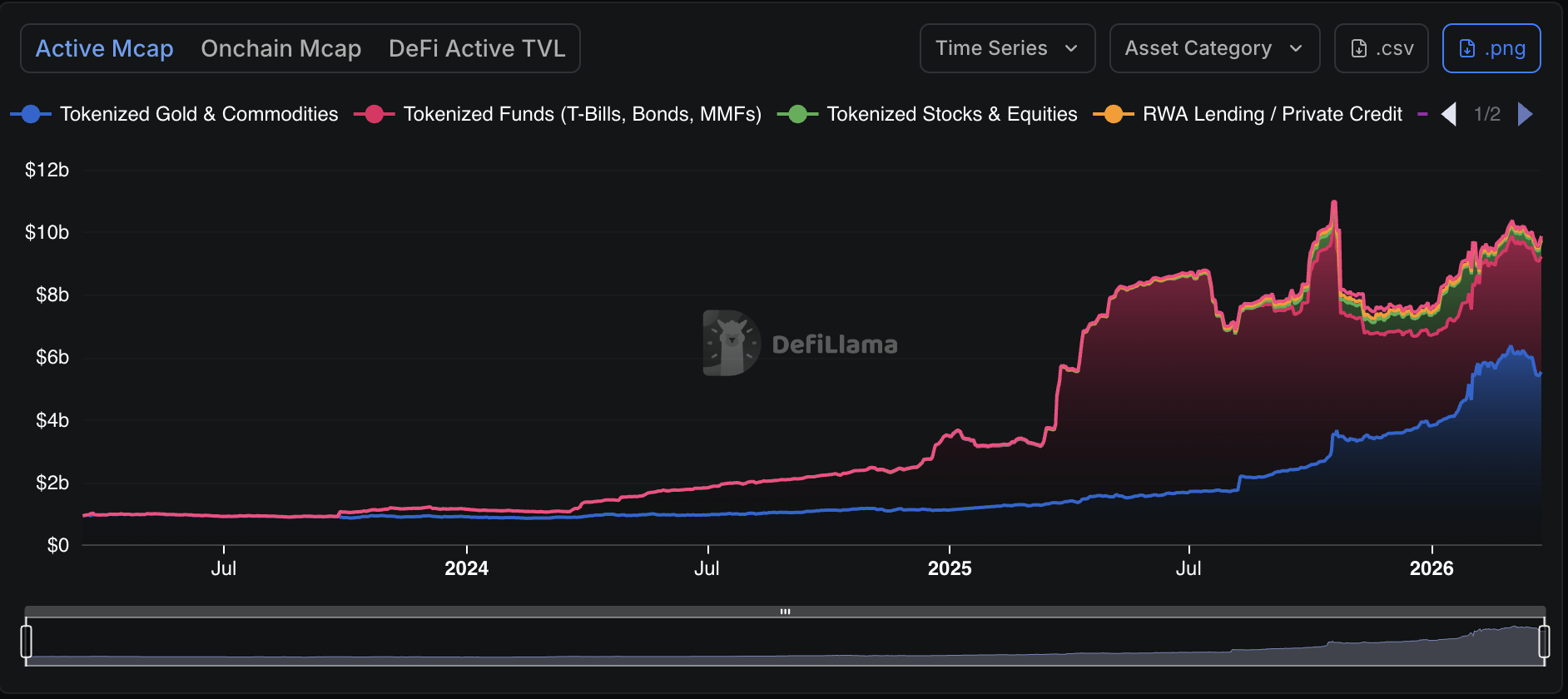
Data shows total on-chain RWA market capitalization on the network has reached approximately $13.6 billion. Also, around $9.86 billion is actively circulating across 36 issuers.
Source: DefiLlama

Within that market, tokenized U.S. Treasury products account for roughly $11.8 billion, making them the largest segment.

This aligns closely with Franklin Templeton’s decision to include a Treasury-focused ETF, suggesting the firm is targeting an already established demand base.

Growth has accelerated since 2024, with tokenized funds and credit products driving most of the expansion. The trend points to increasing institutional participation, as asset managers test blockchain-based distribution and settlement models.

The ETFs are expected to launch in the coming weeks, pending regulatory clearance.


Final Summary

  • Franklin Templeton’s ETFs shift trading from broker-led systems to wallet-based, 24/7 access on Ethereum.
  • The launch aligns with a $13.6B tokenized asset market where Treasuries already dominate demand.

Related Questions

QWhat is Franklin Templeton launching and on which blockchain?

AFranklin Templeton is launching two exchange-traded funds (ETFs) that can be traded directly through crypto wallets, and they are being issued on the Ethereum blockchain.

QHow do these new ETFs differ from traditional ETFs in terms of trading and settlement?

AUnlike traditional ETFs limited by exchange hours and settlement timelines, these new funds can be traded 24/7 with transactions settled directly on-chain, reducing reliance on intermediaries and allowing peer-to-peer trading.

QWhat is the total value of tokenized real-world assets on Ethereum mentioned in the article?

AThe total on-chain real-world asset market capitalization on Ethereum has reached approximately $13.6 billion.

QWhich type of tokenized asset dominates the current on-chain market, and what is its approximate value?

ATokenized U.S. Treasury products dominate the market, accounting for roughly $11.8 billion of the total tokenized assets on Ethereum.

QWho is Franklin Templeton collaborating with to support the tokenized distribution of these funds?

AFranklin Templeton is working with Ondo Finance to support the tokenized distribution of the funds.

Related Reads

The $290 Million Deficit: A Three-Way Game Between Aave, L0, and Kelp—Who Should Foot the Bill?

An incident involving the theft of 116,500 rsETH (worth approximately $290 million) from Kelp DAO’s cross-chain bridge contract has triggered a complex dispute over responsibility and compensation among Kelp DAO, LayerZero, and Aave. The attack occurred due to a compromised RPC provider used by LayerZero’s Decentralized Verifier Network (DVN). Since Kelp DAO’s bridge used a 1/1 DVN configuration—a single point of failure—the attacker successfully forged a cross-chain message, leading to the unauthorized release of rsETH tokens from the mainnet. These genuine tokens were then deposited into Aave and other lending platforms to borrow WETH, enabling the attacker to exit with the funds. Responsibility is attributed primarily to Kelp DAO for its risky 1/1 DVN setup. LayerZero bears secondary responsibility for permitting such a vulnerable configuration in its protocol layer. Aave also shares indirect blame for over-collateralizing rsETH and other Liquid Restaking Token (LRT) assets without adequate ongoing risk oversight. Kelp DAO lacks sufficient funds to cover the loss, shifting focus to the deeper-pocketed players: LayerZero, whose cross-chain ecosystem and reputation are at risk, and Aave, which faces massive bad loans and declining Total Value Locked (TVL). Aave has asserted that mainnet rsETH remains fully backed, implying it expects Kelp DAO to allow redemption of underlying ETH. This approach would preserve Aave’s mainnet positions but invalidate Layer2 rsETH, damaging LayerZero’s cross-chain credibility. Potential solutions include: - A universal 18.5% haircut on all rsETH holders, causing significant Aave bad debt. - Writing off Layer2 rsETH entirely, protecting Aave mainnet but harming LayerZero and Kelp DAO. - Negotiating a bounty with the hacker for partial fund return. - A joint bailout, possibly led by LayerZero’s ecosystem fund, given its long-term stake in the cross-chain ecosystem. The situation remains unresolved as the parties negotiate, but prolonged delay risks broader DeFi instability, including potential liquidity crises and loss of confidence in LRT and cross-chain infrastructures.

Odaily星球日报11m ago

The $290 Million Deficit: A Three-Way Game Between Aave, L0, and Kelp—Who Should Foot the Bill?

Odaily星球日报11m ago

Bitcoin's Bull-Bear Range Battle Continues, HYPE Faces Critical Test of Wave V Support | Exclusive Analysis

This market analysis covers Bitcoin (BTC) and HYPE, highlighting key levels and trading strategies for the week. HYPE is currently testing a critical support level at $40.17. A hold above this level could lead to consolidation between $40.17–$45.76, while a break below it may signal the end of its current V-wave uptrend from the April 2 low. The short-term strategy is to look for long entries near $40.17 if support holds, using 30% leverage and strict stop-loss discipline. Bitcoin is interpreted to be in a larger D-wave rebound from the February 6 low of $60,000, currently trading within a $73,500–$79,000 range. Key resistance lies at $79,000–$80,600 and $83,500–$84,500, with supports at $73,500, $69,500, and $65,000–$66,000. The medium-term strategy maintains a 60% short position from $89,000. Short-term tactics include selling into rallies near $76,500–$79,000 (Scenario A) or breaking below $73,500 (Scenario B), using 30% leverage. Last week, a 1x leveraged long trade in HYPE yielded a 6.80% gain, and the BTC short from $89,000 is currently up approximately 17.08%. Risk management is emphasized: set stop-losses at entry, move to breakeven at +1% profit, and trail stops to lock in gains thereafter. All views are based on technical analysis and are not investment advice. Traders are urged to exercise caution and adapt to market changes.

marsbit42m ago

Bitcoin's Bull-Bear Range Battle Continues, HYPE Faces Critical Test of Wave V Support | Exclusive Analysis

marsbit42m ago

Bitcoin's Bull-Bear Range Battle Continues, HYPE Faces Critical Test of Wave V Support | Invited Analysis

The market is experiencing directional uncertainty with both opportunities and risks. HYPE's daily V-wave structure is at a critical juncture, with the $40.17 support level being pivotal for its future trajectory. A break below this level, followed by an inability to surpass the recent high of $45.76, could signal the end of the current upward structure. The short-term strategy for HYPE is to "follow the trend and buy on dips," using a 30% position size and a 30/60-minute trading cycle, entering long upon confirmed support holds with model signals. Bitcoin's market structure is reinterpreted, with the rally from the $60,000 low now considered a larger D-wave rebound within a medium-term correction, facing a key test between $73,500 and $79,000. A break above the upper bound may lead to limited upside, while a drop below could see a decline toward $69,500. Core resistance lies at $79,000–$80,600 and $83,500–$84,500, with support at $73,500, $69,500, and $65,000–$66,000. The medium-term strategy maintains a 60% short position from $89,000, to be exited if price stabilizes above the multi-empty band. Short-term tactics involve 30% positions for "spread" opportunities, with two scenarios: selling on rallies near $76,500–$79,000 (Scheme A) or shorting on a breakdown below $73,500 (Scheme B), both with strict stop-losses. A复盘 of HYPE's recent short trade showed a 6.80% gain from a long entry at $41.59 (based on model buy signals) and exit at $44.42 (triggered by top signals). Key reminders include setting initial stops at entry, moving to breakeven at +1% profit, and trailing stops thereafter. All views are for reference only; market conditions change rapidly, and caution is advised.

Odaily星球日报49m ago

Bitcoin's Bull-Bear Range Battle Continues, HYPE Faces Critical Test of Wave V Support | Invited Analysis

Odaily星球日报49m ago

Strategy's 'Money Printer': Is STRC Bitcoin's Savior or Destroyer?

Bitcoin's recent price movement is being heavily influenced by Michael Saylor and his company, MicroStrategy, through a new financial instrument: STRC (Variable Rate Series A Perpetual Stretch Preferred Stock). This Nasdaq-listed perpetual preferred stock offers an 11.5% annual dividend, attracting significant capital. Crucially, funds raised from STRC are used to purchase Bitcoin, with a 3x leverage effect—for every $1 from STRC, MicroStrategy adds $2 from MSTR equity to buy $3 worth of BTC. This creates a powerful "flywheel": more STRC sales fuel massive BTC buying, supporting its price and improving MicroStrategy's credit, which in turn makes STRC more attractive to investors. However, this mechanism introduces risks. A significant "ex-dividend arbitrage" pattern has emerged, where traders buy STRC before its monthly dividend, collect the payout, and quickly sell, causing price volatility and potentially driving up Bitcoin's cost basis for MicroStrategy. In response, Saylor has proposed shifting STRC to a semi-monthly dividend to smooth out these effects. Furthermore, STRC's high yield is being integrated into DeFi protocols like Apyx Protocol and Saturn Credit, offering new on-chain yield opportunities. The central concern remains: as MicroStrategy aggressively accumulates over 3.5% of all BTC, it challenges Bitcoin's foundational principle of decentralization, creating a system where a single public company significantly influences the market.

marsbit57m ago

Strategy's 'Money Printer': Is STRC Bitcoin's Savior or Destroyer?

marsbit57m ago

Trading

Spot
Futures

Hot Articles

Discussions

Welcome to the HTX Community. Here, you can stay informed about the latest platform developments and gain access to professional market insights. Users' opinions on the price of ETH (ETH) are presented below.

活动图片