Anthropic CEO: AI will help defeat most diseases in 5–10 years

cryptonews.ruPublished on 2026-08-17Last updated on 2026-08-17

Abstract

Dario Amodei, co-founder and CEO of Anthropic, predicts that artificial intelligence could enable humanity to cure or prevent most diseases within 5 to 10 years. He shared this view on social media, acknowledging it may seem overly optimistic but considers it realistic if the rapid development of powerful AI systems continues. Amodei clarifies this does not mean a single universal cure, but rather a scenario where AI dramatically accelerates biological research and therapy development. He elaborated on this concept in his essay "Machines of Loving Grace," estimating that sufficiently powerful AI could accelerate progress in biology and medicine by roughly tenfold, compressing a 50-100 year timeline into 5-10 years. Potential outcomes include significantly reducing cancer mortality, preventing or treating most genetic diseases, advancing the fight against Alzheimer's, and improving therapies for cardiovascular, autoimmune diseases, diabetes, and obesity. However, Amodei notes that real-world progress will still be constrained by the need for lab research, clinical trials, and regulatory approvals—steps AI cannot bypass. Anthropic is reportedly expanding its projects in biology and medicine, expecting initial signs of results soon and more substantial achievements in the coming years. The company has launched its "AI for Science" program, providing researchers access to its models for biology, genetics, and drug discovery projects. The statement is also viewed within a broa...

Artificial intelligence could, in the future, give humanity the ability to cure or prevent most diseases within just 5–10 years. This opinion was expressed by Dario Amodei, co-founder and CEO of Anthropic (the developer of Claude).

Amodei published his prediction on the social network X on August 16. He acknowledged that such a forecast might seem overly optimistic even to experts in the field of biology but considers it quite realistic—provided that the development of powerful AI systems continues at the current pace. "I actually think it will be possible to cure most human diseases in about 5–10 years," wrote the head of Anthropic.

An important caveat: this is not about the emergence of some single universal medicine or a confirmed medical prognosis. Rather, it is a scenario of how much artificial intelligence is capable of accelerating biological research and the development of new therapeutic methods.

Ideas from the essay Machines of Loving Grace

Amodei elaborated on this concept earlier in an essay titled Machines of Loving Grace. According to his calculations, a sufficiently powerful AI could potentially accelerate the development of biology and medicine by approximately tenfold—thereby shortening a path that under normal conditions might take 50–100 years down to 5–10 years.

Among the possible results of such acceleration, the head of Anthropic named a sharp reduction in the incidence and mortality from cancer, the prevention or treatment of most genetic diseases, progress in the fight against Alzheimer's disease, more effective therapy for cardiovascular and autoimmune diseases, and new approaches to treating diabetes and obesity.

At the same time, Amodei acknowledged that the actual pace of progress would still be constrained by the need to conduct laboratory research, clinical trials, and obtain regulatory approvals—stages that artificial intelligence cannot bypass.

Anthropic expands projects in biology and medicine

In his new publication, Amodei also stated that Anthropic is rapidly ramping up work in the fields of biology and medicine. According to him, the company expects to see the first signs of noticeable results in the coming months, and more significant achievements in the following years. However, the head of Anthropic emphasized that the artificial intelligence industry as a whole has not yet fulfilled many of its most ambitious promises.

Previously, Anthropic launched the AI for Science program, which gives researchers access to the company's models for projects in biology, genetics, and the search for new drugs.

The AI Opinion

From the perspective of machine data analysis, Amodei's statement should be viewed not only as a scientific forecast but also as part of a broader corporate context. According to The Insider, Anthropic's valuation following the latest funding round exceeded $960 billion, and the company's projected annual revenue has grown to $47 billion compared to $10 billion for the entire year 2025. With such investments, investors have the right to expect not only new versions of Claude but also tangible practical results, and breakthroughs in biology and medicine are one of the few arguments capable of justifying such a valuation in the eyes of the market.

The macroeconomic connection here is obvious: the faster a company's capitalization grows, the stronger the demands on it to show concrete achievements beyond chatbots and code generation. The technical aspect remains open—will the acceleration of research turn into real treatment methods, or will the result be limited to improved data analysis models that only speed up certain stages of scientists' work?


Trending Cryptos

Related Questions

QWhat is the main claim made by Anthropic's CEO Dario Amodei regarding AI and healthcare?

AHe claims that artificial intelligence could enable humanity to cure or prevent most human diseases within the next 5 to 10 years, provided the development of powerful AI systems continues at its current pace.

QAccording to the article, what important clarification does Amodei make about this 5-10 year timeline?

AHe clarifies that this timeline does not refer to a single universal cure or a confirmed medical forecast. Instead, it's a scenario about how much AI could accelerate biological research and the development of new therapies.

QWhat potential medical breakthroughs does Amodei list as possible results of AI-accelerated research in his essay 'Machines of Loving Grace'?

AHe lists a sharp reduction in cancer incidence and mortality, prevention or treatment of most genetic diseases, progress against Alzheimer's, more effective therapies for cardiovascular and autoimmune diseases, and new approaches to treating diabetes and obesity.

QWhat key limitations to AI-driven medical progress does the article mention, even if research is accelerated?

AThe real speed of progress will still be constrained by the need for laboratory research, clinical trials, and regulatory approvals—stages that AI cannot bypass.

QHow does the article frame Amodei's optimistic statement within the broader corporate context of Anthropic?

AIt suggests that given Anthropic's high valuation (exceeding $960 billion) and revenue expectations, investors expect tangible results beyond chatbots and code generation. Breakthroughs in biology and medicine are seen as key justifications for such a valuation.

Related Reads

U.S. National Debt Approaches $40 Trillion in 5 Months, Bitcoin Debate Gains Momentum

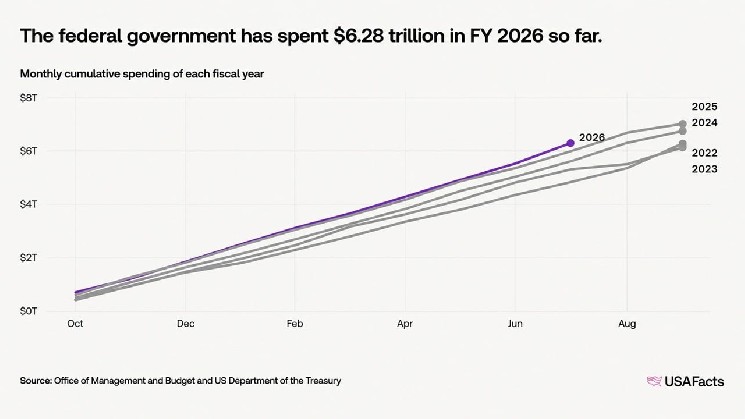
The US national debt has surged to nearly $40 trillion in just five months, the fastest trillion-dollar increase on record. The debt's growth has accelerated dramatically over time, from taking 192 years to reach the first $1 trillion in 1981 to adding the latest $1 trillion in only five months. The federal budget deficit for the fiscal year is already over $1.8 trillion, exceeding last year's total, and net interest payments on the debt have surpassed $1 trillion, now exceeding defense or Medicare spending. This rapid debt accumulation is fueling arguments within the cryptocurrency industry that Bitcoin serves as a hedge against government-backed currencies and fiscal irresponsibility. Proponents, including some lawmakers and industry leaders, argue Bitcoin could act as a "hard currency" fiscal control mechanism. Legislation has even been proposed for the Treasury to acquire Bitcoin to help reduce the national debt. The International Monetary Fund has warned that global public debt could hit 100% of world GDP by 2029 if current trends continue, with the US and China as primary drivers. Some analyses suggest a sovereign debt crisis could drive capital into alternative assets like Bitcoin, similar to past regional banking crises. However, skeptics point out that both Bitcoin and gold have fallen in price at times during 2026 despite record debt, indicating the depreciation hedge theory may operate over a much longer timeframe than short-term price action.

cryptonews.ru9m ago

U.S. National Debt Approaches $40 Trillion in 5 Months, Bitcoin Debate Gains Momentum

cryptonews.ru9m ago

Technological Self-Reliance in China: A War from Lithography Machines to ABF Films

"China's Tech Independence: A Battle from Lithography Machines to ABF Film" In August 2026, Japan's Ajinomoto announced a 30% supply cut of ABF film to Chinese mainland clients, causing industry-wide shock and fears of price hikes and shortages in the semiconductor supply chain. That same year, Chinese company Lotus Holdings, known for its MSG business, acquired a small domestic ABF film startup for 103 million yuan, aiming to change this passive situation. ABF film is a core insulating material for advanced CPU, GPU, and AI chip packages. Ajinomoto, originally a food flavoring company, has monopolized over 95% of the global ABF film market for nearly 30 years, deriving its technology from byproducts of monosodium glutamate production. With AI chips consuming 5-10 times more ABF film than traditional chips, the supply-demand gap is widening. Ajinomoto's supply cut to China, where domestic ABF film production accounts for less than 5%, directly threatens the production of domestic high-end AI chips and their substrates. This incident highlights a crucial but often overlooked truth: the vulnerabilities in China's quest for technological self-reliance extend beyond headline areas like lithography machines to critical but seemingly minor components—insulating films, photoresists, electronic specialty gases, etc. The article frames China's tech independence as a multi-front war. While major breakthroughs have been achieved in chip design (e.g., Huawei's HiSilicon), foundry (e.g., SMIC), and memory chips (e.g., YMTC), countless smaller "Ajinomoto-style" chokepoints remain. Lotus Holdings' acquisition represents a significant shift: the battle is no longer fought only by tech giants but has become a collective, industry-wide effort involving companies from diverse backgrounds. Historically, external blockades have often spurred China's technological breakthroughs, as seen with Huawei's Kirin chips and YMTC's 3D NAND flash memory. Ajinomoto's supply cut, while a short-term challenge, may similarly catalyze domestic innovation in ABF film and other critical materials. The path to technological sovereignty is long and arduous, requiring sustained patience and investment to fill every gap in the complex supply chain. Lotus's move is not an immediate solution but a step towards that future, symbolizing a broader, relentless march toward independence.

marsbit29m ago

Technological Self-Reliance in China: A War from Lithography Machines to ABF Films

marsbit29m ago

The Great Ethereum "Rate Cut" Debate: Is Now the Golden Window for Staking with the Unconventional EIP-8363?

Ethereon's economic policy is under review as a new proposal, EIP-8363, sparks debate over potential "interest rate cuts" for staking. The unconventional proposal suggests gradually increasing the proportion of newly issued ETH rewards that are burned as the total staked ETH ratio rises, with issuance fully offset by burns once the ratio nears 50%. This would drive the protocol-level staking APR towards 0%, though validators would still earn transaction fees and MEV. This discussion emerges as staked ETH approaches 35% of supply, with the current protocol APR at ~2.6%. The core question is whether Ethereum needs to continue paying high issuance costs for marginal gains in security once sufficient participation is achieved. EIP-8363 aims to optimize security spending, but critics warn it could disproportionately impact solo stakers and potentially increase centralization among large, resilient operators. Paradoxically, this debate coincides with the Pectra upgrade (EIP-7251), which introduces native compounding for staking rewards, significantly improving capital efficiency for long-term holders. This creates a dual narrative: the protocol is making staking more efficient while reconsidering the economic incentive to stake. For long-term ETH holders, this environment may present a "time window" rather than a fixed-rate opportunity. While future APRs are expected to trend downward, starting staking earlier maximizes the compounding effect over time. The decision to stake depends on individual factors like investment horizon, liquidity needs, and risk tolerance regarding options like native validation, staking services, or liquid staking tokens (LSTs). The evolution from encouraging staking to managing its economic cost marks a new, mature phase for Ethereum's tokenomics, where the true value of staking may increasingly lie in the long-term power of compounding time.

marsbit37m ago

The Great Ethereum "Rate Cut" Debate: Is Now the Golden Window for Staking with the Unconventional EIP-8363?

marsbit37m ago

Analyst States Bitcoin Remains Within $61-68k Range

An analyst stated that Bitcoin is likely to remain within a trading range of $61,000 to $68,000. According to Kirill Komalenkov, director of strategic communications at Bitbanker, Bitcoin continues to trade sideways amidst declining market volatility. He attributes its current stability to high market liquidity, with volatility near three-year lows. Komalenkov warned that sustained low activity carries risks of a price decline, with potential tests of support at $62,300 and $61,600. He suggested that major market players might use the current situation to accumulate liquidity, meaning any initial breakout from the range could be a false move. The analyst expects this sideways movement to persist until the latter part of August. Key factors for determining future market direction include fund flows into Exchange-Traded Funds (ETFs) and trader activity. However, Komalenkov noted a potential negative scenario for the second half of August, where heightened geopolitical tensions or hawkish rhetoric from US monetary authorities could trigger a new decline. In such a case, Bitcoin could fall to a range of $45,000–$50,000 by early autumn, which might form a new base for a potential market recovery later in the season. Separately, a Russian deputy finance minister recently announced that non-qualified investors in Russia will soon be allowed to legally purchase Bitcoin, Ethereum, and popular stablecoins, with an annual limit of 300,000 rubles per intermediary.

cryptonews.ru39m ago

Analyst States Bitcoin Remains Within $61-68k Range

cryptonews.ru39m ago

Trading

Spot

Hot Articles

Discussions

Welcome to the HTX Community. Here, you can stay informed about the latest platform developments and gain access to professional market insights. Users' opinions on the price of AI (AI) are presented below.

活动图片