The 'battle' among AI large model companies is spreading all the way to chips.
Just a few days ago, OpenAI proudly announced its first self-developed inference chip 'Jalapeño' outperforming Nvidia, while on the other side, Anthropic's chip 'ambitions' have also surfaced......
According to an exclusive Reuters report, Anthropic previously discussed acquiring AI chip startup MatX for approximately $7 billion, hoping to accelerate internal chip development through this move.
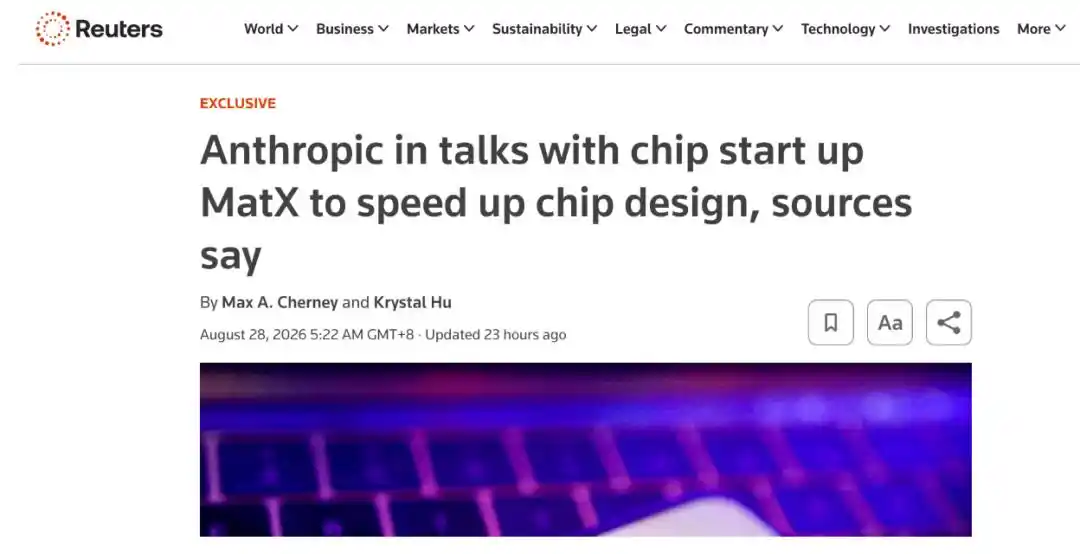
Seeing this news, netizens also exclaimed, first OpenAI, now Anthropic, "Now large models are all starting to get involved in the chip field."

However, unfortunately, this deal ultimately did not proceed. According to informed sources, the discussions between the two parties have currently shifted from acquisition to potential cooperation.
As for the specific reasons for the termination of the acquisition negotiations, Reuters has not yet disclosed them. However, it is worth noting the seriousness Anthropic showed towards this deal: In order to find faster and cheaper computing power for Claude, this model company has already begun to delve from the model layer all the way down to the chip layer.
And what kind of chip company is this that could command such a high price from Anthropic for an acquisition?
Information shows that MatX was founded in 2023, and its co-founders Reiner Pope and Mike Gunter are both from Google. Reiner Pope was involved in Google TPU software and large model infrastructure-related work, while Mike Gunter has long been engaged in TPU hardware design.
In February of this year, MatX completed a $500 million Series B funding round, with investors including Jane Street, Situational Awareness, and others.
Notably, MatX focuses on designing chips for large language models, primarily serving the 'training' phase.
This point might be an important reason why Anthropic chose to engage with them. Reuters cited informed sources saying that the negotiations with MatX indicate Anthropic may be interested in developing its own 'training chips', and of course, it might also launch chips for inference in the future.
This clearly forms an interesting contrast with the path recently announced by OpenAI: OpenAI's first self-developed chip 'Jalapeño' currently emphasizes inference: how to run model services with lower latency, higher throughput, and better energy efficiency after the model has been trained. The interest exposed by Anthropic, however, extends simultaneously to the training side.
Actually, it's not surprising for Anthropic to start laying out a 'training chip' strategy.
Currently, as models become larger and larger, model training is increasingly resembling a super engineering project. From pre-training, post-training to reinforcement learning, each model iteration requires mobilizing massive clusters of chips. Even a few percentage points improvement in training efficiency, when scaled to tens of thousands or even hundreds of thousands of accelerators, can ultimately correspond to a significant cost difference.
If chips, model architecture, and training systems can be co-designed from the start, this advantage could be further amplified.
This is also why Google started building TPUs many years ago, Amazon has Trainium, and OpenAI is now closely following with Jalapeño...... Chips are gradually becoming part of model capabilities.
MatX is not the only chip company Anthropic has contacted
In fact, Anthropic is not only contacting MatX but is seriously planning chip design.
According to Reuters, in recent weeks, Anthropic has held meetings with multiple AI chip startups. However, it has not yet decided which company to ultimately acquire, nor has it fully determined which technical route its self-developed chips will adopt. A major purpose of these contacts is to systematically allow Anthropic's engineers and management to understand the different AI chip architectures currently on the market.
At the same time, Anthropic is also aggressively recruiting talent in the chip field.
Just a few days ago, Bloomberg reported that Anthropic is forming an internal chip team and has hired former Google TPU core lead Amir Salek to join the computing department to advance the self-developed chip plan.
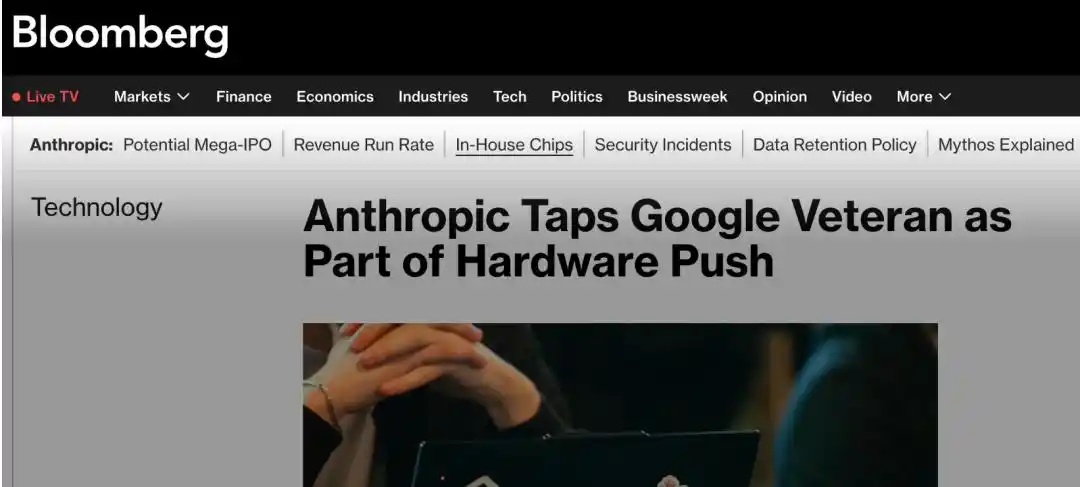
Amir Salek is a seasoned veteran in the chip industry. He joined Google in 2013, participated in founding and leading its custom chip business, and long-termly oversaw the TPU project until leaving in 2022. During this time, he drove the development and delivery of Google's first seven generations of TPU products and participated in building Google's custom chip capabilities for data centers.
Before joining Google, Salek worked at Nvidia for about eight years, serving as Senior Engineering Director, and founded and led Nvidia's system-on-chip (SoC) design department, accumulating extensive experience in GPU, mobile processors, and other chip fields.
After leaving Google in 2022, Salek moved into the investment field, joining the private equity firm Cerberus Capital Management as a Senior Managing Director, and also serving as a partner at its deep-tech investment platform Tracker Ventures, focusing on semiconductors, AI, edge computing, and other fields.
Now he returns to the front lines of chip R&D by joining Anthropic's computing team. It is reported that he will report to the company's head of computing, James Bradbury.
Earlier this year, in June, Anthropic also hired former OpenAI chip engineer Clive Chan, who had participated in OpenAI's self-developed chip project.
If we connect these operations, the overall view of Anthropic's chip roadmap becomes very clear: Hiring chip talent, building an internal team, researching different architectures, contacting chip startups, and even directly considering billion-dollar-level acquisitions......
Of course, Anthropic does not plan to completely shift to self-developed chips. According to Reuters, it still plans to continue with a multi-chip strategy, maintaining cooperation with chip and cloud computing suppliers like Nvidia and Google.
Because chip design itself is a massive, expensive, and time-consuming engineering project. Even with ample funds, it is not an easy task. It must be noted that an actually usable advanced chip might take a year or even longer from design to deployment, and the design cost for a single generation of chips could reach hundreds of millions of dollars.
Therefore, acquisition targets like MatX are very attractive to Anthropic. After all, directly acquiring a mature AI chip startup can quickly gain internal chip design experience and potentially reduce costs in the long run.
And you? What do you think of Anthropic's move?
Reference links:
https://www.reuters.com/business/finance/anthropic-planned-then-abandoned-7-billion-purchase-matx-sources-say-2026-08-27/
https://www.bloomberg.com/news/articles/2026-08-21/anthropic-taps-google-chip-veteran-as-part-of-push-into-hardware
This article comes from the WeChat public account "Almost Human" (ID: almosthuman2014), author: Focus on AI