Bitcoin Rallies On Venezuela Oil Story: Here’s What’s Wrong

bitcoinistPublished on 2026-01-06Last updated on 2026-01-06

Abstract

Bitcoin's 5% rally on January 5 was widely attributed to a narrative linking Venezuela's political shift to lower oil prices, reduced inflation, anticipated rate cuts, and a subsequent BTC surge. However, Bitwise Head of Research Ryan Rasmussen disputes this theory. He points out that market-implied probabilities of Federal Reserve rate cuts showed little to no change following the news, indicating the rally wasn't driven by monetary policy expectations. Instead, Rasmussen attributes the price increase to sustained institutional demand from new ETF inflows, a favorable regulatory shift post-election, a broader risk-on sentiment driven by AI optimism, and the ongoing expectation of future quantitative easing. He concludes that while the Venezuela event had some relevance, it was not the primary catalyst for Bitcoin's move.

Bitcoin’s roughly 5% jump on Jan. 5 landed on a clean, TV-friendly explanation: a shock political turn in Venezuela would “unlock” oil supply, push energy prices down, cool inflation, bring rate cuts forward, and lift BTC. Bitwise Head of Research Ryan Rasmussen says there’s a major flaw with that.

The catalyst for the narrative was Venezuela’s weekend drama, culminating in Nicolás Maduro’s capture and transfer into US custody, an episode that immediately spilled into geopolitics, commodities chatter, and macro cross-asset takes.

Rasmussen, posting in a thread on X, summarized the “Wall Street theory” as follows: “Venezuela oil reserves unlocked >> lower oil prices >> lower inflation >> interest rates >> bitcoin rallies. A thread on why that’s wrong.”

Why This Bitcoin Theory Is Wrong

Rasmussen’s central point is mechanical: if the rally is being driven by a sudden repricing of monetary policy expectations, it should show up in the probabilities traders are assigning to rate cuts. In his read, it didn’t.

He cited a slight dip in the implied odds of a 25 basis-point cut in January 2026 immediately after the Venezuela headlines. “Probability of a 25bps Rate Cut in Jan’26: Prior to Maduro’s Capture: 16.6%. After Maduro’s Capture: 16.1%,” Rasmussen wrote, adding that “the probability of a 25bps rate cut this month actually fell.”

Even further out, he argued, the change was marginal to nonexistent. “Probability of a 25bps Rate Cut in Dec’26: Prior to Maduro’s Capture: 19.1%. After Maduro’s Capture: 19.2%,” he wrote, framing it as “barely moved.”
That’s the mismatch Rasmussen wants investors to notice: a tidy causal story was making the rounds, but the pricing in the instrument closest to that story, rate expectations, was effectively unchanged.

If not a Venezuela-to-Fed chain reaction, what explains the day’s BTC strength? Rasmussen pointed to a cluster of themes that have been building without needing a weekend headline to justify them.

First is institutional demand. Rasmussen argued that the post-2024 spot bitcoin ETF channel continues to widen, with more major platforms beginning to allocate. He cited an example of “+$500m into bitcoin ETFs on Jan. 2nd,” and named Morgan Stanley, Wells Fargo, and Merrill Lynch as part of the distribution wave which have opened their door with the beginning of the year.

Second is the regulatory backdrop. Rasmussen described a “pro-crypto regulatory shift” following the 2024 election, saying crypto markets are beginning to “feel the benefits” as wealth managers, endowments, pensions, and sovereigns get more comfortable adopting bitcoin.

Third is a broader risk-on tone tied to AI. In Rasmussen’s framing, “fears of an AI-bubble are settling,” and investors have been “piling into risk-on assets, like tech stocks and bitcoin.”

Finally, he returned to policy, just not via Venezuela. “Did Maduro’s capture materially change short-term rate cut expectations? No. Does that mean QE is out of the picture. Also no,” Rasmussen wrote, before adding: “QE is just beginning. The market was—and still is—expecting 50bps (or more) rate cuts in 2026.”

Overall, Rasmussen did not argue Venezuela is irrelevant. His conclusion was narrower: “Yes. Somewhat,” he wrote when asked whether the weekend’s events matter for bitcoin, before answering the bigger question whether it’s the main reason for the +5% move with a flat “No. Zoom Out.”

At press time, BTC traded at $93,750.
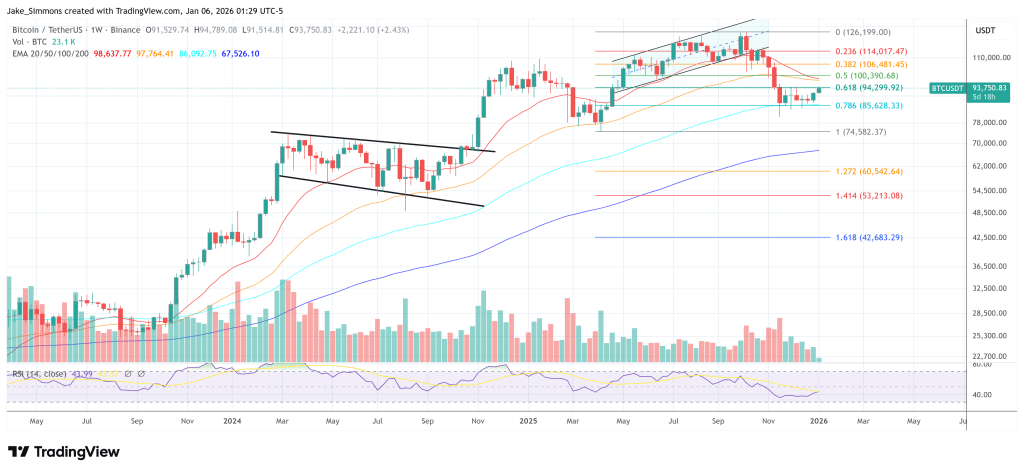
Bitcoin remains below the 0.618 Fib, 1-week chart | Source: BTCUSDT on TradingView.com

Related Questions

QWhat was the main flaw in the 'Wall Street theory' that linked Venezuela's political events to Bitcoin rally, according to Ryan Rasmussen?

AThe main flaw was that the theory suggested a causal chain from Venezuela's oil supply to lower inflation and rate cuts, but the actual pricing in rate expectations showed no meaningful change, indicating the narrative didn't align with market mechanics.

QHow did the probability of a 25 basis-point rate cut in January 2026 change after the Venezuela headlines, as cited by Rasmussen?

AThe probability slightly decreased from 16.6% prior to Maduro's capture to 16.1% after, which Rasmussen argued showed no supportive evidence for the theory.

QWhat were the key factors Rasmussen identified as the real drivers behind Bitcoin's 5% jump, instead of the Venezuela narrative?

ARasmussen pointed to institutional demand from ETFs, a pro-crypto regulatory shift post-2024 election, a broader risk-on tone tied to AI investments, and ongoing expectations of rate cuts in 2026.

QDid Ryan Rasmussen completely dismiss the relevance of Venezuela's events to Bitcoin's movement?

ANo, he acknowledged the events mattered 'somewhat,' but concluded they were not the main reason for the 5% move, urging investors to 'zoom out' for broader context.

QWhat example of institutional demand did Rasmussen provide to support his argument?

AHe cited over $500 million flowing into bitcoin ETFs on January 2nd and mentioned major platforms like Morgan Stanley, Wells Fargo, and Merrill Lynch increasing allocations.

Related Reads

2025 Prediction Market Review: Total Trading Volume Exceeds $50 Billion, Top Two Players Hold Over 97.5% Market Share

2025 Prediction Market Review: Total Trading Volume Exceeds $50 Billion, Duopoly Holds Over 97.5% Market Share In 2025, the prediction market sector reached a total trading volume of $50.25 billion, with Kalshi and Polymarket dominating the landscape by capturing over 97.5% of the market share. The remaining ecosystem accounted for just $1.25 billion in trading volume, involving emerging platforms like Azuro, TrendleFi, and others. Kalshi reported a record-breaking year with a nominal trading volume of $23.8 billion, marking a 1,108% year-over-year increase. December alone saw $6.38 billion in trades, setting multiple historical highs. Polymarket’s annual volume was estimated at approximately $22 billion, though data varied across sources like DefiLlama and Dune. Sports dominated Kalshi’s trading volume (85%), while Polymarket saw a more diversified distribution: sports (39%), politics (34%), and cryptocurrency (18%). Other categories like economics and tech/science also saw significant growth, with open interest expanding substantially throughout the year. Trading activity surged in the second half of 2025, driven by major events and elections. November and December were particularly strong, with combined monthly volumes for Kalshi and Polymarket nearing $10 billion and exceeding $13 billion, respectively. The top platforms by historical trading volume were Kalshi ($27.1B), Polymarket ($23.2B), Opinion ($13.1B), Limitless ($512M), and Azuro ($444M). The sector is poised for further growth in 2026, fueled by events like the U.S. midterm elections and the World Cup.

Odaily星球日报51m ago

2025 Prediction Market Review: Total Trading Volume Exceeds $50 Billion, Top Two Players Hold Over 97.5% Market Share

Odaily星球日报51m ago

Trading

Spot
Futures

Hot Articles

Discussions

Welcome to the HTX Community. Here, you can stay informed about the latest platform developments and gain access to professional market insights. Users' opinions on the price of S (S) are presented below.

活动图片