Original|Odaily Planet Daily(@OdailyChina)
Author|Wenser(@wenser 2010 )

As 2025 concludes, the prediction market sector has delivered its report card.
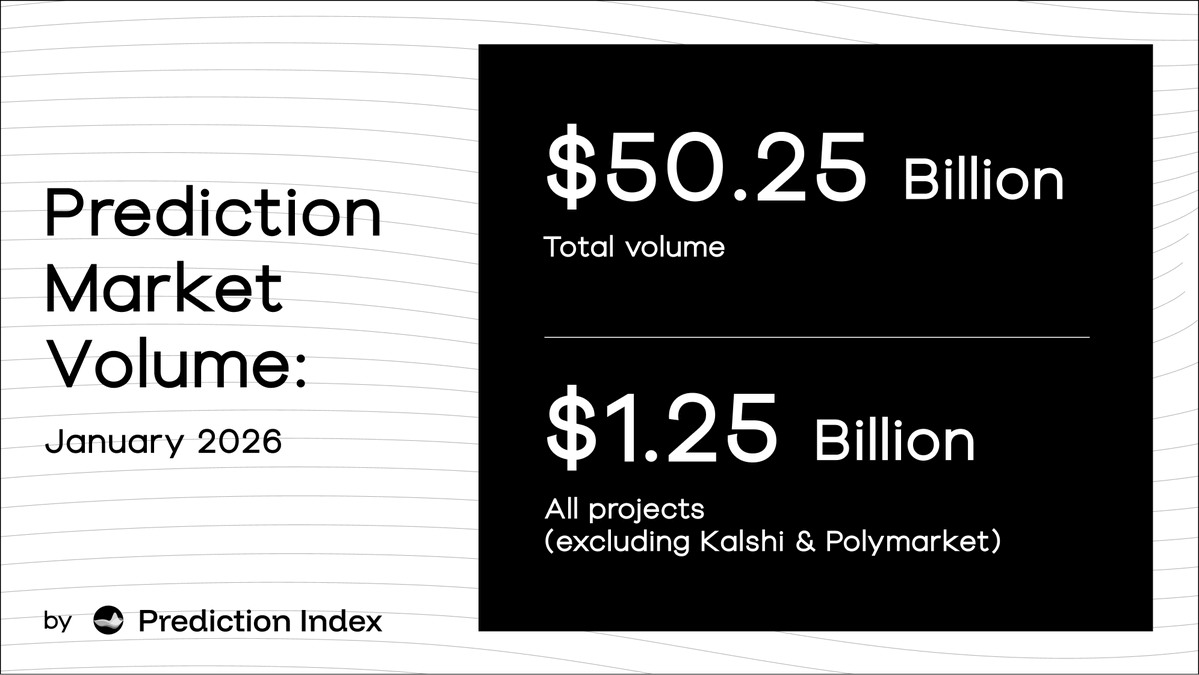
According to data from PredictionIndex.xyz, the total trading volume in the prediction market sector for 2025 reached $50.25 billion. Excluding Kalshi and Polymarket, the trading volume for the rest of the ecosystem was $1.25 billion. Additionally, data released by KalshiData shows that Kalshi's total nominal trading volume for the year reached $23.8 billion, a year-on-year increase of 1108%. With both Polymarket and Kalshi achieving valuations exceeding $10 billion, these results undoubtedly provide a strong boost of confidence to the capital markets and user base. In 2026, the prediction market sector will continue to be a focal point in crypto.
Odaily Planet Daily will provide a梳理 (overview) and brief analysis of the overall 2025 prediction market data in this article for readers' reference.
Overall Scale of the 2025 Prediction Market: The $50 Billion Level, Kalshi and Polymarket Hold Over 97.5% Market Share
PredictionIndex.xyz conducted end-to-end index tracking of the prediction market ecosystem, covering markets, infrastructure, end-users, and new experimental projects. The final results are as follows—
- According to incomplete statistics from the platform, the total trading volume of the prediction market in 2025 was approximately $50.25 billion.
- Excluding Kalshi and Polymarket, the trading volume for the rest of the ecosystem was $1.25 billion.
- This long-tail market is crucial for testing and evolving new market designs, incentives, and ideas, involving projects such as azuroprotocol, TrendleFi, hyperstiti0ns, Limitless, MyriadMarkets, overtime, footballdotfun, xodotmarket, predictonfliq, DGbet_official, and BRKTgg.
If such data shows us the current "duopoly"格局 (landscape) of the prediction market, then the 2025 annual data provided by KalshiData, under the Kalshi platform, gives us a more detailed view of the火热程度 (hotness) of the current popular sectors.
Kalshi's 2025 Report Card: Trading Volume Reaches $23.8 Billion, Over 11x Year-on-Year Growth
On January 3rd, KalshiData announced that Kalshi achieved record growth across all metrics in 2025.
In terms of nominal trading volume, the annual total reached $23.8 billion, a year-on-year increase of 1108%, approximately 12.1 times.
- December set a monthly historical high of $6.38 billion;
- The 4th week of December set a weekly historical high of $1.7 billion;
- December 21st set a daily historical high of $381.7 million.
In terms of the number of trades, the annual total reached 97 million, a year-on-year increase of 1680%, approximately 17.8 times.
- December saw 27.67 million trades;
- The 4th week of December saw 7.6 million trades;
- December 21st saw 1.5 million trades, all setting historical highs.
In terms of open interest, the total reached $225 million, a year-on-year increase of 169%, approximately 2.7 times.
- March 9th set a daily historical high of $533 million,
- The 1st week of March set a weekly historical high of $530 million,
- February set a monthly historical high of $499.5 million.
In terms of the number of contracts traded, the annual total reached 23.8 billion, a year-on-year increase of 1108%, approximately 12.1 times.
- December set a monthly historical high with 6.38 billion contracts;
- The 4th week of December set a weekly historical high with 1.7 billion contracts;
- December 21st set a daily historical high with 382 million contracts.
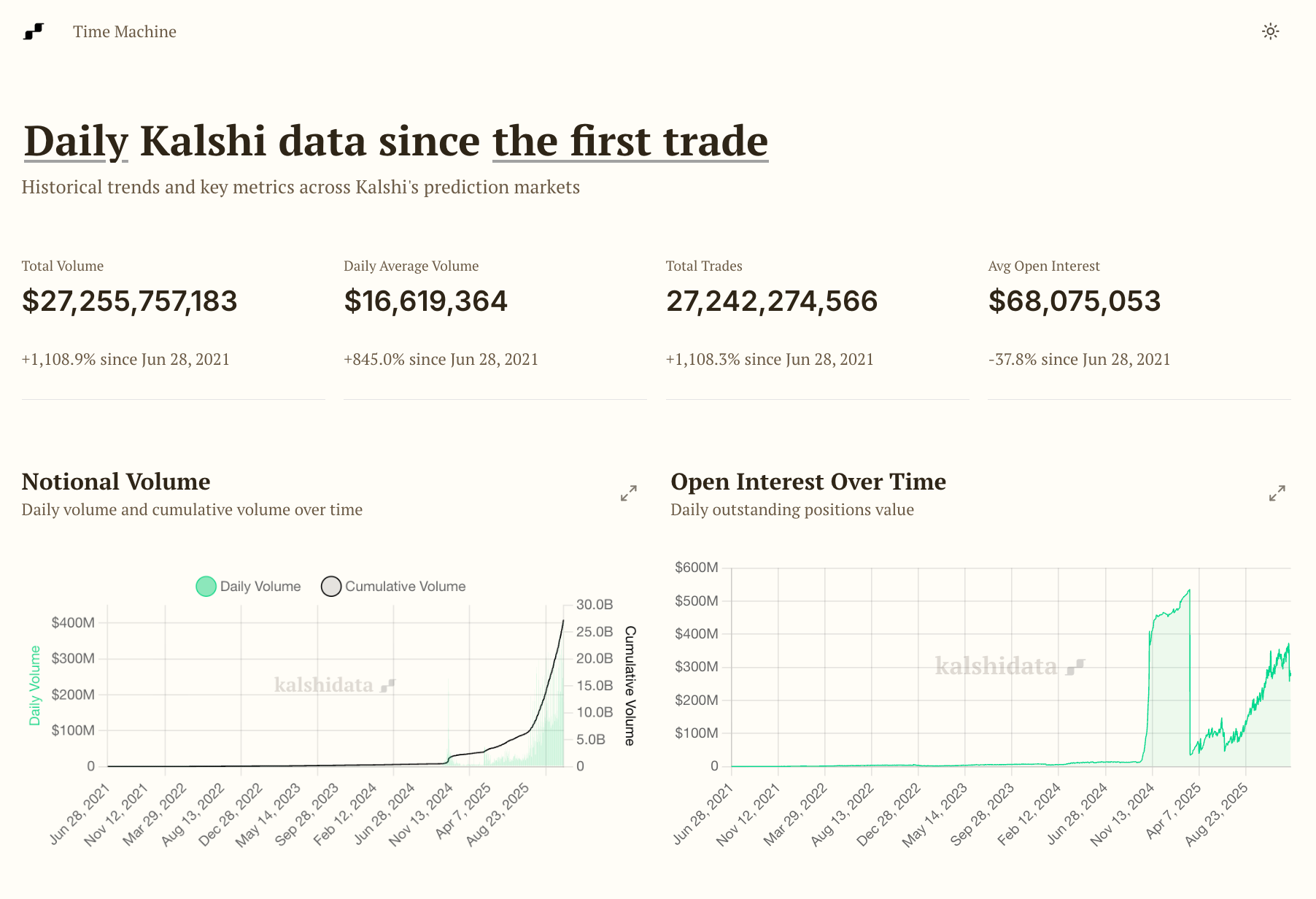
According to data from the KalshiData website, since its launch on June 28, 2021, Kalshi's historical total trading volume has reached $2,725,575,718, with a daily average trading volume of $16,619,364, and a total number of trades of 27,242,274,566.
As for Polymarket, although it promotes the concept of an "on-chain prediction market," perhaps due to differences in statistical calibers and trading data channels, its 2025 trading volume data is relatively模糊 (vague).
Polymarket's 2025 Report Card: Trading Volume Estimated Around $22~25 Billion
According to DefiLlama data, Polymarket's annual DEX trading volume for 2025 was approximately $10.5 billion.
According to information from a Dune dashboard, Polymarket's annual trading volume for 2025 was approximately $22.5 billion.
According to information from the PredictionIndex.xyz website, Polymarket's historical cumulative trading volume is $23.2 billion.
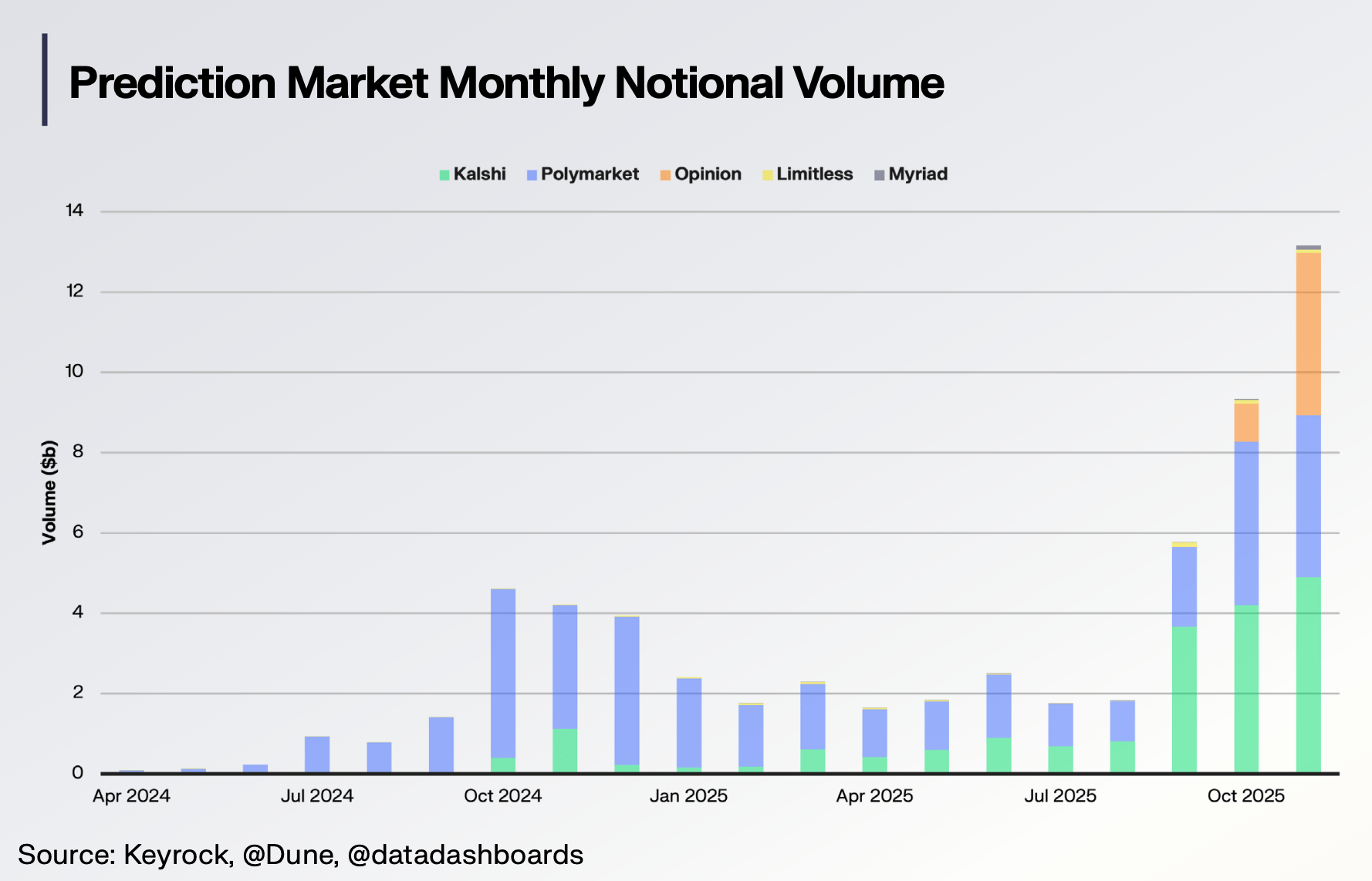
According to the "Prediction Market Report" jointly issued by Keyrock and platforms like Dune, the total transaction volume of the prediction market in 2025 was $44 billion, of which Polymarket's trading volume was approximately $21.5 billion (Odaily Planet Daily Note: In contrast, Kalshi's trading volume was about $17.1 billion).
综合以上信息以及 Kalshi 官方平台在前文中给出的 “Kalshi 年度交易量为 238 亿美元”的数据来看,我们取一个相对中间值,预估 Polymarket 2025 年总体交易量约为 220 亿美元左右。 (Synthesizing the above information and the data "Kalshi's annual trading volume is $23.8 billion" given by the official Kalshi platform earlier, we take a relatively median value and estimate Polymarket's total trading volume for 2025 to be approximately $22 billion.)
Prediction Market Segments: Sports Rank First, Political Events and Crypto Rank Second and Third
According to relevant information from the "Prediction Market Report" jointly issued by Keyrock and platforms like Dune, specifically regarding prediction market betting events,
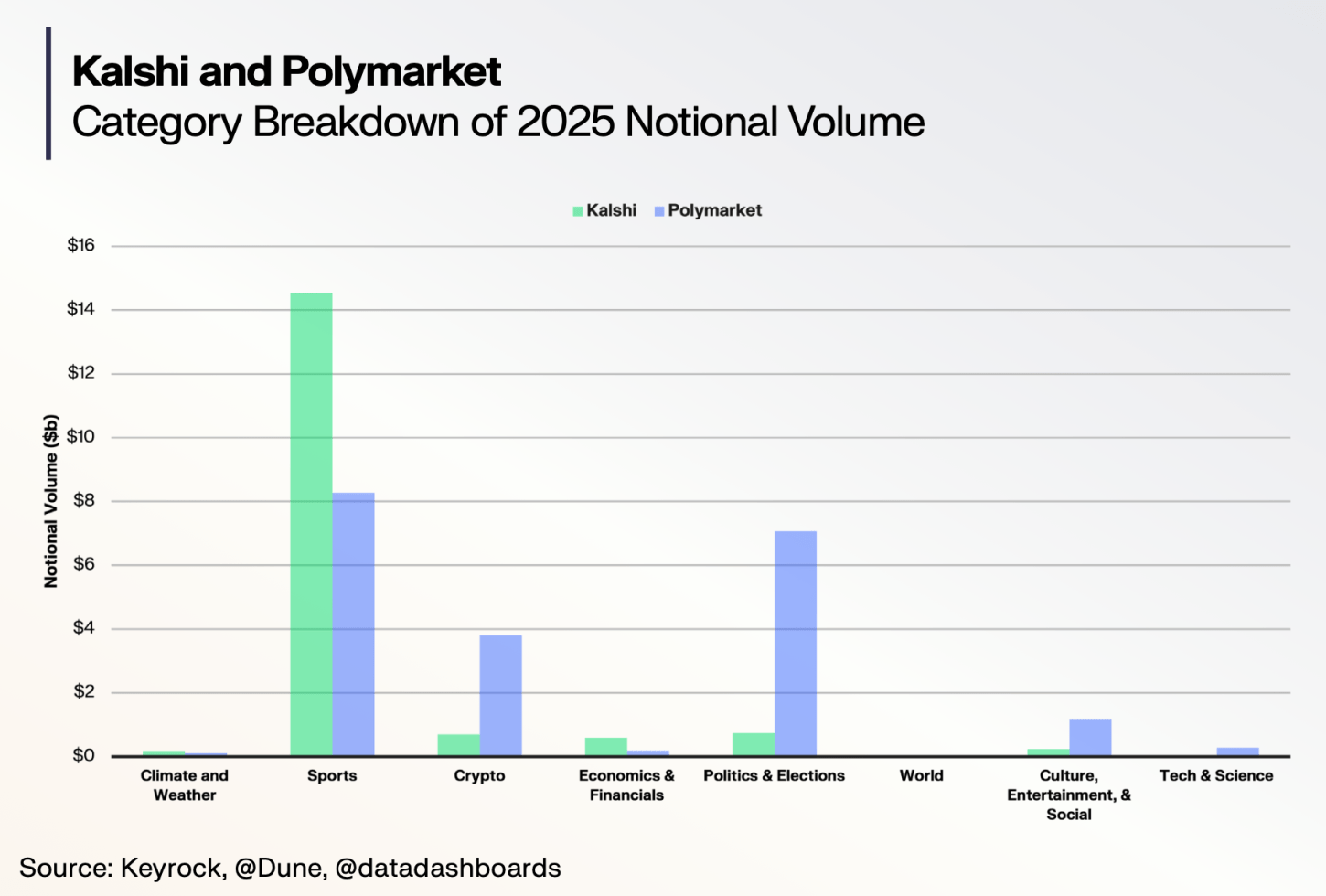
In 2025, Kalshi still focused on sports, with sports accounting for about 85% of the nominal trading volume.
In contrast, Polymarket exhibited a more diversified portfolio—
Sports (39%), politics (34%), and cryptocurrency (18%) together drove over 90% of prediction market betting activity.
Furthermore, calculated by trading volume,
- Trading volume for prediction events in the economics field grew 905%, reaching $112 million;
- Trading volume for prediction events in technology and science grew 1637%, reaching $123 million;
- Open betting events were led by economics (grew 7x to a market size of about $800 million) and social & culture (grew 6x to a market size of about $700 million), showing increasing use for macro hedging and long-term positioning.
- Other categories (e.g., culture, society) also saw significant growth, with the overall contract opening trading size growing from about $3.3 billion at the beginning of 2025 to around $13 billion, indicating a substantial improvement in market depth and liquidity.
Prediction Markets Also Have "Peak and Off-Peak Seasons": The Second Half of the Year Saw a Trading Volume Surge
It is worth noting that, as of late August 2025, data showed that Polymarket's trading volume was still maintained at a market size of around $7.5~8 billion. However, with the surge of various unexpected events, political events, and sporting events in the second half of the year, both Polymarket and Kalshi experienced a "trading explosion period":
September: Combined trading volume of Kalshi and Polymarket reached $1.44 billion;
October: Prediction market trading volume reached $8.7 billion, with Kalshi leading and Polymarket following;
November: Combined trading volume of Kalshi and Polymarket approached $10 billion,其中 (among which), Kalshi's trading volume reached $5.8 billion, a month-on-month increase of 32%; Polymarket's trading volume reached $3.74 billion, a month-on-month increase of 23.8%.
In December 2025, analyst Patrick Scott stated that in November 2025, prediction market trading volume exceeded $13 billion, more than three times the trading volume during the peak of the 2024 election. Polymarket, Kalshi, and OPINION accounted for the vast majority of the trading volume. Binary options are now applied to political speeches, sporting events, and listed company earnings reports, becoming a probability layer for world events and news.
Combined with Kalshi's December trading volume of $6.38 billion, Polymarket's trading volume势必同样不遑多让 (must surely be equally impressive). The overall prediction market trading volume in December 2025 might have reached a scale of $13-15 billion.
Top 5 Star Players in the Prediction Market: Kalshi, Polymarket, and Others
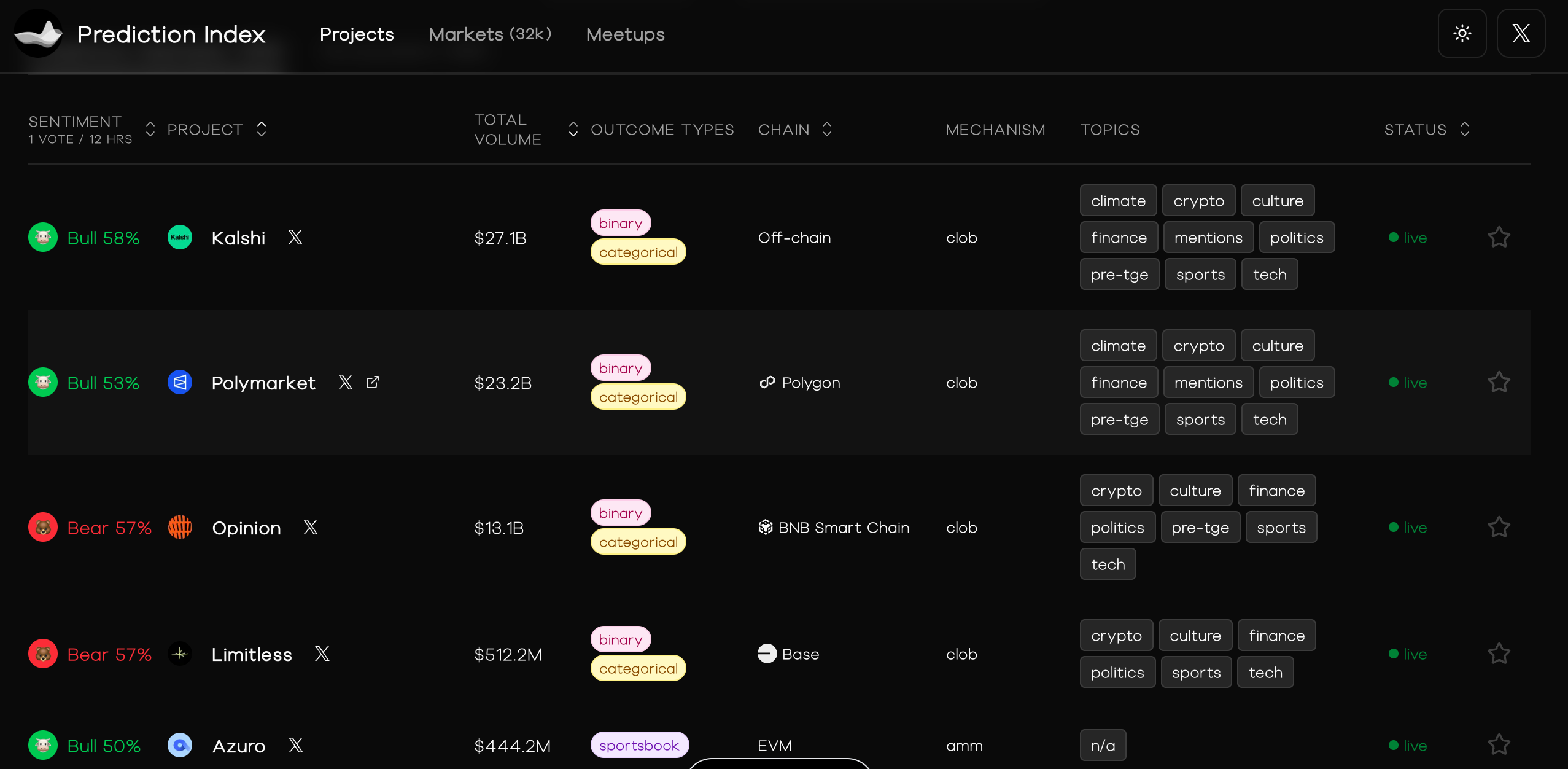
Finally, we can refer to the existing statistical data on the PredictionIndex.xyz website. As of the time of writing, the Top 5 platforms by prediction market trading volume are the following players:
- Kalshi, platform historical trading volume approximately $27.1 billion;
- Polymarket, platform historical trading volume approximately $23.2 billion;
- Opinion, platform historical trading volume approximately $13.1 billion (Odaily Planet Daily Note: Considering the platform's launch time and platform mechanisms, there may be issues with wash trading. Here we only use the data statistics platform information as a reference);
- Limitless, platform historical trading volume approximately $512 million;
- Azuro, platform historical trading volume approximately $444 million.
Previously, Kalshi's CEO stated that the prediction market size is around $150 billion. Although the final total trading volume for 2025 was only one-third of what he mentioned, considering that the prediction market sector was not even fully formed in 2024, his statement of a "$150 billion market size" is not空谈 (empty talk). Combined with the certainty of major prediction events in 2026 such as the US midterm elections and the World Cup and other large sporting events, the overall market size of the prediction market in 2026 may still maintain 10x growth.
Of course, as we mentioned earlier in "Only One in Ten Prediction Markets Will Survive Until the End of the Year, Not an Exaggeration," a hot sector does not mean all projects and platforms will thrive. For ordinary players like us, considering liquidity depth and capital allocation constraints, perhaps specializing in 1-3 mainstream platforms is a better choice.