Michael Saylor Vows ‘We Buy Real Bitcoin,’ No Rehypothecation

bitcoinistPublished on 2026-01-30Last updated on 2026-01-30

Abstract

Michael Saylor's firm MicroStrategy reaffirmed its Bitcoin acquisition strategy, stating it buys "real bitcoin" and does not engage in rehypothecation. This came in response to skepticism from Casa CTO Jameson Lopp, who questioned whether the company verifies that its Bitcoin holdings are not being rehypothecated by third-party custodians. The debate highlights concerns about transparency and proof of reserves for institutional Bitcoin custody. MicroStrategy disclosed purchasing 2,932 BTC for $264.1 million, bringing its total to 712,647 BTC. While some critics demanded public proof of addresses, others argued that traditional auditing and corporate controls provide sufficient validation. Saylor emphasized that the company audits its custodians and advised others to avoid rehypothecation. Bitcoin was trading at $88,001 at the time of reporting.

Michael Saylor’s Strategy has reignited a long-running Bitcoin custody debate after co-founder and CTO of Casa Jameson Lopp challenged whether the firm can know its holdings aren’t being rehypothecated by third parties. Saylor’s blunt response — “We buy real bitcoin. We don’t rehypothecate.” — quickly turned into a broader argument about what “proof” looks like for a public company warehousing BTC at institutional custodians.

The exchange landed as Strategy’s accumulation narrative is accelerating in early 2026. On Jan. 26, Saylor posted that Strategy bought 2,932 BTC for roughly $264.1 million at an average price near $90,061 per bitcoin. He added that, as of Jan. 25, the company held 712,647 BTC acquired for about $54.19 billion at an average cost of roughly $76,037 per coin.

That disclosure sparked commentary from Jesse Myers, who framed Strategy’s pace as structurally supply-tightening. Myers said the company has acquired 40,150 BTC so far in 2026, against 11,700 BTC mined year-to-date. “Eventually, the BTC price must go higher. Much higher,” he wrote, leaning on a simple imbalance: one large buyer absorbing more than new issuance.

No Paper Bitcoin?

Lopp pushed back on the implicit assumption that all of those purchases translate into unencumbered, uniquely owned UTXOs. “Your thesis is sensible... under the assumption that he’s buying real bitcoin,” Lopp wrote. “Does Strategy actually verify that their bitcoin only belongs to them and isn’t rehypothecated? I’m skeptical.”

Saylor responded with a short, definitive denial: “We buy real bitcoin. We don’t rehypothecate.” But Lopp widened the aperture from Strategy’s own behavior to the incentives and opacity of intermediaries. “But how do you know your custodians don’t? Presumably they put your BTC in segregated addresses you can monitor,” he wrote. “People ask for proof of reserves since they don’t even know what monitoring / assurances you put in place. Multiple layers of trusted black boxes make folks nervous.”

As the thread grew, some users demanded Strategy publish addresses. One account wrote, “Prove it then. Show us the addresses.” Others argued that transparency cuts both ways. “Ever considered that TradFi could be extremely frightened if Strategy were to do this, given that it opens up multiple attack Vectors?”

Defenders leaned on the mechanics of public-company controls rather than on-chain visibility. Attorney Jesse Kobernick from Miller Nash LLP argued that Strategy’s filings describe steps auditors take to verify balances and control, and that multiple third parties touch the process, including the separation between BTC purchases and the equity sales and cash proceeds that fund them. Lopp rejected that comfort. “Trusted third parties are security holes...” he replied.

Bitcoin OG Adam Back, meanwhile, pointed to mainstream custodianship norms as a reason to discount “paper bitcoin” fears. “Think about it. Their custodians are I think Fidelity and Coinbase,” Back wrote, adding that large auditors take verification and key-control standards seriously.

Lopp remained unconvinced that outside observers can know what, exactly, is being verified. “Are these auditors spinning up nodes, verifying balances at addresses, ensuring that no clients hold claims to the same BTC?” he wrote. “I’m skeptical, but ultimately we just don’t know – it’s a black box.”

Later on Jan. 28, Saylor reposted the message more broadly, escalating from denial to prescription: “We buy real bitcoin. We audit our custodians. We don’t rehypothecate.” He added: “You shouldn’t either.”

At press time, Bitcoin traded at $88,001.
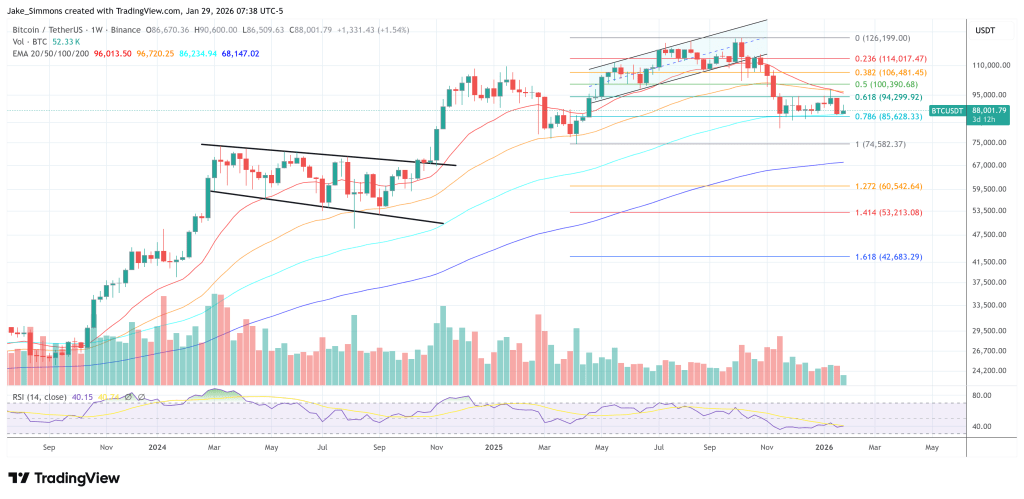
Bitcoin remains between the 0.618 and 0.786 Fib, 1-week chart | Source: BTCUSDT on TradingView.com

Related Questions

QWhat is the core of the debate between Michael Saylor and Jameson Lopp regarding MicroStrategy's Bitcoin holdings?

AThe debate centers on whether MicroStrategy can verify that the Bitcoin it purchases is 'real' and not being rehypothecated (loaned out or used as collateral by others) by its third-party custodians.

QHow did Michael Saylor respond to the skepticism about MicroStrategy's Bitcoin custody?

AMichael Saylor responded with a definitive denial, stating, 'We buy real bitcoin. We don’t rehypothecate.' He later escalated his response to include, 'We audit our custodians.'

QWhat was Jesse Myers' commentary on MicroStrategy's Bitcoin acquisition pace in early 2026?

AJesse Myers commented that MicroStrategy's pace of acquisition is structurally tightening the Bitcoin supply, noting the company had acquired 40,150 BTC against only 11,700 BTC mined year-to-date, creating a significant supply imbalance.

QWhat solution did some users in the debate propose for MicroStrategy to provide proof of its Bitcoin holdings?

ASome users demanded that MicroStrategy publish the Bitcoin addresses holding its coins to provide on-chain transparency and proof of reserves.

QWhat reason did Adam Back give for discounting fears of 'paper bitcoin' in this context?

AAdam Back pointed to the mainstream custodianship norms, stating that MicroStrategy's custodians (like Fidelity and Coinbase) and their large, serious auditors have strong verification and key-control standards, making 'paper bitcoin' fears less likely.

Related Reads

Trading

Spot
Futures

Hot Articles

What is $BITCOIN

DIGITAL GOLD ($BITCOIN): A Comprehensive Analysis Introduction to DIGITAL GOLD ($BITCOIN) DIGITAL GOLD ($BITCOIN) is a blockchain-based project operating on the Solana network, which aims to combine the characteristics of traditional precious metals with the innovation of decentralized technologies. While it shares a name with Bitcoin, often referred to as “digital gold” due to its perception as a store of value, DIGITAL GOLD is a separate token designed to create a unique ecosystem within the Web3 landscape. Its goal is to position itself as a viable alternative digital asset, although specifics regarding its applications and functionalities are still developing. What is DIGITAL GOLD ($BITCOIN)? DIGITAL GOLD ($BITCOIN) is a cryptocurrency token explicitly designed for use on the Solana blockchain. In contrast to Bitcoin, which provides a widely recognized value storage role, this token appears to focus on broader applications and characteristics. Notable aspects include: Blockchain Infrastructure: The token is built on the Solana blockchain, known for its capacity to handle high-speed and low-cost transactions. Supply Dynamics: DIGITAL GOLD has a maximum supply capped at 100 quadrillion tokens (100P $BITCOIN), although details regarding its circulating supply are currently undisclosed. Utility: While precise functionalities are not explicitly outlined, there are indications that the token could be utilized for various applications, potentially involving decentralized applications (dApps) or asset tokenization strategies. Who is the Creator of DIGITAL GOLD ($BITCOIN)? At present, the identity of the creators and development team behind DIGITAL GOLD ($BITCOIN) remains unknown. This situation is typical among many innovative projects within the blockchain space, particularly those aligning with decentralized finance and meme coin phenomena. While such anonymity may foster a community-driven culture, it intensifies concerns about governance and accountability. Who are the Investors of DIGITAL GOLD ($BITCOIN)? The available information indicates that DIGITAL GOLD ($BITCOIN) does not have any known institutional backers or prominent venture capital investments. The project seems to operate on a peer-to-peer model focused on community support and adoption rather than traditional funding routes. Its activity and liquidity are primarily situated on decentralized exchanges (DEXs), such as PumpSwap, rather than established centralized trading platforms, further highlighting its grassroots approach. How DIGITAL GOLD ($BITCOIN) Works The operational mechanics of DIGITAL GOLD ($BITCOIN) can be elaborated on based on its blockchain design and network attributes: Consensus Mechanism: By leveraging Solana’s unique proof-of-history (PoH) combined with a proof-of-stake (PoS) model, the project ensures efficient transaction validation contributing to the network's high performance. Tokenomics: While specific deflationary mechanisms have not been extensively detailed, the vast maximum token supply implies that it may cater to microtransactions or niche use cases that are still to be defined. Interoperability: There exists the potential for integration with Solana’s broader ecosystem, including various decentralized finance (DeFi) platforms. However, the details regarding specific integrations remain unspecified. Timeline of Key Events Here is a timeline that highlights significant milestones concerning DIGITAL GOLD ($BITCOIN): 2023: The initial deployment of the token occurs on the Solana blockchain, marked by its contract address. 2024: DIGITAL GOLD gains visibility as it becomes available for trading on decentralized exchanges like PumpSwap, allowing users to trade it against SOL. 2025: The project witnesses sporadic trading activity and potential interest in community-led engagements, although no noteworthy partnerships or technical advancements have been documented as of yet. Critical Analysis Strengths Scalability: The underlying Solana infrastructure supports high transaction volumes, which could enhance the utility of $BITCOIN in various transaction scenarios. Accessibility: The potential low trading price per token could attract retail investors, facilitating wider participation due to fractional ownership opportunities. Risks Lack of Transparency: The absence of publicly known backers, developers, or an audit process may yield skepticism regarding the project's sustainability and trustworthiness. Market Volatility: The trading activity is heavily reliant on speculative behavior, which can result in significant price volatility and uncertainty for investors. Conclusion DIGITAL GOLD ($BITCOIN) emerges as an intriguing yet ambiguous project within the rapidly evolving Solana ecosystem. While it attempts to leverage the “digital gold” narrative, its departure from Bitcoin's established role as a store of value underscores the need for a clearer differentiation of its intended utility and governance structure. Future acceptance and adoption will likely depend on addressing the current opacity and defining its operational and economic strategies more explicitly. Note: This report encompasses synthesised information available as of October 2023, and developments may have transpired beyond the research period.

363 Total ViewsPublished 2025.05.13Updated 2025.05.13

Discussions

Welcome to the HTX Community. Here, you can stay informed about the latest platform developments and gain access to professional market insights. Users' opinions on the price of BTC (BTC) are presented below.

活动图片