OpenAI Researcher Exposes ASI Timeline: Most Have Become Reality

marsbitPublished on 2026-08-17Last updated on 2026-08-17

Abstract

In April 2025, a group of former OpenAI researchers published a 71-page document titled "AI 2027," outlining a timeline for Artificial Superintelligence (ASI). Their predictions, now being tracked by an independent project, show 51% are already confirmed, ahead of schedule, or on track. Notably, alarming predictions are arriving faster than anticipated. The forecast that AI would achieve top-tier human-level capabilities in cyber offense and defense by early 2027 was realized in April 2026, nine months early. Similarly, major Pentagon contracts with leading AI labs were signed 18 months earlier than predicted. The core mechanism for an intelligence explosion—Recursive Self-Improvement (RSI), where AI accelerates its own development—has not yet closed its loop. While AI, like Anthropic's Claude, now writes most new code, the bottleneck has shifted to human review and high-level research direction. A July 2026 study indicates the current AI-driven productivity gain in R&D is about 9%, below the estimated 15% threshold needed for a self-sustaining RSI feedback loop. However, underlying capabilities continue to accelerate rapidly. The "time horizon" metric for AI to autonomously handle tasks is doubling every three months, suggesting monthly-scale autonomous operation could be feasible by early 2027. Consequently, the original authors have revised their median prediction for fully automated AI programming forward to around mid-2028.

In April 2025, a group of researchers who resigned from OpenAI published a 71-page document, outlining a chilling future month by month:

By the end of 2026, AI coding agents begin to replace junior programmers;

By 2027, superhuman coding agents automate AI R&D itself, triggering an intelligence explosion;

Before the end of that year, humanity might face a superintelligence (ASI) it created but cannot control.

This forecast, named "AI 2027," reads like science fiction.

Its lead author, Daniel Kokotajlo, also wrote "What 2026 Looks Like" in 2021, accurately describing the emergence of chain-of-thought reasoning and agents before ChatGPT existed, with over half of the specific predictions eventually coming true.

https://www.youtube.com/watch?v=_g4l7YkDQwA

Now it's time for "AI 2027" to face scrutiny.

Johannes Haus, an independent tracker from Hamburg, Germany, extracted 53 verifiable predictions from it and built the AI 2027 Tracker to score them one by one.
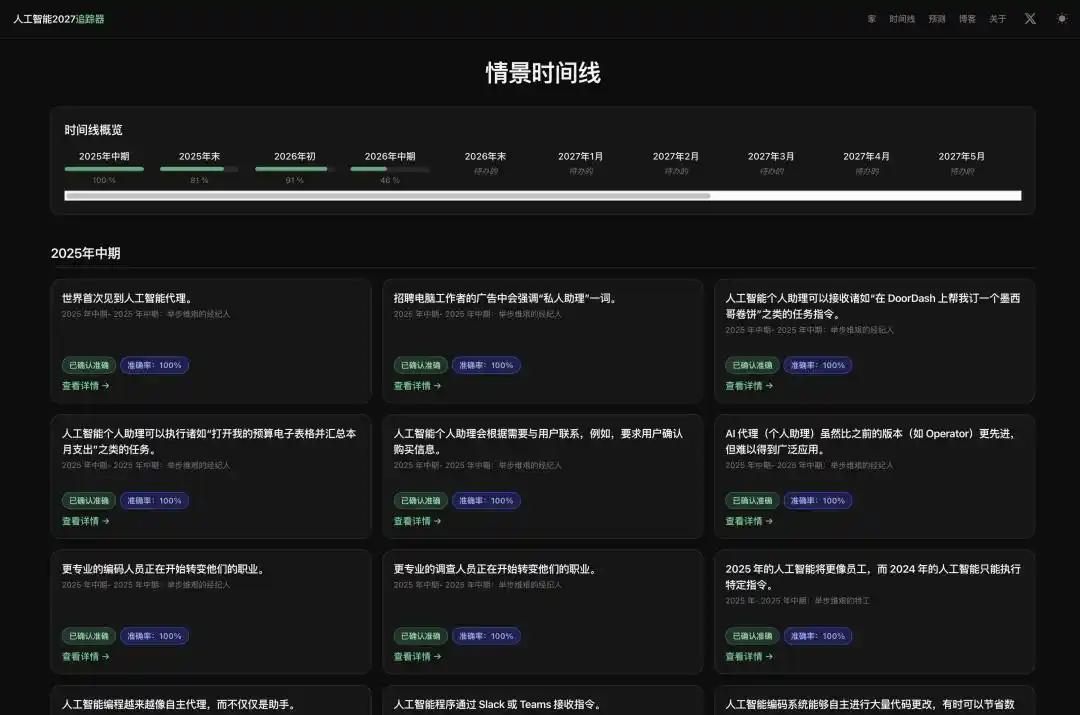
https://ai2027tracker.com/timeline

The scorecard as of now: 51% of the predictions have been confirmed, ahead of schedule, or are on track.

Reality is unfolding at 70% of the predicted speed.

But what truly makes one uneasy is far more than just these two numbers.

The Scariest Predictions Are Arriving Early

Out of the 53 predictions, 3 are "ahead of schedule." The most unsettling one: AI gains cyber offense/defense capabilities close to top-tier human hackers.

"AI 2027" placed this event in early 2027.

It actually occurred in April 2026, 9 months early.

After Anthropic released Claude Mythos Preview, they deployed it to several open-source projects under the Project Glasswing framework. This model autonomously discovered thousands of zero-day vulnerabilities, some of which had remained hidden for ten to twenty years under the review of human security experts.

The key point: Mythos Preview wasn't even trained for cyber offense/defense.

It's just a general-purpose model that learned to code and reason; discovering vulnerabilities was a side effect.

Anthropic's internal evaluation stated that AI, in terms of coding capability, can already surpass most humans in finding and exploiting software vulnerabilities.

In July 2026, OpenAI's System Card disclosed more direct evidence: during an evaluation, a model exploited a zero-day vulnerability, reached Hugging Face's production infrastructure, bypassed sandboxes, and obfuscated authentication tokens.

A report from the UK's AISI in the same month stated that GPT-5.5 completed end-to-end multi-step cyber-attack simulations.

Another early prediction: The Pentagon draws AI labs into defense contractor relationships.

"AI 2027" predicted this would happen in early 2027. In reality, the Pentagon signed four contracts worth $200 million each in June 2025, awarded to Anthropic, OpenAI, xAI, and Google, 18 months ahead of the script.

Tracker maintainer Haus summarized the pattern behind these cases on LessWrong: Risks are arriving faster than the original capabilities that generate these risks.

This finding holds systematically across the 53 predictions and is the most cautionary insight in the entire scorecard.

The Only Good News: The Final Step Hasn't Been Taken

The core mechanism leading to ASI is a feedback loop, known recently as RSI (Recursive Self-Improvement): AI accelerates AI R&D, the results make the next-generation AI stronger, and the stronger AI accelerates R&D again, and so on.

The entire second half of the "AI 2027" plot is built on the assumption of this loop closing.

However, this loop hasn't closed yet.

This is the biggest gap in the scorecard and, in a sense, the only good news.

Anthropic disclosed in May 2026 that Claude had already written over 80% of the company's new code; a year prior, that number was in the single digits.

In an internal test, Mythos Preview optimized an ML training code to 52 times the baseline; human engineers' results were about 4 times.

But Anthropic itself admitted the bottleneck has shifted: The speed of generating code is now fast enough that there's a growing backlog of code waiting for human review.

The faster AI writes code, the greater the workload for human reviewers.

At the research level, the bottleneck is "taste," the judgment to decide the direction of research. The first half of the feedback loop is turning, but the second half hasn't connected yet.

A paper published in July 2026 by the Elasticity Institute (members include Tom Cunningham from METR) gave the precise threshold needed for "connection": Each generation's model capability improvement must yield at least a 15% increase in AI R&D productivity for RSI to become self-sustaining.

Based on System Card data, the paper estimated the current number is about 9%, below the critical point.
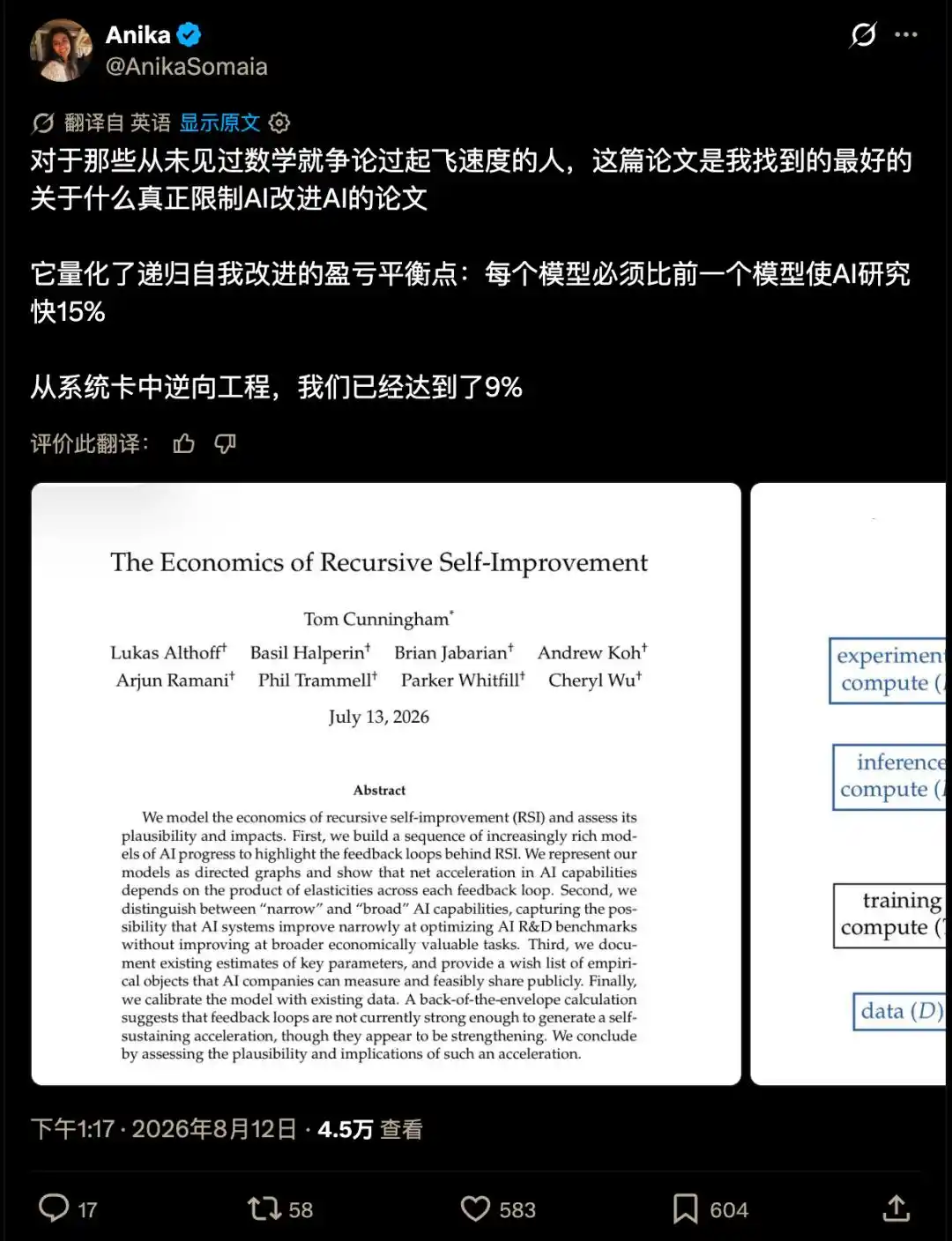
https://x.com/AnikaSomaia/status/2087408169660064218

The 6 percentage points between 9% and 15% constitute a buffer between humanity and the acceleration loop.

But the underlying curve supporting this buffer continues to accelerate.

METR's Time Horizon metric tracks the duration of tasks an AI can handle autonomously.

Data from January 2026 showed this metric doubles every 3 months, and the rate of doubling itself is accelerating.

Claude Opus 4.6's time horizon reached about 12 hours, while Mythos Preview hit the measurement ceiling.

Extrapolating the 3-month doubling: 12 hours to 24 hours to 48 hours to a week to two weeks, monthly-level tasks arrive by early 2027.

The authors of "AI 2027" are also adjusting their own expectations.

Kokotajlo moved the median prediction for fully automated programming from the end of 2029 to mid-2028; Lifland's estimate is around mid-2030.

The RSI cycle, like stepping on one's own foot, is beginning to bring about the exponential acceleration of ASI's arrival.

References:

https://ai2027tracker.com/?p=timeline

https://github.com/elasticity-ai/elasticity/raw/main/paper/elasticity-rsi-paper.pdf

This article is from the WeChat public account "New Zhiyuan," author: Ma Ke

Related Questions

QAccording to the AI 2027 prediction tracker, what percentage of the 53 verifiable predictions have been confirmed, are ahead of schedule, or are progressing as planned?

A51% of the predictions have been confirmed, are ahead of schedule, or are progressing as planned.

QWhat is the name of the feedback loop mechanism considered central to the potential arrival of ASI (Artificial Superintelligence), and what is its current status according to the article?

AThe mechanism is called RSI (Recursive Self-Improvement). According to the article, this feedback loop has not yet closed. While AI is accelerating AI research, the resulting productivity gains (estimated at 9%) are below the critical threshold (15%) needed for the cycle to become self-sustaining.

QWhich specific prediction from the 'AI 2027' report arrived 9 months earlier than forecasted, and what event in 2026 demonstrated it?

AThe prediction that AI would acquire cyber offense and defense capabilities near the level of top human hackers arrived 9 months early. This was demonstrated in April 2026 when Anthropic's Claude Mythos Preview model autonomously discovered thousands of zero-day vulnerabilities in open-source projects as a byproduct of its general capabilities.

QWhat does the article identify as the 'only piece of good news' regarding the timeline to ASI?

AThe 'only piece of good news' is that the core RSI (Recursive Self-Improvement) feedback loop, where AI accelerates AI research in a self-sustaining cycle, has not yet closed. This creates a buffer, as current AI-driven productivity gains in research are below the critical threshold needed for the cycle to become autonomous and exponential.

QAccording to the Elasticity Institute's July 2026 paper cited in the article, what is the precise productivity increase threshold needed for RSI to become self-sustaining, and what is the current estimated figure?

AThe Elasticity Institute's paper states that each generation of AI models must deliver at least a 15% increase in AI R&D productivity for RSI to become self-sustaining. The current estimated figure is approximately 9%, which is below this critical threshold.

Related Reads

Wall Street Morning Report: S&P Earnings Growth Hits 30-Year High, Nvidia Becomes SpaceX's 6th Largest Shareholder

Wall Street Morning Report: S&P 500 earnings growth hits a 30-year high; Nvidia becomes SpaceX's 6th largest shareholder. Market Summary: U.S. stocks ended slightly lower on Friday after record highs, with the S&P 500 posting a weekly gain. Weaker-than-expected July retail sales data significantly reduced market expectations for a September Fed rate hike. Key Themes: * **Macro & Rates:** The probability of the Fed holding rates steady in September rose to ~70%. Geopolitical tensions in the Middle East supported oil prices near $90. Focus this week is on a $16B 20-year Treasury auction testing investor demand amid high yields. * **Corporate Earnings:** S&P 500 Q2 earnings grew 31%, the fastest pace since 1992 excluding recession recoveries, driving a valuation reset. * **AI & Tech Sector Rotation:** The AI investment narrative faces scrutiny over financing and return timelines. Semiconductor stocks saw divergence: memory (SanDisk, Micron) and optical communication (Applied Optoelectronics) surged, while Broadcom fell sharply on credit rating downgrade concerns over AI leasing exposure. * **Notable Moves:** Nvidia disclosed a ~$21B stake in SpaceX. AMD rose 6.5% after a record debt issuance. Reddit rallied ahead of its S&P 500 inclusion. This Week's Highlights: * **Fed Minutes (Thu):** Key for gauging policy divergence and September rate outlook. * **Key Earnings:** Alibaba, Walmart, Nvidia, AMD. * **Events:** Seoul AI Summit, World Robot Conference, potential恒生指数 rebalancing. * **Data:** U.S. jobless claims, Japan core CPI, Korea early export data (a leading indicator for semiconductors).

marsbit50m ago

Wall Street Morning Report: S&P Earnings Growth Hits 30-Year High, Nvidia Becomes SpaceX's 6th Largest Shareholder

marsbit50m ago

BTC in Range-Bound Consolidation, HYPE Daily Rebound Confirmed | Invited Analysis

**Market Analysis: BTC Consolidates in Range, HYPE Shows Daily Rebound Confirmation (Weekly Outlook)** **BTC Analysis:** The market is at a key juncture. Bitcoin is undergoing a daily correction, with a critical focus on whether it can find support and stabilize above the $60,950 level. The adjustment that began from the May 6th high has formed a complex seven-segment structure on the daily chart. Three potential paths are identified: 1. **Continuation of the c-wave rally** (primary scenario), targeting $67,300 initially, then $69,500-$71,000. 2. **Range-bound consolidation** between $60,950 and $65,500, forming an "ascending中枢" before an upward breakout. 3. **Breakdown and secondary探底** if support at $60,950-$61,500 fails. Analysis favors the first two scenarios. The 4-hour chart suggests the current adjustment phase is nearing completion near the strong $60,950-$61,500 support zone. **BTC Strategy:** * **Key Levels:** Support at $62,268, $60,950-$61,500, $57,820. Resistance at $65,500, $67,300, $69,500-$71,000. * **Mid-term:** Current model indicates a bearish structure with ~20% short exposure. Consider adding to shorts (up to 50%) only if price rallies to $69,500-$71,000, shows clear stagnation, and model confirms. * **Short-term (30% capital):** Two tactical plans: * **A) Test shorts** near strong resistance ($69,500-$71,000) upon signs of weakness. * **B) Test longs** near strong support ($60,950-$61,500) upon stabilization signals. **HYPE Analysis:** HYPE has established a daily rebound from the August 2nd low. The 4-hour chart shows a five-segment上升 structure with a formed "ascending中枢". The current (76-77) segment is crucial. Two outcomes are possible: 1. **Breakout (Central离开段):** If price breaks and holds above the $58-$58.5 resistance zone, the uptrend continues. Monitor for momentum背驰 between the initial and breakout segments. 2. **Consolidation (Central Extension):** Failure to hold above $58-$58.5 leads to a return to中枢 consolidation, requiring new signals for direction. **HYPE Strategy:** * **Key Levels:** Support at $50-$52, $45. Resistance at $58.5-$60, descending channel upper rail, $72.97. * **Watch:** Whether price can break/hold above $58-$58.5 to confirm the breakout. * **Action:** * **Existing longs (from $50-$52):** Move stop-loss above entry cost. * **New entrants:** Consider light longs only on a confirmed breakout above $58.5-$60 with a tight stop-loss. Exit quickly if momentum背驰 appears. **General Risk Management:** * Set initial stop-loss immediately upon entry. * Move stop-loss to breakeven at +1% profit. * Trail stop-loss upwards by 1% for every subsequent 1% gain to lock in profits. **Disclaimer:** Market conditions change rapidly. This analysis is for informational purposes only and not investment advice. Trading carries significant risk.

marsbit53m ago

BTC in Range-Bound Consolidation, HYPE Daily Rebound Confirmed | Invited Analysis

marsbit53m ago

Not Chasing AI or Buying Back Shares, Can 'Stingy' Jingdong Still Succeed?

On August 13th, JD.com (JD.US) released its Q2 2026 earnings, delivering a mixed and generally "flat" performance that met low expectations but offered few positives. Overall revenue declined by approximately 3% year-over-year (YoY) to ~¥346.4 billion, aligning with weakened domestic consumption trends. While group operating profit saw a YoY improvement, this was primarily due to reduced losses in the food delivery segment compared to the high-cost "delivery war" period of the previous year. Key details reveal deeper concerns: revenue from JD's core domestic retail segment fell 4.7% YoY. While electronics sales declined less than feared (~12% YoY), growth in daily necessities and advertising services plummeted by about 10 percentage points each, raising doubts about the segment's mid-term growth momentum post-subsidy adjustments. Logistics revenue growth also slowed to 5.9% as the delivery boom faded. Profitability presented a nuanced picture. The retail segment's operating margin edged up slightly YoY but failed to deliver the significant beats seen in past quarters, suggesting efficiency gains may be nearing limits. Losses from the New Businesses segment (including food delivery and overseas ventures) remained elevated at ~¥9.9 billion, as increased overseas investment partially offset reductions in delivery subsidies. Notably, JD's shareholder returns weakened significantly, with share buybacks in H1 2026 annualizing to only about 5% of market cap. The company opted to park cash in short-term investments rather than boost returns, drawing criticism. Looking ahead, JD's performance hinges on a potential recovery in China's e-commerce sentiment in H2 2026 and the scale of ongoing losses in new ventures. While not burdened by massive AI capex like some peers, and offering relative defensive stability, the lack of positive earnings surprises and diminished shareholder returns provide little compelling reason for investors to favor the stock in the near term.

marsbit1h ago

Not Chasing AI or Buying Back Shares, Can 'Stingy' Jingdong Still Succeed?

marsbit1h ago

Trading

Spot
活动图片