From Monday to Friday mornings, focusing on macroeconomics, U.S. stocks, AI, precious metals, crude oil, and more. PANews presents a market review with data and trend analysis for seizing opportunities.
Sharp Consumer Braking Weakens September Rate Hike Expectations; 20-Year Treasury Auction in Focus This Week
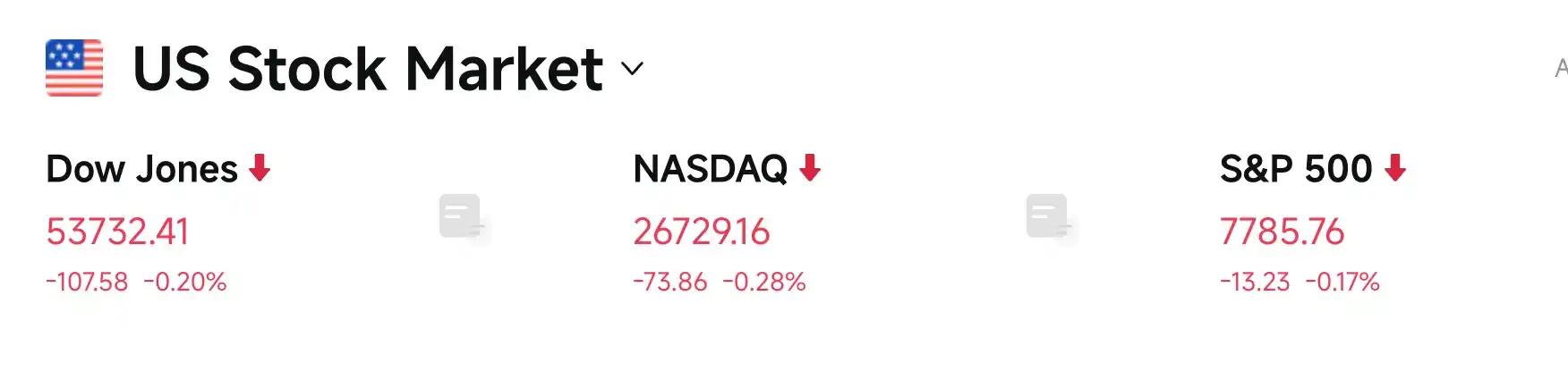
The three major U.S. stock indices closed slightly lower last Friday, with the Dow Jones down 0.2%, the S&P 500 down 0.17% (retreating from the previous day's record high), and the Nasdaq down 0.28%. For the week, the Dow fell 0.56%, the S&P gained 0.36%, the Nasdaq gained 0.14%, and the Russell 2000 gained 1.12%, also hitting a new closing record.
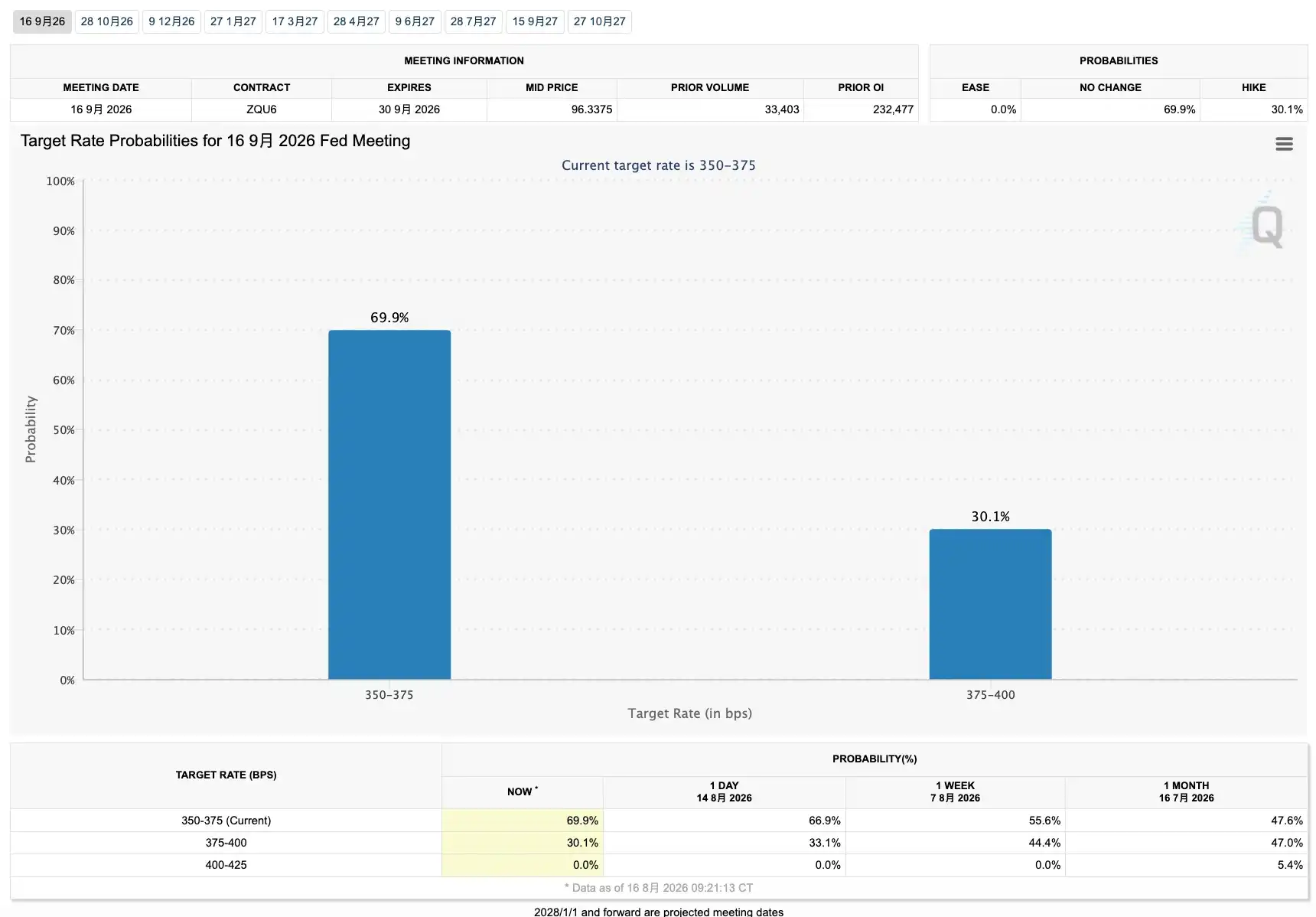
U.S. July retail sales unexpectedly fell 0.6% month-on-month, the largest drop in over a year, far worse than the expected slight increase; the control group sales fell 0.4%. Combined with the previously mild CPI and PPI, CME FedWatch shows a significant drop in market expectations for a September rate hike, with bets on holding steady rising to about 70%.
The market is beginning to believe the Fed's rate hikes are nearing an end but is unwilling to declare inflation dead. Fiscal supply and oil price premiums are still demanding higher term premiums. Collin Martin, Head of Fixed Income Strategy at Charles Schwab, pointed out that a single month's data does not constitute a trend, and a September hike is less likely but not completely ruled out. Tony Pasquariello, Head of Goldman Sachs' Hedge Fund Business, emphasized that massive deficits and AI capital expenditures under full employment remain powerful tailwinds.
Brent crude oil is approaching the $90 mark, up about 6% for the week; WTI is around $83. Ships were attacked again in the Strait of Hormuz, with traffic nearly stalled. The U.S. stated it could maintain a maritime blockade on Iran indefinitely. President Trump and Treasury Secretary Besant previewed "unprecedented" economic measures against Iran, jointly supporting geopolitical risk premiums. Although Middle Eastern oil producers still maintain relatively high export flows through covert shipments, supply chain uncertainty remains. Trump also directed the Department of Defense to "significantly reduce" the scale of U.S.-South Korea joint military exercises, calling them costly and sending inappropriate signals of hostility to North Korea, and mentioned South Korea's refusal to participate in promoting Iranian denuclearization. This statement increases volatility in the Asia-Pacific security narrative, but the South Korean stock market was closed for a holiday, delaying the reaction.
Short-term U.S. Treasuries benefited, with the 2-year yield falling near a one-month low; the 10-year yield closed around 4.68%, and the 30-year yield rose to a 19-year high near 5.25%. This week's 20-year U.S. Treasury auction will be an important stress test. The U.S. Treasury plans to issue $16 billion in 20-year Treasury bonds, with a pre-issuance yield of about 5.27%; if the final yield is close to this level, it will be the highest since this maturity was reintroduced in 2020. Additionally, ultra-long European bond yields hit multi-year highs, further reminding of discount rate pressure on global duration assets. The yields on 30-year German and French bonds rose to 2011 highs, with inflation expectations, fiscal deficits, and supply issues amplified by thin summer liquidity.
Storage and Optical Communication Surge; AI Financing Narrative Faces Credit Repricing
S&P 500 index second-quarter earnings grew 31% year-on-year, significantly exceeding Wall Street's previous expectation of 23%, marking the strongest earnings growth rate since 1992, excluding recession recovery periods. Keith Lerner, Chief Strategist at Truist, stated that earnings growth has pushed the S&P 500's P/E ratio down from about 26x at the start of the year to below 22x, achieving a healthier valuation reset. Ned Davis analyst Ed Clissold pointed out that the outperformance of small- and mid-cap stocks indicates growth is spreading from tech giants to broader sectors.
The sustainability of AI capital expenditures is being re-examined. Goldman Sachs expects global AI data center capital expenditures to potentially reach $1 trillion by 2026, while Bank of America sees a path to $1.2 trillion by 2027. However, bottlenecks in power, chips, construction, regulation, and financing raise concerns. Maria Llerena, Research Director at Domini Impact Investments, warned that if the 10-year Treasury yield rises to 5%, it would challenge tech valuations; Keith Lerner believes the real risk lies in a rapid surge in yields and delayed returns on AI investments.
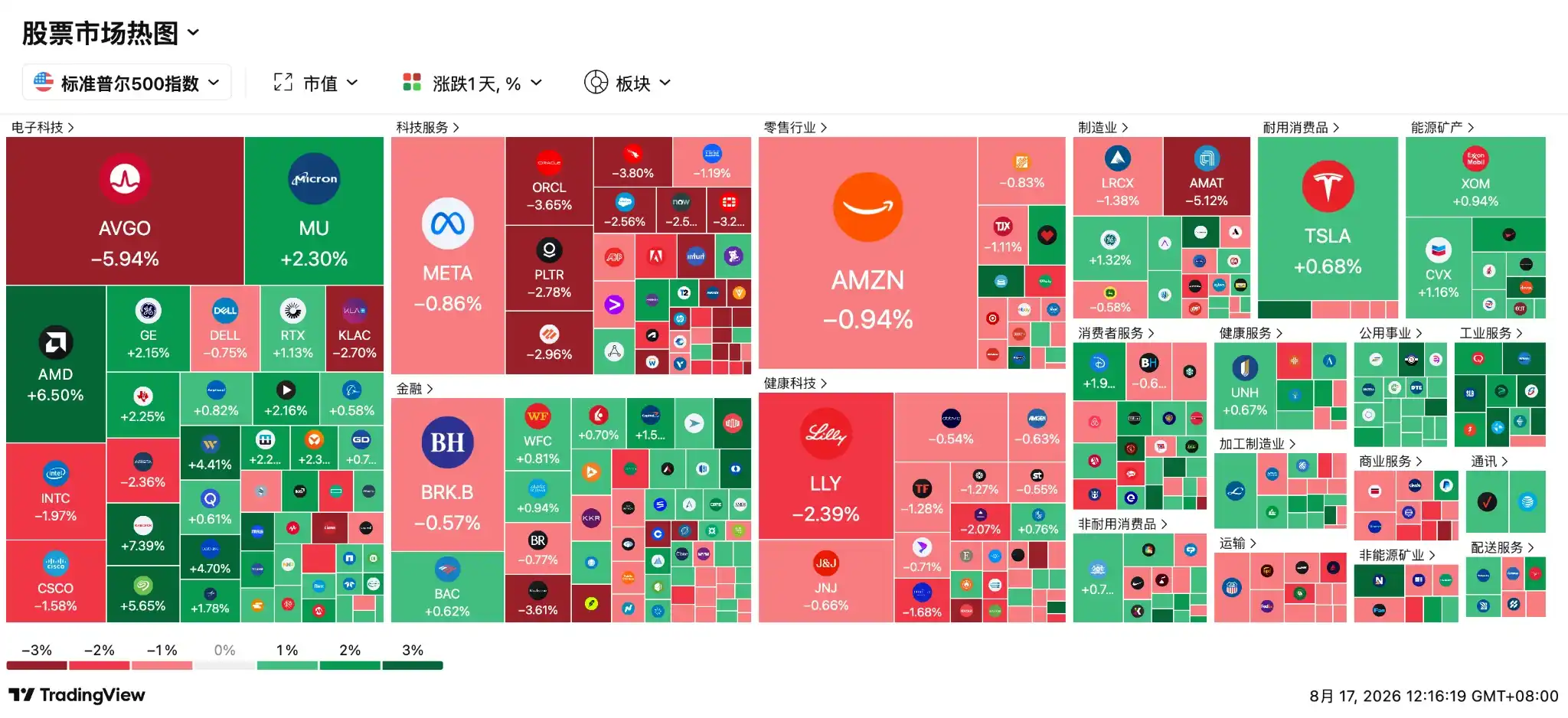
Last Friday, semiconductors saw sharp internal divergence. Storage concepts surged across the board: SanDisk jumped over 7%, up over 35% for the week; Seagate, Western Digital, and Micron followed. In optical communications, Applied Optoelectronics soared over 15%, with Lumentum and Corning also strong. AMD rose 6.5%, benefiting from a record investment-grade bond issuance and analysts raising expectations for the server CPU market.
Meanwhile, Broadcom fell nearly 6%, Applied Materials dropped over 5%, with KLA and Intel also under pressure. Market concerns shifted from "peak demand" to "seller financing guarantee exposure." Bank of America credit analysts downgraded Broadcom's bonds, estimating its AI compute leasing-related residual value guarantees could accumulate massive exposure in extreme scenarios.
The "Magnificent Seven" were mixed: Tesla and Apple rose slightly, Amazon, Meta, and Microsoft retreated modestly, and Nvidia was almost flat. Nvidia disclosed for the first time that it holds approximately $21 billion worth of SpaceX shares, becoming the latter's sixth-largest shareholder, while also holding about $30 billion in Intel shares. Tiger Global's Q2 13F filing showed a clear pattern of "reducing mega-caps, adding new players": selling Alphabet, Broadcom, etc., and establishing new positions in Cerebras, AMD, Seagate, and Visa, while increasing holdings in Intel.
Anthropic's CEO published a rare blog post over the weekend, emphasizing that AI must win trust by delivering on promises with verifiable scientific breakthroughs (like cancer treatment), not grand narratives. Meanwhile, data center demand is spilling over into power generation and energy storage equipment, with Caterpillar, Cummins, Eaton, etc., expanding capacity, and Ford shifting some battery production to energy storage. Goldman Sachs estimates the global space economy will reach $1.8 trillion by 2035, with launch costs falling 95% within a generation; SpaceX and others have become institutional asset classes.
Specific Company Actions and Stock Price Movements:
-
SanDisk up 7.39%, up over 35% for the week: JPMorgan upgraded it to Overweight. The company's Investor Day provided long-term targets of mid-to-high double-digit revenue growth and 80% gross margin, igniting narratives of storage shortages and HBM acyclicality. Micron up 2.3% (New Street Research upgraded Micron to "Buy," significantly raising the target price to $1,250, optimistic about AI's structural reshaping of HBM and DRAM capacity, expecting Micron's market cap to potentially reach $2-3 trillion by 2030.) Related sectors: Seagate up 5.65%, Western Digital up 4.41%.
-
Broadcom down 5.94%: Cumulatively down over 20% from June highs, mainly due to Bank of America downgrading its bonds. The market is extremely concerned about its residual value guarantee exposure for AI compute leasing, which could reach $370 billion by 2029, with potential default risks being repriced by the bond market. Related sectors: Applied Materials down 5.12% (earnings beat expectations but fell short of overly high ones), KLA down about 2.7%, Philadelphia Semiconductor Index down 0.31%.
-
Drone stocks collectively strong: The White House announced the U.S. will impose tariffs on imported drones and components, boosting local drone supply chains. Unusual Machines surged 25.04%, Red Cat Holdings up 8.8%, Draganfly up 5.84%.
-
Applied Optoelectronics surged 15.53%, benefiting from strong data center optical module demand and compute network upgrades. Related optical communication sectors: Lumentum up 5.19%, Corning up 4.70%, Credo Technology down 2.29%, Marvell Technology slightly down 0.07%.
-
Nvidia slightly down 0.06%, SpaceX slightly down 0.91%: Nvidia disclosed for the first time that it holds nearly $21 billion in SpaceX stock, becoming its sixth-largest shareholder. Meanwhile, due to investor concerns about risk exposure, the financial guarantee scale for the Nvidia-OpenAI 5 GW data center project in Ohio was slashed from $250 billion to below $120 billion. Nvidia also formed a $500 billion compute financing platform with financial giants like Blackstone and Apollo to move risk off its balance sheet. Trump advisor David Sacks warned that excessive expansion of GPU securitization could lead to risks similar to "dark fiber," i.e., "dark GPU" risks.
-
AMD up 6.5%, completing a record $4.75 billion bond issuance: Bank of America analysts raised their 2030 server CPU market size expectation to $210 billion and named AMD a top pick; Tiger Global established a $390 million position in AMD in Q2.
-
Oracle closed down 3.70%. Pipeline operator Energy Transfer disclosed that the "Green Chile" natural gas pipeline, supplying Oracle's Project Jupiter (a key node for Stargate) $165 billion AI data center, is delayed by six months to February 2027 due to land permit issues.
-
Nebius up 8.88%, up 47.73% for the week: Wedbush reiterated its optimistic view of benefiting from AI data center price increases, and Citi raised its target price from $278 to $324. The market views Nebius as a high-beta play on AI compute leasing and new cloud infrastructure.
-
Reddit up about 12.63%, confirmed to join the S&P 500 before the market opens on August 18th, driven by passive fund buying.
Focus for This Week:
August 17th (Monday)
-
08:00 South Korean Market Holiday: Supplemental holiday for Liberation Day. The South Korean market is closed. Short-term liquidity in the Asia-Pacific semiconductor chain decreases; sentiment reactions for Samsung Electronics, SK Hynix, etc., will be delayed until Tuesday.
-
Central Bank Overnight Reverse Repo Operations August 17-19: Daily operations up to 600 billion yuan, using fixed-rate, quantity bidding. If liquidity injection increases significantly, it will ease funding pressure and support bonds, interbank rates, and high-dividend assets.
August 18th (Tuesday)
-
Reddit Officially Added to S&P 500 Index: Index fund passive buying may continue to support RDDT short-term performance, but focus will shift to fundamentals post-inclusion, especially advertising growth, AI data licensing revenue, and user activity.
-
Xiaomi Corp. (19:30 call), Baidu (20:00 call), China Unicom, GigaDevice earnings: For Xiaomi, focus on smartphone premiumization, auto business gross margin, delivery pace, and AI investment. For Baidu, focus on AI Cloud, ERNIE commercialization, search advertising recovery, and autonomous driving progress. GigaDevice will test domestic memory cycle and MCU demand. China Unicom will be watched for cloud-network integration, compute network, and dividend stability.
August 19th (Wednesday)
-
U.S. Tariffs on Some Canadian Products: The White House announced on July 20th it would impose an additional 50% tariff on some Canadian dairy, alcohol, apparel, and furniture products, citing Canada's "discriminatory measures" in auto trade with the U.S.
-
Seoul AI Summit August 19-21: Tech leaders from Google DeepMind, Google Cloud, Microsoft Research, Nvidia, LG AI Research, Hyundai Motor, etc., will attend. Market attention on new partnerships in large models, AI cloud, autonomous driving, AI chips, and enterprise applications; related signals may catalyze global AI software, cloud computing, chip, and robotics chains.
-
World Robot Conference August 19-23 in Beijing: Humanoid and industrial robot solutions from companies like Unitree, Ubtech, SIASUN, Galaxy General, and Tiangang will be showcased. If mass production progress, order wins, or cost reductions exceed expectations, A-share robotics chain components (reducers, servos, motors, sensors, controllers) and OEMs may see sentiment-driven rallies.
-
HKEX, Kuaishou (19:00 call), Hengrui Medicine, ZTO Express, Kingsoft Software, Kingsoft Cloud, Weibo earnings: For Kuaishou, focus on e-commerce GMV, advertising recovery, profit margins, and AI video tools. For HKEX, watch trading volume, IPO pipeline, and derivatives business. Hengrui Medicine validates innovative drug overseas expansion and R&D delivery. Kingsoft Cloud serves as an observation point for elasticity in Chinese concept stock AI cloud demand.
August 20th (Thursday)
-
02:00 Fed July FOMC Meeting Minutes: The July meeting saw three dissenting votes to maintain rates, the largest split since 2016. If the minutes show hawkish strength is concentrated among a few officials, expectations for a September pause will solidify further, potentially leading to lower U.S. Treasury yields and a weaker dollar, benefiting gold, the Nasdaq, and high-valuation growth stocks. If more officials were close to supporting a hike, the market will reprice tightening risks, pressuring AI/tech valuations.
-
09:00 China One-Year Loan Prime Rate (LPR) Announcement: If earlier July economic data was weak, whether the LPR is cut will be a test of policy stance. A rate cut would benefit the property chain, consumption, Hong Kong internet stocks, and high-dividend assets. If unchanged, the market may shift to waiting for RRR cuts, fiscal expansion, or further property policy easing.
-
20:30 U.S. Initial Jobless Claims: Employment data will influence Fed pricing alongside the previously weak non-farm payrolls. If claims rise, it will strengthen expectations for economic cooling and a September pause; if employment remains strong, confidence in "holding steady" may decline.
-
Alibaba (20:00 call), Pop Mart, NetEase, Walmart, Ping An of China, China Telecom, AIA, Li Ning, Futu Holdings earnings: Alibaba is the top focus among Chinese concept stocks; the market watches e-commerce GMV, Cloud Intelligence revenue, AI investment, and Tongyi Qianwen commercialization. For Pop Mart, focus on IP overseas expansion, store expansion, and gross margin. NetEase validates game revenue and AI tools. Walmart is a core barometer of U.S. consumer resilience.
August 21st (Friday)
-
07:30 Japan July Core CPI: If inflation exceeds expectations, expectations for a September Bank of Japan rate hike will rise, potentially causing volatility in the yen and global yield curves. If inflation moderates, it will ease pressure from global carry trade unwinding and reduce upward pressure on global long-term rates.
-
08:00 South Korea August 1-20 Export Data: The previous reading showed a year-on-year surge of 52.3%, mainly driven by storage price increases and AI chip exports. This data is a leading indicator for the global semiconductor cycle and AI capex sustainability, directly impacting sentiment for Samsung, SK Hynix, Micron, TSMC, AMD, Nvidia, and A-share semiconductor chains.
-
Q2 Hang Seng Index Series Review Results Announcement: CICC predicts Zijin Gold International, Zhipu AI, MINIMAX-W, etc., are top candidates for potential inclusion. If inclusion expectations materialize, it will bring passive fund allocation and short-term liquidity catalysts. If expectations are dashed, related stocks may see profit-taking pressure.
-
NYMEX WTI Crude Oil September Contract Rollover: Amid Hormuz risks and U.S. sanctions expectations on Iran, the rollover could amplify near-month contract volatility. If the spot premium widens, it indicates tight physical supply. If the spread narrows, upward momentum for oil prices may weaken.
-
ZTE, Zijin Mining, InnoLight, Changfei Fiber, KE Holdings, Sinopec earnings: InnoLight and Changfei Fiber will validate AI optical module and fiber demand. ZTE is watched for compute network and carrier capex. Zijin Mining is driven by gold and copper prices. KE Holdings reflects recovery in China's property transaction chain. Sinopec is directly impacted by oil prices and refining spreads.
August 22nd (Saturday)
-
2nd World Humanoid Robot Sports Games August 22-26: New events like robot tug-of-war, pitching arrows, and weightlifting will showcase humanoid robots' motion control, stability, endurance, and scenario adaptability. If on-site performance exceeds expectations, theme-driven capital may continue chasing robotics OEMs, reducers, servo systems, sensors, and AI control algorithms.