These Metrics Hint At Massive Bitcoin ‘Buying Opportunity’, Says Analyst

BitcoinistPublished on 2023-01-27Last updated on 2023-01-27

Abstract

Bitcoin usually sets the pace for other cryptocurrencies to follow. Analysts usually focus on Bitcoin to identify or predict market trends.

Bitcoin usually sets the pace for other cryptocurrencies to follow. Analysts usually focus on Bitcoin to identify or predict market trends.

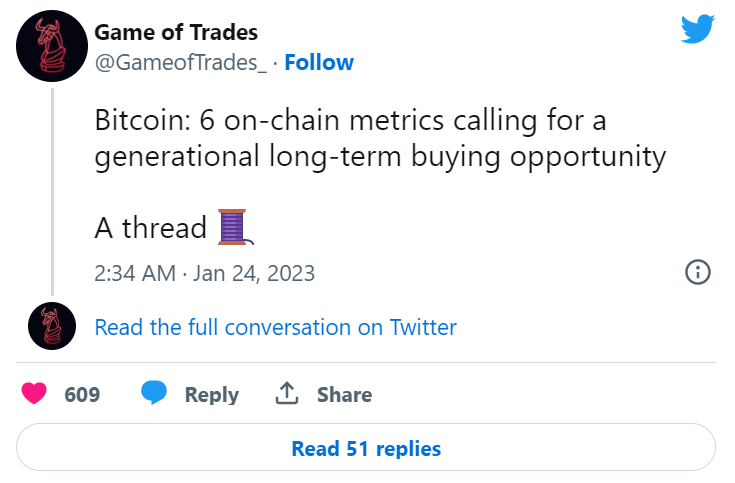
The latest analysis from pseudonym analyst Game of Tradeshas revealed six on-chain metrics showing the same levels that occurred during the bottom three bear markets in the past. The analyst Game of Trades says that the on-chain data signals BTC investment as a “generational buying opportunity.”

Analyst Reveal Six Important Metrics For Bitcoin

The pseudonym analyst shared his findings on Twitter, discussing the current accumulation, reserve risk, dormancy floor, and other positive key indicators for Bitcoin.
Accumulation Trend Score

According to Game of Trades, these on-chain metrics show that there has been a significant accumulation among investors. First, the investors accumulating BTC are large entities and have been buying heavily since the crash of FTX.

Comparing this trend to the past, the analyst pointed out that the same happened in 2018 and 2020 when BTC was bottoming out. The analyst said:

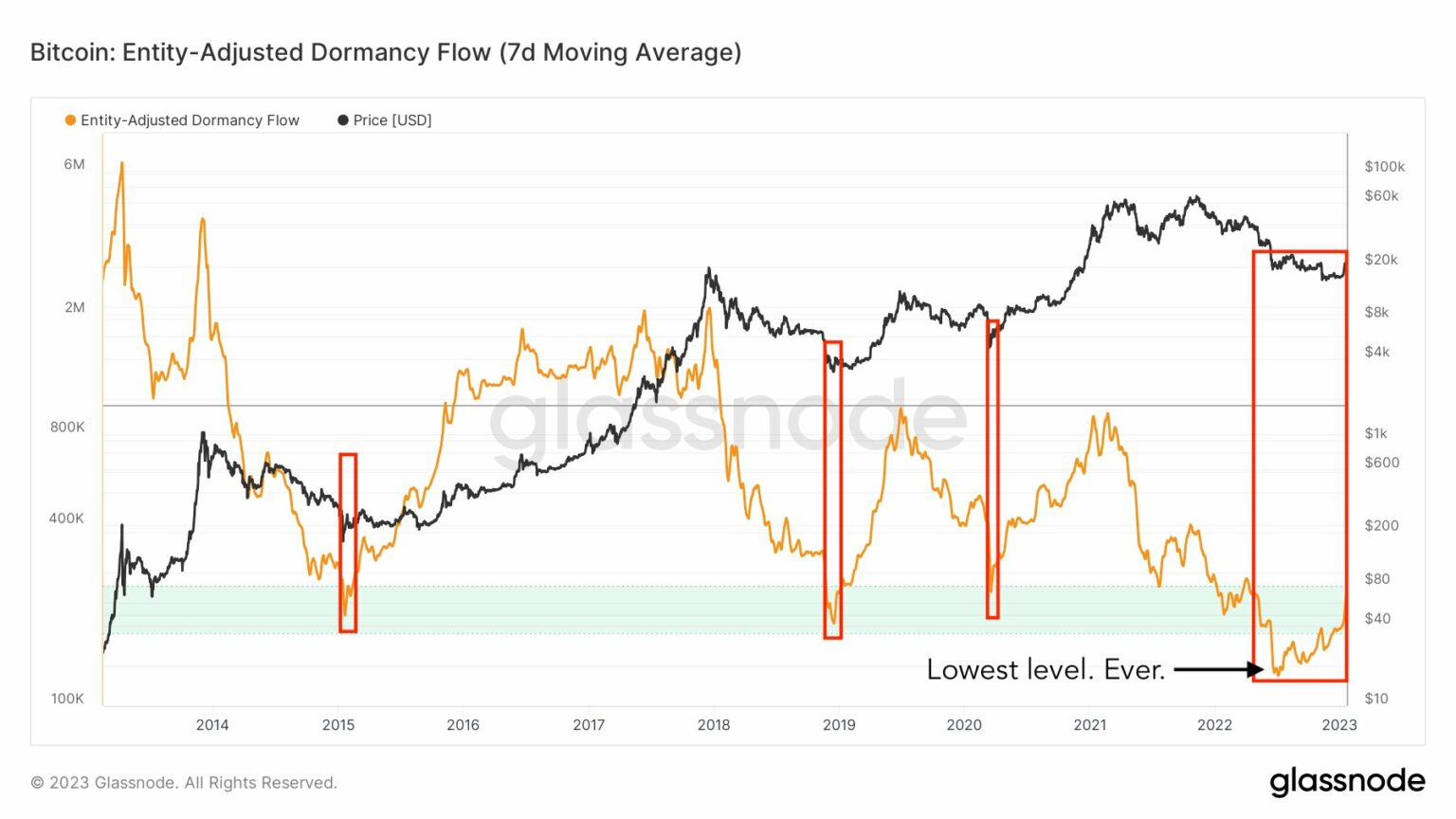
Dormancy flow came down to its lowest level EVER seen Indicating that the speculative hands have been washed out And only the strong holders aka HODLers are remaining

Bitcoin Entity-Adjustment Dormancy Flow

This on-chain metric measures the ratio of the present market cap and the annualized dormancy value.

When the dormancy value is higher than the market cap, the analyst considers the market in total capitulation. Historically, this point signals a buying zone, and Glassnode revealed that it fell to the lowest level last year, 2022.
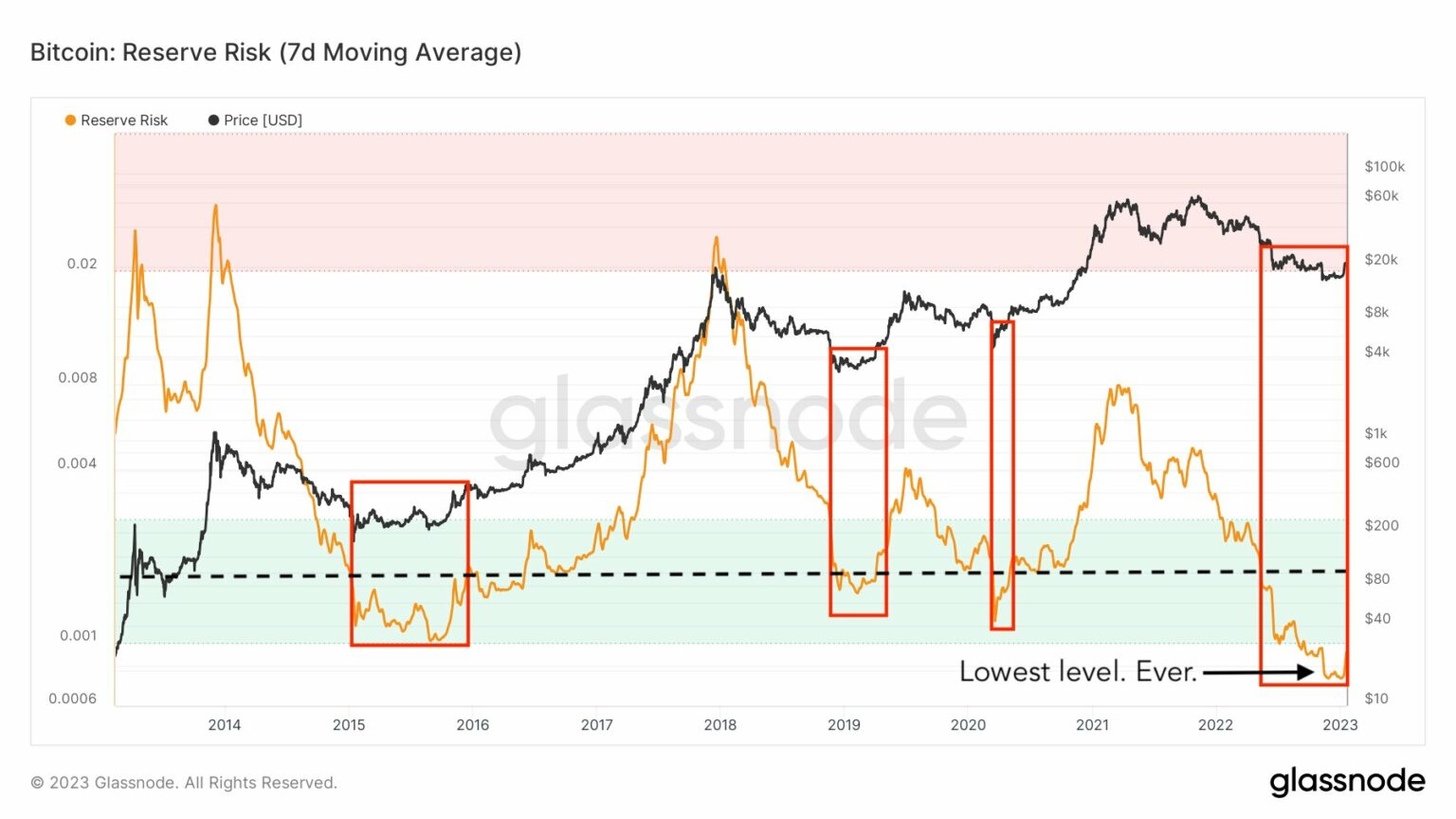
Bitcoin Reserve Risk

This is the third on-chain metrics supporting Game of Trades analysis. The Bitcoin reserve risks measure the confidence level of long-term BTC holders relative to its price. Glassnode data also shows that it fell to the lowest level last year ending indicating high conviction from BTC holders about future price appreciation.
Bitcoin’s Realized Price (RP)

Bitcoin RP is an on-chain metric showing the value of circulating coins at their last price. Simply put, it shows the estimate of what the entire crypto market paid for the BTC supply. But based on Woo Charts, BTC had fallen below the RP level since November 2022, when FTX collapsed until January 13.

According to the analyst, Bitcoin is now above its Realized Price level, suggesting potential for another buying opportunity.
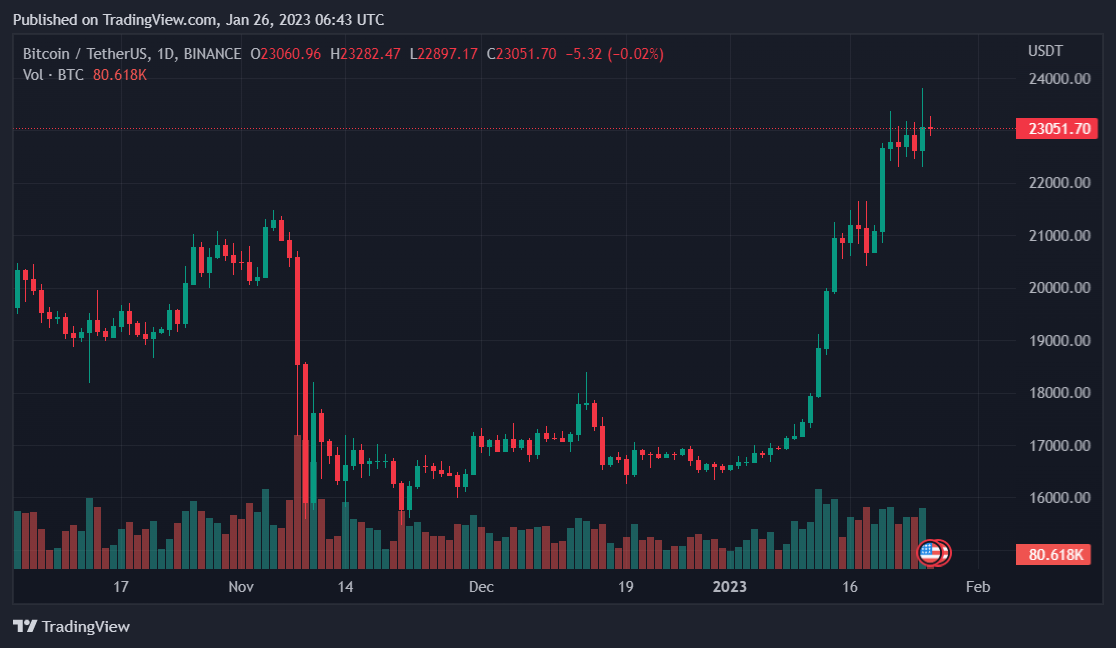
Bitcoin’s MVRV Z-Score

This metric shows when Bitcoin is overvalued or undervalued relative to its realized price or fair value. According to Game of Trades, when the MVRV Z-score moves away from the highly undervalued zone, it indicates a bear market end.

This metric examines mining profitability and how it would affect the market cycles. According to Game of Trades, Bitcoin PM is currently lower, indicating a potential for long-term buying opportunities.

The analyst compared the six metrics above, which marked a bottom in 2015, 2018, and 2022. As mentioned, these metrics are at similar levels. Based on these findings, Game of Trades concludes that investors should expect an unusual risk-reward setup in BTC to the upside.


Trending Cryptos

Related Reads

Analyzing the Impact of AI on Economic Growth and Productivity

**Title: Analyzing AI's Impact on Economic Growth and Productivity** This article examines three contrasting views on AI's influence on economic growth and productivity. **The Optimistic View** posits that AI, especially through automating R&D ("recursive self-improvement"), could dramatically accelerate growth, even triggering a technological "singularity" with explosive, potentially infinite, economic expansion. **The Moderate/Mainstream View** acknowledges AI's productivity benefits but emphasizes significant real-world constraints that could limit its impact. These include: limited cost savings per task, structural ceilings on which jobs and industries are "exposed" to AI, adoption bottlenecks (e.g., compute, energy, regulatory hurdles), and the "weak link" effect where non-automatable tasks cap overall gains. Consequently, the realized AI dividend may be far lower than optimistic projections, with estimates typically ranging from 0.1% to 1.3% annual productivity growth. **The Pessimistic View** stems from two strands. The first aligns with the moderate view but applies extremely conservative assumptions about task exposure and efficiency gains, yielding minimal projected impact. The second introduces a demand-side critique: if AI primarily replaces rather than augments labor, it could depress labor's share of income, weaken consumer demand, and create a "demand trap" that ultimately stifles growth, unless offset by redistribution policies. **The authors' assessment** is nuanced: * **Short-term (1-2 years):** AI will support growth primarily through investment spending, not significant productivity gains. * **Medium-term (3-5 years):** Three potential paths emerge based on AI demand and bottleneck severity: 1. **"Optimistic Path":** High demand, few bottlenecks. Rapid productivity gains but risk of major job displacement and social conflict without redistribution. 2. **"Moderate Path" (most likely):** High demand but significant, surmountable bottlenecks. Leads to moderate productivity gains, financial market volatility (K-shaped returns), and sectoral job losses. 3. **"Pessimistic Path":** Low demand or severe bottlenecks. Minimal productivity and growth impact, triggering financial market corrections but allowing a smoother societal transition with less labor disruption. * **Long-term:** AI holds potential for a major productivity revolution and prosperity. The conclusion stresses that no path is smooth. Technologically "optimistic" outcomes could be socially detrimental, while "pessimistic" technological diffusion might be more socially stable. Policymakers must monitor developments and prepare balanced responses to manage economic, financial, and social sustainability.

marsbit41m ago

Analyzing the Impact of AI on Economic Growth and Productivity

marsbit41m ago

Trading

Spot

Hot Articles

What is $BITCOIN

DIGITAL GOLD ($BITCOIN): A Comprehensive Analysis Introduction to DIGITAL GOLD ($BITCOIN) DIGITAL GOLD ($BITCOIN) is a blockchain-based project operating on the Solana network, which aims to combine the characteristics of traditional precious metals with the innovation of decentralized technologies. While it shares a name with Bitcoin, often referred to as “digital gold” due to its perception as a store of value, DIGITAL GOLD is a separate token designed to create a unique ecosystem within the Web3 landscape. Its goal is to position itself as a viable alternative digital asset, although specifics regarding its applications and functionalities are still developing. What is DIGITAL GOLD ($BITCOIN)? DIGITAL GOLD ($BITCOIN) is a cryptocurrency token explicitly designed for use on the Solana blockchain. In contrast to Bitcoin, which provides a widely recognized value storage role, this token appears to focus on broader applications and characteristics. Notable aspects include: Blockchain Infrastructure: The token is built on the Solana blockchain, known for its capacity to handle high-speed and low-cost transactions. Supply Dynamics: DIGITAL GOLD has a maximum supply capped at 100 quadrillion tokens (100P $BITCOIN), although details regarding its circulating supply are currently undisclosed. Utility: While precise functionalities are not explicitly outlined, there are indications that the token could be utilized for various applications, potentially involving decentralized applications (dApps) or asset tokenization strategies. Who is the Creator of DIGITAL GOLD ($BITCOIN)? At present, the identity of the creators and development team behind DIGITAL GOLD ($BITCOIN) remains unknown. This situation is typical among many innovative projects within the blockchain space, particularly those aligning with decentralized finance and meme coin phenomena. While such anonymity may foster a community-driven culture, it intensifies concerns about governance and accountability. Who are the Investors of DIGITAL GOLD ($BITCOIN)? The available information indicates that DIGITAL GOLD ($BITCOIN) does not have any known institutional backers or prominent venture capital investments. The project seems to operate on a peer-to-peer model focused on community support and adoption rather than traditional funding routes. Its activity and liquidity are primarily situated on decentralized exchanges (DEXs), such as PumpSwap, rather than established centralized trading platforms, further highlighting its grassroots approach. How DIGITAL GOLD ($BITCOIN) Works The operational mechanics of DIGITAL GOLD ($BITCOIN) can be elaborated on based on its blockchain design and network attributes: Consensus Mechanism: By leveraging Solana’s unique proof-of-history (PoH) combined with a proof-of-stake (PoS) model, the project ensures efficient transaction validation contributing to the network's high performance. Tokenomics: While specific deflationary mechanisms have not been extensively detailed, the vast maximum token supply implies that it may cater to microtransactions or niche use cases that are still to be defined. Interoperability: There exists the potential for integration with Solana’s broader ecosystem, including various decentralized finance (DeFi) platforms. However, the details regarding specific integrations remain unspecified. Timeline of Key Events Here is a timeline that highlights significant milestones concerning DIGITAL GOLD ($BITCOIN): 2023: The initial deployment of the token occurs on the Solana blockchain, marked by its contract address. 2024: DIGITAL GOLD gains visibility as it becomes available for trading on decentralized exchanges like PumpSwap, allowing users to trade it against SOL. 2025: The project witnesses sporadic trading activity and potential interest in community-led engagements, although no noteworthy partnerships or technical advancements have been documented as of yet. Critical Analysis Strengths Scalability: The underlying Solana infrastructure supports high transaction volumes, which could enhance the utility of $BITCOIN in various transaction scenarios. Accessibility: The potential low trading price per token could attract retail investors, facilitating wider participation due to fractional ownership opportunities. Risks Lack of Transparency: The absence of publicly known backers, developers, or an audit process may yield skepticism regarding the project's sustainability and trustworthiness. Market Volatility: The trading activity is heavily reliant on speculative behavior, which can result in significant price volatility and uncertainty for investors. Conclusion DIGITAL GOLD ($BITCOIN) emerges as an intriguing yet ambiguous project within the rapidly evolving Solana ecosystem. While it attempts to leverage the “digital gold” narrative, its departure from Bitcoin's established role as a store of value underscores the need for a clearer differentiation of its intended utility and governance structure. Future acceptance and adoption will likely depend on addressing the current opacity and defining its operational and economic strategies more explicitly. Note: This report encompasses synthesised information available as of October 2023, and developments may have transpired beyond the research period.

1.2k Total ViewsPublished 2025.05.13Updated 2025.05.13

What is $BITCOIN

Discussions

Welcome to the HTX Community. Here, you can stay informed about the latest platform developments and gain access to professional market insights. Users' opinions on the price of BTC (BTC) are presented below.

活动图片