FT: World’s largest crypto fund swept into FTX storm

Financial TimesPublished on 2022-11-21Last updated on 2022-11-22

Abstract

The world’s largest cryptocurrency fund has become embroiled in the turmoil swirling around the troubled sector, in a further sign of waning enthusiasm for digital assets.

The world’s largest cryptocurrency fund has become embroiled in the turmoil swirling around the troubled sector, in a further sign of waning enthusiasm for digital assets.

The share price of the $10.5bn Grayscale Bitcoin Trust (GBTC), which owns 3.5 per cent of the world’s bitcoin, has plummeted to a 39 per cent discount to the value of its underlying assets as investors have embarked on an increasingly desperate scramble to exit.

The blowout means investors in the trust have suffered an 83 per cent loss since bitcoin peaked in November 2021, outstripping the 74 per cent slide in the value of bitcoin itself.

Confidence in digital assets has been sideswiped by the implosion of crypto exchange FTX, the fallout from which is rippling through the near-$1tn industry due to the complex and often opaque linkages between major players.

Fears struck closer to home for Grayscale on Wednesday when crypto broker Genesis Trading, which originated more than $50bn of loans last year, suspended redemptions and originations of loans at its lending arm after suffering financial contagion from the failure of Three Arrows Capital, the Singapore crypto hedge fund that filed for bankruptcy in July.

Grayscale and Genesis are both subsidiaries of Digital Currency Group, a Stamford, Connecticut-based venture capital company.
Genesis acted as authorised participant to GBTC, responsible for issuing new shares, until last month when Grayscale launched an in-house broker-dealer, Grayscale Securities.

Digital Currency Group is also the largest shareholder in GBTC, with a 4.1 per cent stake, or 28.2mn shares, according to Refinitiv data.

GBTC’s central problem is that it has been superseded by the advent of better vehicles for holding bitcoin.

When it launched as a private placement offering in 2013 it was one of the few of its kind and, as the crypto industry expanded, it rapidly increased its share count to soak up the incoming tide of cash.

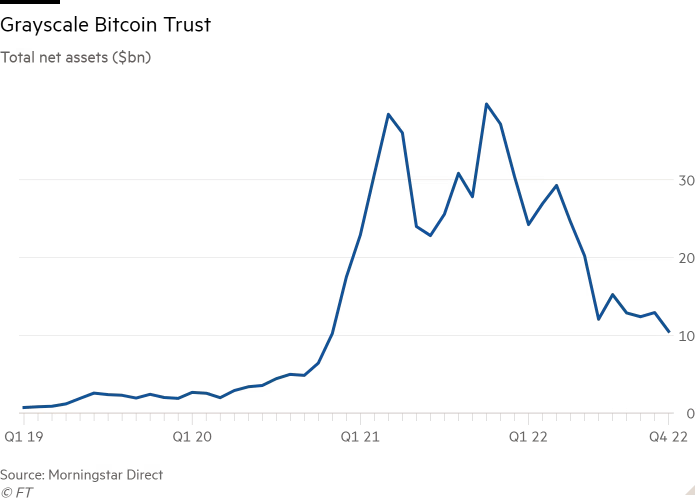
Net assets peaked at $39.8bn in October 2021, according to Morningstar data, and GBTC perennially traded at a premium to net asset value.

However, it was undermined by the emergence of the first bitcoin exchange traded funds in Canada that year. These vehicles’ fees were typically less than half the 2 per cent a year charged by GBTC. They also offered greater liquidity and new investors did not need to pay a premium.
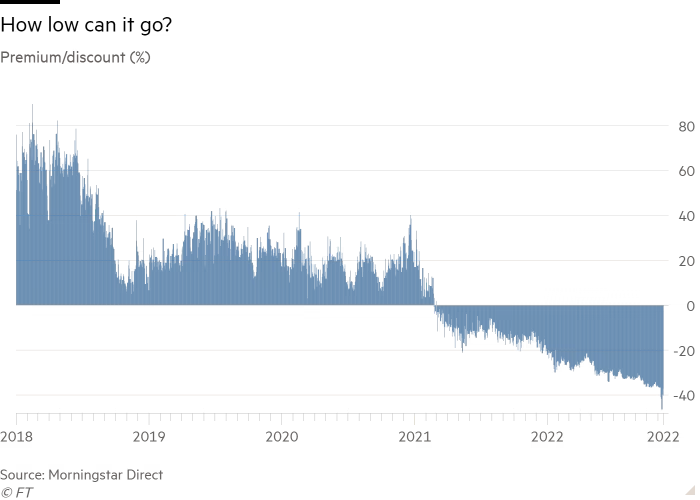
As flows drifted away from GBTC, demand and supply for its shares was tipped out of kilter, pushing its share price to a sharp discount to NAV.

The underlying problem is that — unlike for ETFs — there is no arbitrage mechanism to bring supply and demand back into balance.

GBTC shares cannot be redeemed for bitcoin or cash and can only be sold to another buyer via the over-the-counter market. Grayscale would need regulatory approval to institute a share buyback programme.

Grayscale instead hopes to convert GBTC into a “spot” bitcoin ETF, holding the “physical” currency. These plans have so far been blocked by the US Securities and Exchange Commission, which has refused to follow the lead of regulators in Canada and elsewhere by approving spot bitcoin ETFs, citing concerns over potential fraud and manipulation on the unregulated exchanges where trading occurs.

Grayscale, which declined to comment for this story, is currently suing the SEC for the right to convert GBTC. The ever-widening discount suggests few market participants believe it is likely to succeed, however.

“If they were successful in winning the court case then any investors would be made whole. The discount would sharply erode because the [share] creation and redemption process can freely occur,” said Todd Rosenbluth, head of research at VettaFi.

Nate Geraci, president of The ETF Store, said “GBTC’s structure is clearly suboptimal, since shares cannot be redeemed.

“It’s highly disappointing that the SEC continues allowing any retail investor to access this fund, yet they won’t approve a spot bitcoin ETF which would solve the discount problem. This is yet another example of the absurd regulatory dysfunction around the entire crypto ecosystem right now,” Geraci added.

Some investors have kept the faith. Ark Investment Management, already the third-largest shareholder in GBTC with a near-1 per cent stake, this week bought a further $2.8mn of shares.

In October, Ark chief executive Cathie Wood said GBTC was trading at a “fire sale” price given the possibility of it being converted into an ETF at some point. Ark, which is also seeking permission to launch a spot ETF, said it does not comment on daily trading activity.

The second-largest shareholder, with 2.9 per cent, is BlockFi, a crypto lending and trading platform that has halted withdrawals of customer deposits due to its “significant exposure” to FTX.

Peter Tchir, head of macro strategy at Academy Securities, raised the prospect of Grayscale seeking permission to buy back a large quantity of shares, then liquidating the fund, potentially making more than enough profit to compensate for its loss of fee income and making external investors whole in the process.

However, Geraci believed there was every chance of the discount widening still further “especially if there is further FTX contagion which weighs on the crypto space as a whole”.

Nevertheless, he suggested GBTC “is clearly a better option than holding bitcoin on an exchange like FTX, as investors can operate with confidence that the underlying bitcoin is actually there”.

Moreover, Geraci believed the FTX debacle has bolstered the case for regulatory oversight of crypto exchanges, “theoretically accelerating the timeline for spot bitcoin ETF approval”.

However, Rosenbluth thought the SEC would see the fiasco as a vindication of its position.

“The SEC has viewed spot bitcoin as risky and is concerned about fraud and manipulation,” he said. “I’m not sure they are going to be surprised by these developments.”


Related Reads

Listed and Halted, Surge Over 108% in a Single Day, Is Cerebras Really the 'Next Nvidia'?

Cerebras Systems (CBRS), labeled the "next Nvidia," debuted on the NASDAQ on May 14th, 2025. Its stock price surged over 108% from its $185 IPO price, briefly touching $385 before settling around $311. CEO Andrew Feldman claimed the company's wafer-scale AI chips are "58 times larger and 15-20 times faster" than competitors like Nvidia. The company's core innovation is the Wafer Scale Engine (WSE), a massive, dinner-plate-sized chip designed to avoid the bottlenecks of interconnecting multiple GPUs. Its latest system, the CS-3, offers high-performance computing for AI training and inference. While still a niche player with $5.1 billion in 2025 revenue, Cerebras has secured major contracts, most notably a multi-year, over $20 billion computing deal with OpenAI. This partnership is deep: OpenAI is a major customer, a creditor via a $1 billion loan, and holds warrants that could make it a 10-11% shareholder in Cerebras. Despite the hype, the article argues Cerebras is unlikely to dethrone Nvidia soon. Nvidia's ecosystem (CUDA), vast scale, manufacturing efficiency, and diversified product line present a formidable moat. Cerebras faces high costs, production challenges with its giant chips, and competition from AMD, Google, and others. However, strong demand for AI inference and its key partnerships could support its stock price in the short to medium term. In conclusion, Cerebras is positioned as a high-speed specialist in the AI hardware market, not a broad-market replacement for the current industry leader.

Odaily星球日报11m ago

Listed and Halted, Surge Over 108% in a Single Day, Is Cerebras Really the 'Next Nvidia'?

Odaily星球日报11m ago

BIT Research: If It Followed Nasdaq, Bitcoin Should Be Close to $140,000

BIT Research: Bitcoin Price Analysis Under Inflation Re-pricing The market is currently undergoing a macro adjustment phase dominated by inflation re-pricing. Analysis suggests that if Bitcoin had continued to follow Nasdaq's trajectory, its theoretical price would be near $140,000. However, a significant divergence between the two assets has emerged since October 2025. The core reason is the resurgence of US inflation, which has led to a reversal in market expectations for the Federal Reserve's rate-cut path. Recent data shows US CPI rising to 3.8% and PPI to 6.0%, prompting markets to scale back expectations for 2026 rate cuts. For Bitcoin, the previous supportive narrative of anticipated loose liquidity is weakening. Concurrently, escalating tensions involving Iran have driven oil prices up approximately 40% since late February 2026, heightening inflation concerns through rising energy costs. While the market currently views this inflation surge as a temporary pressure point, the interplay between energy, interest rates, and risk appetite is prompting a reassessment of the potential for a prolonged high-rate environment. In this context, Bitcoin has begun to underperform tech stocks, which can benefit from nominal inflation. The divergence stems from a key distinction: Bitcoin's past rallies were driven by loose liquidity and rate-cut expectations, not inflation itself. As a long-duration asset, Bitcoin is highly sensitive to interest rate paths. When expectations for rate cuts are withdrawn, its valuation faces pressure. Unlike equities, which can benefit from increased nominal revenues and reduced real debt burdens during inflation, Bitcoin possesses neither debt that inflates away nor cash flows that expand with inflation, offering no direct structural benefit from rising prices. Looking ahead, the critical question is whether high inflation will force the Fed to maintain elevated rates for longer. The BIT model anticipates US CPI could potentially rise further to 6.0%. Additionally, factors like AI infrastructure expansion—driving data center construction and power demand—may sustain energy price pressures and extend the period of above-target inflation. In such an environment, tech stocks gain from order growth and improved earnings expectations, while Bitcoin remains susceptible to high-rate pressure. In summary, the current shift does not invalidate Bitcoin's long-term thesis but reflects a market re-evaluation of interest rate and liquidity paths amid resurgent inflation. In the short term, a high-inflation environment may continue to suppress Bitcoin's performance relative to Nasdaq. This represents a slowdown in its upward momentum rather than a bearish turn. Bitcoin could regain support once markets begin to reprice expectations for future liquidity easing.

marsbit38m ago

BIT Research: If It Followed Nasdaq, Bitcoin Should Be Close to $140,000

marsbit38m ago

Bankless Interview: Private Equity Insiders Reveal the Inside Story of Anthropic's Primary Market Trading

**Bankless Interview: A Private Equity Veteran Exposes the Dark Side of Anthropic's Pre-IPO Trading** In a Bankless podcast, Patagon founder Dio Casares reveals the opaque inner workings of the massive secondary market for shares in pre-IPO giants like Anthropic. The market, driven by private SPVs (special purpose vehicles), brokers, and even informal networks, sees hundreds of billions in notional value changing hands, with single-deal fees as high as 10%. However, an estimated 10-20% of transactions involve fraud or fabricated share certificates. Intermediaries often profit more from these deals than from their core investment businesses. Two types of "secondary" exist: company-sanctioned trades (like employee tender offers) that bring new money to the company, and disruptive "gray market" trades on platforms like Hive or Forge, which companies like Anthropic actively fight. The latter creates pricing chaos and complicates primary fundraising. A major risk involves multi-layered, nested SPV structures. When a company like Anthropic finally IPOs, delays in distributing shares down these chains, combined with discretionary powers of fund managers (GPs) to hold or sell, could trigger a wave of lawsuits and settlement nightmares lasting years. For small investors in "tokenized" versions of these assets, transparency is minimal, and due diligence is often impossible. Casares advises extreme caution, suggesting investors trust their gut and exit if something feels wrong. He warns that the post-IPO period will be a major "reckoning" for this wild and largely unregulated market.

marsbit1h ago

Bankless Interview: Private Equity Insiders Reveal the Inside Story of Anthropic's Primary Market Trading

marsbit1h ago

Is Elon Musk Actually the Victim?

"Victim or Vindicator? Inside the OpenAI Trial That Shattered the Myth." In May 2026, the federal court in Oakland became the stage for deconstructing the carefully curated narrative of OpenAI. The trial revealed a complex reality far removed from its founding ideals. The core dispute centered on whether OpenAI, founded in 2015 as a non-profit dedicated to benefiting "all of humanity," had betrayed its mission by shifting towards a lucrative commercial structure, particularly after its 2019 capped-profit affiliate (OpenAI LP) was established and Microsoft invested $13 billion. Elon Musk, a co-founder and early funder, sued, claiming the organization was "stolen" and turned into a de facto Microsoft subsidiary for private gain. OpenAI countered that Musk's funds were unconditional donations and his lawsuit was driven by a desire for control and regret after leaving to found his own AI venture, xAI. The trial exposed early fractures. Evidence from 2017, years before ChatGPT's success, showed the founders were already grappling with the immense financial demands of pursuing Artificial General Intelligence (AGI). Musk himself had proposed having Tesla fund OpenAI. The court scrutinized whether the founders knowingly crossed a moral line. Greg Brockman's personal diary, entered as evidence, contained entries about wealth goals and anxieties over the company's revenue path, alongside self-reminders about the moral bankruptcy of "stealing" the non-profit. Brockman later testified his OpenAI stake was worth nearly $30 billion. The character of CEO Sam Altman was a key battleground. Musk's legal team cited five individuals, including co-founder Ilya Sutskever and former board members, who had described Altman as dishonest. This highlighted a recurring "trust debt" within OpenAI's leadership, exemplified by the chaotic 2023 boardroom coup and subsequent reinstatement. Altman defended his position, arguing Musk sought to absorb OpenAI into Tesla and that commercial success amplified OpenAI's charitable impact. Testimony from Microsoft CEO Satya Nadella underscored how commercial realities now dominated. While framing Microsoft's massive investment as a way to enlarge the non-profit's funding "pie," texts revealed Nadella pressuring Altman to launch ChatGPT's paid version quickly. Nadella also revealed that during the 2023 crisis, Microsoft was prepared to hire Altman and his team, showcasing the board's diminished power against the gravity of capital, talent, and infrastructure. Ultimately, the trial depicted OpenAI not as a singular act of betrayal but as a gradual, systemic transformation. Its grand AGI mission required a "heavier machine" to sustain it—a machine of computing power (largely from Microsoft), capital, and commercial obligations that inevitably reshaped its priorities. The non-profit board, tasked with guarding the mission, found itself unable to control the commercial juggernaut it had enabled. For the public, the proceedings served as a sobering window into the making of a foundational technology. The AI tools increasingly integrated into daily life—from writing and coding to customer service—are not born from a transparent, purely altruistic process. They emerge from a tangled web of personal ambitions, private negotiations, control struggles, and cloud computing bills. The trial's legacy is the stark realization that as AI becomes societal infrastructure, its steering wheel remains in very few, and very human, hands.

marsbit1h ago

Is Elon Musk Actually the Victim?

marsbit1h ago

Trading

Spot
Futures
活动图片