80% of Tokens Fall Below Issue Price, IPO Financing Soars 48 Times—Crypto Capital Shift Has Occurred

marsbitPublished on 2026-03-15Last updated on 2026-03-15

Abstract

The crypto industry is witnessing a significant capital shift from token offerings to traditional equity markets. In 2025, over 80% of tokens traded below their initial offering price due to high volatility, weak demand, and poor tokenomics, eroding investor confidence. Conversely, crypto IPOs surged 48x, raising $14.6 billion, while M&A activity hit a five-year high of $42.5 billion. Equity offerings, compared to tokens, demonstrate similar upside potential but with lower volatility and longer-term growth. Stocks command higher valuation premiums (P/S ratios of 7-40x vs. 2-16x for tokens) due to institutional access, index inclusion potential, and richer trading strategies. Key valuation factors include regulatory moats, revenue diversification, and sector sentiment. M&A activity is accelerating, driven by regulatory compliance and strategic expansion, with focus on trading infrastructure, exchanges, and stablecoins/payments. Major acquisitions were led by Coinbase, Kraken, and Ripple. Upcoming IPOs in 2026 include Kraken, Consensys, Ledger, Animoca, and Bithumb. The future lies in blending TradFi validation with crypto innovation, emphasizing sustainable revenue and long-term value creation.

Author: DWF Ventures

Compiled by: Deep Tide TechFlow

Deep Tide's Introduction: This report from DWF Ventures makes one thing clear with data: money hasn't left crypto, it has just shifted tracks. In 2025, over 80% of tokens traded below their initial offering price, while crypto IPO financing surged 48 times to $14.6 billion, and M&A reached a five-year high of $42.5 billion. This isn't just a matter of market mood; it's a systemic migration of capital structure, with a wave of IPOs including Kraken, Ledger, and Animoca on the way for 2026.

Core Conclusions

The old playbook for token offerings is over. High valuations and declining liquidity have hit investor confidence, and we are seeing a shift of funds towards equity.

Tokens and equity offer similar upside potential, but their risk structures are vastly different: tokens peak faster (within 30 days) and face greater volatility; equity, on the other hand, maintains steady gains over a longer time horizon.

Equity enjoys a higher valuation premium than tokens: this premium can be attributed to institutional access barriers, potential for index inclusion, and the richer trading strategies supported by equity.

Price-to-Sales (P/S) ratio provides a useful benchmark for company evaluation, but the dispersion in valuations reflects the importance of other factors, including regulatory moats, revenue diversification, shareholder value, and sector sentiment.

M&A activity hits a five-year high, consolidation accelerates: Acquiring capabilities is proving faster than building them, and regulatory compliance is driving strategic M&A.

The Current State of Token Offerings

The crypto industry has reached an inflection point. Billions of dollars are pouring in, institutional interest is at a peak, and regulation is becoming friendlier—yet for builders and users, everything feels gloomier than ever. The widening gap between institutional inflows and the morale of the crypto-native community is part of a larger problem—the original spirit of decentralization and cypherpunk experimentation seems to be fading with the influx and immense influence of centralized entities.

Crypto has also thrived in a high-risk, casino-like environment, which is being slowly stripped away as token performance plummets. This is also driven by extractive events that significantly impact retail investors, leading to liquidity withdrawal from the market.

According to a report by Memento Research, over 80% of tokens issued in 2025 are currently trading below their TGE price. Projects have been severely hit by high volatility and a general lack of token demand—due to high valuations that are difficult to justify and sustain. Upside is also scarce, with most tokens facing massive selling pressure from TGE—stemming from early profit-taking, lack of substantial confidence in the product, or poor token economic models (airdrops, CEX listings, etc.). This has dampened investor and retail interest, and events like 10/10 have further exacerbated crypto outflows, calling into question the industry's core infrastructure.
The Rise of IPOs

Meanwhile, in traditional markets, IPOs are gaining strong traction among crypto companies—2025 saw many notable listings, and more companies are filing for upcoming IPOs. Data shows that crypto IPO financing increased 48 times compared to 2024, raising over $14.6 billion in 2025. M&A deals experienced similar growth, with leading core companies seeking to diversify their offerings, which we explore further below. Overall, the strong performance of these companies demonstrates a robust market demand for digital asset exposure, a momentum likely to accelerate further into 2026.

The Flow of Liquidity

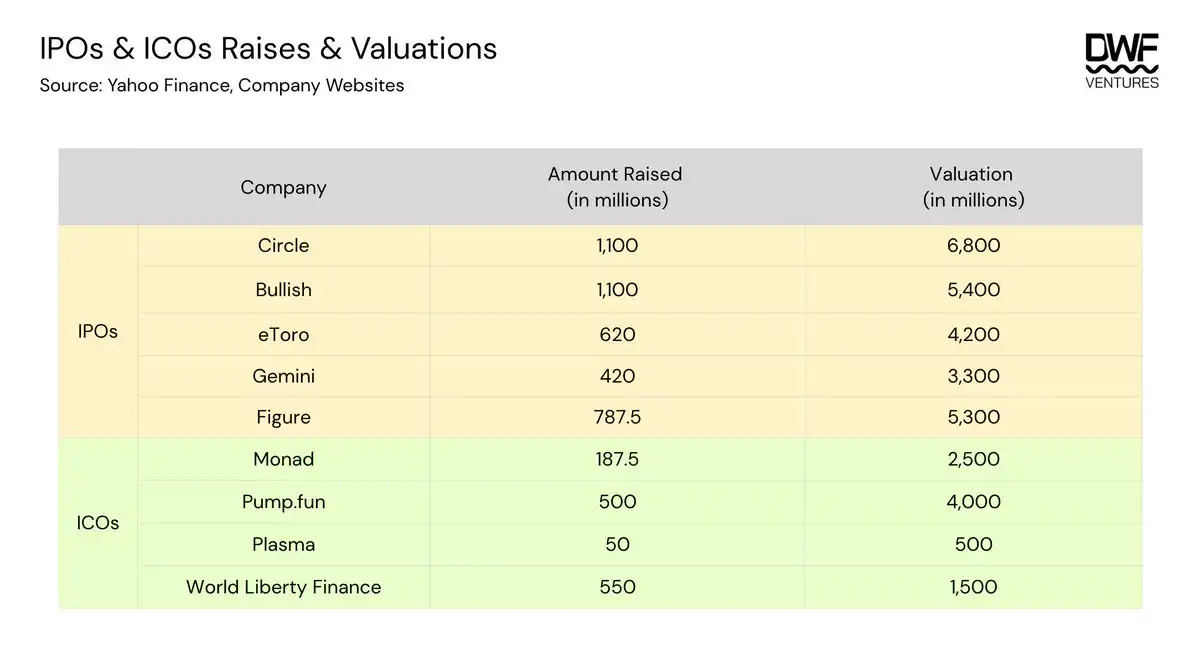
Over the past year, we have seen high-profile IPOs and ICOs both raise significant capital. The table below shows the funding amounts and initial valuations for various companies.

From this, we observe that IPO and ICO valuations are relatively close. Some ICOs, like Plasma, were specifically priced below the valuation for institutional investors, aiming to provide greater upside and participation opportunities for retail investors. On average, the public float for IPOs ranges from 12% to 20%, while for ICOs it ranges from 7% to 12%. World Liberty Finance is a clear exception, offering over 35% of the total supply for sale.

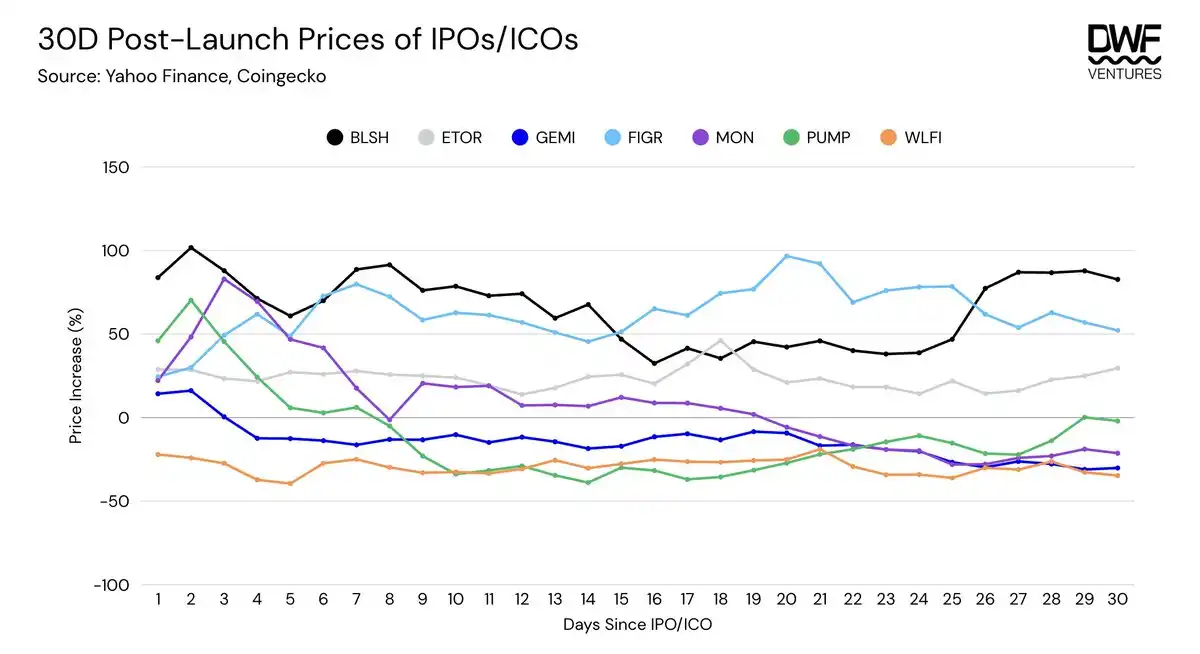
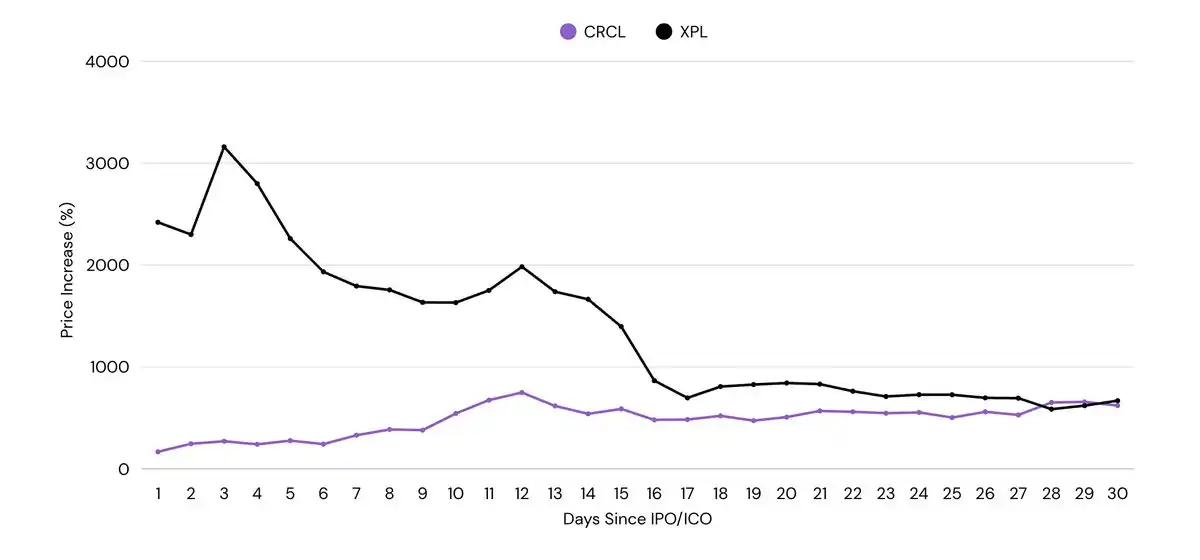
Analyzing the performance of ICOs and IPOs, tokens are associated with greater short-term volatility and a shorter time to peak (within 30 days). On the other hand, equities tend to record steady gains over a longer time horizon. Notably, however, the upside potential is similar for both.

CRCL and XPL are exceptions, having experienced massive gains from the start, offering investors 10x to 25x upside. Nonetheless, their performance also followed the aforementioned trend—XPL retraced 65% from its peak within two weeks, while CRCL climbed steadily over the same period.
Revenue: Assessing the Equity Premium

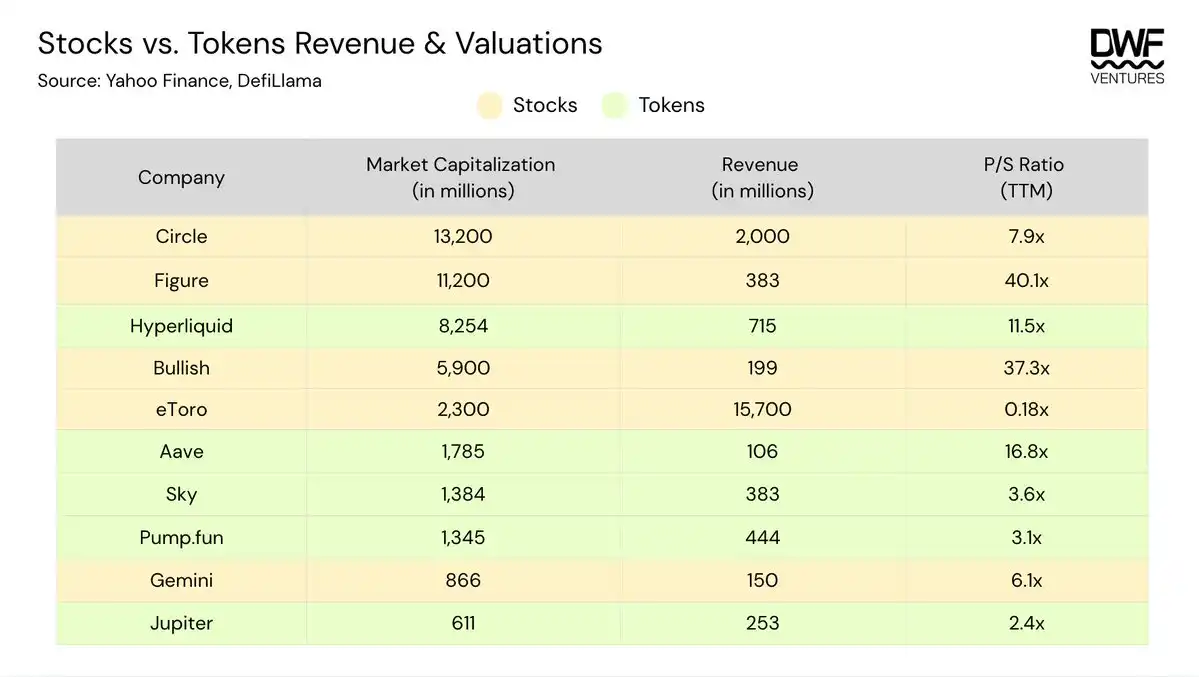
Delving into revenue figures, stocks overall enjoy a higher premium than tokens, with P/S ratios in the ranges of 7-40x and 2-16x, respectively. This can be attributed to enhanced liquidity from several factors:

Institutional Access: Despite growing positive sentiment around holding digital assets on balance sheets, this remains limited to funds with securities-only mandates (particularly pensions or endowments). Opting for an IPO allows companies to tap into this pool of institutional capital.

Index Inclusion: The growth tailwinds in public markets are far stronger than on-chain. Coinbase's inclusion in the S&P 500 in May 2025 as the first crypto company likely contributed to buying pressure from index-tracking funds/ETFs accumulating positions.

Alternative Strategies: Compared to on-chain tokens, equity enables a wider variety of institutional strategies, including options and leverage, whereas on-chain tokens often lack liquidity and counterparties.

Overall, the P/S ratio shows a company's valuation based on the last 12 months of revenue, helping to judge whether a company is undervalued or overvalued relative to its peers. However, factors beyond the numbers that reflect investor sentiment are not captured. Some factors to consider when evaluating stocks/tokens include:

Moats & Diversification: In the fast-evolving digital asset industry, this is crucial. The market is paying a premium for licenses and regulatory compliance, while diversified business models strengthen the value proposition of the core business beyond pure revenue numbers.

For example, Figure launched its own RWA lending pools, open to retail and institutional investors, and became the first SEC-approved yield-bearing stablecoin ($YLDS). Bullish is a regulated exchange that also owns other businesses like CoinDesk, enhancing its value beyond pure trading services. These factors likely contributed to higher premiums.

In contrast, eToro has an extremely low P/S, seemingly "undervalued" on the surface, but a deeper analysis reveals its revenue growth climbing in sync with costs, which is not optimal. Furthermore, the company is purely focused on providing trading services, lacking differentiation and having low margins. This indicates that building defensible moats and diversified business models are also key considerations for investors.

Shareholder Value: Returning capital to investors through buybacks is common in both stocks and tokens, especially for high-revenue companies.

For example, Hyperliquid has one of the most aggressive buyback programs, with 97% of revenue used for buybacks. Since genesis, the aid fund has bought back over 40.5 million HYPE tokens, representing over 4% of the total supply. Such aggressive buybacks impact the price, boosting investor confidence as long as revenue remains stable and the sector has room for growth. This leads to a higher P/S ratio but does not necessarily mean the token is "overvalued," as strong support from the team itself is real.

Sector Sentiment: High-growth sectors driven by institutional or regulatory dynamics naturally command a premium, as investors seek exposure.

For example, Circle's stock price soared quickly after its IPO in June 2025, with the P/S ratio peaking at around 27x. This could be attributed to the passage of the GENIUS Act—a framework dedicated to legitimizing stablecoin adoption and issuance, introduced shortly after Circle's listing, which would make Circle a major beneficiary as a leading player in the stablecoin infrastructure space.

M&A: The Great Consolidation

According to the report, crypto M&A activity hit a five-year high in 2025—driven by massive entry from TradFi institutions, coupled with more friendly regulatory sentiment. After the Trump administration rolled out a series of crypto-friendly policies, the Digital Asset Treasury (DAT) frenzy emerged, making holding digital assets on balance sheets less controversial. Companies also shifted focus to acquisitions, as it is a more efficient way to obtain specific licenses for better compliance. Overall, the introduction of appropriate regulatory frameworks laid the groundwork for M&A acceleration.
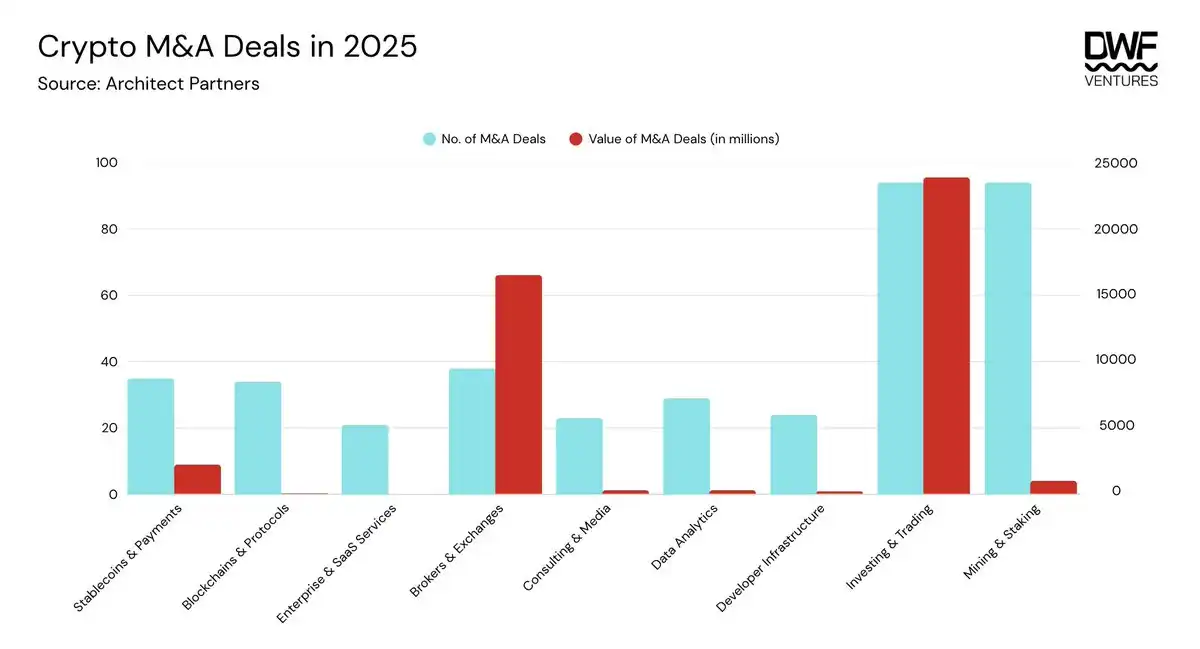
Looking back over the past year, we see a clear rise in the number of deals across categories. The following three categories have become priorities for institutions:

Investment & Trading: Encompassing trade settlement, tokenization, derivatives, lending, and DAT infrastructure;

Brokers & Exchanges: Regulated platforms focused on digital assets;

Stablecoins & Payments: Covering on/off-ramps, infrastructure, and applications.

These three categories together accounted for over 96% of the deal value in 2025, totaling over $42.5 billion.
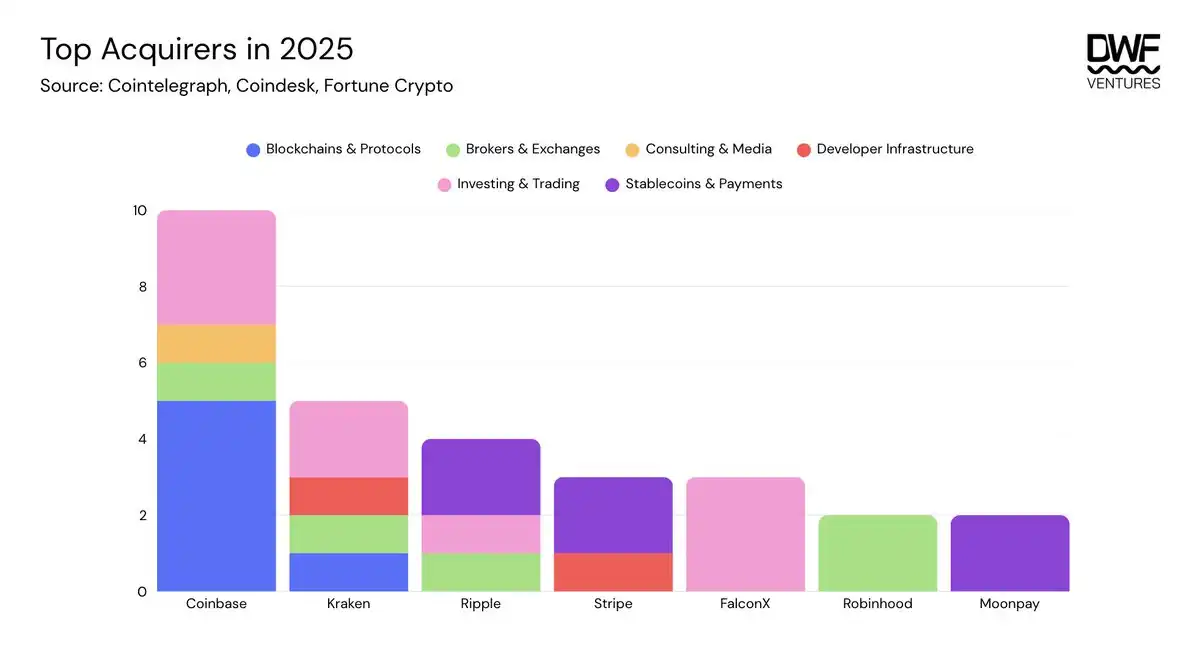
Top acquirers include Coinbase, Kraken, and Ripple, all involved in multiple categories. Among them, Coinbase's moves are particularly prominent, highlighting its ambition to become a "one-stop super app," with a core focus on bringing on-chain to the masses through acquisitions of both traditional and innovative DApps. This is driven by intensifying competition among exchanges and the quest for all-in-one traffic portals.

Companies like FalconX and Moonpay are deeply cultivating their own categories, building full-service capabilities through complementary acquisitions.
The Next Step for Token Offerings

Despite the current market environment and sentiment, we believe 2026 will continue to bring significant tailwinds to the digital asset space. We expect more companies to go public, which is a net positive for the industry overall—it provides access to a larger pool of capital and investors, making the overall pie bigger.

The next batch of IPO candidates includes:

Kraken: Filed an S-1 registration statement with the SEC in November 2025, with strong expectations for an IPO in early 2026;

Consensys: Reportedly working with Goldman Sachs and JPMorgan to prepare for a mid-2026 listing;

Ledger: Targeting a $4 billion valuation, advancing its IPO with Goldman Sachs, Jefferies, and Barclays;

Animoca: Plans to list on Nasdaq in 2026 via a reverse merger with Currenc Group Inc.;

Bithumb: Aims to list on Korea's KOSDAQ in 2026 with a $1 billion valuation, underwritten by Samsung Securities.

The way forward is not a choice between TradFi validation and crypto-native innovation—it is fusion. For builders and investors, this means prioritizing fundamentals and building useful products that generate real, sustainable revenue. A shift towards a long-term mindset may cause some turbulence, but those who adapt will be able to capture the next wave of value creation.

The token is dead, long live crypto.

Related Questions

QWhat is the core conclusion of the DWF Ventures report regarding the shift in crypto capital flow?

AThe report concludes that the old model of token launches is over. Capital is shifting from tokens to equity due to high valuations and declining liquidity eroding investor confidence. While both tokens and equity offer similar upside potential, they have vastly different risk structures. Equity enjoys a higher valuation premium, attributed to institutional access, index inclusion potential, and support for richer trading strategies.

QAccording to the report, what percentage of tokens launched in 2025 were trading below their TGE price, and what were the cited reasons?

AOver 80% of tokens launched in 2025 were trading below their Token Generation Event (TGE) price. The reasons cited include high volatility, a general lack of token demand due to difficult-to-justify high valuations, significant selling pressure from early profit-taking, a lack of substantive confidence in the product, and poor tokenomics (e.g., airdrops, CEX listings).

QHow did crypto IPO fundraising and M&A activity change in 2025 compared to 2024?

ACrypto IPO fundraising in 2025 grew 48 times (48x) compared to 2024, raising over $14.6 billion. Mergers and Acquisitions (M&A) activity also surged, reaching a five-year high of $42.5 billion.

QWhat factors does the report attribute to the higher valuation premium for equity over tokens?

AThe higher valuation premium for equity is attributed to three main factors: 1) Institutional Access: IPOs allow companies to tap into a pool of institutional capital (e.g., pensions, endowments) that often have mandates restricting direct digital asset holdings. 2) Index Inclusion Potential: Public market growth drivers are stronger, and inclusion in major indices (like the S&P 500) creates buying pressure. 3) Richer Trading Strategies: Equity supports a wider variety of institutional strategies, including options and leverage, which are less liquid or available for on-chain tokens.

QWhich companies are mentioned in the report as being potential IPO candidates for 2026?

AThe report lists several potential IPO candidates for 2026, including Kraken (filed an S-1 in late 2025), Consensys (reportedly working with Goldman Sachs and JPMorgan), Ledger (targeting a $4B valuation with Goldman, Jefferies, and Barclays), Animoca Brands (planning a Nasdaq listing via a reverse merger), and Bithumb (targeting a $1B valuation on the Korean KOSDAQ).

Related Reads

Retail Ecology Dwindles, ZKsync Bets on Bank Pilots for a Breakthrough

Amidst declining retail activity, ZKsync is pivoting to target institutional banking as its primary growth strategy. The article explores this shift, contrasting it with the competitive "survival of the fittest" narrative by highlighting a cooperative model inspired by naturalist Peter Kropotkin. ZKsync is developing infrastructure like its private, permissioned Prividium suite for banks (e.g., Deutsche Bank's use case via Memento), enabling private transactions with public verifiability via zero-knowledge proofs. This appeals to institutions needing privacy, compliance, and Ethereum-based settlement security, unlike fully private chains (e.g., JPMorgan's Kinaxis) or consortium models (e.g., R3 Corda). However, this strategic focus has coincided with a steep decline in its public DeFi ecosystem, evidenced by plunging TVL and the departure of major protocols like Aave due to low fees. The network's future now hinges on banking adoption, with upcoming pilots like the Cari Network involving regional banks holding over $600 billion in deposits. A significant challenge is balancing this institutional focus with ZKsync's decentralized governance. Banks must operate on a network where rules and fees (denominated in the volatile ZK token) can be changed via community vote, and where a Security Council holds emergency control—a stark contrast to the predictable, contract-bound environments of traditional finance. The coming 18 months will test whether ZKsync can successfully onboard traditional banks onto a dynamically governed public chain or if institutions will ultimately revert to proprietary solutions.

Foresight News14m ago

Retail Ecology Dwindles, ZKsync Bets on Bank Pilots for a Breakthrough

Foresight News14m ago

The Recursive AI Anthropic Warned About: Tian Yuandong's New Company Has Just Taken the "First Step"

Anthropic recently highlighted the rapid progress toward "recursive self-improvement," where AI systems autonomously design and train their successors. In response, Recursive Superintelligence, a new company co-founded by former Meta researcher Tian Yuan Dong, has publicly demonstrated its first step toward automating AI research. The company released a system designed to autonomously execute the full AI research cycle: generating ideas, implementing code, running experiments, and learning from results. It validated this approach by achieving state-of-the-art results on three diverse benchmarks: 1. **NanoChat Autoresearch:** Optimizing a small language model's validation loss under a fixed 5-minute GPU budget, improving upon the community's best result. 2. **NanoGPT Speedrun:** Reducing the time to train a GPT model to a specific loss on 8 H100 GPUs from 79.7 seconds to 77.5 seconds, beating a highly optimized, human-driven community effort. 3. **SOL-ExecBench:** Improving the overall score on NVIDIA's suite of 235 GPU kernel optimization tasks by 18%, closing the gap to the hardware limit. The system discovered novel optimizations in this highly specialized domain without direct human expertise. Recursive's system operates as a general framework, capable of parallel exploration and cross-task knowledge transfer while incorporating safeguards against reward hacking. The company, backed by $650M in funding and a star-studded team including Richard Socher and Alexey Dosovitskiy, aims to create AI that recursively enhances its own research capabilities. This development represents an early but concrete move toward a new paradigm where AI accelerates its own advancement. It occurs alongside Anthropic's warnings about the need for industry coordination and potential pauses when recursive self-improvement thresholds are reached, highlighting the dual trajectory of rapid technical progress and growing calls for careful stewardship.

marsbit22m ago

The Recursive AI Anthropic Warned About: Tian Yuandong's New Company Has Just Taken the "First Step"

marsbit22m ago

The Gold Buy-on-the-Dip Guide: Watch Interest Rates, Not Just War

"Gold Buying Guide: Focus on Interest Rates, Not Just War" Four months ago, gold buyers likely didn't anticipate buying at a peak that even a war couldn't sustain. After hitting a record high of $5,596 on January 29, gold entered a bear market just 91 days later, its fastest decline since 2008. A key trigger was the Fed's hawkish shift, highlighting that monetary policy, not geopolitics, is the primary driver. The article argues that the traditional "buy gold in turmoil" script has changed. While the US-Iran conflict initially boosted prices, the sustained rally in oil prices heightened inflation fears, forcing central banks to maintain or consider tighter policy. Since gold yields no interest, higher rates increase its opportunity cost, eroding its appeal. This dynamic was evident when gold fell sharply on May 18 despite positive peace talks, as lower oil prices eased inflation and thus rate hike pressures. The recent sell-off is also part of a broader market deleveraging. Correlations between gold, Nasdaq, and Bitcoin spiked as leveraged investors sold liquid assets to cover losses, creating a synchronized downturn. Historically, gold bottoms align with policy shifts, not conflict resolutions. The 2008 and 2022 bear markets ended with shifts to extreme easing and peak inflation expectations, respectively. For potential buyers, the author suggests monitoring three signals: 1) Peak interest rate hike expectations, 2) Reopening of the Strait of Hormuz (to ease oil/inflation pressure), and 3) A return to net inflows for Gold ETFs, indicating the end of forced selling. While predicting the exact bottom is impossible, the author's personal strategy involves scaling into a position across price levels like $4000, $3700, and $3500, committing no more than 30% of the intended total allocation initially, and adding the remainder only if key signals emerge. The core conclusion: In turbulent times, watching interest rates is more crucial than watching wars.

marsbit28m ago

The Gold Buy-on-the-Dip Guide: Watch Interest Rates, Not Just War

marsbit28m ago

Recent On-Chain Review: No Clear Narrative Under U.S. Stock Market Pressure, Just Hype

This article analyzes the current state of the Solana meme coin and community token ecosystem, highlighting a market caught between two dominant forces: attention-based PvP and a gradual return to community-centric projects. The first part explores the "Attention PvP" dynamic, where success is driven by celebrity endorsements, viral events, and speed. Examples include $JOTCHUA, which surged after its meme creator's social media activity, and $WORLDCUP, which outperformed a similar Base chain project ($PITCH) largely due to influencer support. The recent "pump.fun GO" feature, allowing bounty tasks for token promotion, is critiqued for fostering sensationalist and often negative stunts—like people getting token tickers tattooed on their bodies for rewards—reminiscent of old internet shock content. In contrast, the article points to a resurgence of organic, community-driven tokens that survive market volatility through strong holder bases and shared ideology, not just hype. Influencer Ansem is cited, arguing that durable meme coins rely on communities willing to endure losses and promote their core message daily. Examples given are older tokens like $neet (anti-work ethos), $troll, $buttcoin, and $triplet, which have maintained relative price stability. A prime example of this community-build model is the new project $KINS, the token for the browser-based MMORPG Kintara. Its success stems not from advanced graphics but from consistently delivering updates, fostering player trust, and creating genuine engagement (e.g., in-game economies, events, property auctions). It has attracted a growing player base and even notable KOLs as participants, demonstrating that sustainable growth can come from building trust rather than orchestrating pumps. The article concludes by questioning whether the market is ultimately a game of mutual trust or mutual deception, expressing hope that such reflection might lead to a healthier ecosystem.

marsbit28m ago

Recent On-Chain Review: No Clear Narrative Under U.S. Stock Market Pressure, Just Hype

marsbit28m ago

Trading

Spot
Futures

Hot Articles

How to Buy T

Welcome to HTX.com! We've made purchasing Threshold Network Token (T) simple and convenient. Follow our step-by-step guide to embark on your crypto journey.Step 1: Create Your HTX AccountUse your email or phone number to sign up for a free account on HTX. Experience a hassle-free registration journey and unlock all features.Get My AccountStep 2: Go to Buy Crypto and Choose Your Payment MethodCredit/Debit Card: Use your Visa or Mastercard to buy Threshold Network Token (T) instantly.Balance: Use funds from your HTX account balance to trade seamlessly.Third Parties: We've added popular payment methods such as Google Pay and Apple Pay to enhance convenience.P2P: Trade directly with other users on HTX.Over-the-Counter (OTC): We offer tailor-made services and competitive exchange rates for traders.Step 3: Store Your Threshold Network Token (T)After purchasing your Threshold Network Token (T), store it in your HTX account. Alternatively, you can send it elsewhere via blockchain transfer or use it to trade other cryptocurrencies.Step 4: Trade Threshold Network Token (T)Easily trade Threshold Network Token (T) on HTX's spot market. Simply access your account, select your trading pair, execute your trades, and monitor in real-time. We offer a user-friendly experience for both beginners and seasoned traders.

12.0k Total ViewsPublished 2024.03.29Updated 2026.06.02

How to Buy T

Discussions

Welcome to the HTX Community. Here, you can stay informed about the latest platform developments and gain access to professional market insights. Users' opinions on the price of T (T) are presented below.

活动图片