70% Of Institutional Investors Aren’t Buying The Bitcoin Top Narrative – Here’s Why

bitcoinistPublished on 2026-01-26Last updated on 2026-01-26

Abstract

Institutional investors maintain strong confidence in Bitcoin's long-term value, with 71% considering it undervalued between $85,000 and $95,000, according to Coinbase's Q1 2026 report. Despite recent price volatility and outflows into traditional safe-havens like gold and silver due to geopolitical tensions, the majority of institutions plan to hold or increase their Bitcoin holdings even if prices drop further. Over 60% have maintained or raised their positions since October's peak. While macroeconomic uncertainties and geopolitical risks may cause near-term price fluctuations, the institutional outlook remains cautiously optimistic, supported by expectations of potential Federal Reserve rate cuts and sustained accumulation behavior.

Investors are showing a steady faith in Bitcoin even as money moves elsewhere. According to Coinbase’s Charting Crypto Q1 2026 report, many big players think the current price is a bargain. The mood is cautious, but the view among large institutions leans toward holding for the long run.

Institutional Confidence And Behavior

Reports say about 71% of institutional investors view Bitcoin as undervalued when it sits between $85,000 and $95,000. Independent investors are not far behind, with 60% sharing that view.

A quarter of institutions felt the price was fair, and only a small share thought it was too high. These numbers show a strong tilt toward belief in future gains.

Gold And Silver Are Doing Very Well

Gold has climbed sharply, and silver has more than doubled since last October. That flow into metals has come as investors seek shelter while worries over global tensions rise.

Stocks have not surged as much; the S&P 500 has posted modest gains. The contrast is clear: some money went into traditional hedges instead of crypto.
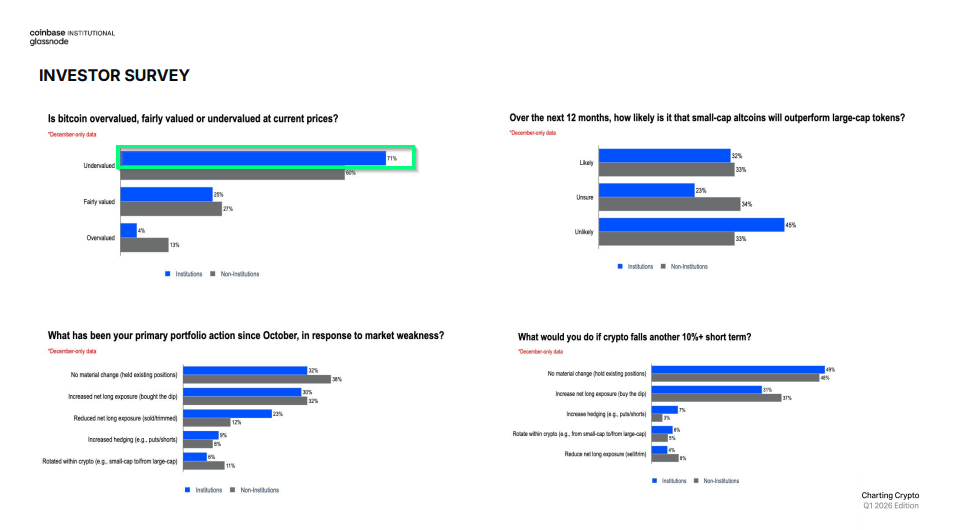
Survey measuring Bitcoin’s valuation: Undervalued, fairly priced, or overvalued. Source: Coinbase.

Geopolitical Friction And Trade Signals

Reports note renewed tariff threats from US President Donald Trump and rising strain between the US and parts of the Middle East.

Such moves have been linked to market nervousness. If energy supply or trade routes are hit, risk assets often wobble. That makes Bitcoin more sensitive than usual to headlines.

Bitcoin Price Action In Context

Bitcoin has been trading in the high $80,000s. It briefly tried to hold above $90K but slipped back, touching nearer $86,000 at times.

Volatility has returned, and liquidations were seen after the big October move. Still, many technical analysts keep longer-term targets on their charts, arguing that the broader trend is not necessarily broken.

BTCUSD currently trading at $87,707. Chart: TradingView

Institutional Game Plan

Reports say 80% of those large investors would either keep their stakes or add more if prices fell another 10%. More than 60% have already held or raised their positions since October’s peak.

Over half think the market is in an accumulation phase or still in a bear cycle, which explains why many prefer to buy on weakness rather than sell.

Macro Outlook And Possible Tailwinds

Coinbase expects the Federal Reserve to cut rates twice in 2026, an outlook that could help risk assets if it comes to pass. Consumer inflation has been steady and GDP growth looked strong in the last quarter. These conditions could nudge sentiment back toward risk-taking, though timing is far from sure.

The story is not simply bullish or bearish. On one hand, large investors show clear conviction and are willing to act on dips.

On the other, safe-haven flows and geopolitical shocks keep a lid on rapid re-rating. The near-term path is likely choppy, while the longer view depends on whether macro calm returns and whether demand for crypto picks up again.

Featured image from Unsplash, chart from TradingView

Trending Cryptos

Related Questions

QAccording to Coinbase's report, what percentage of institutional investors view Bitcoin as undervalued between $85,000 and $95,000?

A71% of institutional investors view Bitcoin as undervalued when it sits between $85,000 and $95,000.

QWhat is the two main traditional safe-haven assets mentioned that have performed well amid global tensions?

AGold and silver are the two main traditional safe-haven assets mentioned, with gold climbing sharply and silver more than doubling since last October.

QWhat is the reported stance of 80% of large institutional investors if Bitcoin's price were to drop another 10%?

A80% of large institutional investors reported that they would either keep their current stakes or add more to their positions if prices fell another 10%.

QWhat two potential macroeconomic factors from the Federal Reserve does Coinbase expect could help risk assets in 2026?

ACoinbase expects the Federal Reserve to cut interest rates twice in 2026, an outlook that could help risk assets.

QBeyond geopolitics, what other factor is mentioned as keeping a lid on Bitcoin's rapid price appreciation in the near term?

ASafe-haven flows into assets like gold and silver, along with geopolitical shocks, are mentioned as factors keeping a lid on rapid price re-rating for Bitcoin in the near term.

Related Reads

Crypto Miners' Big AI Gamble: Valuations Enter Differentiation Stage, Comeback Fight Proves Tough

Crypto Mining Firms' AI Bet: Valuation Divergence and a Challenging Transformation Facing declining profitability in crypto mining, mining companies are pivoting to AI infrastructure, capitalizing on their existing power resources, land, and data center expertise to offer GPU compute power. This transition narrative has boosted their stock prices significantly, with firms like Hut 8 and Bitfarms seeing gains over 100% year-to-date, far outpacing Bitcoin. This has led to a market valuation split, with pioneers like CoreWeave reaching a $62.8B market cap, while others remain below $5B. The market currently prioritizes growth potential over short-term profits, which remain under pressure due to heavy capital expenditures for AI build-outs and crypto asset volatility. However, the transformation is a high-stakes gamble. Bitcoin mining profitability is shrinking, with the average production cost around $63,707 and miner margins contracting. While AI offers a more lucrative long-term path, it requires massive investment—estimated at a $500B near-term funding gap. Success now hinges on execution: delivering on contracted power capacity, securing quality tenants like major cloud providers, and managing the immense financial burden. The valuation focus is shifting from mere power capacity to project delivery, future cash flows, and tenant quality, making this a difficult but critical turnaround attempt.

链捕手3m ago

Crypto Miners' Big AI Gamble: Valuations Enter Differentiation Stage, Comeback Fight Proves Tough

链捕手3m ago

Analysis of the Latest Portfolio Adjustment by the "Top Player" in the U.S. Stock Market: $9 Billion Short on NVIDIA, Shifting Focus to Power and Memory Sectors

AI investor Leopold Aschenbrenner has made a significant portfolio shift, taking a $9 billion nominal short position against top AI infrastructure stocks like NVIDIA, ASML, and Oracle. Simultaneously, he is redirecting capital towards what he sees as the next critical bottlenecks in the AI boom: power, memory, and data center networking, alongside private investments in AI model companies like Anthropic. This move is interpreted not as a call that the AI bubble has burst, but as a rotation within the infrastructure stack. The analysis highlights NVIDIA's recent $25 billion bond issuance as a potential signal, questioning why a cash-rich company would seek external debt despite high profits and increased dividends/buybacks. The core investment thesis is that the initial, crowded "picks and shovels" trade in semiconductors is maturing. The next wave of capital is expected to flow into the physical and logistical constraints of AI expansion: electricity supply, memory chip capacity, data center construction, and enabling technologies like optical networking (fiber) for high-bandwidth communication, where copper remains crucial for short distances. Aschenbrenner's substantial (approx. 20% of fund) private stake in Anthropic is noted as a key part of his strategy—investing directly in the "mine" (AI models) rather than just the "shovels." The discussion concludes that while certain segments may be overvalued, the overarching AI infrastructure demand driven by real product usage remains robust. The most promising long-term investments are seen in essential, non-sexy infrastructure—particularly energy and power companies—whose demand is viewed as a global constant irrespective of AI's cyclicality.

marsbit24m ago

Analysis of the Latest Portfolio Adjustment by the "Top Player" in the U.S. Stock Market: $9 Billion Short on NVIDIA, Shifting Focus to Power and Memory Sectors

marsbit24m ago

BIT Research: Liquidity is Disappearing, Will Bitcoin Replay the Bottoming Pattern of 2022?

The crypto market is currently in an adjustment phase driven by policy expectations and liquidity shifts. Despite a brief rebound fueled by geopolitical easing and SpaceX's strong IPO performance, unexpectedly hawkish signals from new Fed Chair Kevin Warsh have removed anticipated easing support. Concurrently, stablecoin liquidity is shrinking, with insufficient new capital inflows, pushing the market into a typically quiet summer period. Pricing lacks catalysts for a sustained rally. Daily trading volume has significantly contracted, stablecoin growth has slowed markedly, and the supportive effect of Strategy's (formerly MicroStrategy) STRC preferred stock-financed Bitcoin purchases is fading. Amid policy uncertainty, seasonal weakness, and liquidity contraction, Bitcoin faces near-term downward pressure. Warsh's hawkish pivot and refusal to provide a clear policy outlook have increased risk premiums, historically unfavorable for Bitcoin. Technically, the trend remains bearish below $73,700, with $62,446 as critical support. A break below could accelerate declines, though a prolonged consolidation phase, similar to 2022's bottoming process, is possible. Liquidity is a core constraint. Current daily volume is around $500 billion, roughly 25% of the peak during the July-Oct 2025 rally. The 12-month growth rates for USDT and USDC have fallen to ~20%, with 6-month growth near zero, indicating weak new inflows. Bitcoin ETF and Strategy-driven inflows have also weakened, with a 30-day rolling net outflow. With inflation at 4.2% above the Fed's target, combined hawkish policy, seasonal factors, and liquidity shortages challenge Bitcoin's ability to hold above $60,000. However, this adjustment phase may be forming a cyclical low this summer, potentially setting the stage for the next bull cycle.

marsbit52m ago

BIT Research: Liquidity is Disappearing, Will Bitcoin Replay the Bottoming Pattern of 2022?

marsbit52m ago

Who Makes the Best Use of Claude Code? The Answer Might Not Be Programmers

Claude Code Usage Report Summary (Based on ~400k sessions) Core Finding: In agentic programming with Claude Code, a clear division of labor has emerged: humans primarily decide *what* to build (planning decisions), while Claude decides *how* to build it (execution decisions). Key Insights: 1. **Effectiveness is not limited to programmers.** In code-generation tasks, success rates for users in non-technical fields (law, finance, management, research) are nearing those of software engineers. What matters most is the user's domain expertise and understanding of the problem to be solved. 2. **Domain expertise drives success and efficiency.** Sessions where users exhibited "expert" proficiency in the task's domain saw verified success rates double compared to "novice" sessions. Experts also delegated more work per instruction, with Claude executing more actions and producing more output. 3. **AI is amplifying, not replacing, domain knowledge.** Claude Code lowers the *implementation* barrier, not the *judgment* barrier. The value of knowing the "what" and "why" is increasing relative to just knowing the "how" to code. 4. **Usage is evolving.** Over a 7-month period (Oct '25 - Apr '26), the share of sessions for debugging halved, while use for software operations, data analysis, and non-code writing roughly doubled. The estimated economic value of typical tasks increased by ~25%. Conclusion: The data suggests coding agents are making programming background less critical for completing technical tasks. However, they reward and amplify deep domain understanding. The ability to successfully direct an AI agent stems more from mastery of a specific field than from coding skill itself. The primary gains come from being competent in a domain; deep specialization adds only marginal additional advantage. This may signal a shift where software creation becomes integrated into various professions.

marsbit1h ago

Who Makes the Best Use of Claude Code? The Answer Might Not Be Programmers

marsbit1h ago

Trading

Spot
Futures

Hot Articles

Discussions

Welcome to the HTX Community. Here, you can stay informed about the latest platform developments and gain access to professional market insights. Users' opinions on the price of S (S) are presented below.

活动图片