Why Bitcoin Could Be About to Pump if This Signal is Right - US CPI Explained

CryptonewsPublished on 2022-09-14Last updated on 2022-09-14

Abstract

The leading cryptocurrency, Bitcoin, suffered a massive drop, losing more than 12% to $19,850 amid stronger-than-expected US CPI figures.

Why Bitcoin Could Be About to Pump if This Signal is Right - US CPI Explained

The leading cryptocurrency, Bitcoin, suffered a massive drop, losing more than 12% to $19,850 amid stronger-than-expected US CPI figures. Before the news release, technical indicators, particularly the 100-day moving average (MA), indicated the possibility of a bullish trend continuation. However, the BTC/USD has fallen below the moving average, resulting in a significant drop. 
In this update, I will discuss the fundamentals that drove a sharp sell-off in Bitcoin and the technical outlook that suggests Bitcoin may be about to pump if the signal is right.
US Inflation at 8.3% in August 
The Bureau of Labor Statistics released one of the most anticipated data sets, the Consumer Price Index (CPI) and Core CPI, during the US session. Both figures outperformed the previous month's release, fueling a strong rise in dollar demand. 
Consumer prices rose 0.1% month on month, following a flat reading in July and falling short of a 0.1% reduction estimate. The US CPI index was 296.17 points in August, compared to 296.28 points the previous month and 295.53 points expected by the market.
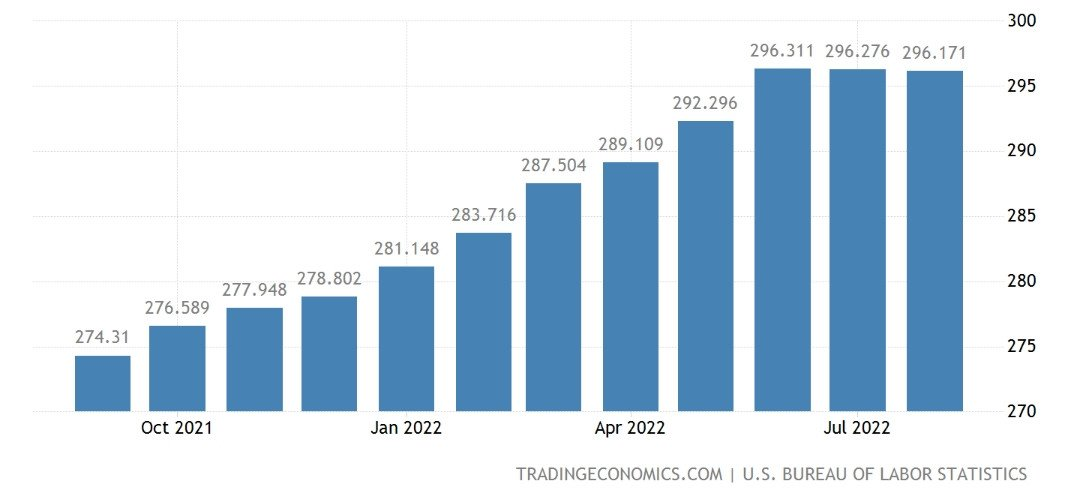
Source: US Bureau of Labor Statistics

The annual inflation rate in the United States fell for the second month in a row to 8.3% in August 2022, the lowest in four months, from 8.5% in July. However, it's still above market expectations of 8.1%.

What Effect Does a Higher Inflation Rate Have on Cryptocurrencies?
To understand this, we first need to understand what inflation is. It reflects a change in the price of consumer goods and services. So a higher inflation rate signifies solid economic growth. However, if the CPI figures cross the Fed's inflation target levels, it becomes hyperinflation, which isn't considered suitable for the economy.

The US government has mandated a 2% inflation target to maintain price stability. The results are beneficial for long-term preparations. However, when inflation is significant or fluctuates frequently, it becomes difficult for companies and consumers to predict costs accurately.
The Fed's 2% Inflation Target 
The Federal Reserve's policymaking Federal Open Market Committee has had a 2% annual inflation target "as assessed by the yearly change in the price index for personal consumption expenditures" (PCE) since January 2012.
According to a recent IMF report:
The economy is expected to slow, as the Federal Reserve (the Fed) continues to tighten monetary policy and COVID economic relief programs come to an end, bringing core Personal Consumption Expenditure (PCE) inflation down to the Fed’s 2 percent medium-term target by late 2023
The Fed's medium-term target for inflation is 2%, while the current inflation rate is above 8%. So, to control this, the Federal Reserve may have to go for another round of rate hikes. 
BTC Under Pressure as another Big Rate Hike Expected
The high CPI figures ensure that on Wednesday of next week, when the US Federal Reserve announces its next policy decision, the Fed fund rate has a strong prospect of being raised by three-quarters of one percent. 
The Federal Reserve raised its key policy rate from 1.5%-1.7% last month to 2.25%-2.5%, and the market is now pricing in a further increase to 3%-3.25%. At the beginning of the year, the Fed Funds rate was between 0% and 0.25%. If the rate is increased again next week, it will be the third straight increase to the 3%-3.25% level. 
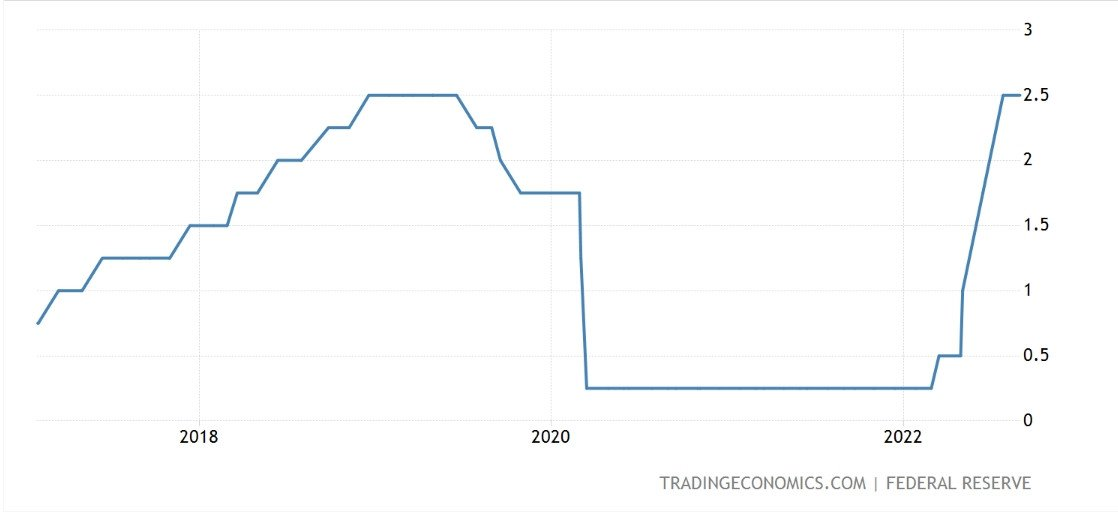
Source: Federal Reserve

The markets have been anticipating such a hike since Fed chairman Jay Powell's speech at the end of August to a symposium of central bankers at Jackson Hole in Wyoming, in which he said the Fed would be prepared to risk a US recession if that was the price to be paid for bringing US inflation under control. 
Rate Hikes Kick in Risk-off Sentiment
Higher interest rates cause a "risk-off" reaction, in which investors shift their investments away from risky securities such as stocks, indices, and cryptocurrencies and toward safe-haven assets for a risk-free return.
These risk-free securities include government bonds, interest on saving accounts, T-bills, and repurchase agreements. As a result, the Bitcoin price fell sharply following the release of the CPI figures.
Enough said about fundamentals; let us now look at Bitcoin's technical outlook.
Why Bitcoin Could Be About to Pump if This Signal is Right 
The Bitcoin price fell so sharply after the release of US CPI figures that it entered the oversold zone. The BTC/USD pair is currently trading at $20,331, with immediate support at $20,108.

Bitcoin Price Chart - Source: TradingviewOn the 4-hour timeframe, the BTC/USD pair has completed a 61.8% Fibonacci retracement at $20,108 and has formed a candlestick pattern known as a "hammer," which indicates that sellers are exhausted, and bulls may take control soon. It typically weakens the bearish trend and initiates a bullish reversal.
Simultaneously, leading technical indicators such as the relative strength index (RSI) and moving average convergence divergence (MACD) have entered the oversold territory. Both indicators increase the likelihood of a bullish bounce above the 61.8% Fibonacci retracement level.
The 50-day moving average, on the other hand, indicates the inverse. It is extending significant resistance at the $20,650 level. Increased Bitcoin demand could cut through the 50 MA, allowing for more buying until the $21,165 or 22,735 resistance levels. 
Alternatively, a bearish breakout of the $20,108 support zone could prolong the selling trend until the next support level of $19,424 or $18,515. Let's keep an eye on $20,108 to determine further price action in Bitcoin. 

Trending Cryptos

Related Reads

US Calls for Restrictions on Sports Prediction Markets

The National Football League (NFL) has urged the U.S. Commodity Futures Trading Commission (CFTC) to tighten rules for prediction markets on sports events. In a July letter, the NFL argued that current proposals fail to adequately protect the integrity of games and market participants. Key demands include banning contracts on events easily manipulated by individuals (e.g., a kicker missing a field goal), clarifying definitions to prevent gambling-like contracts, and explicitly prohibiting trading based on non-public insider information. The league also called for restricted person lists, a ban on margin trading, advertising limits, stronger user protections, and a minimum age of 21. This push coincides with an ongoing jurisdictional dispute between the CFTC and several states. The CFTC claims exclusive federal oversight, classifying event contracts as swaps, while states argue these platforms violate local gambling laws. Recent legal actions in Michigan and Minnesota highlight the conflict, with a federal court temporarily blocking Minnesota from applying a new law to CFTC-registered platforms like Kalshi and Polymarket. Meanwhile, prediction markets are experiencing significant growth. In June, driven by events like the World Cup, Kalshi's trading volume exceeded $31 billion (85% from sports contracts), while Polymarket's global platform hit a monthly record of $10.8 billion. However, platforms face legal challenges, such as lawsuits from Kentucky accusing them of operating unlicensed sports betting disguised as prediction markets.

cryptonews.ru8m ago

US Calls for Restrictions on Sports Prediction Markets

cryptonews.ru8m ago

Peskov Says Russia Is Among Top Five Leaders in AI Race. What Do Global Rankings Say?

On July 27, 2026, Kremlin spokesman Dmitry Peskov stated that Russia remains among the top five countries in the global AI development race. He acknowledged Russian models still lag behind leading U.S. counterparts but claimed they have reached a "very high level," aiming to close the gap with "superhuman efforts." He highlighted the differing approaches of Russia's GigaChat, built from scratch, and Yandex, which initially used foreign technology. However, this claim is not supported by major international AI rankings. Stanford University's Global AI Vibrancy Tool (2024-25) ranks Russia 28th out of 36 countries. The top five are the U.S., China, India, South Korea, and the UK. The Stanford AI Index Report 2026 does not mention Russia's position, focusing instead on U.S. and Chinese leadership across various metrics like investments and model performance. In benchmarks, GigaChat ranks 25th on the Russian-language LM Arena. While it passed a financial analyst exam in December 2025, its business usage costs are reportedly tens to hundreds of times higher than China's DeepSeek. In related developments, President Putin signed a law on July 26, 2026, establishing a legal framework for sovereign AI models and granting developers access to state data. Previously, Russia joined 28 other nations, including China, to establish the World AI Cooperation Organization (WAICO) in Shanghai. The article notes that rankings vary due to different criteria, such as research, investment, infrastructure, or responsible AI governance. While Russian authorities are bolstering AI through legislation and international cooperation, independent analyses suggest the country faces significant challenges, including a hardware deficit for training models, which legal frameworks alone cannot resolve.

cryptonews.ru8m ago

Peskov Says Russia Is Among Top Five Leaders in AI Race. What Do Global Rankings Say?

cryptonews.ru8m ago

From Sand to Chips: Hefei's Semiconductor Alchemy

From Sand to Chips: Hefei's Semiconductor "Alchemy" On July 27, 2026, a memory chip maker from Hefei made history by surpassing the market capitalization of Industrial and Commercial Bank of China on its Shanghai Stock Exchange debut. This marks the culmination of Hefei's two-decade industrial transformation, often summarized in three strategic leaps: "Screen, Chip, Vehicle." The journey began in 2008 with a bold investment in BOE, establishing China's first 6th-generation LCD panel line. The second leap was the "Project 506" in 2016, which gave birth to ChangXin Memory Technologies (CXMT). With initial backing of 14.4 billion RMB from Hefei's state-owned investment platform, CXMT aimed to break into the global DRAM market, then over 95% controlled by three overseas giants. CXMT achieved a breakthrough in 2019 by producing China's first 8GB DDR4 DRAM chip, employing "generational leapfrog" R&D to catch up. After years of significant losses, the company turned profitable in 2025. A dramatic surge followed in 2026, driven by AI-driven demand and full capacity utilization, propelling CXMT to become the world's fourth-largest DRAM manufacturer. CXMT's success is not isolated. It anchors a dense, localized semiconductor ecosystem in Hefei. Within its vicinity are numerous supporting companies for equipment, materials, and packaging & testing. This cluster has fueled the regional economy, with Hefei's integrated circuit industry output growing over sevenfold between 2016 and 2025. The ripple effects extend beyond high-tech, revitalizing local communities with new businesses and services catering to the influx of workers. For individuals, Hefei offers competitive tech salaries at a significantly lower cost of living compared to major coastal cities, along with improved amenities and shorter commutes. Hefei's story demonstrates two decades of focused, long-term industrial policy, transforming the city from a provincial capital into a trillion-RMB GDP "Double Ten-Thousand" city (10 million people, 1 trillion RMB GDP). It shows how persistence in strategic sectors—turning sand into chips—can redefine a city's economic destiny.

marsbit38m ago

From Sand to Chips: Hefei's Semiconductor Alchemy

marsbit38m ago

Trading

Spot

Hot Articles

What is $BITCOIN

DIGITAL GOLD ($BITCOIN): A Comprehensive Analysis Introduction to DIGITAL GOLD ($BITCOIN) DIGITAL GOLD ($BITCOIN) is a blockchain-based project operating on the Solana network, which aims to combine the characteristics of traditional precious metals with the innovation of decentralized technologies. While it shares a name with Bitcoin, often referred to as “digital gold” due to its perception as a store of value, DIGITAL GOLD is a separate token designed to create a unique ecosystem within the Web3 landscape. Its goal is to position itself as a viable alternative digital asset, although specifics regarding its applications and functionalities are still developing. What is DIGITAL GOLD ($BITCOIN)? DIGITAL GOLD ($BITCOIN) is a cryptocurrency token explicitly designed for use on the Solana blockchain. In contrast to Bitcoin, which provides a widely recognized value storage role, this token appears to focus on broader applications and characteristics. Notable aspects include: Blockchain Infrastructure: The token is built on the Solana blockchain, known for its capacity to handle high-speed and low-cost transactions. Supply Dynamics: DIGITAL GOLD has a maximum supply capped at 100 quadrillion tokens (100P $BITCOIN), although details regarding its circulating supply are currently undisclosed. Utility: While precise functionalities are not explicitly outlined, there are indications that the token could be utilized for various applications, potentially involving decentralized applications (dApps) or asset tokenization strategies. Who is the Creator of DIGITAL GOLD ($BITCOIN)? At present, the identity of the creators and development team behind DIGITAL GOLD ($BITCOIN) remains unknown. This situation is typical among many innovative projects within the blockchain space, particularly those aligning with decentralized finance and meme coin phenomena. While such anonymity may foster a community-driven culture, it intensifies concerns about governance and accountability. Who are the Investors of DIGITAL GOLD ($BITCOIN)? The available information indicates that DIGITAL GOLD ($BITCOIN) does not have any known institutional backers or prominent venture capital investments. The project seems to operate on a peer-to-peer model focused on community support and adoption rather than traditional funding routes. Its activity and liquidity are primarily situated on decentralized exchanges (DEXs), such as PumpSwap, rather than established centralized trading platforms, further highlighting its grassroots approach. How DIGITAL GOLD ($BITCOIN) Works The operational mechanics of DIGITAL GOLD ($BITCOIN) can be elaborated on based on its blockchain design and network attributes: Consensus Mechanism: By leveraging Solana’s unique proof-of-history (PoH) combined with a proof-of-stake (PoS) model, the project ensures efficient transaction validation contributing to the network's high performance. Tokenomics: While specific deflationary mechanisms have not been extensively detailed, the vast maximum token supply implies that it may cater to microtransactions or niche use cases that are still to be defined. Interoperability: There exists the potential for integration with Solana’s broader ecosystem, including various decentralized finance (DeFi) platforms. However, the details regarding specific integrations remain unspecified. Timeline of Key Events Here is a timeline that highlights significant milestones concerning DIGITAL GOLD ($BITCOIN): 2023: The initial deployment of the token occurs on the Solana blockchain, marked by its contract address. 2024: DIGITAL GOLD gains visibility as it becomes available for trading on decentralized exchanges like PumpSwap, allowing users to trade it against SOL. 2025: The project witnesses sporadic trading activity and potential interest in community-led engagements, although no noteworthy partnerships or technical advancements have been documented as of yet. Critical Analysis Strengths Scalability: The underlying Solana infrastructure supports high transaction volumes, which could enhance the utility of $BITCOIN in various transaction scenarios. Accessibility: The potential low trading price per token could attract retail investors, facilitating wider participation due to fractional ownership opportunities. Risks Lack of Transparency: The absence of publicly known backers, developers, or an audit process may yield skepticism regarding the project's sustainability and trustworthiness. Market Volatility: The trading activity is heavily reliant on speculative behavior, which can result in significant price volatility and uncertainty for investors. Conclusion DIGITAL GOLD ($BITCOIN) emerges as an intriguing yet ambiguous project within the rapidly evolving Solana ecosystem. While it attempts to leverage the “digital gold” narrative, its departure from Bitcoin's established role as a store of value underscores the need for a clearer differentiation of its intended utility and governance structure. Future acceptance and adoption will likely depend on addressing the current opacity and defining its operational and economic strategies more explicitly. Note: This report encompasses synthesised information available as of October 2023, and developments may have transpired beyond the research period.

1.1k Total ViewsPublished 2025.05.13Updated 2025.05.13

What is $BITCOIN

Discussions

Welcome to the HTX Community. Here, you can stay informed about the latest platform developments and gain access to professional market insights. Users' opinions on the price of BTC (BTC) are presented below.

活动图片