Just One Step Away, Where Is the Clarity Act Stuck?

Odaily星球日报Опубліковано о 2026-07-28Востаннє оновлено о 2026-07-28

Анотація

The U.S. Digital Asset Market Structure Act, or Clarity Act, faces a critical, time-sensitive hurdle in the Senate despite recent progress. While the White House added an "ethics provision" to the bill—seen as a compromise with Republicans—significant disagreements persist, particularly regarding the details of this clause. Democrats oppose key elements: they object to granting enforcement authority solely to the Department of Justice, citing potential conflicts due to the Attorney General's past role as Trump's lawyer; they criticize a sunset clause that would void the provision after Trump's potential term ends in 2029; and they argue the restrictions on officials and their families are insufficient. With the Senate's summer recess approaching, the bill's timeline is severely constrained. It must compete for floor time with other contentious legislation, and procedural rules could further delay a vote. Analysts, noting strong Democratic resistance and limited negotiation time, have significantly lowered the probability of the bill passing in 2026. The final obstacle remains bridging the gap on the ethics provision's specifics, determining whether the long-awaited regulatory framework will be enacted imminently or postponed indefinitely.

Original | Odaily Planet Daily (@OdailyChina)

Author | Azuma (@azuma_eth)

With only a few workdays left before the U.S. Congress enters its summer recess (scheduled to begin on August 7th), time is running out for the "Digital Asset Market Structure Act" (hereinafter referred to as the Clarity Act) to pass through the Senate.

Last week, the White House agreed to include an "ethics provision" in the Clarity Act aimed at restricting the President, Vice President, members of Congress, and other federal officials from profiting from digital assets during their terms. This move was widely interpreted by the market as an indication that Trump and the Republicans had expressed a willingness to compromise and reach a consensus with Democratic senators on this remaining major point of contention.

However, as details of the Clarity Act amendments were revealed, the market discovered that the situation is far more complex than imagined.

Alex Thorn, Head of Research at Galaxy, posted over the weekend, stating that the Clarity Act is now on the final "one-yard line." Like in American football, this last yard might be the toughest yard on the field; in politics, it is a game of fierce, inch-by-inch contention...... Considering the limited time remaining and the strong opposition from the Democratic senators involved in negotiations to the current wording of the ethics provision, the probability of the bill being enacted by 2026 has been lowered to 30%.

The Biggest Disagreement Lies in the Details of the Ethics Provision

Alex Thorn summarized in his post that there are still varying degrees of disagreement on multiple aspects of the Clarity Act, including developer protections, DeFi regulatory boundaries, stablecoin yield restrictions, CFTC registration mechanisms, and newly added enforcement provisions.

However, the current broad consensus in the market is that the greatest obstacle preventing further progress of the bill remains the ethics provision, which was previously interpreted as an area where Trump and the Republicans were willing to concede.

According to the latest consolidated Senate text, the Clarity Act spans 616 pages. The newly added content related to the ethics provision is primarily used to restrict the President, Vice President, members of Congress, and other senior federal officials from engaging in digital asset-related activities. This includes prohibiting the issuance or promotion of digital assets by such officials and their spouses during their terms, restricting the listing of related assets on regulated platforms, requiring disclosure of interests, and introducing a blind trust mechanism. At the same time, the provision stipulates that enforcement authority lies with the Department of Justice (DOJ) and that it will automatically expire on January 20, 2029, after the end of Trump's current term.

The problem is that Democrats believe the current version of the ethics provision still has significant shortcomings.

  • First, Democrats believe that granting enforcement authority solely to the Department of Justice lacks sufficient independence. Since the DOJ is part of the executive branch, and the current Acting Attorney General, Todd Blanche, is also Trump's former personal lawyer, there are doubts about the effectiveness of internal oversight when the restrictions involve the President or senior administrative officials. Therefore, Democrats demand that enforcement authority be given to various Inspectors General.
  • Secondly, the provision for automatic expiration in 2029 has also drawn strong criticism and opposition from Democrats. This timing coincides exactly with the end of Trump's current presidential term, meaning that after Trump leaves office, there will be no legal basis for successors to investigate Trump's past actions. Democrats argue that if the goal of the Clarity Act is to establish a long-term digital asset regulatory framework, then ethical norms should also become a permanent institution, not one that terminates with the end of Trump's term.
  • Furthermore, Democrats are also concerned that the current scope of restrictions is still limited. The current version primarily targets direct actions like issuing or promoting digital assets but does not explicitly restrict involvement in crypto profits through affiliated businesses, family members, or other indirect means, especially considering that several of Trump's sons are deeply involved in the cryptocurrency industry. The adequacy of the current version's coverage remains questionable.

Democratic Senator Elizabeth Warren, a consistent strong critic of the bill, issued a formal statement last week criticizing the "DOJ-only enforcement" mechanism in the ethics provisions, calling the bill something that "should be dead on arrival."

More impactful for the vote count is that the seven Democrats who have been negotiating with Republicans (Sens. Mark Warner, Angela Alsobrooks, Cory Booker, Catherine Cortez Masto, Ruben Gallego, John Hickenlooper, Raphael Warnock) also issued a joint statement saying the current text "falls short."

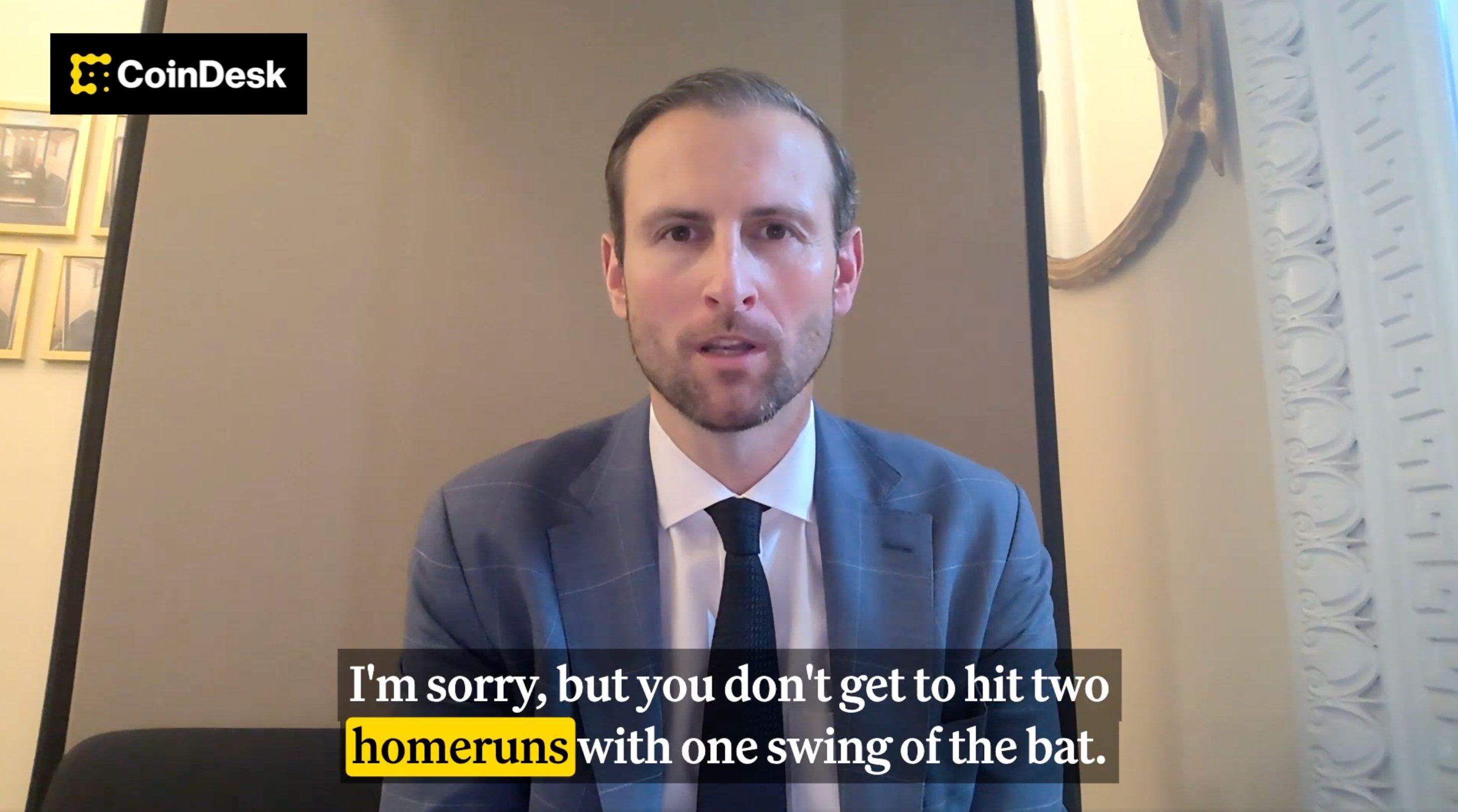
As for the Republican side, they appear, for now, to show no signs of further concessions in response to the Democrats' strong resistance. Patrick Witt, Executive Director of the White House Digital Asset Advisory Committee, stated firmly that the President has made historic concessions, yet Democrats remain unsatisfied — "you can't hit a home run, hit two home runs."
How Much Time Window Remains?

Early this morning, Senate Majority Leader John Thune stated that he would temporarily set aside the Clarity Act to prioritize advancing government official nomination confirmations and the Russian sanctions bill. Additionally, the Senate will be occupied on Tuesday and Wednesday this week due to the funeral of the late Senator Lindsey Graham.

This means that the already limited time available for the Clarity Act to advance before the summer recess has been further compressed. Current market expectations are that the Clarity Act may not enter the voting process until next week at the earliest, the final few days before the Senate recess.

Former Senate staffer Anne Kelley also posted on X today, stating that according to Senate rules, once the cloture process is initiated on a major, controversial bill, that bill becomes the Senate's primary agenda — until the completion of amendment consideration, a second cloture vote, and up to 30 hours of formal debate, it is difficult for the Senate to simultaneously advance another major, contentious bill.

This means that the Clarity Act not only has to face the question of whether it can resolve its own differences in time but also must compete for the already limited Senate voting time with other contentious bills like the Russian sanctions bill, the budget bill, and the SAVE Act.

This is why, although the market once hoped the Clarity Act could pass before the recess, more and more Washington observers are lowering their expectations.

For the cryptocurrency industry, this prolonged legislative battle has now entered its final stage. The regulatory framework is just "one step away" from implementation, but whether that step will be taken in the coming days or will be deferred to an uncertain future will soon be revealed.


Трендові криптовалюти

Пов'язані питання

QWhat is the main obstacle currently preventing the Clarity Act from moving forward?

AThe main obstacle is the disagreement over the details of the newly added 'ethics provision'. Democrats have significant concerns about its enforcement mechanism, expiration date, and scope of coverage.

QWhat are the three key objections raised by Democrats regarding the current 'ethics provision' text?

AFirst, they object to the Department of Justice (DOJ) having sole enforcement power, questioning its independence, especially given the DOJ's current leadership. Second, they strongly oppose the clause that automatically sunsets the provision in January 2029, which coincides with the end of Trump's potential term. Third, they believe the restriction scope is too limited and may not cover indirect participation by family members or associates.

QWhy has Galaxy's head of research, Alex Thorn, lowered the probability of the Clarity Act passing in 2026 to 30%?

AAlex Thorn lowered the probability to 30% due to the very limited time left before the summer recess and the strong opposition from Democratic negotiators to the current wording of the ethics provision, indicating significant unresolved political hurdles.

QWhat logistical challenges does the Clarity Act face in the Senate regarding its timeline before the summer recess?

AThe Senate has limited working days left. The schedule is further compressed by the need to prioritize other matters like government nominations, a Russian sanctions bill, and Senator Graham's funeral. The bill must also compete for floor time with other controversial legislation.

QAccording to the article, what action did the White House take that was initially seen as a compromise on the ethics issue?

AThe White House agreed to include an 'ethics provision' in the Clarity Act, which was initially interpreted as a sign of compromise from Trump and the Republicans, suggesting they were willing to reach a consensus with Democrats on this key remaining issue.

Пов'язані матеріали

Microsoft CEO Satya Nadella's Latest Warning: Betting Entirely on a Single AI Model Hands Over a Company's Lifeblood

Microsoft CEO Satya Nadella warns that companies relying solely on a single AI model could jeopardize their survival. He argues that over-dependence leads to "vendor lock-in," where businesses risk ceding control over their core data, memory, contextual history, and AI usage patterns. This dependence essentially outsources a company's critical thinking and operational know-how to an external provider. The deeper a company integrates with one AI system—feeding it prompts, internal data, and workflows—the more it reveals its unique business methods and competitive edge. This accumulated knowledge could become accessible to the AI supplier. Furthermore, switching providers becomes extremely costly and complex, as companies would need to rebuild their entire AI-augmented workflow, memory, and tool integrations from scratch. Nadella's solution is "decoupling." Companies should separate their proprietary data, memory, and control layer (or "harness") from the underlying AI models. By retaining metadata from every AI interaction, businesses can preserve their operational "brain" or institutional knowledge. This allows them to flexibly use different AI models (e.g., from OpenAI, Anthropic, Microsoft) for specific tasks without losing their accumulated expertise. The core idea: companies can rent the smartest models available, but they must keep their own "brain" and operational control firmly in-house.

marsbit28 хв тому

Microsoft CEO Satya Nadella's Latest Warning: Betting Entirely on a Single AI Model Hands Over a Company's Lifeblood

marsbit28 хв тому

Miners Advised Not to Buy GPUs for AI and to Focus on Infrastructure

A founder at an energy investment forum advises bitcoin miners not to purchase GPUs for AI themselves, but to instead focus on infrastructure like power and data center space. Mike Alfred of Alpine Fox stated that while AI infrastructure demand is a long-term, 20-30 year trend, it presents a key choice for miners. The first, riskier model involves owning and operating GPUs, which requires financing expensive hardware that quickly becomes obsolete. The second, more conservative model is akin to real estate: providing colocation services where clients bring their own servers, and the miner sells space, power, cooling, and water. Alfred noted this model is easier to finance. Most existing bitcoin mining sites are difficult and expensive to convert for AI, as AI data centers require far higher construction costs, redundant fiber connections, backup power, complex cooling, and near 100% uptime. A hybrid model, where mining acts as a flexible load to use excess power during AI data center construction or from generation facilities, was discussed. However, participants concluded this is only viable with very cheap power; otherwise, developers are better off focusing solely on AI. Miners are increasingly being evaluated for their available power capacity and project portfolios rather than just bitcoin output. Panelists also warned of risks in the AI sector, predicting at least one major default or contract breach among AI tenants, lenders, or landlords before bitcoin's next halving in 2028.

cryptonews.ru38 хв тому

Miners Advised Not to Buy GPUs for AI and to Focus on Infrastructure

cryptonews.ru38 хв тому

Millisecond 'Pay-to-Cut': How Did Hyperliquid's Priority Fee Turn into a Multi-Million Dollar Business?

"Millisecond 'Paid Queue-Jumping': How Hyperliquid's Priority Fee Became a Multi-Million Dollar Annual Business" In traditional finance, high-frequency trading firms spend millions on infrastructure for millisecond advantages. Hyperliquid has translated this race onto the blockchain with its "Priority Fee" system, creating an open economic game for speed. This system auctions two types of priority: **Gossip Priority** for faster data feeds (via a Dutch auction every 3 minutes), and **Order Priority** for front-of-queue trade execution (users bid a fee for lower latency). This converts a hardware race into a transparent, market-priced mechanism. Since launch, this feature has generated over $5M in protocol revenue. Projected annualized buybacks from this income exceed $30M, accounting for ~7% of total protocol revenue. The demand stems from large traders and market makers on Hyperliquid, for whom milliseconds can mean the difference between profit/loss or avoiding liquidation. Market makers pay these fees as "protection" to ensure their orders execute first, which in turn improves liquidity for all users. Crucially, Hyperliquid internalizes Maximum Extractable Value (MEV) that typically leaks to external validators or searchers, creating a new revenue stream beyond trading fees. The mechanism also strengthens HYPE's tokenomics. While 97% of trading fees fund secondary market buybacks (via the Assistance Fund), Priority Fees are **directly burned**, adding a second deflationary engine. Furthermore, fees for order priority are deducted from users' undelegated HYPE balances, encouraging large traders to hold and lock up tokens, reducing circulating supply. However, a key challenge remains: balancing the speed needs of institutional players with fair market access for retail users, as those who cannot pay high fees may suffer worse slippage during volatility. In summary, Hyperliquid's Priority Fee is a novel model that monetizes latency, captures MEV for the protocol, and enhances its native token's value through burning and lock-ups.

marsbit43 хв тому

Millisecond 'Pay-to-Cut': How Did Hyperliquid's Priority Fee Turn into a Multi-Million Dollar Business?

marsbit43 хв тому

Торгівля

Спот

Популярні статті

Як купити ONE

Ласкаво просимо до HTX.com! Ми зробили покупку Harmony (ONE) простою та зручною. Дотримуйтесь нашої покрокової інструкції, щоб розпочати свою криптовалютну подорож.Крок 1: Створіть обліковий запис на HTXВикористовуйте свою електронну пошту або номер телефону, щоб зареєструвати обліковий запис на HTX безплатно. Пройдіть безпроблемну реєстрацію й отримайте доступ до всіх функцій.ЗареєструватисьКрок 2: Перейдіть до розділу Купити крипту і виберіть спосіб оплатиКредитна/дебетова картка: використовуйте вашу картку Visa або Mastercard, щоб миттєво купити Harmony (ONE).Баланс: використовуйте кошти з балансу вашого рахунку HTX для безперешкодної торгівлі.Треті особи: ми додали популярні способи оплати, такі як Google Pay та Apple Pay, щоб підвищити зручність.P2P: Торгуйте безпосередньо з іншими користувачами на HTX.Позабіржова торгівля (OTC): ми пропонуємо індивідуальні послуги та конкурентні обмінні курси для трейдерів.Крок 3: Зберігайте свої Harmony (ONE)Після придбання Harmony (ONE) збережіть його у своєму обліковому записі на HTX. Крім того, ви можете відправити його в інше місце за допомогою блокчейн-переказу або використовувати його для торгівлі іншими криптовалютами.Крок 4: Торгівля Harmony (ONE)Легко торгуйте Harmony (ONE) на спотовому ринку HTX. Просто увійдіть до свого облікового запису, виберіть торгову пару, укладайте угоди та спостерігайте за ними в режимі реального часу. Ми пропонуємо зручний досвід як для початківців, так і для досвідчених трейдерів.

440 переглядів усьогоОпубліковано 2024.12.12Оновлено 2026.06.02

Як купити ONE

Обговорення

Ласкаво просимо до спільноти HTX. Тут ви можете бути в курсі останніх подій розвитку платформи та отримати доступ до професійної ринкової інформації. Нижче представлені думки користувачів щодо ціни ONE (ONE).

活动图片