流动性证明+三代币模型,熊来护你不堕死亡螺旋!

老雅痞Published on 2022-09-03Last updated on 2022-09-03

Abstract

作为一条新生L1公链,Berachain尝试以其独创的流动性证明机制解决DeFi长久以来面对的流动性匮乏、持续性不足等问题。并引入了少见的三代币机制,尝试协调投资者、开发者和用户之间的激励机制。

Berachain——DeFi原生L1区块链
Berachain是一个高性能、可扩展,且等效于EVM的智能合约和跨链互操作性平台。它基于Cosmos-SDK而建立,同时采用了Tendermint共识机制。

Tendermint是一种基于拜占庭容错(BFT)共识的区块链引擎。在构建区块链系统时,一般包括网络层,共识层和应用层,Tendermint可以把网络层和共识层打包成一个通用的引擎,并通过模块化的方式,方便开发不同应用场景的区块链网络。
目前,已经有超过1500亿美元的资产被保护在基于Tendermint构建的公链中,它是当今市场上真正经过实践考验,且凝聚了一定共识的共识框架之一。

Tendermint与Berachain的流动性证明女巫抵抗机制相结合,使Berachain能够为用户提供更快的交易速度、更低的交易成本以及更为稳定的网络。

同时,它还在共识引擎和虚拟机之间创建了一个新的互操作层,该层负责维护“共识抵押”链原生稳定币,提高质押资本的效率。最重要的是,与传统的权益证明区块链相比,其具有更高的女巫抗性水平。

流动性证明
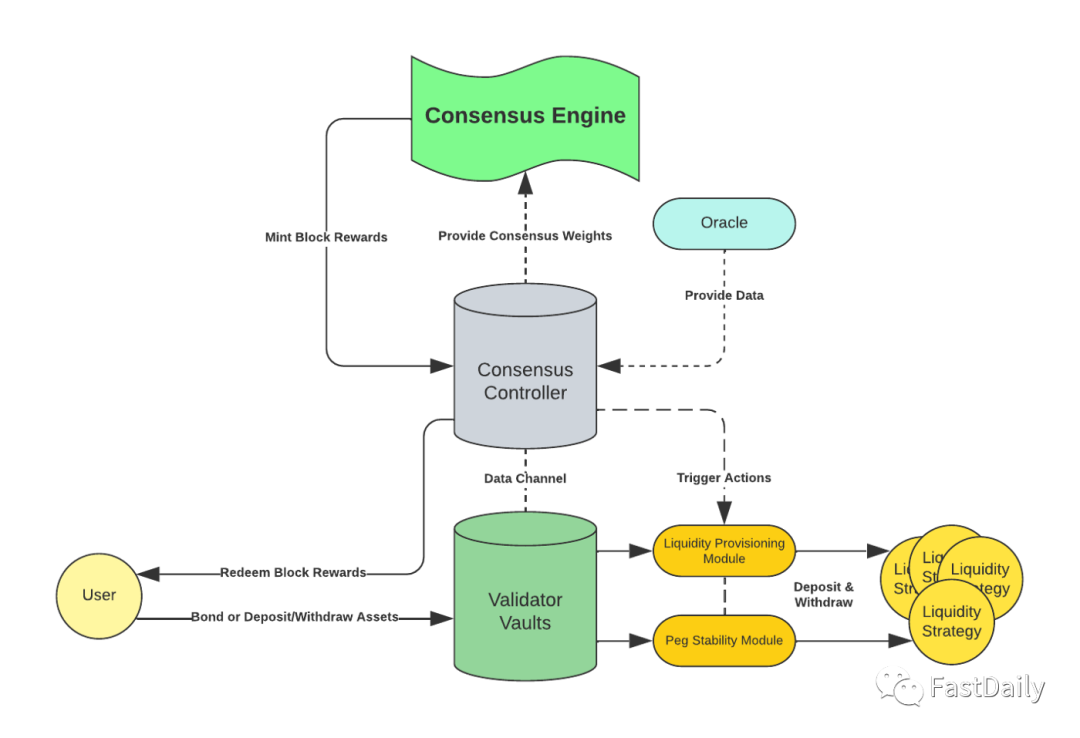
以往的DeFi通常面临基础设施薄弱、流动性匮乏等问题,其生态系统缺乏可持续性,因此通常陷入“庞氏骗局”的死亡螺旋。而BeraChain就致力于改变这一现状,采用更加可持续的方式来激励构建新的DeFi生态系统。

流动性证明是由Berachain独创的新型女巫抵抗机制,它利用共识保险库来计算验证者的投票权重、分配区块奖励并刺激资本的流动速度和流动性深度。

用户和验证者可以将其资产存入或绑定到共识保险库的系统中,以获得代表其存款的代币化股份。这些代币化股份不仅代表该用户在系统中的代币份额,还可以用于系统的治理。

用户也可以将他们的存款委托给特定的验证者,从而将共识投票权分配给他们选择的验证者。该模型与委托权益证明系统(dPOS)有一定的相似性。

流动性证明共识创造了一个环境,在该环境内,BeraChain的流动性将与其利用率和市值同步增长,从而推动系统整体的可持续、健康增长。在流动性证明之下,建立在BeraChain上的每个协议和网络本身将实现真正意义的双赢,因为其TVL将在产生BERA代币奖励的同时提高网络的安全性和女巫抵抗力。

综上,我们不难发现,BeraChain旨在协调投资者、开发者和用户之间的激励机制,因此,可以说它是一个真正意义上的DeFi原生L1。

代币经济
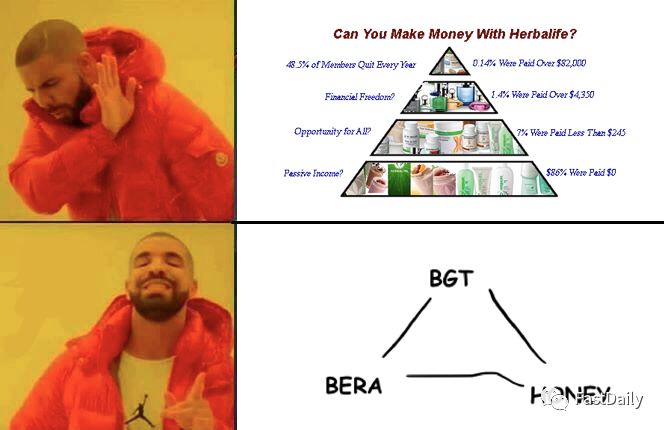
通常情况下,L1区块链网络为了保持内在经济体系的良性循环都会发行专为其生态系统量身打造的原生Token。其中比较常见的包括单代币系统,如比特币、以太坊等;双代币系统,如Terra等。

但Berachain却采用了较为少见的三代币系统,其Token种类如下所示:

1、BERA:Berachain的Gas代币;

2、BGT:Berachain的治理代币;

3、HONEY:Berachain的原生共识抵押稳定币。

而之所以采取三代币模式,很大程度上与Berachain一直以来所秉持的观念有关。Berachain认为每个去中心化经济体都需要拥有对于生态系统运作至关重要的三大媒介,它们分别是:

1、既为工作单元定价,又以智能合约执行的形式执行所述工作的媒介;

2、以民主功能组织并达成共识,且就网络的未来做出决策的媒介;

3、通过共同稳定面额进行交易的媒介。

不难发现,这三大媒介所具有的职能几乎同Berachain生态系统中的三种代币如出一辙。BERA作为Berachain的Gas代币,不仅为工作单元定价,还以智能合约执行的形式执行所述工作;BGT作为Berachain的治理代币,可以帮助社区成员达成共识,且就网络的未来做出决策;HONEY作为Berachain的原生共识抵押稳定币,可以充当稳定交易的重要媒介。

而这三点,传统的单币模型或双币模型如果不借助外在条件是很难同时实现的,我们可以举一个典型的例子。

在流通代币同时充当治理代币的环境中,交易最多且使用网络最多的用户,随着时间的推移,反而在无形之中减少了投票权,这明显是不太合理的。而将费用和治理代币分开就可以有效的消除这种不合理。三代币系统的优势就在于可以通过这种方式,允许用户通过使用网络和为流动性证明系统提供价值来获得治理代币,从而更有力的为网络的发声。这样更愿意做事的人就可以获得更多的激励和权益,带领整个系统走向良性循环。

Berachain建设现状

Berachain目前还处于相当早期的阶段,进入项目官网甚至连白皮书都还尚未发布。除了正处于建设之中的区块链网络之外,还有一个名为Bit Bears by Berachain的NFT项目,目前披露的信息也相当有限。整体而言,项目方可以说是相当低调了。当然,低调做事未必是坏事。

另外,据项目方透露,其目前已经建立起并运行了一个内部开发网络,该网络正在接受压力测试,并正在与其几个合作伙伴进行集成。预计该激励性测试网将在未来几个月内准备就绪并启动,白皮书也将在后续随之更新。

用户将可在其上质押各种Token,并委托给验证者,为生态系统提供流动性的同时保护网络。他们也将以Bera Token的形式获得区块奖励。

结语

作为一条新生L1公链,Berachain尝试以其独创的流动性证明机制解决DeFi长久以来面对的流动性匮乏、持续性不足等问题。并引入了少见的三代币机制,尝试协调投资者、开发者和用户之间的激励机制。

从上述一系列创新和举措,我们不难看出,Berachain已经看到了当下DeFi所存在问题的核心,并打算通过机制的革新来破除往日的魔障。但知易行难,这条路显然不是这么容易走得通的。DeFi作为加密世界的核心之一,其几乎渗透到了每一个赛道,因此DeFi的问题也几乎可以等同为整个加密世界的“老大难”。在这种背景之下,问题仍尚未得到妥善的解决,其难度之大可想而知。

而Berachain作为新生项目,许多细节尚未公布,其设计难免略显粗糙。同时,它也还需要大量的实践检测,才能验证其是否具有可行性。因而,我们可以对其保持关注,静观其变。

Related Reads

Where Is the AI Infrastructure Industry Chain Stuck?

The AI infrastructure (AI Infra) industry chain is facing unprecedented systemic bottlenecks, despite the rapid emergence of applications like DeepSeek and Seedance 2.0. The surge in global computing demand has exposed critical constraints across multiple layers of the supply chain—from core manufacturing equipment and data center cabling to specialty materials and cleanroom facilities. Key challenges include four major "walls": - **Memory Wall**: High-bandwidth memory (HBM) and DRAM face structural shortages as AI inference demand outpaces training, with new capacity not expected until 2027. - **Bandwidth Wall**: Data transfer speeds lag behind computing power, causing multi-level bottlenecks in-chip, between chips, and across data centers. - **Compute Wall**: Advanced chip manufacturing, reliant on EUV lithography and monopolized by ASML, remains the fundamental constraint, with supply chain fragility affecting production. - **Power Wall**: While energy demand from data centers is rising, power supply is a solvable near-term challenge through diversified energy infrastructure. Expansion is further hindered by shortages in testing equipment, IC substrates (critical for GPUs and seeing price hikes over 30%), specialty materials like low-CTE glass fiber, and high-end cleanroom facilities. Connection technologies are evolving, with copper cables resurging for short-range links due to cost and latency advantages, while optical solutions dominate long-range scenarios. Innovations like hollow-core fiber and advanced PCB technologies (e.g., glass substrates, mSAP) are emerging to meet bandwidth needs. In summary, AI Infra bottlenecks are multidimensional, spanning compute, memory, bandwidth, power, and supply chain logistics. Advanced chip manufacturing remains the core constraint, while substrate, material, and equipment shortages present immediate challenges. The industry is moving toward hybrid copper-optical solutions and accelerated domestic supply chain development.

marsbit56m ago

Where Is the AI Infrastructure Industry Chain Stuck?

marsbit56m ago

Autonomy or Compatibility: The Choice Facing China's AI Ecosystem Behind the Delay of DeepSeek V4

DeepSeek V4's repeated delay in early 2026 has sparked global discussions on "de-CUDA-ization" in AI. The highly anticipated trillion-parameter open-source model is undergoing deep adaptation to Huawei’s Ascend chips using the CANN framework, representing China’s first systematic attempt to run a core AI model outside the CUDA ecosystem. This shift, however, comes with significant engineering challenges. While the model uses a MoE architecture to reduce computational load, it places extreme demands on memory bandwidth, chip interconnects, and system scheduling—areas where NVIDIA’s mature CUDA ecosystem currently excels. Migrating to Ascend introduces complexities in hardware topology, communication latency, and software optimization due to CANN’s relative immaturity compared to CUDA. The move highlights a broader strategic dilemma: short-term compatibility with CUDA offers practical benefits and faster adoption, as seen in CANN’s efforts to emulate CUDA interfaces. Yet, long-term over-reliance on compatibility risks inheriting CUDA’s limitations and stifling native innovation. If global AI shifts away from transformer-based architectures, strict compatibility could lead to technological obsolescence. Despite these challenges, DeepSeek V4’s eventual release could demonstrate the viability of a full domestic AI stack and accelerate CANN’s ecosystem growth. However, true technological independence will require building an original software-hardware paradigm beyond compatibility—a critical task for China’s AI ambitions in the next 3-5 years.

marsbit1h ago

Autonomy or Compatibility: The Choice Facing China's AI Ecosystem Behind the Delay of DeepSeek V4

marsbit1h ago

Trading

Spot
Futures

Hot Articles

What is $BITCOIN

DIGITAL GOLD ($BITCOIN): A Comprehensive Analysis Introduction to DIGITAL GOLD ($BITCOIN) DIGITAL GOLD ($BITCOIN) is a blockchain-based project operating on the Solana network, which aims to combine the characteristics of traditional precious metals with the innovation of decentralized technologies. While it shares a name with Bitcoin, often referred to as “digital gold” due to its perception as a store of value, DIGITAL GOLD is a separate token designed to create a unique ecosystem within the Web3 landscape. Its goal is to position itself as a viable alternative digital asset, although specifics regarding its applications and functionalities are still developing. What is DIGITAL GOLD ($BITCOIN)? DIGITAL GOLD ($BITCOIN) is a cryptocurrency token explicitly designed for use on the Solana blockchain. In contrast to Bitcoin, which provides a widely recognized value storage role, this token appears to focus on broader applications and characteristics. Notable aspects include: Blockchain Infrastructure: The token is built on the Solana blockchain, known for its capacity to handle high-speed and low-cost transactions. Supply Dynamics: DIGITAL GOLD has a maximum supply capped at 100 quadrillion tokens (100P $BITCOIN), although details regarding its circulating supply are currently undisclosed. Utility: While precise functionalities are not explicitly outlined, there are indications that the token could be utilized for various applications, potentially involving decentralized applications (dApps) or asset tokenization strategies. Who is the Creator of DIGITAL GOLD ($BITCOIN)? At present, the identity of the creators and development team behind DIGITAL GOLD ($BITCOIN) remains unknown. This situation is typical among many innovative projects within the blockchain space, particularly those aligning with decentralized finance and meme coin phenomena. While such anonymity may foster a community-driven culture, it intensifies concerns about governance and accountability. Who are the Investors of DIGITAL GOLD ($BITCOIN)? The available information indicates that DIGITAL GOLD ($BITCOIN) does not have any known institutional backers or prominent venture capital investments. The project seems to operate on a peer-to-peer model focused on community support and adoption rather than traditional funding routes. Its activity and liquidity are primarily situated on decentralized exchanges (DEXs), such as PumpSwap, rather than established centralized trading platforms, further highlighting its grassroots approach. How DIGITAL GOLD ($BITCOIN) Works The operational mechanics of DIGITAL GOLD ($BITCOIN) can be elaborated on based on its blockchain design and network attributes: Consensus Mechanism: By leveraging Solana’s unique proof-of-history (PoH) combined with a proof-of-stake (PoS) model, the project ensures efficient transaction validation contributing to the network's high performance. Tokenomics: While specific deflationary mechanisms have not been extensively detailed, the vast maximum token supply implies that it may cater to microtransactions or niche use cases that are still to be defined. Interoperability: There exists the potential for integration with Solana’s broader ecosystem, including various decentralized finance (DeFi) platforms. However, the details regarding specific integrations remain unspecified. Timeline of Key Events Here is a timeline that highlights significant milestones concerning DIGITAL GOLD ($BITCOIN): 2023: The initial deployment of the token occurs on the Solana blockchain, marked by its contract address. 2024: DIGITAL GOLD gains visibility as it becomes available for trading on decentralized exchanges like PumpSwap, allowing users to trade it against SOL. 2025: The project witnesses sporadic trading activity and potential interest in community-led engagements, although no noteworthy partnerships or technical advancements have been documented as of yet. Critical Analysis Strengths Scalability: The underlying Solana infrastructure supports high transaction volumes, which could enhance the utility of $BITCOIN in various transaction scenarios. Accessibility: The potential low trading price per token could attract retail investors, facilitating wider participation due to fractional ownership opportunities. Risks Lack of Transparency: The absence of publicly known backers, developers, or an audit process may yield skepticism regarding the project's sustainability and trustworthiness. Market Volatility: The trading activity is heavily reliant on speculative behavior, which can result in significant price volatility and uncertainty for investors. Conclusion DIGITAL GOLD ($BITCOIN) emerges as an intriguing yet ambiguous project within the rapidly evolving Solana ecosystem. While it attempts to leverage the “digital gold” narrative, its departure from Bitcoin's established role as a store of value underscores the need for a clearer differentiation of its intended utility and governance structure. Future acceptance and adoption will likely depend on addressing the current opacity and defining its operational and economic strategies more explicitly. Note: This report encompasses synthesised information available as of October 2023, and developments may have transpired beyond the research period.

363 Total ViewsPublished 2025.05.13Updated 2025.05.13

What is $BITCOIN

Discussions

Welcome to the HTX Community. Here, you can stay informed about the latest platform developments and gain access to professional market insights. Users' opinions on the price of BTC (BTC) are presented below.

活动图片