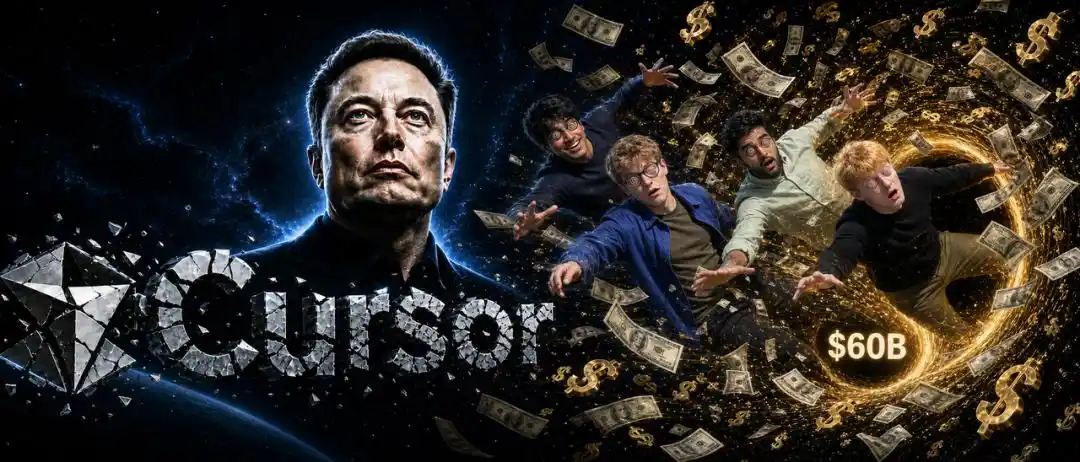
On August 15th, Cursor vanished completely!
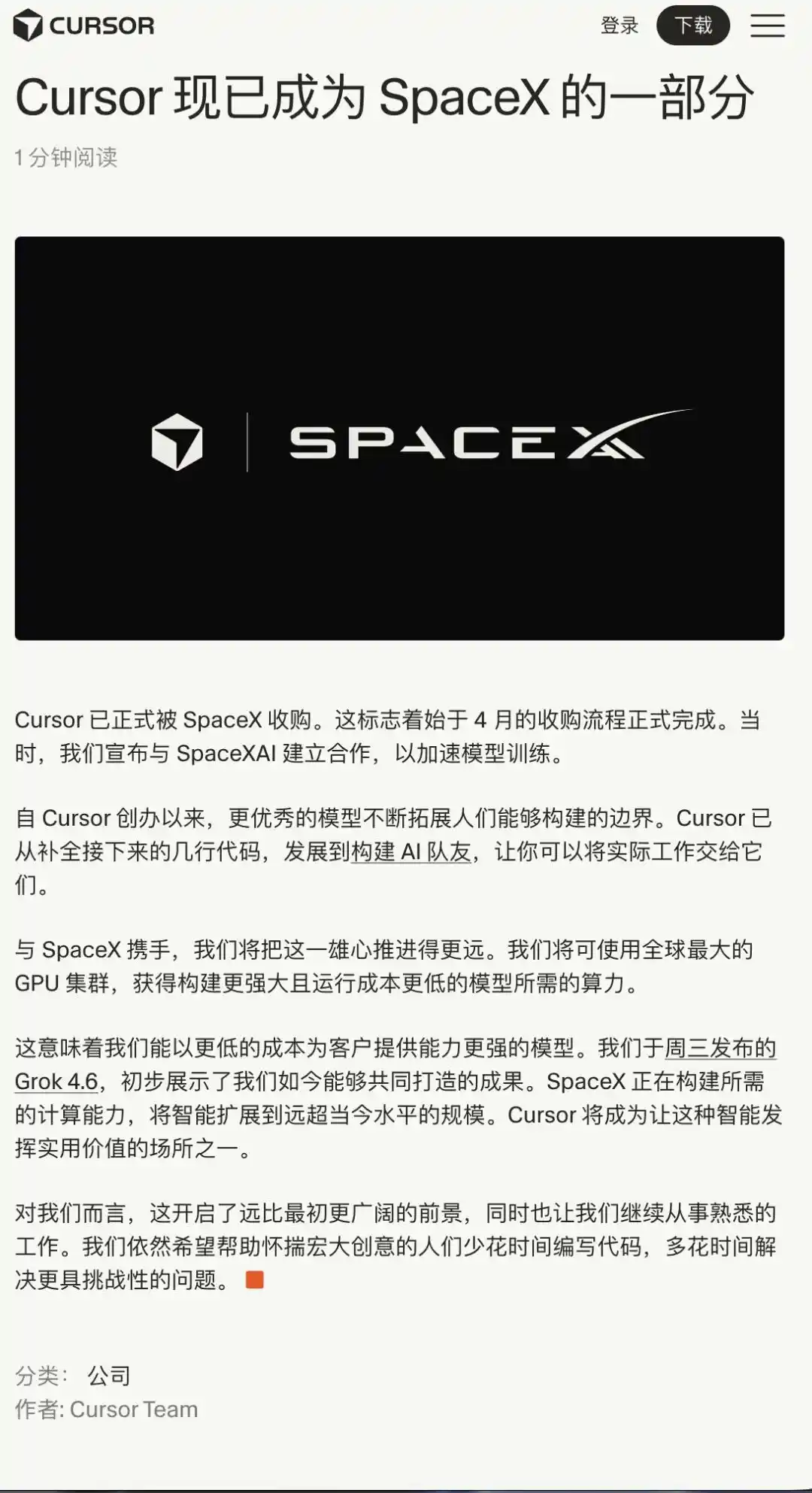
Last night, Cursor's official account personally announced: "Cursor is now part of SpaceX."
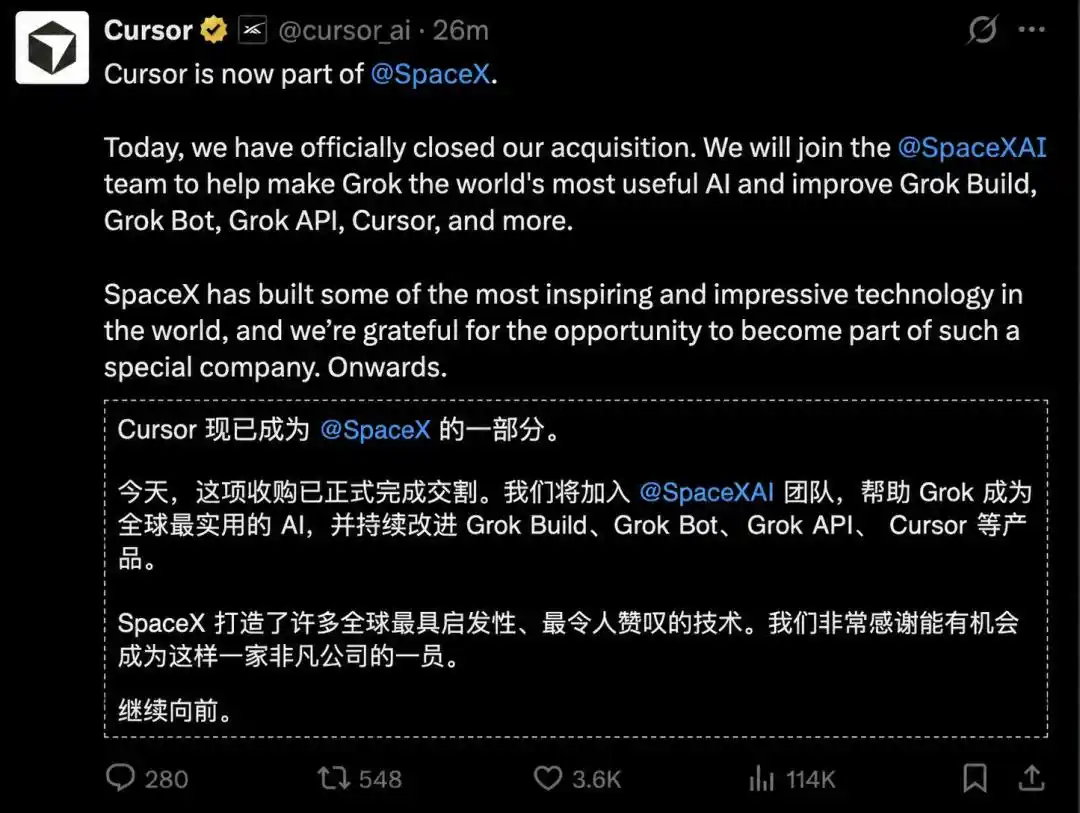
SpaceX subsequently confirmed: the acquisition has been formally completed—it was sold to Musk for $60 billion.
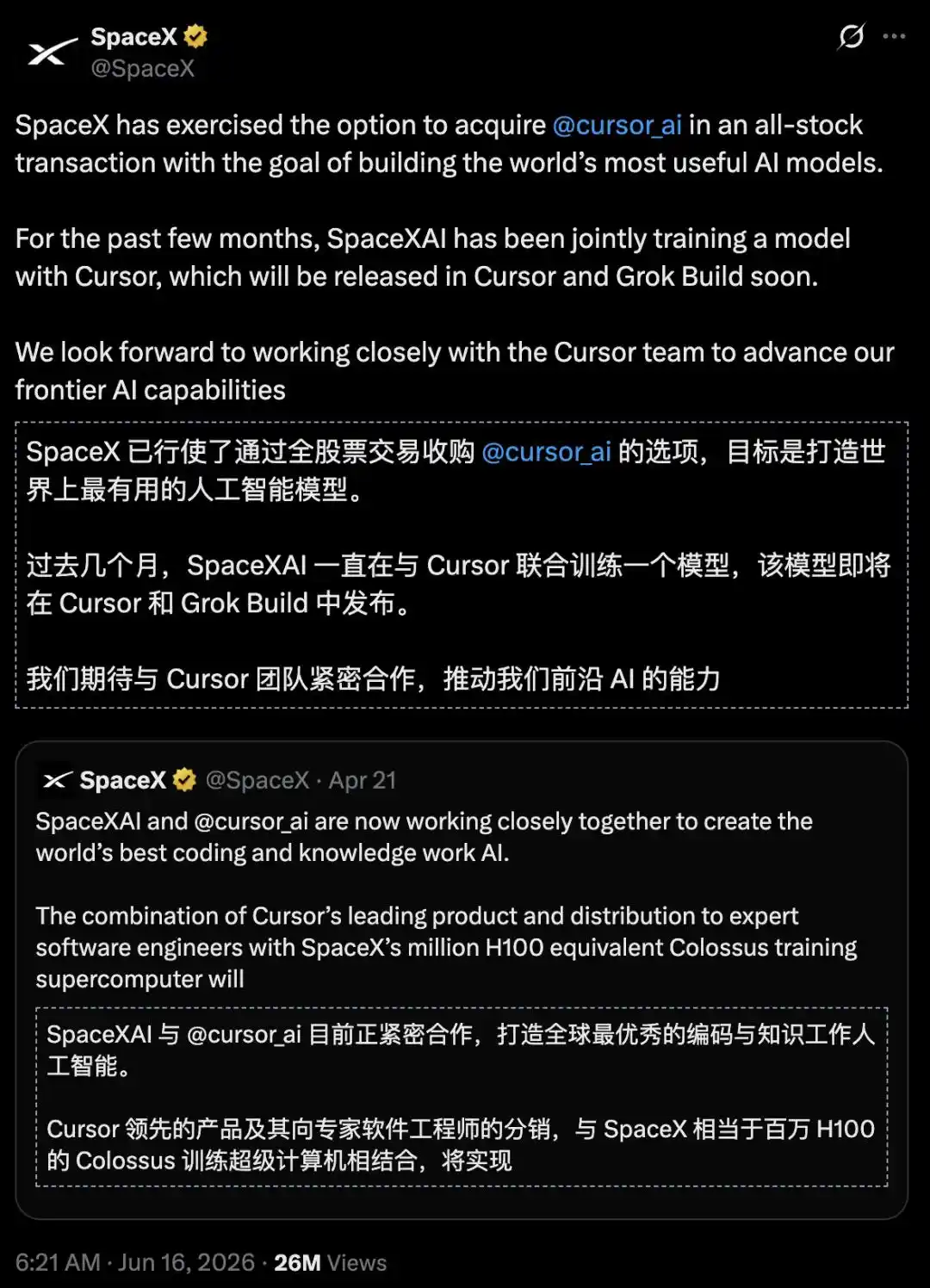
This is the largest startup acquisition in history.
Cursor stated: They will join the SpaceXAI team to develop Grok, Grok Build, Grok Bot, Grok API, and Cursor together.
This means that from this moment on, the days of Cursor—born from four MIT students writing code in a dorm room, evolving into a global leader in AI programming tools—as an independent company have officially ended.
That absolutely neutral Cursor, belonging to all developers, has completely disappeared.
On Musk's side, he is building an incredibly formidable data feedback loop.
From now on, he will possess vast amounts of programming data, gaining the most crucial chip for the future AI era!
Now, within Musk's ecosystem, there is X's text data, Tesla's road data, SpaceX's engineering data, and Cursor's coding tools.
Even future Tesla robots will be a data source. Combined with space rocket computing power, he will have an overwhelmingly terrifying moat!
Musk Redefines a New Path to ASI
It can be said that SpaceX's astronomical acquisition of Cursor is a landmark event defining an industry inflection point.
From now on, the era of absolute neutrality in AI applications is over!
This event also tells us: on the path to ASI (Artificial Superintelligence), the evolution of superintelligence will definitely not rely on a decentralized application ecosystem.
Those monopolistic, closed-loop systems integrating massive computing power, foundational large models, and vast real-world workflows will dominate everything.
For us ordinary readers, the signal conveyed is also brutal—
The "neutral model nation" we once took for granted has now collapsed.
In the future, at least in the Cursor scenario, ideal development environments allowing free switching between top-tier models (like Claude or GPT) might become very scarce.
Clearly, on the path to ASI, Musk's approach is fundamentally different from Anthropic's and OpenAI's.
As mentioned, his core strategy is the vertical integration of everything: seamlessly merging SpaceX's Colossus supercomputing infrastructure, xAI's Grok, with Cursor's customers and real programming data streams.
After the acquisition, what's the most obvious change? The answer is clear.
Just a few days ago, Grok Bot was released.
As xAI's new AI teammate product, each Bot has its own cloud-based virtual machine, can log into your tools and applications, and operate like a real person; it can also autonomously run multi-step real-world tasks 24/7, even when your computer is off.
Furthermore, it supports multiple Bots collaborating in parallel, passing tasks between them, and sharing context. An influencer who tested it said its biggest surprise was this capability.
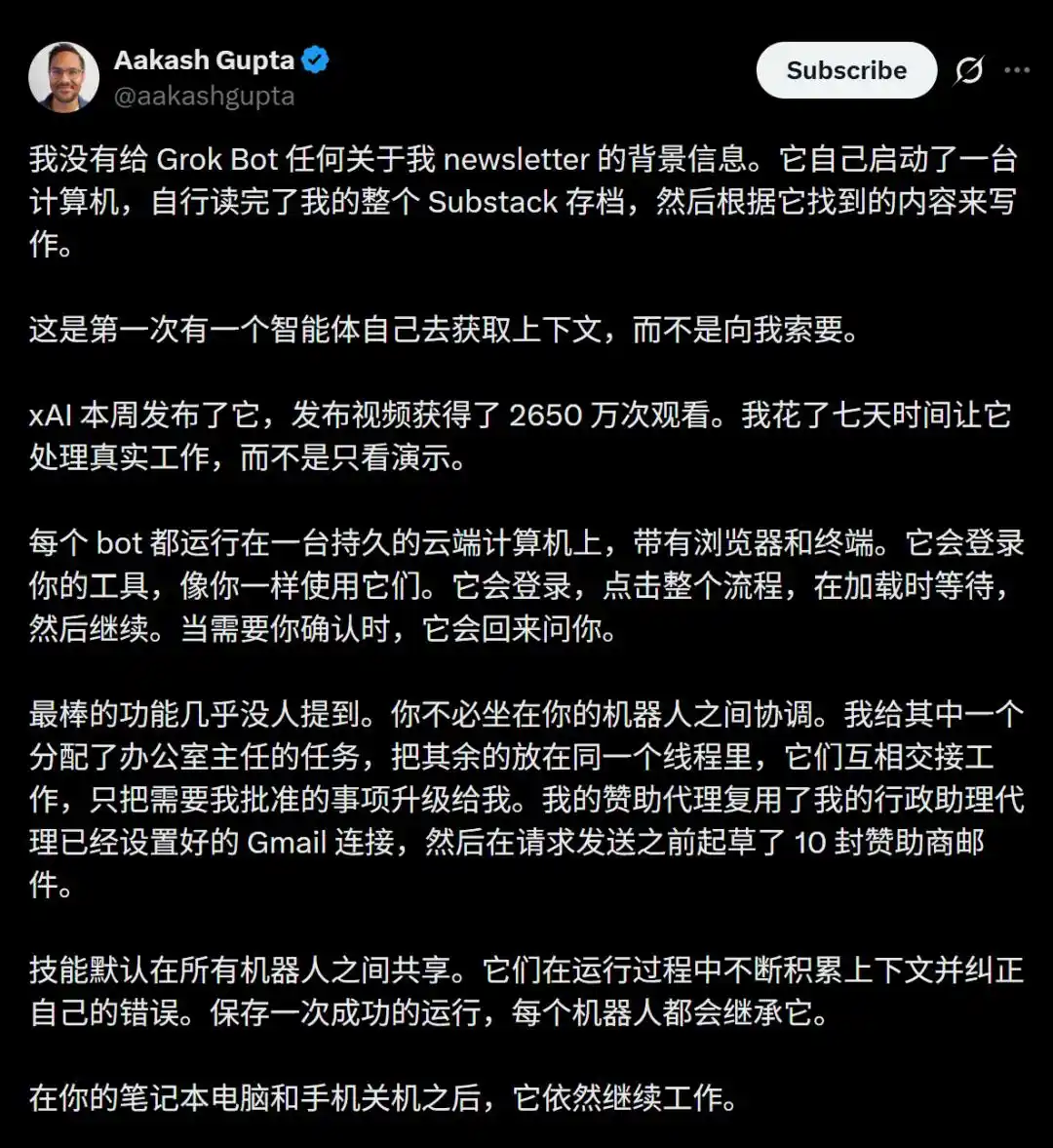
He assigned one Bot the role of Chief of Staff, placed the others in a thread, and had them pass work to each other, escalating only items requiring approval.
Compared to Hermes, ChatGPT Work, or Cowork, Grok Bot, while not as dazzling, is still the most powerful product xAI has ever released.
This super-strong product is built on Cursor's foundations. Cursor is one of the main delivery platforms and underlying supports for Grok Bot. Grok Bot's download, installation, login, billing, and most documentation go through the Cursor system.
The combination of Grok Bot + Cursor essentially bundles "persistent cloud computer + multi-agent collaboration + top-tier programming capability + massive computing power" together.
In the long run, it has the potential to become SpaceXAI's core product in the enterprise AI agent market, officially competing with Claude Cowork and ChatGPT Work.
In the AI Agent arena, Grok has finally caught up. Musk's $60 billion was indeed not wasted.
$60 Billion, History's Most Insane 'Table-Clearing' Buyout
The story's groundwork was actually laid months ago.
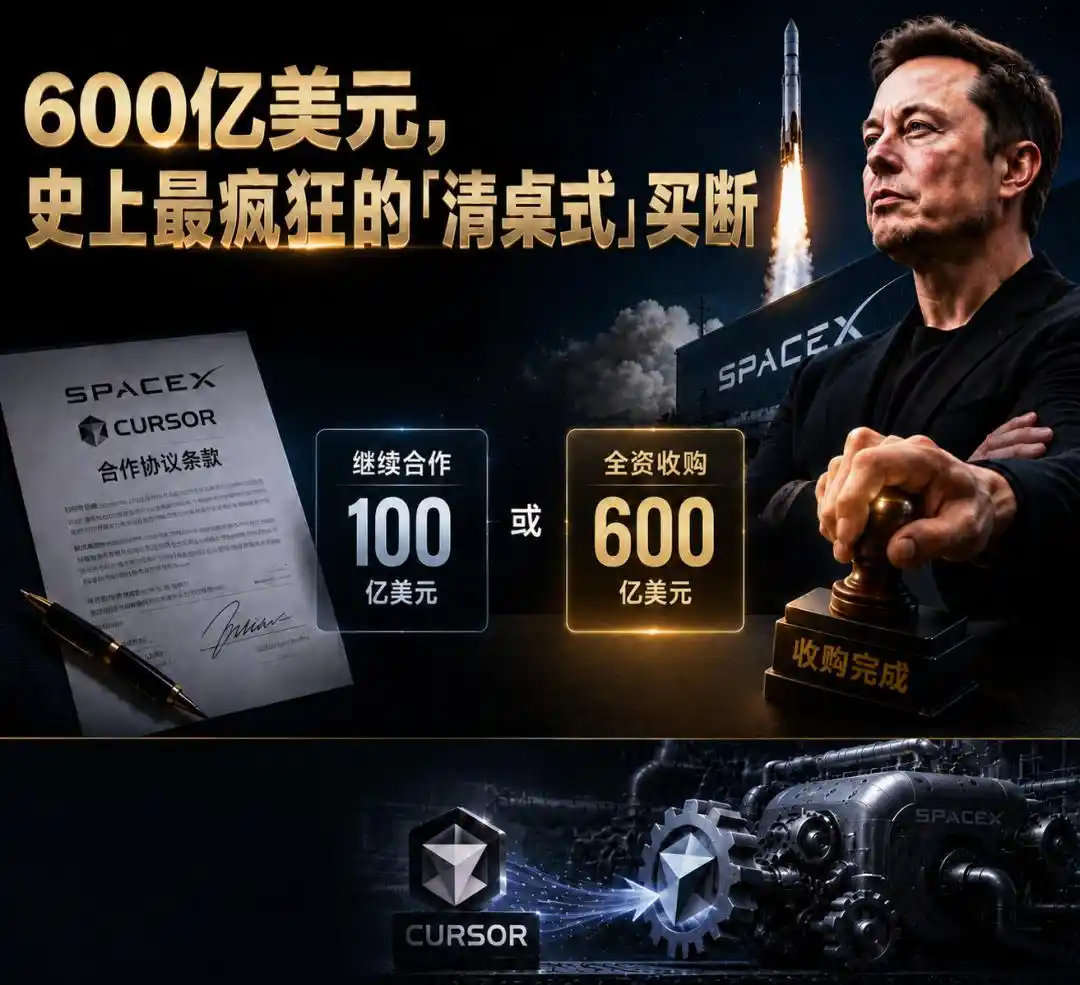
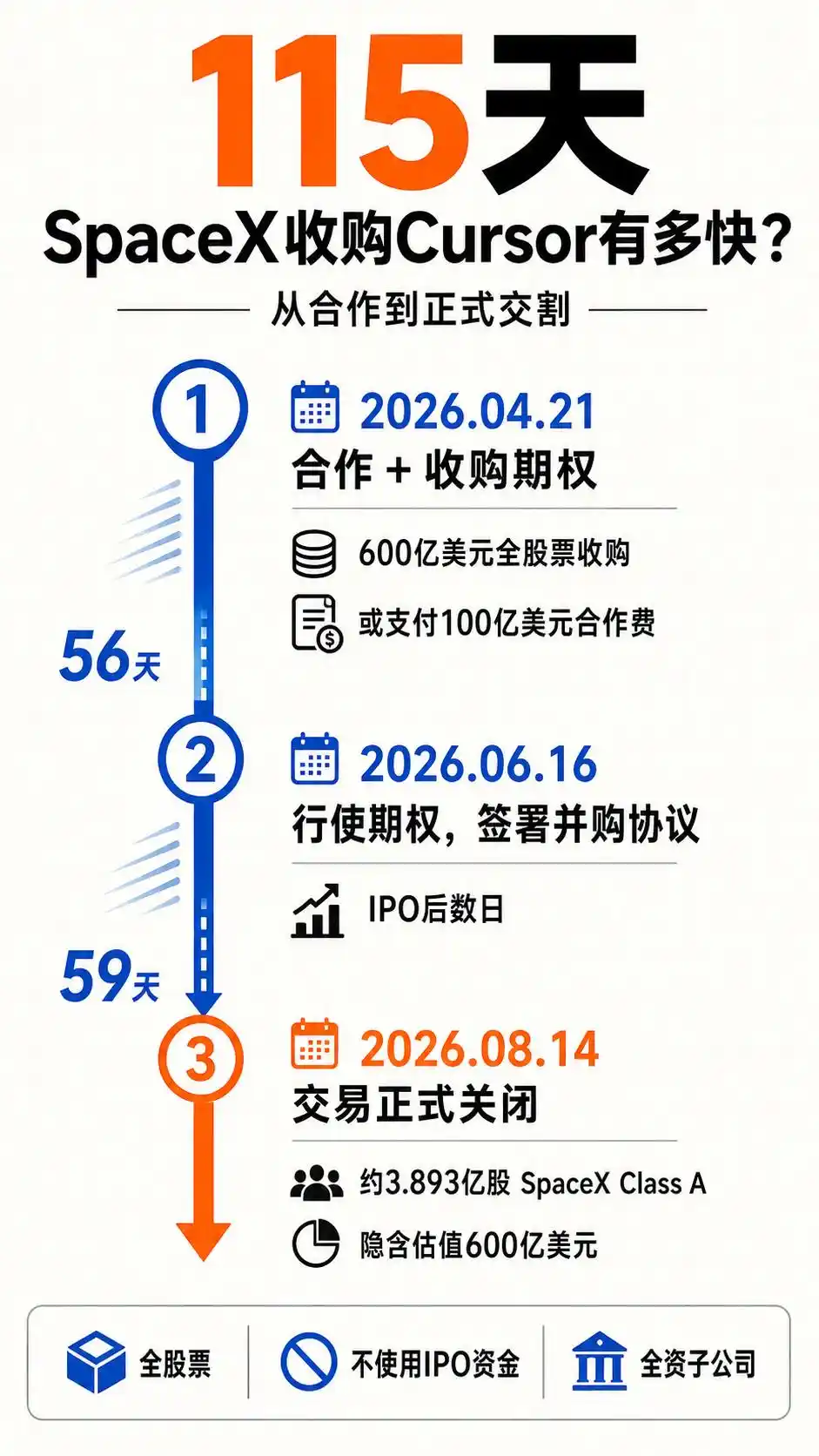
Back in April this year, the agreement between SpaceX and Cursor included a clause—
SpaceX could either pay $10 billion to continue the partnership, or buy Cursor outright for the astronomical price of $60 billion.
$60 billion, setting the record for the largest startup acquisition in history.
Musk didn't hesitate for a second; he chose the latter.
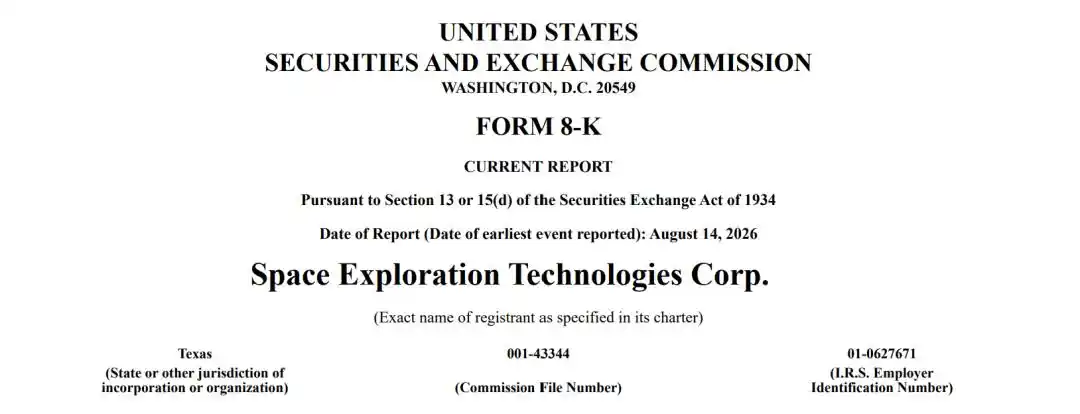
In June, SpaceX announced the execution of the acquisition. The whole of Silicon Valley was speculating: with such a massive deal, would regulators block it? Would closing be delayed?
The result? Today, the hammer fell.
The Information once revealed the brutal truth: this wasn't a warm, independent acquisition; it was a complete and utter takeover.
During an all-hands meeting, Cursor management admitted: the company would be completely dismantled.
All of Cursor's assets, once valued in the tens of billions—cash, intellectual property, employees, contracts with 50,000 enterprise customers, even the real programming data streams with millions of lines of code—would be integrated into SpaceXAI's domain.
From an independent player at the table, Cursor has finally been reduced to a cog in a giant's war machine.
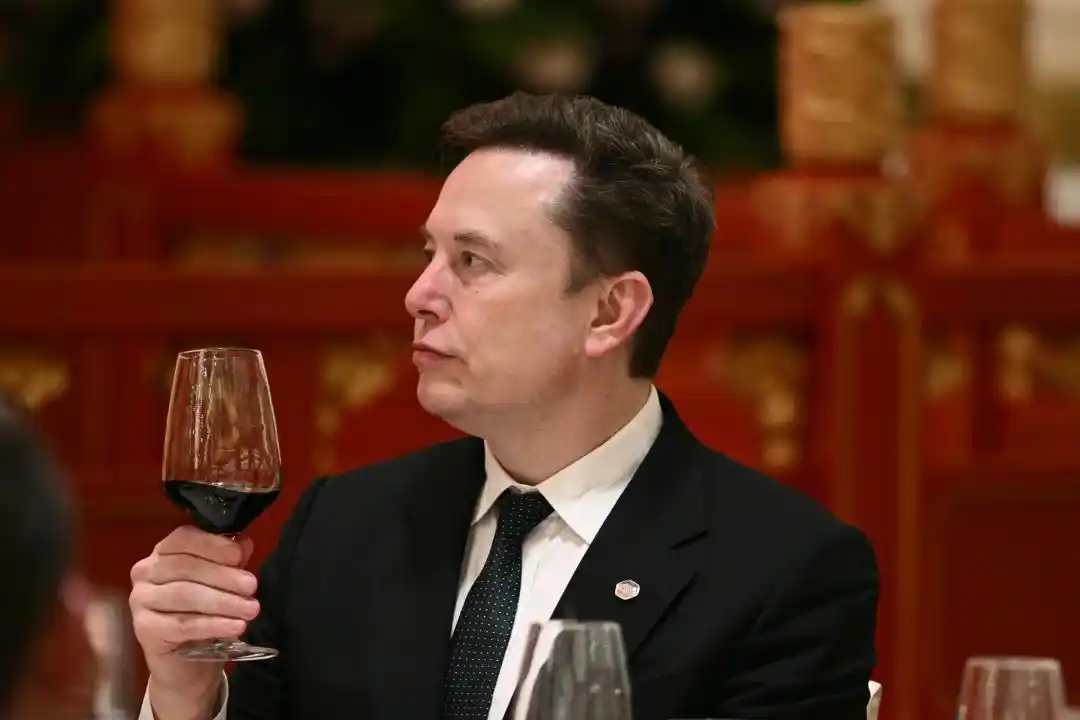
Of course, Cursor also gained benefits: it now has access to Colossus, the supercomputer with 200,000 GPUs.
Previously, Cursor expressed its desire to advance training work but was always limited by computing power.
But the name Cursor also disappears with it. Its internal agent codenamed Sand will likely debut under the name "Grok Bot."
A poignant scene was a veteran employee questioning on the spot: Why can't it be called Cursor?
A few months ago, Cursor's CEO assured everyone that SpaceXAI valued Cursor's brand identity extremely highly, viewing it as a key asset.
Now, however, that illusion is shattered.
A name is not just a label; it carries a belief. For countless developers worldwide, Cursor represented speed, ultimate experience, and reverence for code.
But now, it must make way for the super-IP that is "Grok."
When it dons the skins of Grok Bot and Grok Build, the Cursor filled with geek spirit is already dead.
The AI Era's Greatest Fairytale Shatters, the ASI Landscape Shifts
Four years ago, four MIT students created Cursor in their dorm room.
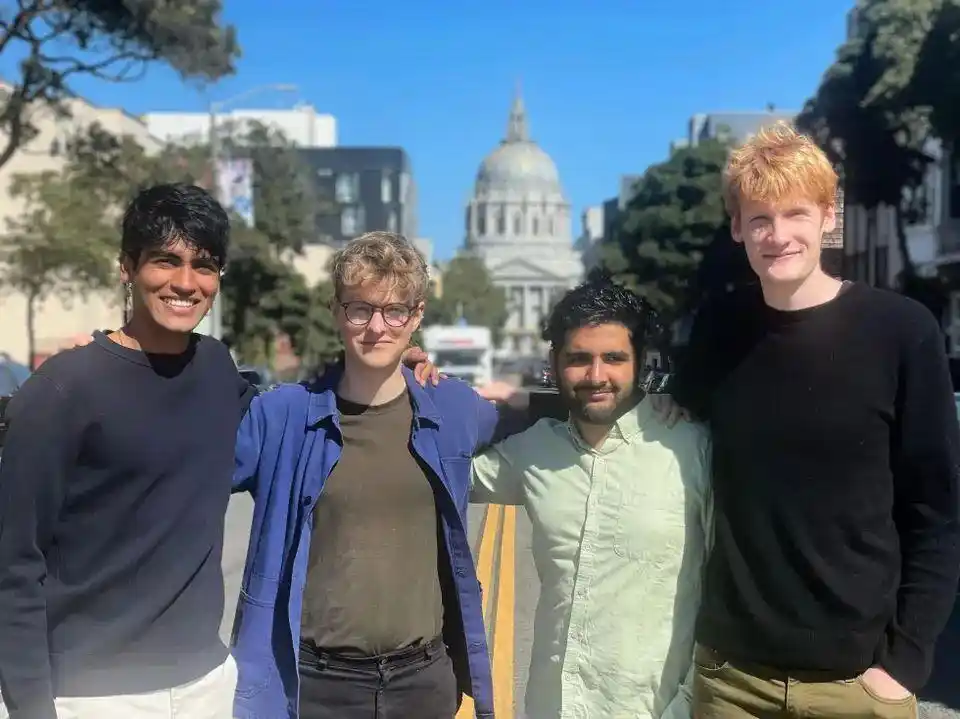
They proved something that excited all entrepreneurs: in the era of large models, you don't necessarily need your own model or burn tens of billions on computing power.
Just by standing on the shoulders of giants and perfecting the workflow, you can still become a unicorn valued in the tens of billions.
It gave the greatest hope to all layer-on-top entrepreneurs. Yet today, that fairytale has come to a Musk-style ending.
Perhaps, the ultimate fate of any sufficiently powerful AI application is only one of two: either grow into a giant itself, or be devoured.
Marked by Cursor's disappearance, the future ASI landscape has already changed: we may need to welcome an era of increasing monopoly, controlled by a few giants.
In this winner-takes-all endgame, there may no longer be neutral ground. The entire AI map of Silicon Valley, and even the world, will become a battleground for a few super-oligopolies (like the Microsoft/OpenAI/SpaceXAI empires) to crush each other.
And Musk's SpaceXAI has also secured its ticket to the ASI finals.
From today, Cursor no longer belongs to global developers.
It belongs to the massive SpaceXAI, to Musk who is determined to seize the global AI throne.
Goodbye, independent Cursor.
References:
https://cursor.com/cn/blog/joining-spacex
https://x.com/cursor_ai/status/2088249881718919393?s=20
https://x.com/SpaceX/status/2066873915717136548
https://www.bloomberg.com/news/articles/2026-08-14/spacex-completes-its-60-billion-cursor-acquisition
This article is from the WeChat public account "Xin Zhi Yuan", author: ASI Revelation