Article | Aurora AI Lab, Author | Li Xiaotian
Just as the entire AI community was almost forgetting it, Manus has returned.
On August 11, Manus published a letter to its users on its official website: it will soon resume its status as an independent company and continue serving global users. The letter did not mention the specific progress of the buyback by old shareholders such as Tencent and ZhenFund, maintaining a tone so restrained as to be almost devoid of waves. The only detail worth noting is hidden in the appendix: to meet specific regional regulatory requirements, some user data generated after December 29, 2025, will be deleted between August 23 and 24—the very day Meta announced its acquisition of Manus. Drawing a data boundary to conclude an acquisition relationship is, in a sense, the most dignified way for Manus and Meta to part.
From its overnight explosion in popularity in March 2025, to its sale to Meta at a valuation of $2-3 billion by year's end, then to the Chinese regulators halting the deal in April 2026, and ultimately being bought back by domestic old shareholders to regain independence, Manus compressed the plotlines most startups might not experience in a lifetime into just over a year. And the moment of its restart happens to coincide with the aftermath of another event: the "State Council Regulations on Outbound Investment" (State Council Decree No. 837) officially came into effect on July 1.
Looking at these two events together is more interesting than viewing either alone.
A New Regulation, A Cautionary Tale
Decree 837 was adopted at the 83rd Executive Meeting of the State Council on April 17, 2026. Comprising 34 articles, it clarifies the scope of application for outbound investment (overseas investment). Its purpose is "to promote high-standard opening up and facilitate the high-quality development of outbound investment," while simultaneously "safeguarding national sovereignty, security, and development interests." The regulation emphasizes that investors have the right to make autonomous decisions regarding outbound investment according to law and bear their own risks and profits/losses—however, the premise of this autonomy is legal and compliant structuring from the very beginning of the entity's establishment.
Ellen (who previously led investments for a US-dollar fund in China and is now engaged in AI outbound investment and growth services in Singapore) believes this new regulation and the Manus incident are almost two sides of the same logic: the policy is defining the bottom line, while Manus precisely stepped into the gray area during a period of ambiguous policy. In her view, Manus's problem was neither a lack of funds nor a lack of users, but "opportunistic shell-shifting"—the company completed the transfer from a Chinese entity to a Singaporean entity during the policy gray area, failing to clarify its compliant structure at the outset. Coupled with the product's own high-profile nature, it attracted far more attention than expected during a sensitive window.
This assessment aligns with Manus's own technical foundation: Chief Scientist Ji Yichao publicly admitted that Manus is built upon external model capabilities like Claude and Qwen, along with various open-source technologies. Its core competitiveness lies not in a piece of underlying code that others cannot write, but in product integration capabilities and the user mindshare it established ahead of the curve in March 2025.
In other words, Manus lacked the technological moat to justify its high profile. Once backlashed by structural issues and public scrutiny, it had almost no buffer.
Post-Manus, What Constitutes "Robust Global Expansion"?
The collapse of Manus does not mean the path of global expansion itself is unviable. Viewed in the current market context, there are at least two layers of reality worth unpacking.
Firstly, investor enthusiasm has not cooled because of the Manus incident. According to Ellen, top US-dollar funds in Singapore and Australia are specifically hiring investment managers fluent in Chinese to scout projects from Chinese AI entrepreneurs targeting global markets; the investment logic of domestic US-dollar funds has not significantly tightened due to the Manus event either, with capital still actively flowing into projects targeting overseas markets—geopolitical tensions have not reduced the amount of money, but made it more discerning.
Simultaneously, compliance has become particularly crucial. Investors now scrutinize structure: one type of project is positioned for the global market from day one, directly adopting an overseas entity; the other is the "Manus-style late-stage shell shift," moving operations abroad only after scaling up. The former is design, the latter is remediation, and the cost of remediation is often endless compliance loopholes—this is precisely the gap Decree 837 aims to plug: companies must respect the red lines on the Chinese side while also meeting the data security and business compliance requirements of the target market. There is no choice between dual compliance.
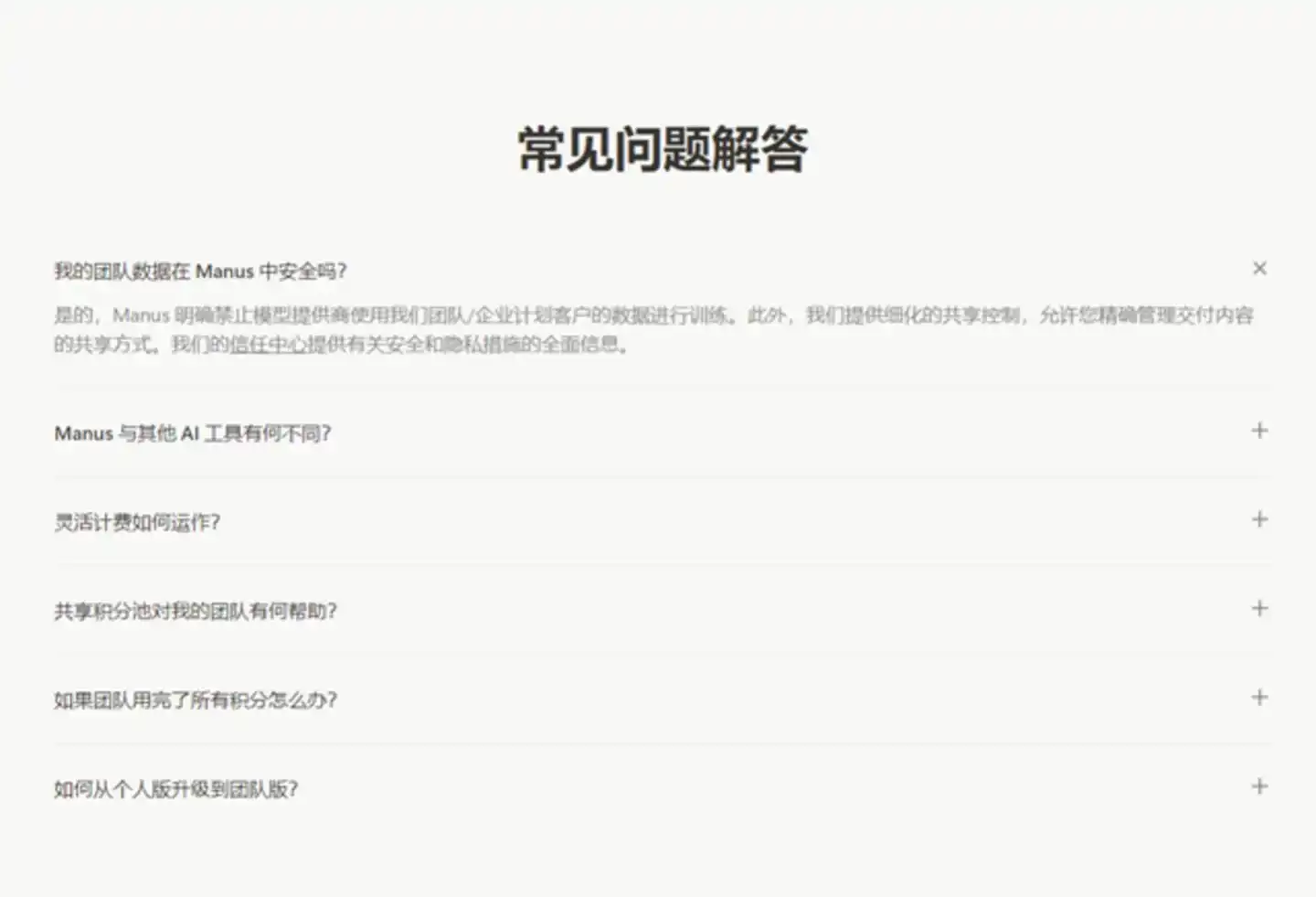
Image Source: Manus Official Website
However, upfront structuring can easily be confused with a more superficial operation—changing a registered address to pose as a "foreign company." Zhu Xiaohu, an investor, drew a clear line regarding this boundary at a previous public event: "No matter where you move your company, investors and clients know, they will still treat you as a Chinese company. Pretending is useless." His example was also quite pointed: several companies recently moved their headquarters to the US, hoping a change of address would secure Silicon Valley funding. The financing didn't materialize, and they came back looking for Chinese investors again—"a wasted move."
In this regard, Ellen shared with Aurora AI a reference case that can serve as a comparison group with Manus: ccMonet.AI, an AI-native finance company based in Singapore—providing bookkeeping, reconciliation, and tax automation for SMEs, promoting "AI processing + certified accountant review." It has served over 1000 enterprise clients, with a presence in Singapore, the US, and the UK. The legal entity, 2ND BRAIN PTE. LTD., is registered in Singapore. Founder Hua Mao is a serial entrepreneur spanning both China and Singapore. Since 2022, the headquarters and business entity have been based in Singapore from day one, with R&D outsourced to a team in China, leveraging the efficiency advantage of Chinese R&D. The compliant structure was completed from the starting point, avoiding the need to retroactively fix things after the company grows.
The Market is Forcing a Choice, and Product Forms are Fragmenting Accordingly
Additionally, Ellen mentioned a more structural trend: AI startups are being pushed towards a binary choice of "either deeply cultivating the domestic market or focusing exclusively on overseas markets." Attempting to cover both is extremely difficult.
Behind this lies a pragmatic recognition. An investor close to Manus told media, "For top-tier talent, mobility is non-existent; if you're going to start a business, that venture is inevitably tied to a specific time and place. The new generation of entrepreneurs in China today, being among the smartest in the population, should possess sufficient ability to interpret these things."
This also means companies must clarify their positioning early. If adopting the "R&D in China, sales overseas" route, the optimal solution is for the overseas company to handle only sales, with core technology entirely retained domestically, avoiding compliance issues related to technology export/transfer at the root. As long as overseas sales performance is stable, or the product is based on open-source models, subsequent overseas financing and listing will not face major obstacles. However, if seeking to package R&D and overseas sales together for a higher valuation, one must clearly define whether the company's primary domicile is China or the US. These two will face entirely different Chinese technology export control requirements, necessitating comprehensive planning in advance.
For AI companies expanding globally, the choice between B2B and B2C sectors is a strategic proposition equally critical as defining the primary market.
In Zhu Xiaohu's view, targeting C-end users, Chinese entrepreneurs face "virtually no rivals" in the global market—nearly all consumer apps reaching tens of billions in valuation over the past decade have come from Chinese teams. This is also why US VCs have been less inclined to invest in the Consumer sector recently. However, targeting enterprises, especially selling to large US corporations, Go-to-Market is a tough battle, with long procurement cycles and slow trust-building. He delineated a watershed at $50 million in ARR (Annual Recurring Revenue): before that, Product-Led Growth (PLG) can sustain the company; after that, a shift to Sales-Led Growth (SLG) is necessary, building a sales team capable of penetrating local relationship networks—a step where the difficulty increases sharply for Chinese founders.
Zhu Xiaohu's conclusion represents the current consensus of many frontline investors: compliant structure determines whether you can survive, while product power and profitability determine how well you survive. After Decree 837 takes effect, "upfront structuring" will transition from a smart choice to a compulsory course for everyone. And Manus's dramatic year-long journey has proven one thing—the window of opportunity waits for no one. Policy gray areas might seem like opportunities, but the price is often settled only after the window closes.