Thị trường Hàn Quốc lại sụp đổ, Văn phòng Tổng thống Blue House lên tiếng phản hồi mới nhất

marsbitPublished on 2026-08-06Last updated on 2026-08-06

Abstract

Chứng khoán Hàn Quốc một lần nữa lao dốc mạnh vào thứ Năm, với chỉ số KOSPI giảm hơn 4%, xuống mức 6.322,55 điểm. Các cổ phiếu công nghệ lớn như SK Hynix và Samsung Electronics chịu áp lực bán mạnh, lần lượt giảm hơn 8% và 5%. Làn sóng bán tháo này được cho là bắt nguồn từ dự báo kinh doanh quý tới kém khả quan của các gã khổng lồ lưu trữ Mỹ là SanDisk và Western Digital, khiến cổ phiếu ngành này trên thị trường Mỹ và sau đó là châu Á đồng loạt giảm giá. Chính phủ Hàn Quốc đang theo dõi sát sao và có động thái ứng phó. Một quan chức cấp cao của Văn phòng Tổng thống nhấn mạnh tầm quan trọng của việc quan sát thị trường và chuẩn bị các biện pháp phù hợp. Gần đây, cơ quan quản lý tài chính nước này đã siết chặt yêu cầu ký quỹ đối với các quỹ ETF có đòn bẩy tập trung vào cổ phiếu đơn lẻ, dẫn đến khối lượng giao dịch các sản phẩm này sụt giảm rõ rệt. Về triển vọng, các nhà phân tích cho rằng thị trường bán dẫn toàn cầu, sau một chu kỳ tăng trưởng dài, đang bước vào giai đoạn nhạy cảm và biến động cao, cần thời gian để tiêu hóa các cú sốc tâm lý ngắn hạn. Tuy nhiên, một số định chế tài chính lớn như Goldman Sachs vẫn lạc quan về dài hạn, giữ nguyên mục tiêu chỉ số KOSPI ở 12.000 điểm và coi đợt điều chỉnh hiện tại là cơ hội để mua vào.

Vào thứ Năm, thị trường chứng khoán Hàn Quốc giảm mạnh.

Tính đến thời điểm đưa tin, chỉ số KOSPI của Hàn Quốc giảm hơn 4%, hiện ở mức 6322.55 điểm. Trong đó, SK Hynix giảm hơn 8%, Samsung Electronics giảm hơn 5%.
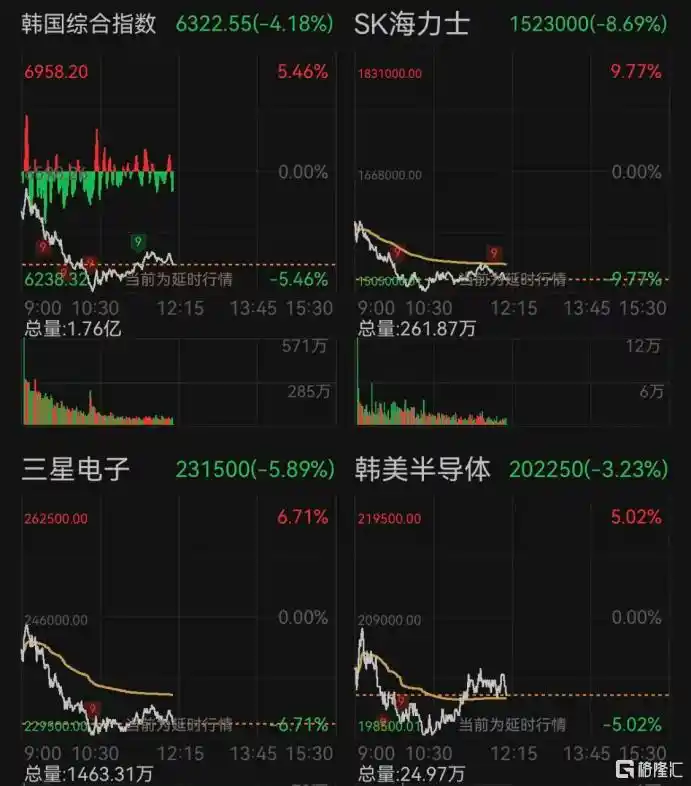
Trên thị trường chứng khoán Hồng Kông, Southern 2x Long SK Hynix giảm hơn 15%, 2x Long Samsung giảm hơn 11%.

Hướng dẫn lợi nhuận của các ông lớn bộ nhớ Mỹ "nổ tung"

Ngòi nổ cho đợt bán tháo này được xác định là "hướng dẫn lợi nhuận bất ngờ" từ ngành bộ nhớ của thị trường Mỹ.

Sau giờ giao dịch vào tối thứ Tư (giờ Mỹ), SanDisk và Western Digital cùng công bố báo cáo tài chính mới nhất.

Báo cáo cho thấy, hiệu suất của hai gã khổng lồ lưu trữ này trong quý tài chính trước mạnh mẽ bất ngờ, nhưng hướng dẫn cho quý này đều không đáp ứng được kỳ vọng tăng trưởng vượt bậc hơn của Phố Wall.

Trong đó, SanDisk dự kiến doanh thu quý tài chính tiếp theo là 10,3-10,8 tỷ USD, thấp hơn mức 11,16 tỷ USD mà các nhà phân tích kỳ vọng; Western Digital dự kiến doanh thu quý tiếp theo trong khoảng 4,0-4,2 tỷ USD, cao hơn một chút so với mức kỳ vọng 4,04 tỷ USD của nhà phân tích.

"Quá khứ vượt kỳ vọng" không thể hoàn toàn bù đắp cho "tương lai thấp hơn kỳ vọng một chút".

Sau khi công bố báo cáo tài chính, hai gã khổng lồ lưu trữ này bị bán tháo mạnh, SanDisk giảm hơn 8%, Western Digital giảm hơn 11%.

Hướng dẫn bi quan từ các ông lớn lưu trữ nhanh chóng lan truyền sang thị trường châu Á thông qua chuỗi cung ứng.

Sáng thứ Năm, sau khi thị trường chứng khoán Hàn Quốc mở cửa, SK Hynix và Samsung Electronics hứng chịu áp lực bán lớn.

Số liệu cho thấy, tính đến phiên giao dịch trước, vốn nước ngoài tích lũy mua ròng 1,4513 nghìn tỷ won cổ phiếu trên thị trường chứng khoán tổng hợp Hàn Quốc, nhưng riêng ngày 6, họ đã bán ròng hơn 5000 tỷ won trên thị trường này.

Các nhà phân tích chỉ ra rằng, thị trường châu Á cuối cùng vẫn phải xem sắc mặt của thị trường Mỹ, không có quyền định giá.

Nhà nghiên cứu Han Ji-young của Mirae Asset Securities cho biết, mặc dù môi trường địa chính trị và vĩ mô đã được cải thiện, do chỉ số bán dẫn Philadelphia yếu đi và việc chốt lời sau đợt tăng giá nhanh trong thời gian ngắn trước đó, thị trường có khả năng cao sẽ chứng kiến giai đoạn điều chỉnh tạm thời và chu kỳ luân chuyển ngành.

"Các biến động bất thường được khuếch đại mạnh trong thời kỳ sụt giảm mạnh vào tháng 7 đã qua đỉnh."

Phản hồi mới nhất từ Blue House

Đáng chú ý là, kể từ khi tăng vọt lên mức cao kỷ lục mới vào ngày 19 tháng 6, thị trường chứng khoán Hàn Quốc đã dao động giảm. Trong gần một tháng qua, chỉ số KOSPI của Hàn Quốc tích lũy giảm 21,17%.
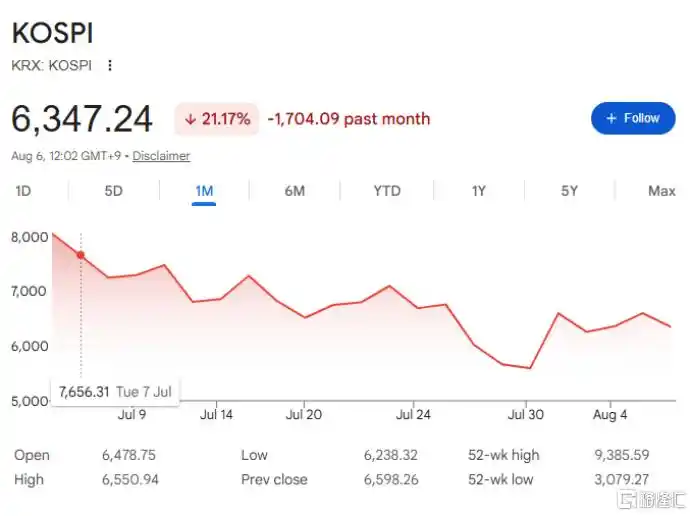
Trước tình hình thị trường biến động dữ dội, chính phủ Hàn Quốc đang khẩn trương "giải cứu thị trường".

Trước đó, Trưởng phòng Chính sách Văn phòng Tổng thống Hàn Quốc Kim Yong-beom đang phải đối mặt với cáo buộc hình sự vì "giới thiệu vội vàng ETF có đòn bẩy".

Trước vấn đề này, Thư ký cấp cao về Quan hệ công chúng và Truyền thông của Văn phòng Tổng thống, Sung Gi-hong, mới đây đã phản hồi rằng, điều quan trọng hơn hiện nay là theo dõi sát sao tình hình thị trường và xây dựng các biện pháp ứng phó phù hợp.

"Tất cả các quan chức liên quan tại Văn phòng Tổng thống đều đang xem xét kỹ lưỡng từng tình huống và nghiên cứu rất thận trọng cách xây dựng các biện pháp liên quan."

Vào thứ Sáu tuần trước, cơ quan quản lý tài chính Hàn Quốc đã nâng yêu cầu ký quỹ tiền mặt tối thiểu đối với việc đầu tư vào ETF có đòn bẩy cổ phiếu đơn lẻ.

Sau khi các biện pháp hạn chế của cơ quan quản lý được đưa ra, khối lượng giao dịch ETF đòn bẩy cổ phiếu Hàn Quốc đã giảm mạnh.

Số liệu mới nhất từ Sở Giao dịch Hàn Quốc cho thấy, khối lượng giao dịch trung bình hàng ngày của 16 ETF đòn bẩy cổ phiếu đơn lẻ vào thứ Tư đã giảm xuống còn 919,8 tỷ won, lần đầu tiên giảm xuống dưới 1 nghìn tỷ won kể từ khi niêm yết vào ngày 27 tháng 5.

Morgan Stanley chỉ ra rằng, đợt thanh lọc đòn bẩy mạnh mẽ trước đó đã gần kết thúc, định giá của KOSPI đã giảm xuống mức cực thấp lịch sử, cung cấp thời điểm vào lệnh hấp dẫn hơn cho nhà đầu tư.

Tuy nhiên, CITIC Securities có quan điểm khác về vấn đề này.

Tổ chức này cho rằng, mặc dù đòn bẩy của nhà đầu tư nhỏ lẻ Hàn Quốc đã được giải tỏa nhanh chóng, nhưng số dư vay ký quỹ vẫn đang co lại với tốc độ nhanh nhất trong năm, tỷ lệ thanh lý vẫn cao hơn nhiều so với mức bình thường, dự kiến biến động thị trường sau đó vẫn sẽ ở mức cao.

Nhìn về phía trước, các nhà phân tích cho biết, sau một thị trường tăng giá dài hạn, lĩnh vực bán dẫn lưu trữ toàn cầu đã bước vào giai đoạn nhạy cảm cao và biến động mạnh, các cú sốc tâm lý ngắn hạn cần thời gian để tiêu hóa.

Về trung và dài hạn, Goldman Sachs kiên định duy trì mục tiêu 12.000 điểm cho chỉ số KOSPI, dự kiến thị trường vẫn còn không gian tăng trưởng khoảng 80% đến 90%.

Ngân hàng này cho rằng, định giá thị trường hiện tại không phản ánh được tình trạng thiếu hụt chip nhớ nghiêm trọng có thể kéo dài đến năm 2030, khi nhu cầu tính toán AI tăng tốc, ngành công nghiệp bán dẫn chiếm hơn 50% trọng số của KOSPI sẽ trở thành động cơ lợi nhuận toàn cầu.

JPMorgan Chase cũng duy trì đánh giá lạc quan đối với SK Hynix và ngành công nghiệp chip nhớ, coi đợt điều chỉnh này là cơ hội để tăng vị thế mua.

Bài viết này đến từ tài khoản WeChat công cộng "Gelonghui APP" (ID: hkguruclub), tác giả: Biên tập viên Gelonghui


Trending Cryptos

Related Questions

QNguyên nhân chính nào dẫn đến việc thị trường chứng khoán Hàn Quốc (KOSPI) giảm mạnh vào ngày Thứ Năm?

ANguyên nhân chính đến từ việc hai gã khổng lồ lưu trữ Mỹ là SanDisk và Western Digital đưa ra dự báo doanh thu quý tới thấp hơn kỳ vọng của Phố Wall. Điều này đã khiến cổ phiếu của họ lao dốc trong phiên sau giờ giao dịch và tạo ra hiệu ứng lan truyền sang các thị trường châu Á, đặc biệt là các công ty bán dẫn hàng đầu Hàn Quốc như SK Hynix và Samsung Electronics.

QPhản ứng mới nhất của Văn phòng Tổng thống Hàn Quốc (Thanh Oa Đài) trước biến động thị trường là gì?

AThư ký cấp cao về quan hệ công chúng và truyền thông của Tổng thống Hàn Quốc, Seong Gi-hong, cho biết hiện tại điều quan trọng hơn là theo dõi sát sao tình hình thị trường và xây dựng các biện pháp ứng phó phù hợp. Ông nói rằng tất cả các quan chức liên quan đang xem xét cẩn thận từng tình huống và nghiên cứu rất thận trọng cách thức xây dựng các biện pháp.

QBiện pháp nào đã được cơ quan quản lý tài chính Hàn Quốc thực hiện để ổn định thị trường và kết quả ra sao?

AVào thứ Sáu tuần trước, cơ quan quản lý tài chính Hàn Quốc đã nâng yêu cầu về ký quỹ tiền mặt tối thiểu đối với việc đầu tư vào các quỹ ETF có đòn bẩy cổ phiếu đơn lẻ. Sau khi biện pháp hạn chế này được đưa ra, khối lượng giao dịch của các quỹ ETF đòn bẩy cổ phiếu Hàn Quốc đã giảm mạnh, lần đầu tiên xuống dưới 1 nghìn tỷ won kể từ khi niêm yết.

QQuan điểm của Morgan Stanley về cơ hội đầu tư vào chỉ số KOSPI sau đợt giảm này như thế nào?

AMorgan Stanley chỉ ra rằng đợt thanh lý đòn bẩy mạnh mẽ trước đó đã gần kết thúc và định giá của KOSPI đã giảm xuống mức cực thấp trong lịch sử, điều này cung cấp thời điểm tham gia thị trường hấp dẫn hơn cho các nhà đầu tư.

QDự báo dài hạn của Goldman Sachs (Cao Thịnh) đối với chỉ số KOSPI và ngành công nghiệp bán dẫn Hàn Quốc là gì?

AGoldman Sachs kiên định duy trì mục tiêu 12.000 điểm cho chỉ số KOSPI, dự kiến thị trường vẫn có không gian tăng trưởng khoảng 80% đến 90%. Họ cho rằng định giá thị trường hiện tại không phản ánh tình trạng thiếu hụt nghiêm trọng có thể kéo dài đến năm 2030 của chip nhớ. Với nhu cầu tính toán AI tăng tốc, ngành công nghiệp bán dẫn chiếm hơn 50% trọng số KOSPI sẽ trở thành động cơ lợi nhuận toàn cầu.

Related Reads

Dialogue with Bitwise CIO: Bitcoin May Be Near Bottom, Who Will Drive the Next Rally?

In a recent podcast, Bitwise CIO Matt Hougan analyzed Bitcoin's current market cycle, suggesting it is near a bottom characterized by low volatility and investor indifference. He believes the next major price surge will be driven primarily by wealth management platforms, financial advisors, and family offices, who control trillions in assets and are now gaining access to Bitcoin ETFs. Hougan views Bitcoin as a long-dated, out-of-the-money call option on it becoming a global reserve asset. Its value increases with global monetary system volatility, making it a natural hedge against currency disorder. He outlined Bitcoin's adoption path: first as a global digital store of value (competing with gold), and potentially later as a check against fiat currency abuse by sovereign states. Addressing the muted price action despite institutional ETF inflows, Hougan explained that significant selling by long-term retail holders has offset buying pressure. However, he is optimistic as data shows retail selling has subsided, which, combined with continued institutional inflows, could propel prices higher. Hougan downplayed the future impact of Federal Reserve interest rates and MicroStrategy's actions on Bitcoin's price, arguing they are becoming less relevant. Instead, he pointed to runaway U.S. fiscal deficits and debt as the core long-term drivers. Finally, he discussed the transformative potential of asset tokenization, predicting all traditional assets will eventually trade 24/7 on blockchains. This will merge traditional and crypto markets, increasing efficiency but also introducing crypto-like features such as overnight volatility and easier access to leverage into traditional finance.

marsbit11m ago

Dialogue with Bitwise CIO: Bitcoin May Be Near Bottom, Who Will Drive the Next Rally?

marsbit11m ago

Dalio Warns of U.S. Bond Supply-Demand Imbalance: Gold and Bitcoin Could Become Hedge Assets in Debt Crisis

Ray Dalio warns of an unsustainable imbalance in US Treasury supply and demand, drawing parallels to the mechanisms of a "big debt cycle" described in his book. Key recent developments include Japan selling US bonds to support the yen, rising US long-term yields amid weak demand, and limited Treasury buybacks. Dalio explains that when debt service burdens become too large relative to income, and bond supply outstrips market demand, a crisis point approaches. Typically, central banks then print money to buy bonds, leading to currency devaluation and inflation. He simplifies the US government's position: with ~$5.5T in revenue, ~$7.5T in spending, a $2T deficit, and $32T in debt, annual debt service is roughly $1T in interest plus ~$10T in maturing principal needing refinancing. Without change, he estimates a potential debt crisis in roughly three years, give or take two. Dalio proposes a "3% three-part solution" to reduce the deficit to 3% of GDP through balanced spending cuts, tax increases, and naturally lower interest rates. He warns that Japan's high debt, often cited as sustainable, has led to poor bond returns and significant currency losses versus gold and the dollar. In response to questions, Dalio states that all reserve currencies eventually decline via this debt cycle mechanism. He advises investors to diversify globally, favor countries with strong finances and stable politics, underweight bonds, overweight gold, and allocate a small portion (e.g., 10-15%) to Bitcoin as hedges against government-created currency devaluation.

marsbit12m ago

Dalio Warns of U.S. Bond Supply-Demand Imbalance: Gold and Bitcoin Could Become Hedge Assets in Debt Crisis

marsbit12m ago

Trading

Spot

Hot Articles

What is VRJAM(BLUE)

VRJAM(BLUE): Revolutionizing Live Experiences in the Virtual World Introduction to VRJAM(BLUE), $vrjam(blue) In an age where virtual experiences are becoming increasingly prevalent, VRJAM(BLUE), represented by the token $vrjam(blue), emerges as a pioneering project within the cryptocurrency space. Launched in 2022, VRJAM(BLUE) seeks to transform how live events are conducted in the digital realm by utilizing the power of blockchain technology and the Hedera Hashgraph platform. As a unique blend of immersive social gaming and interactive virtual events, VRJAM(BLUE) strives to create a comprehensive, engaging experience that resonates with users worldwide. What is VRJAM(BLUE), $vrjam(blue)? At its core, VRJAM(BLUE) is a live experience platform harnessing blockchain to facilitate immersive interactions during virtual events. It stands out as a futuristic solution that allows users to engage with one another in real time, bridging the gap between the physical and digital worlds. The platform leverages advanced technologies, including AI-powered virtual humans, which introduce customizable digital representations of users. These entities serve as avatars that enhance the social dynamics of virtual gatherings. Coupling these virtual beings with the use of non-fungible tokens (NFTs) introduces a layer of security and authenticity, ensuring that unique digital assets can be traded and valued properly within the platform's ecosystem. Moreover, VRJAM(BLUE) integrates a native cryptocurrency, the VRJAM Coin, which acts as the medium of exchange within its virtual world. This digital currency facilitates transactions for services, content, and assets while enabling users to participate seamlessly in live events and interactive experiences. Creator of VRJAM(BLUE), $vrjam(blue) The specific identity of the creator of VRJAM(BLUE) remains undisclosed, though the project is under the leadership of CEO Sam Speaight. His vision for the platform aims at leveraging innovative technology and strategic partnerships to expand the reach and impact of VRJAM(BLUE) in the rapidly evolving web3 ecosystem. Investors of VRJAM(BLUE), $vrjam(blue) VRJAM(BLUE) has garnered considerable interest from various investors and funding rounds, successfully raising a total of $5.34 million throughout 12 funding events. These various initiatives, including Initial DEX Offerings (IDO) and token launches, have provided the necessary capital to propel the project forward. However, specific details regarding the individual investors or organizations backing VRJAM(BLUE) have not been disclosed. How Does VRJAM(BLUE), $vrjam(blue) Work? The innovative approach of VRJAM(BLUE) revolves around multiple cutting-edge technologies, notably artificial intelligence, virtual reality, and blockchain. AI-Powered Virtual Humans A distinguishing feature of VRJAM(BLUE) is its integration of AI-powered virtual humans. These customizable characters respond dynamically to user interactions, enriching the overall experience of virtual events. This personalization allows users to create unique identities and facilitating more meaningful connections within the community. NFT Technology By incorporating NFT technology into its framework, VRJAM(BLUE) provides users with enhanced security and ownership of digital assets. Users can purchase, sell, or trade NFTs that represent virtual tickets, memorabilia, or other digital creations linked to live events, ensuring that ownership is verifiable and protected. Native Cryptocurrency The VRJAM Coin serves as the platform's native currency, allowing users to transact seamlessly within the virtual environment. This cryptocurrency not only supports traditional user activities but also bolsters a larger economic ecosystem tailored to the needs of VRJAM’s community. DeFi Solutions The project also embraces decentralized finance (DeFi) by incorporating trustless protocols. These solutions aim to stabilize token prices and enhance liquidity, allowing users to engage in financial transactions without intermediary restrictions. Timeline of VRJAM(BLUE), $vrjam(blue) To fully understand the evolution of VRJAM(BLUE), it's essential to take a closer look at its timeline: 2022: Launch of VRJAM(BLUE) – The platform made its debut, ushering in a new era for virtual event experiences. November 30, 2022: Completion of the Token Generation Event (TGE) – This marked a significant milestone, as the platform's native cryptocurrency became available for investor engagement. Post-TGE: Following the TGE, the distribution of tokens initiated, featuring a 20% immediate release, followed by a linear vesting phase of the remaining 80% over a period of six months. Key Features and Partnerships The success of VRJAM(BLUE) can also be attributed to its strategic partnerships and innovative features. Partnerships In its quest to bring life to the metaverse, VRJAM(BLUE) has formed alliances with prominent entities in the industry. Notably, its collaboration with Polygon aims to enhance the efficiency and reach of live events. Additional partnerships with organizations such as Agora and Enjin further bolster content distribution and the utilization of NFT technology. These collaborations are enhancing VRJAM(BLUE)'s capabilities and expanding its influence in the web3 ecosystem. Token Liquidity Protocol Operating on the Hedera Hashgraph, VRJAM(BLUE) employs a token liquidity protocol that aggregates liquidity across various trading platforms. This initiative is designed to unify token pricing, thus enhancing user confidence in the VRJAM Coin and promoting stability within the ecosystem. Web3 Economy With the overarching aim of fostering a sustainable web3 economy, VRJAM(BLUE) is diligently working on its DeFi product suite. By providing users with tools for financial engagement, such as yield farming or staking, the project is paving the way for broader participation in its virtual economy. Conclusion VRJAM(BLUE), with its token $vrjam(blue), stands at the forefront of the revolution in virtual experiences and live interactions within the digital space. By intertwining advanced technologies such as AI, virtual reality, and blockchain, the project has developed a platform that not only facilitates immersive experiences but also builds a vibrant, interactive community. As the landscape of the crypto and web3 industries continues to evolve, VRJAM(BLUE) aims to play a critical role in shaping the future of virtual events and experiences. With its commitment to innovation and community engagement, VRJAM(BLUE) is well-positioned to pave a prosperous path for digital interactions in the years to come.

1.2k Total ViewsPublished 2024.12.03Updated 2024.12.03

What is VRJAM(BLUE)

How to Buy BLUE

Welcome to HTX.com! We've made purchasing Bluefin (BLUE) simple and convenient. Follow our step-by-step guide to embark on your crypto journey.Step 1: Create Your HTX AccountUse your email or phone number to sign up for a free account on HTX. Experience a hassle-free registration journey and unlock all features.Get My AccountStep 2: Go to Buy Crypto and Choose Your Payment MethodCredit/Debit Card: Use your Visa or Mastercard to buy Bluefin (BLUE) instantly.Balance: Use funds from your HTX account balance to trade seamlessly.Third Parties: We've added popular payment methods such as Google Pay and Apple Pay to enhance convenience.P2P: Trade directly with other users on HTX.Over-the-Counter (OTC): We offer tailor-made services and competitive exchange rates for traders.Step 3: Store Your Bluefin (BLUE)After purchasing your Bluefin (BLUE), store it in your HTX account. Alternatively, you can send it elsewhere via blockchain transfer or use it to trade other cryptocurrencies.Step 4: Trade Bluefin (BLUE)Easily trade Bluefin (BLUE) on HTX's spot market. Simply access your account, select your trading pair, execute your trades, and monitor in real-time. We offer a user-friendly experience for both beginners and seasoned traders.

5.0k Total ViewsPublished 2024.12.11Updated 2026.08.21

How to Buy BLUE

Discussions

Welcome to the HTX Community. Here, you can stay informed about the latest platform developments and gain access to professional market insights. Users' opinions on the price of BLUE (BLUE) are presented below.

活动图片