Cardano Price Forecast for August 2026: Will ADA Triangle Breakout Happen Before or After the CLARITY Act Deadline?

cryptonews.ruPublished on 2026-07-30Last updated on 2026-07-30

Abstract

Cardano (ADA) is trading at $0.1642, testing the apex of a symmetrical triangle pattern on the daily chart, which signals an impending directional move. Technical analysis identifies key resistance at the 20-day EMA ($0.1650) and the triangle's upper trendline. A breakout above could target the 50-day EMA at $0.1732, with a cup-and-handle pattern potentially forming. Support lies at the SuperTrend indicator ($0.1536) and the June low of $0.1386. Historically, August has been a weak month for ADA, with a median return of -12.8%. A weekly forecast outlines a volatile month influenced by the imminent August 8th deadline for the U.S. CLARITY Act vote, potential SEC regulatory action, and renewed geopolitical tensions following Iran's missile strike. Key bullish catalysts include the potential passage of the CLARITY Act and a major upgrade integrating Cardano's developer documentation and tools into AI coding assistants like Claude, which could significantly boost developer adoption. On-chain data also shows whale accumulation, a potential Wyckoff accumulation signal. The price forecast presents two scenarios: a bullish breakout above $0.1650 targeting $0.17-$0.1732 if the CLARITY Act passes and AI integration fuels momentum, or a bearish break below $0.1536 toward $0.1386 if the bill fails, seasonal weakness persists, and risk appetite diminishes.

Cardano is trading at $0.1642 on July 30, up 1.42%, holding at the apex of a triangle that forces a directional decision, while Iran violated a five-day truce with a ballistic missile strike on a US base in Jordan, and the hawkish FOMC stance raised the probability of a September rate hike to 72%.

$ADA is at Triangle Apex, SuperTrend is Last Bullish Signal
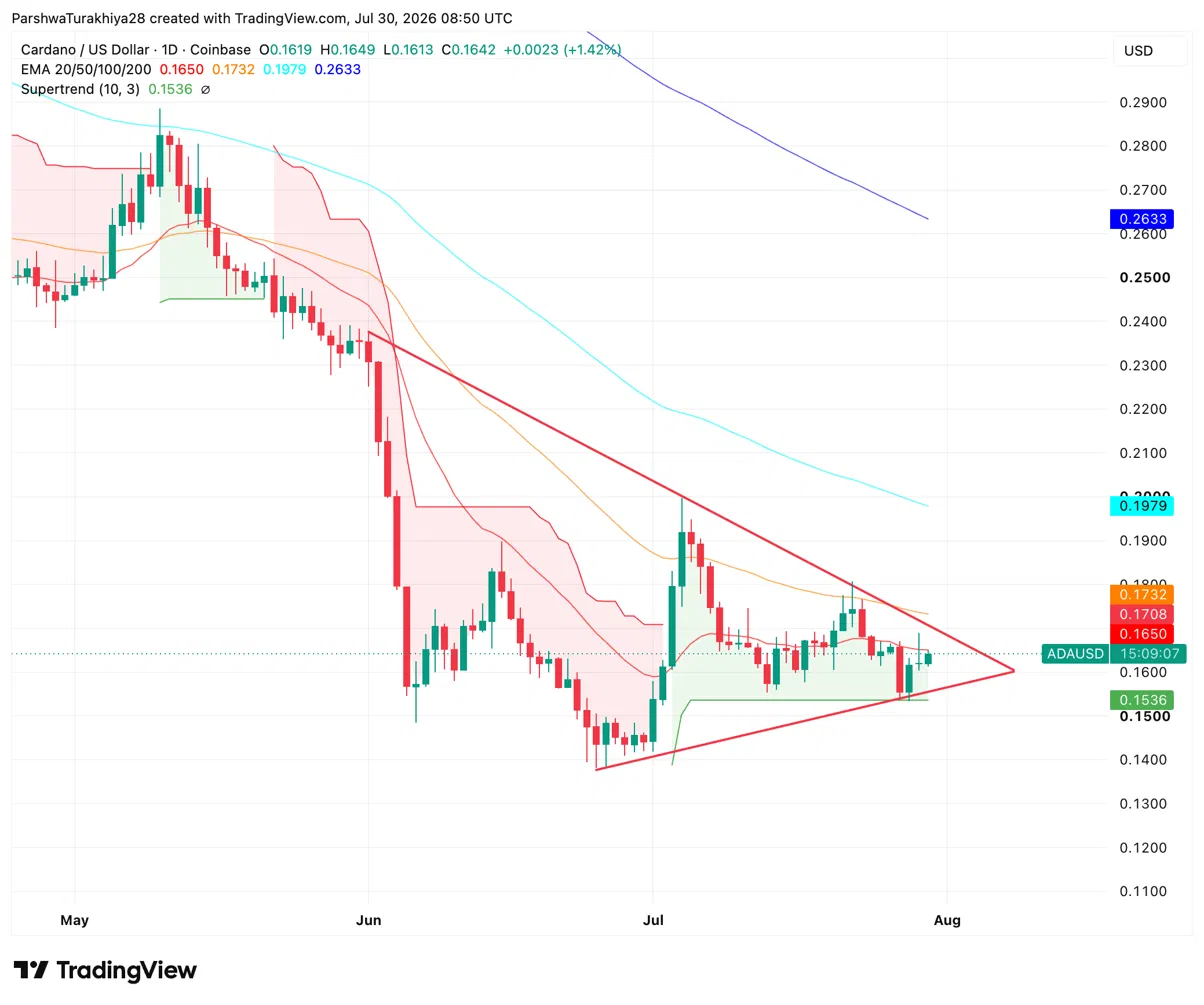
$ADA 1D Price Movement (Source: TradingView)

The daily chart shows $ADA at the converging apex of a triangle formed between a descending trendline from the May peak and an ascending line from the June low around $0.1386. The 20-day EMA at $0.1650 is just above the current price and almost exactly aligns with the upper trendline, making this cluster a key resistance that needs to break for a bullish triangle resolution. The SuperTrend at $0.1536 remains bullish below the price, staying as the sole trend-following indicator on the buyers' side.

Related: Bitcoin Price Forecast for August 2026: Four Analysts Read the Same Fed Decision and Reached Four Different Conclusions

The next ceiling above is the 50-day EMA at $0.1732, followed by the 100-day at $0.1979 and the 200-day at $0.2633. LuckSide Crypto noted that $ADA might be building control for a potential cup and handle structure, targeting a move towards $0.17 if the upper trendline breaks. Below, the SuperTrend at $0.1536 and the June low at $0.1386 define the floor.

What are the Key Support and Resistance Levels for $ADA in August?

Resistance Levels

  1. $0.1650 — 20-day EMA and upper triangular trendline need a close above for a breakout
  2. $0.1732 — 50-day EMA, the next significant ceiling
  3. $0.1979 — 100-day EMA, an extended recovery target
  4. $0.2633 — 200-day EMA, long-term ceiling

Support Levels

  1. $0.1536 — SuperTrend, the last bullish signal below price
  2. $0.1500 — Round number and recent support zone
  3. $0.1386 — June low and Fibonacci zero point, the last line of defense

Has August Historically Been Strong for $ADA?
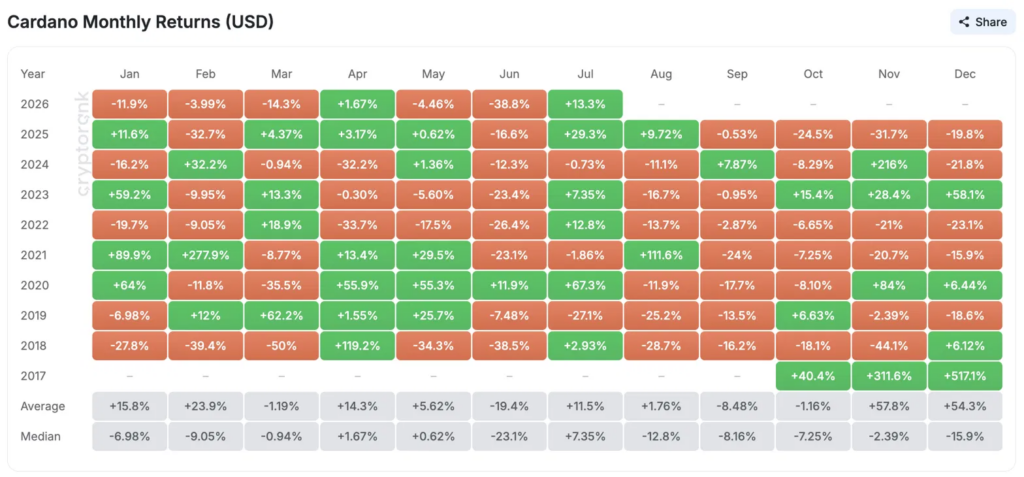
$ADA Monthly Return Analysis (Source: CryptoRank)

The Cardano monthly returns chart speaks directly to this question. The median return for August across all available years is -12.8%, making it the worst-performing month on the $ADA calendar.

August has closed in the red in six of eight years with data, including -28.7% in 2018, -25.2% in 2019, -13.7% in 2022, -11.1% in 2024, with +9.72% in 2025 being the only notable exception.

Related: Pi Network Price Forecast for August 2026: Will the August 11 Node Receiving Deadline Act as a Catalyst for Recovery?

The average stands at +1.76%, lifted by an extraordinary +111.6% in 2021, which masks how consistently negative August has been outside of that outlier year.

Weekly $ADA Forecast for August 2026

Period Price Range Outlook
Aug 1-8 $0.155 — $0.175 Final CLARITY Act window, Iran escalation risk, FOMC reassessment, hawkish pivot
Aug 9-20 $0.150 — $0.185 Post-deadline period, SEC alternative if CLARITY Act fails
Aug 21-31 $0.145 — $0.195 September FOMC pricing grows, seasonal weakness historically peaks

CLARITY Act: 10 Democratic Votes, SEC Backup Plan, and Days Left

Democratic Votes That Could Push It Over

Bloomberg reported that up to 10 Democrats may vote for the CLARITY Act, enough to surpass the 60-vote threshold needed to advance the bill. LuckSide Crypto called this the most encouraging development in weeks, noting significant concessions have been made in the bill's wording to bring those votes onboard. The voting window before the Senate's August 8 recess is now days, not weeks.

SEC Backup That Changes Risk Profile

Separately, the SEC announced it's prepared to establish crypto regulations on its own if Congress doesn't pass the CLARITY Act. LuckSide called this a massive shift from the 2022–2023 crackdown era, arguing it removes the binary risk of total legislative failure, creating a regulatory backstop. The market hasn't reacted as sharply as he expected, but the practical takeaway is that regulatory clarity is coming one way or another—just at a different time if the bill misses the August 8 window.

Cardano Developer Skills Now Available in Claude and Codex

Cardano developer documentation, tools, and workflow guidance are now available natively in Claude, Codex, and other AI coding agents, replacing outdated training data that previously made AI-assisted Cardano development more difficult than Ethereum or Solana.

LuckSide Crypto flagged this as a potentially significant adoption catalyst. AI-assisted development has become a standard part of builders' workflows, and removing the friction of outdated docs could trigger a wave of new Cardano projects. The update directly addresses one of the most persistent criticisms regarding working with Cardano versus competitors, where AI-based coding support has been more comprehensive for years.

What the AI Coding Update Means for Cardano

Before After
Outdated Cardano training data in AI tools Current documentation, tools, and workflows available natively
AI-assisted Cardano development harder than ETH/SOL Now comparable across all three ecosystems
Friction for new builders Friction removed—AI agents can directly guide Cardano development

Iran Violates Truce, Whale Accumulation Shifts

Iran launched ballistic missiles at a US military base in Jordan overnight, ending a five-day ceasefire and pushing US oil up 5% for the session. The escalation reintroduces the geopolitical risk premium that had been gradually fading since the ceasefire signal, and LuckSide Crypto noted this adds uncertainty to an already volatile week for risk assets.

Related: AEON Price Forecast: Rising Open Interest Signals Larger Moves After 22% Daily Spike

On the positive side, on-chain data cited by LuckSide shows Bitcoin wallets held by whales and sharks have accumulated nearly 19,700 BTC over the last eight days as retail buying subsided from July peaks. LuckSide presented this as a Wyckoff Phase C signal, where smart money absorbs supply at depressed prices ahead of the next markup phase. $ADA's own whale accumulation data showed a similar trend in June and July.

$ADA Price Forecast for August 2026: Upside and Downside Targets

  • Bullish Case: Triangle breaks above the 20-day EMA at $0.1650, CLARITY Act passes before August 8, AI coding adoption sparks new developer interest in Cardano, and $ADA targets the 50-day EMA at $0.1732 as the cup and handle structure outlined by LuckSide begins to validate towards $0.17 and beyond.
  • Bearish Case: August's seasonal weakness repeats its historical pattern, CLARITY Act fails to reach a vote before the recess, Iran escalation dampens risk appetite, and $ADA loses the SuperTrend at $0.1536 towards the June low at $0.1386 as the triangle breaks lower, not higher.
end-content

Trending Cryptos

Related Questions

QAccording to the article, what are the main reasons for Cardano (ADA) to be at a decision point regarding price direction in late July 2026?

ACardano's price is at the converging apex of a symmetrical triangle pattern, trading around $0.1642 on July 30, 2026. This technical pattern forces a directional decision. Key fundamental factors adding pressure include the impending August 8th deadline for the CLARITY Act vote in the U.S. Senate, Iran breaking a ceasefire with a ballistic missile strike (introducing geopolitical risk), and a hawkish FOMC stance increasing the probability of a September rate hike to 72%.

QBased on the article's technical analysis, what are the key resistance levels for ADA that need to be broken for a bullish move in August 2026?

AThe key resistance levels for a bullish breakout, according to the article, are: 1) $0.1650 - the 20-day EMA and the upper triangle trendline. A close above this cluster is crucial. 2) $0.1732 - the 50-day EMA. 3) $0.1979 - the 100-day EMA. 4) $0.2633 - the 200-day EMA, representing the long-term ceiling.

QWhat is the historical performance trend for Cardano (ADA) in the month of August, according to the data presented?

AHistorically, August has been Cardano's weakest month. The median return for ADA in August across all available years is -12.8%. It has closed in the red (negative) in six out of the eight years with data, including significant losses in 2018 (-28.7%) and 2019 (-25.2%). The average is skewed to +1.76% solely due to an exceptional +111.6% gain in 2021, which masks the consistently poor performance in other years.

QWhat two potential paths are presented for the future of cryptocurrency regulation in the U.S., and how does this relate to the CLARITY Act deadline of August 8, 2026?

AThe article presents two paths for U.S. crypto regulation: 1) The primary path is the passage of the CLARITY Act, which had a critical voting window before the Senate's August 8th recess. 2) The backup path is the SEC announcing its readiness to establish cryptocurrency regulation independently if Congress fails to pass the CLARITY Act. This shift reportedly removes the 'binary risk' of total legislative failure, ensuring regulatory clarity will arrive eventually, just on a different timeline if the bill misses the August 8th window.

QAccording to the article, what recent development could act as a significant catalyst for Cardano adoption, specifically for developers?

AA significant catalyst mentioned is that Cardano's developer documentation, tools, and workflow guides are now natively available in AI coding agents like Claude and Codex. This update replaces outdated training data that previously made AI-assisted Cardano development more difficult compared to Ethereum or Solana. The article suggests this removal of friction could potentially trigger a wave of new Cardano projects by making development comparable across these major ecosystems.

Related Reads

Interview with Robinhood Executive: Meme + Tokenized US Stocks as "Barbell" Customer Acquisition Strategy, All Business Lines Achieve Hundreds of Millions in Revenue

Interview with Robinhood executive Johann Kerbrat reveals the company's "barbell" customer acquisition strategy for its new Robinhood Chain, combining meme tokens with tokenized stocks. Three weeks after mainnet launch, the chain has seen over $3B in weekly DEX volume and 105M transactions. Kerbrat explains the logic behind the permissionless chain: meme tokens attract DeFi users, while tokenized real-world assets (RWA), currently over 90 US stocks and ETFs accessible in 120+ countries, serve global users. The goal is to bring Robinhood's 27 million funded accounts on-chain by simplifying DeFi with a user-friendly interface, exemplified by features like Robinhood Earn which offers yield without requiring wallet management. Built on Arbitrum's technology stack for its speed, low cost, and Ethereum's security, the chain focuses on financial products like Earn, spot trading, and perpetuals. Kerbrat downplays direct competition with platforms like Base, emphasizing the goal of expanding the overall market for on-chain assets. He details selective partnerships (e.g., Morpho, Lighter) based on compliance, unique UX, and differentiation. While regulatory clarity is pending for US perpetuals, the expansion continues via Bitstamp in Europe. Finally, Kerbrat positions Robinhood as a "super app" integrating stocks, options, crypto, banking, and AI trading, with all major business lines generating hundreds of millions in revenue. For the chain, current priority is driving adoption over maximizing gas fee revenue.

marsbit2m ago

Interview with Robinhood Executive: Meme + Tokenized US Stocks as "Barbell" Customer Acquisition Strategy, All Business Lines Achieve Hundreds of Millions in Revenue

marsbit2m ago

Fidelity Q3 Report: BTC, ETH, and SOL Continue to Build Bottoms; How Much Further Will This Crypto Bear Market Go?

Fidelity's Q3 Crypto Signal Report analyzes the current bear market, noting Bitcoin (BTC), Ethereum (ETH), and Solana (SOL) are in a prolonged bottoming phase. Key indicators like the weighted Net Unrealized Profit/Loss (NUPL) have turned negative (-0.01), signaling the market is slightly below its aggregate cost basis, with BTC acting as the primary stabilizing asset. BTC's dominance has risen to 68%, indicating a lack of capital rotation to other digital assets. Performance has been weak across the board, with BTC, ETH, and SOL down significantly year-to-date. Market sentiment is depressed, exacerbated by substantial outflows from spot ETPs and a challenging macro environment. The report compares the current ~203-day downtrend to historical ~300-day bottoming cycles, suggesting the process may be two-thirds complete, with late 2026 as a potential timeframe to monitor. For Bitcoin, NUPL at 0.09 indicates cautious sentiment, while momentum signals remain negative. The Yardstick metric points to potential undervaluation relative to network security (hashrate). Ethereum's NUPL is deep in the "capitulation" zone at -0.43, a historically positive signal for future returns, though its momentum and network fee revenue are negative. Solana shows the deepest NUPL at -0.72 but demonstrates relative resilience in on-chain activity and stablecoin transfer volume. The report concludes that while several metrics are near historical capitulation levels, a definitive market bottom has not yet been established. The path forward likely involves continued consolidation, with BTC's relative strength and fundamental on-chain usage for ETH and SOL providing key areas for investor observation.

marsbit17m ago

Fidelity Q3 Report: BTC, ETH, and SOL Continue to Build Bottoms; How Much Further Will This Crypto Bear Market Go?

marsbit17m ago

Trading

Spot

Hot Articles

Discussions

Welcome to the HTX Community. Here, you can stay informed about the latest platform developments and gain access to professional market insights. Users' opinions on the price of ADA (ADA) are presented below.

活动图片