Memecoins Reclaim 29% of Spot Trading Volume on Solana DEX, Highest Since August 2025

cryptonews.ruPublished on 2026-07-29Last updated on 2026-07-29

Abstract

Memecoins on Solana have surged back to account for 29% of the network's decentralized exchange (DEX) spot trading volume for the week of July 20-26, marking their highest share since August 2025. This represents a significant jump from the 10-15% levels seen just weeks prior. The resurgence is largely attributed to the explosive rise of the memecoin $ANSEM ("The Black Bull"), which saw an 18,000% surge in three days after its June launch and peaked at a market cap near $449 million, revitalizing trading activity on platforms like Pump.fun. Despite this memecoin rally, the data refutes the simplified view of Solana as a memecoin-dominated chain. SOL-stablecoin pairs accounted for 37% of weekly volume, stablecoin-to-stablecoin swaps made up 22%, with foreign tokens, project tokens, and tokenized assets comprising smaller shares. Memecoins ranked second, not first. The article highlights Solana's underlying strength beyond speculative activity. The network's stablecoin supply surpassed $15 billion in July and remained resilient during the 2026 market downturn. Furthermore, Solana leads all networks in the number of tokenized real-world assets (RWAs), hosting 2,582 such assets valued over $3.5 billion. Institutional adoption, evidenced by firms like Western Union and B2C2 utilizing the chain for settlements, underscores its growing utility. While memecoin volumes are cyclical, Solana's stablecoin and RWA ecosystems have shown consistent, counter-cyclical growth.

During the week of July 20-26, memecoin activity on Solana reached levels not seen since August of last year. Data from Blockworks shows that memecoins accounted for 29% of the network's spot decentralized exchange volume, a notable jump from just a few weeks prior when the figure ranged from 10% to 15%.
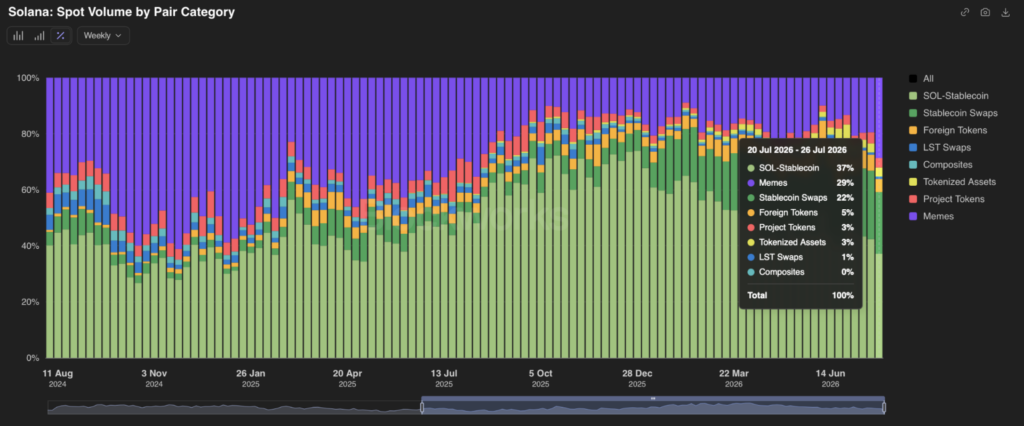
Source: Blockworks

The rest of the chart refutes the simplified conclusion that Solana is a meme-dominated network. SOL-stablecoin pairs accounted for 37% of trading volume for the same week, with stablecoin-to-stablecoin swaps making up another 22%. Foreign tokens accounted for 5%, while project tokens and tokenized assets each accounted for 3%. Memes ranked second, not first.

$ANSEM Brought Idle Traders Back to Work

The revival of memecoins in the network can essentially be traced back to a single token. $ANSEM, or "The Black Bull," was launched on Pump.fun in late June. It has no product, team, or roadmap. Its advantage, however, is its connection to Ansem, one of the most active traders on Solana, after an anonymous developer sent a large portion of the token supply to his wallet, and he decided to use it rather than ignore it. He then promised to redistribute his Pump.fun creator fees to holders through weekly giveaways. It was this promise, not any protocol mechanism, that traders were buying.

$ANSEM saw an explosive surge of roughly 18,000% in just three days. The growth didn't stop there, and its market capitalization peaked around $449 million on July 7th. This alone was able to breathe new life into Solana. Trading volumes on Pump.fun gradually began to rise, and according to DefiLlama, about $614 million of Solana's roughly $1.65 billion daily DEX trading volume is now traded on that platform.

Notably, this is happening at a time when sentiment in the crypto sector is still in the fear zone, at a level of 29.

Stablecoin Volume Exceeded $15 Billion and Remained at That Level Throughout the Downturn

The memecoin revival does not mean the network has regained its 'meme-chain' status. That definition stopped fitting Solana some time ago, and the volume structure is just the tip of the iceberg of the reasons why.

In July, stablecoin supply volume exceeded $15 billion. Stablecoins other than USDC and USDT account for about $4.81 billion of that. The key is not the peak amount, but its resilience. This liquidity did not disappear during the 2026 downturn, when speculative capital typically flees first.

Two companies have leveraged this chain. Western Union deployed USDPT on Solana as a settlement layer, and B2C2 named this chain its primary settlement network for stablecoins. B2C2 is an institutional market maker, so this decision is operational and concerns where trade settlements actually occur. It is not a partnership announcement.

In Terms of Real-World Asset Associations, Solana Has Quietly Taken a Leading Role

Solana hosts 2,582 tokenized real-world assets, more than any other network by number of assets, according to data from rwa.xyz. The total value of distributed assets in the network has exceeded $3.5 billion. Only Robinhood Chain has more asset holders, with Robinhood's holder base being formed by a single broker bringing its users onto the chain, while Solana's is formed by a wider range of issuers.

Stablecoins and RWAs are the unglamorous half of the network. However, it is this half that grew while prices fell.

Memecoin volumes are cyclical by nature. Over twelve months, they dropped from 29% to single digits and returned to their former level, and this will repeat the next time a ticker goes up 300% in a week. Stablecoin supply and risk-weighted asset (RWA) counts have moved in one direction over the same period, including the parts of it that no one enjoyed.


qq

end-content

Trending Cryptos

Related Questions

QWhat percentage of Solana DEX spot trading volume did memecoins account for during the week of July 20-26, reaching its highest level since when?

AMemecoins accounted for 29% of Solana DEX spot trading volume during that week, which is the highest level since August 2025.

QAccording to the article, which specific token is credited with reviving memecoin activity on Solana in late June?

AThe token credited with reviving memecoin activity is $ANSEM, also known as 'The Black Bull', which was launched on Pump.fun.

QBeyond memecoins, what were the two largest categories by trading volume on Solana DEXs for the same week, and what were their respective percentages?

ASOL-stablecoin pairs accounted for 37% of the trading volume, and stablecoin-to-stablecoin swaps accounted for another 22%. These were the two largest categories.

QThe article states that stablecoin supply on Solana has remained resilient. What key metric is mentioned to have stayed above $15 billion during the 2026 downturn?

AThe stablecoin supply on Solana surpassed $15 billion and remained at that level throughout the market downturn in 2026.

QIn which area does Solana lead all other networks according to data from rwa.xyz mentioned in the article?

ASolana leads all other networks in the number of tokenized real-world assets (RWAs), hosting 2,582 such assets.

Related Reads

After R&D Investment Catches Up with the U.S., Is the Sino-U.S. Chip Competition Still Just About Money?

The article examines the significance of recent data showing China's total R&D expenditure, measured by purchasing power parity (PPP), catching up to or slightly surpassing that of the United States in 2024. It argues that while this milestone reflects China's immense capacity to mobilize research resources, the competition in semiconductors now extends far beyond sheer financial input. The analysis highlights key differences: China's R&D is heavily skewed towards experimental development (over 80%), focusing on product engineering and industrialization, whereas the U.S. allocates a proportionally larger share (about 15%) to basic research. Furthermore, leading U.S. semiconductor firms reinvest a significant portion of their substantial global sales revenue into R&D, creating a sustainable commercial innovation cycle that is difficult to replicate. The article emphasizes that semiconductor progress depends on converting R&D into commercially viable products that pass rigorous customer validation and achieve repeat orders, not just on spending levels. It concludes that as China enters the top tier of R&D spenders, the critical challenges shift to improving resource allocation efficiency, fostering long-term basic research, and building effective mechanisms to bridge the gap between laboratory discoveries and reliable, market-ready industrial capabilities.

marsbit35m ago

After R&D Investment Catches Up with the U.S., Is the Sino-U.S. Chip Competition Still Just About Money?

marsbit35m ago

Top 10% of American Households Capture 88% of Wealth, How Is the AI Era Cake Divided?

AI Worsens Wealth Inequality as Top 10% of US Families Garner 88% of Stock Gains (2019-2026) A report from the China Finance 40 Forum highlights that the AI boom is significantly widening wealth inequality in the United States. From 2019 to Q1 2026, wealth from directly held stocks by US households nearly doubled from $29 trillion to approximately $55 trillion, with rapid growth concentrated post-2023, coinciding with the AI-driven stock market surge. The distribution of these gains has been starkly uneven. Between 2022 and Q1 2026, the wealth increase of about $21 trillion was captured almost entirely by the wealthiest families: the top 10% secured roughly 88% ($18.5 trillion), while the bottom 50% received only about 1% ($0.2 trillion). This has contributed to a growing disparity in disposable income shares. The report, referencing economic historian Robert Allen, draws parallels to historical technological shifts like the "Engels' Pause" during the First Industrial Revolution, where worker wages stagnated despite productivity gains. It suggests AI could induce a similar period where capital收益 outpace labor income, exacerbating inequality. Huang Yiping of Peking University identifies four mechanisms through which AI impacts income distribution: capital-bias (reducing labor's income share), task polarization (hollowing out middle-skill jobs), skill-based digital divides, and wealth amplification through assets. He warns that if this trend continues, strong supply growth driven by AI could be undermined by persistently weak consumer demand, threatening sustainable economic growth. To address these challenges, the report proposes a three-pronged strategy: 1) Defensive measures like strengthening social safety nets and antitrust enforcement; 2) Empowering workers through education reform and lifelong learning to collaborate with AI; and 3) Rebalancing via policies such as potential taxes on AI超额收益 and mechanisms for broader sharing of technology's benefits, ensuring AI's红利 are more equitably distributed.

marsbit41m ago

Top 10% of American Households Capture 88% of Wealth, How Is the AI Era Cake Divided?

marsbit41m ago

Trading

Spot

Hot Articles

Discussions

Welcome to the HTX Community. Here, you can stay informed about the latest platform developments and gain access to professional market insights. Users' opinions on the price of SOL (SOL) are presented below.

活动图片