INJ price prediction – Can Injective’s SEC filing trigger a breakout above $5.20?

ambcryptoPublished on 2026-07-17Last updated on 2026-07-17

Abstract

Injective (INJ) has recovered above $5, but faces key resistance at $5.20 to break out from its July consolidation range. This price movement follows the project's filing for transfer agent registration with the U.S. SEC, aiming to bring regulated, on-chain record-keeping for tokenized real-world assets and securities. The filing initiates the process and does not imply SEC approval. Injective also published a MiCAR whitepaper to support expansion in the EU, highlighting a broader regulatory push. While the RSI indicates strengthening buying momentum, a decisive move above $5.20 is needed to signal an extended recovery. Failure could see a retest of lower support levels.

Injective [INJ] traded back above $5 as the token attempted to extend its recovery from June lows, with buyers now facing resistance around the $5.20 region.

The latest price move comes as Injective filed its transfer agent registration with the U.S. Securities and Exchange Commission [SEC]. This is part of the blockchain network’s push to bring on-chain regulated real-world assets [RWAs] and securities infrastructure.

Injective files for SEC transfer-agent registration

Injective announced on July 16 that it had officially filed its transfer agent registration with the SEC.

Transfer agents maintain official ownership records for securities and process changes when those assets change hands. Injective wants to bring this function on-chain, allowing the ownership record to exist on the same blockchain as the tokenized security rather than relying on a separate off-chain database.

According to Injective, moving the transfer-agent function on-chain could allow market participants to record and transfer ownership of tokenized securities within seconds while reducing the need for multiple intermediaries to reconcile transactions.

The filing begins the registration process and should not be interpreted as SEC approval or confirmation that Injective is already operating as a registered transfer agent.

Regulatory push extends beyond the U.S.

The SEC filing forms part of Injective’s broader push to expand its regulated financial infrastructure.

Injective said the announcement came hours after it published its MiCAR whitepaper, which the project says will support its expansion across European Union member states within the region’s regulatory framework.

Together, the developments highlight Injective’s efforts to position its blockchain infrastructure for institutional and regulated markets across the U.S. and Europe.

However, the developments have yet to trigger a decisive breakout for INJ.

Can INJ break above $5.20?

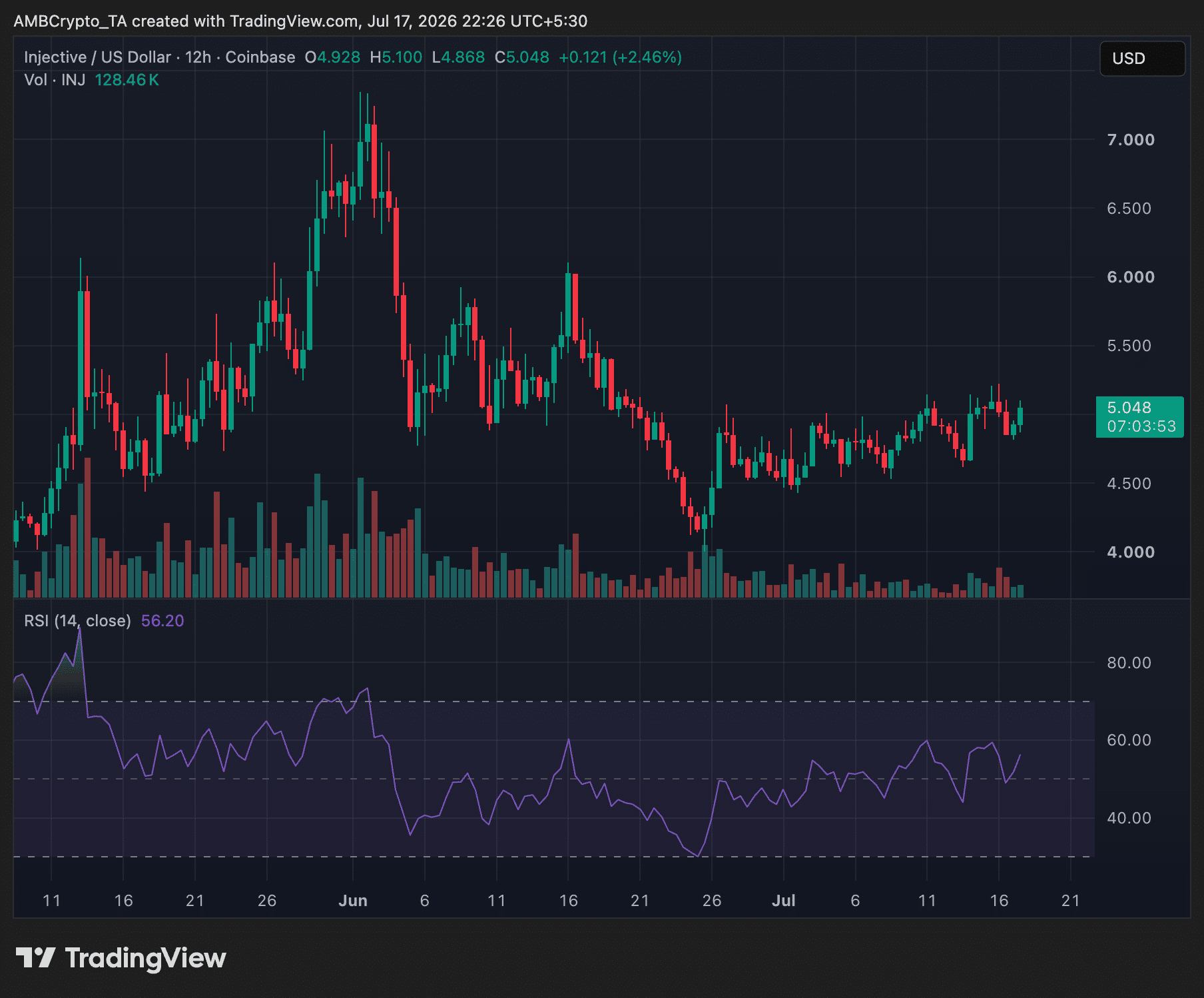
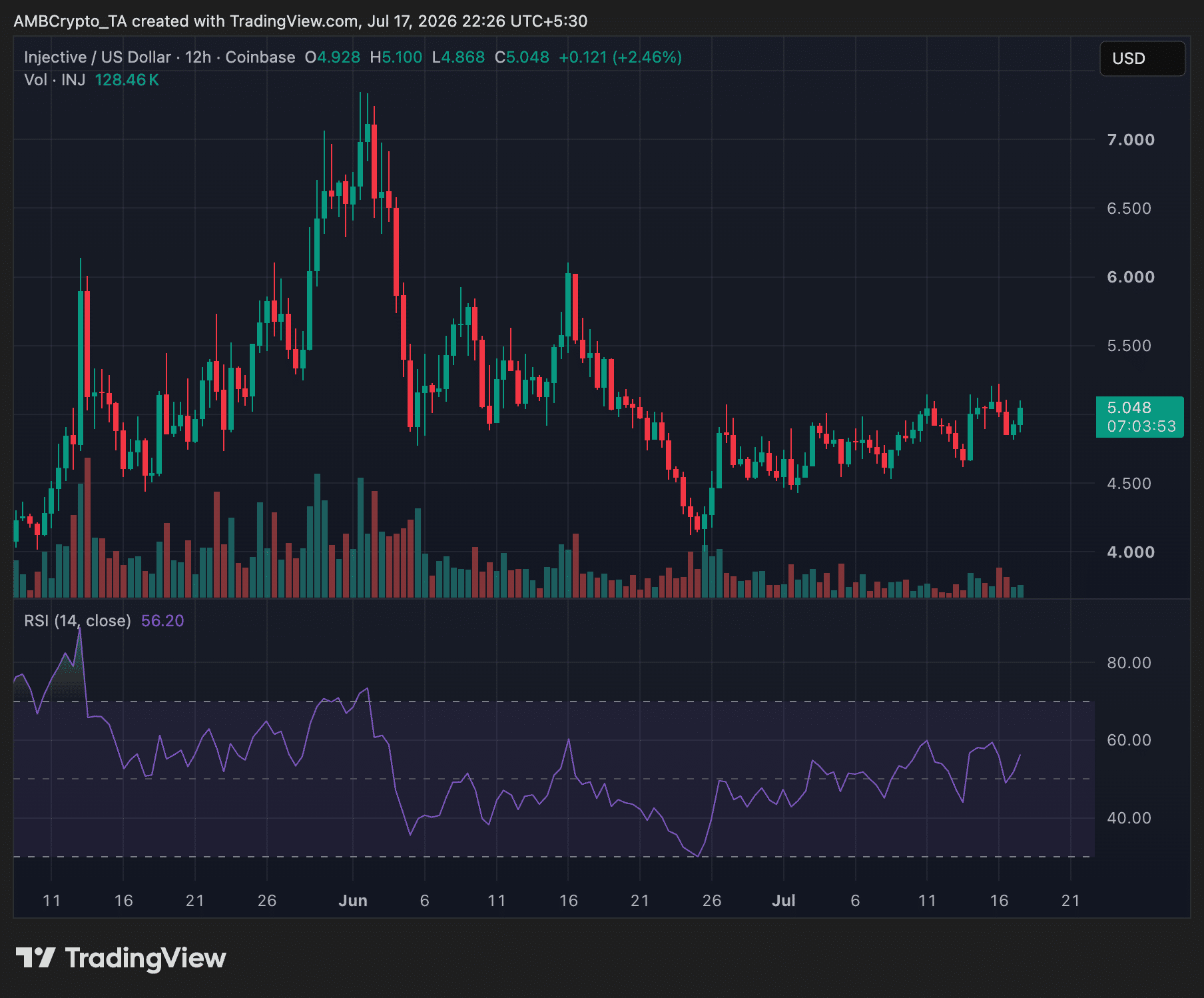
At press time, INJ was trading at approximately $5.05, with the latest 12-hour candle gaining around 2.5%.

The token has recovered considerably since falling towards $4.10 in late June. However, its price action throughout July has largely remained within a consolidation range between approximately $4.50 and $5.20.
Source: TradingView

The Relative Strength Index [RSI] stood at 56.20, above the neutral 50 level, suggesting that buying momentum had strengthened. However, the indicator remained well below overbought territory, leaving room for further upside if demand increases.

The immediate challenge is the $5.20 region, which has repeatedly limited INJ’s recovery attempts during July. A decisive move above this area could signal a breakout from the recent consolidation range and strengthen the case for an extended recovery.

Failure to overcome the resistance, however, could leave INJ range-bound and expose the token to another test of support around the lower end of its recent trading range.


Final Summary

  • Injective has filed for SEC transfer-agent registration to bring official ownership records for tokenized securities on-chain.
  • INJ has recovered above $5 with its RSI rising to 56.20. Still, the token must overcome resistance around $5.20 to confirm a breakout from its July consolidation range.


Trending Cryptos

Related Questions

QWhat is the significance of Injective filing its transfer agent registration with the SEC?

AIt is part of Injective's push to bring regulated real-world assets and securities infrastructure on-chain. A transfer agent maintains ownership records, and moving this function on-chain would allow faster recording/transfer of tokenized securities and reduce intermediaries.

QWhat is the key price level that INJ must overcome to signal a breakout according to the article?

AThe key resistance level is around $5.20. A decisive move above this area is needed to break out of its recent consolidation range and signal an extended recovery.

QBesides the SEC filing, what other regulatory effort did Injective announce recently?

AInjective published its MiCAR whitepaper, which is intended to support its expansion across European Union member states within the region's regulatory framework.

QWhat does the Relative Strength Index (RSI) reading of 56.20 for INJ suggest about its momentum?

AAn RSI of 56.20, above the neutral 50 level, suggests that buying momentum has strengthened. However, it is still well below overbought territory, indicating potential for further upside if demand increases.

QWhat is the current trading range for INJ mentioned in the article?

AThroughout July, INJ's price action has largely remained within a consolidation range between approximately $4.50 and $5.20.

Related Reads

After R&D Investment Catches Up with the U.S., Is the Sino-U.S. Chip Competition Still Just About Money?

The article examines the significance of recent data showing China's total R&D expenditure, measured by purchasing power parity (PPP), catching up to or slightly surpassing that of the United States in 2024. It argues that while this milestone reflects China's immense capacity to mobilize research resources, the competition in semiconductors now extends far beyond sheer financial input. The analysis highlights key differences: China's R&D is heavily skewed towards experimental development (over 80%), focusing on product engineering and industrialization, whereas the U.S. allocates a proportionally larger share (about 15%) to basic research. Furthermore, leading U.S. semiconductor firms reinvest a significant portion of their substantial global sales revenue into R&D, creating a sustainable commercial innovation cycle that is difficult to replicate. The article emphasizes that semiconductor progress depends on converting R&D into commercially viable products that pass rigorous customer validation and achieve repeat orders, not just on spending levels. It concludes that as China enters the top tier of R&D spenders, the critical challenges shift to improving resource allocation efficiency, fostering long-term basic research, and building effective mechanisms to bridge the gap between laboratory discoveries and reliable, market-ready industrial capabilities.

marsbit35m ago

After R&D Investment Catches Up with the U.S., Is the Sino-U.S. Chip Competition Still Just About Money?

marsbit35m ago

Top 10% of American Households Capture 88% of Wealth, How Is the AI Era Cake Divided?

AI Worsens Wealth Inequality as Top 10% of US Families Garner 88% of Stock Gains (2019-2026) A report from the China Finance 40 Forum highlights that the AI boom is significantly widening wealth inequality in the United States. From 2019 to Q1 2026, wealth from directly held stocks by US households nearly doubled from $29 trillion to approximately $55 trillion, with rapid growth concentrated post-2023, coinciding with the AI-driven stock market surge. The distribution of these gains has been starkly uneven. Between 2022 and Q1 2026, the wealth increase of about $21 trillion was captured almost entirely by the wealthiest families: the top 10% secured roughly 88% ($18.5 trillion), while the bottom 50% received only about 1% ($0.2 trillion). This has contributed to a growing disparity in disposable income shares. The report, referencing economic historian Robert Allen, draws parallels to historical technological shifts like the "Engels' Pause" during the First Industrial Revolution, where worker wages stagnated despite productivity gains. It suggests AI could induce a similar period where capital收益 outpace labor income, exacerbating inequality. Huang Yiping of Peking University identifies four mechanisms through which AI impacts income distribution: capital-bias (reducing labor's income share), task polarization (hollowing out middle-skill jobs), skill-based digital divides, and wealth amplification through assets. He warns that if this trend continues, strong supply growth driven by AI could be undermined by persistently weak consumer demand, threatening sustainable economic growth. To address these challenges, the report proposes a three-pronged strategy: 1) Defensive measures like strengthening social safety nets and antitrust enforcement; 2) Empowering workers through education reform and lifelong learning to collaborate with AI; and 3) Rebalancing via policies such as potential taxes on AI超额收益 and mechanisms for broader sharing of technology's benefits, ensuring AI's红利 are more equitably distributed.

marsbit41m ago

Top 10% of American Households Capture 88% of Wealth, How Is the AI Era Cake Divided?

marsbit41m ago

Trading

Spot

Hot Articles

Discussions

Welcome to the HTX Community. Here, you can stay informed about the latest platform developments and gain access to professional market insights. Users' opinions on the price of S (S) are presented below.

活动图片