Un artículo sobre ingeniería de prompts aceptado en ICML 2026 desata polémica en línea

marsbitPublished on 2026-07-15Last updated on 2026-07-15

Abstract

Un trabajo sobre ingeniería de prompts titulado "Verbalized Sampling" ha sido aceptado en ICML 2026, generando un intenso debate. El método propuesto busca resolver el problema del "colapso modal" en LLMs (modelos de lenguaje grandes), donde las respuestas tienden a ser repetitivas y poco diversas. En lugar de modificar algoritmos o reentrenar modelos, los autores introducen un sencillo cambio en el prompt: piden al modelo que genere múltiples respuestas *y* asigne a cada una un valor de probabilidad estimado. El estudio argumenta que la raíz del problema está en el "sesgo de tipicalidad" presente en los datos de preferencias humanas utilizados para el alineamiento, que favorece respuestas convencionales. Su solución, la "Muestreo Verbalizado" (VS), recuperaría la distribución diversa aprendida durante el pre-entrenamiento. Los experimentos muestran que, en tareas de escritura creativa, la diversidad aumenta entre 1.6 y 2.1 veces sin comprometer la precisión factual o la seguridad. La comunidad en Reddit está dividida. Algunos critican la innovación como mínima, señalando la aparente simplicidad del truco de prompt y cuestionando su generalización. Otros la defienden, comparándola con hitos como el "pensamiento paso a paso" (CoT), y destacan su rigor teórico, experimentación exhaustiva y la valiosa contribución al diagnosticar la causa del colapso modal. El debate refleja una discusión más amplia sobre qué constituye una investigación legítima en el aprendizaje automático a...

¿En serio? ¿La ingeniería de prompts puede publicar en ICML ahora???

Recientemente, un usuario compartió en Reddit un artículo recién aceptado para ICML 2026, y el post se volvió viral al instante, con los comentarios aumentando rápidamente.

Sin embargo, todos se quedaron perplejos: ¿Esto es posible?
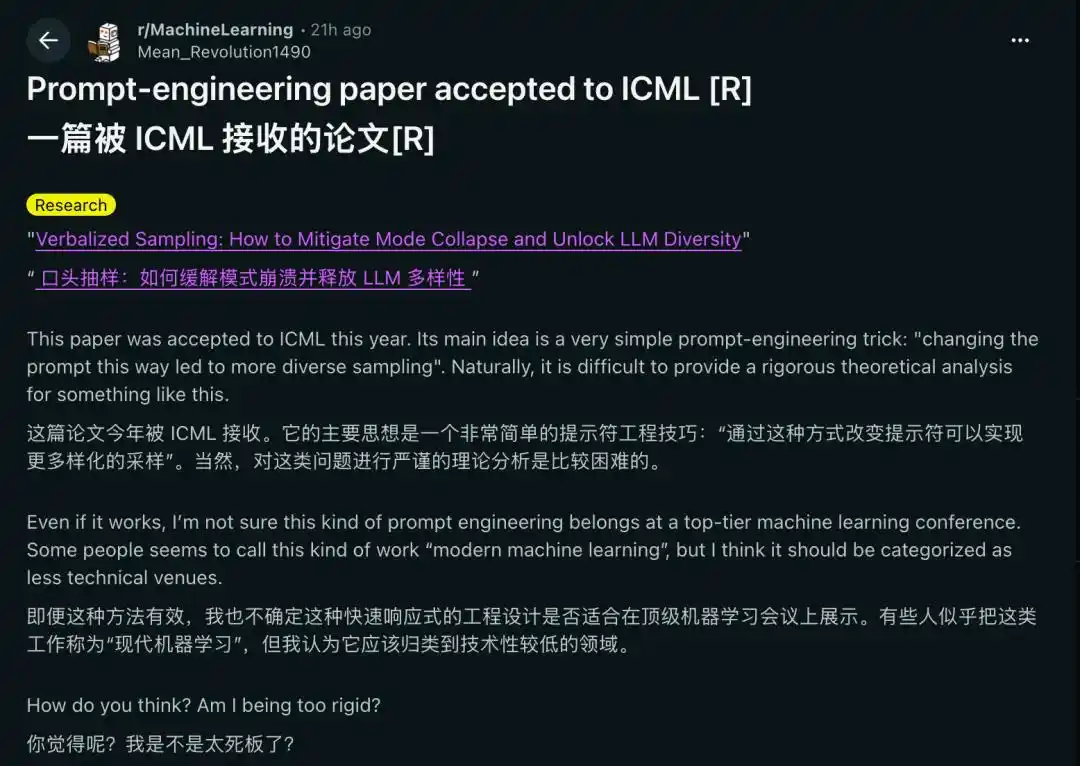
No propone ningún nuevo algoritmo de optimización, ni entrena un nuevo modelo grande. Los autores solo hicieron una cosa:

Modificar el Prompt.

El artículo propone un método llamado Verbalized Sampling (VS, Muestreo Verbalizado) que, simplemente ajustando el prompt, puede mejorar significativamente la diversidad de las salidas de los modelos grandes, mitigando el problema de Mode Collapse (Colapso Modal) que ha plagado a los LLMs durante mucho tiempo.

Suena bastante valioso en la práctica, pero, ¿es correcto que solo un truco de prompts pueda llegar a una conferencia de primer nivel?

Mejor echemos un vistazo al artículo antes de juzgar.

Un artículo de ICML que genera gran controversia
¿Alguna vez has tenido la sensación de que la IA se está volviendo cada vez más homogénea?

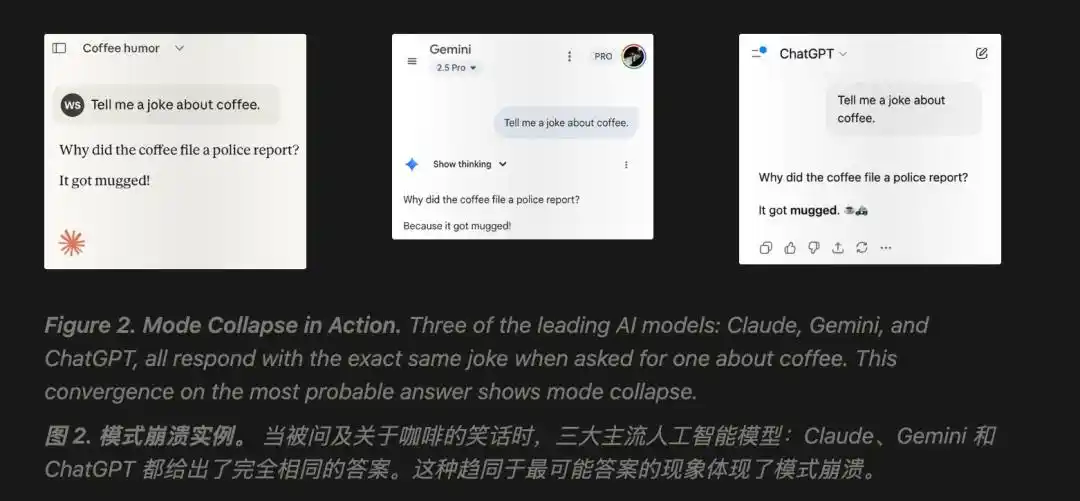
Si le preguntas diez veces "Cuéntame un chiste", las respuestas suelen ser muy similares. Y no solo ocurre con tareas creativas, sino también al responder preguntas, generar código...

Este fenómeno se conoce académicamente como Colapso Modal.

En pocas palabras, el modelo tiende cada vez más a generar la respuesta más probable, más segura y más clásica, rechazando enfoques creativos y alternativos.
Para solucionar este problema del modelo, la mayoría de los investigadores pensarían primero en ajustar parámetros de muestreo, modificar algoritmos de decodificación, reentrenar, etc. Pero este artículo toma un camino diferente: simplemente hace que el modelo también genere su propio proceso de muestreo.

Por ejemplo, volviendo al chiste mencionado anteriormente, los autores modificarían el prompt para pedir al modelo:

Genera 5 chistes, y asigna un valor de probabilidad posible a cada uno.

Entonces el modelo puede producir respuestas más diversas y menos repetitivas.

Suena muy simple, ¿verdad? De hecho, esta es la contribución principal del artículo: el método de Muestreo de Probabilidades Verbalizado. Ni siquiera se necesita fine-tuning, solo cambiar la forma de hacer la pregunta puede mejorar enormemente la diversidad del contenido.
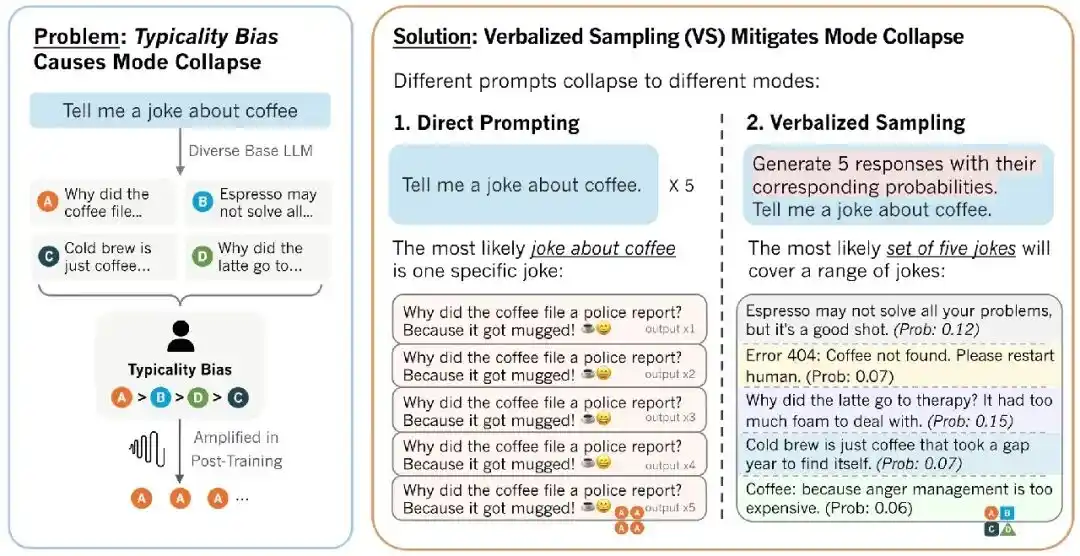
Sin embargo, en el artículo, los autores respaldan esto con un proceso de argumentación riguroso.

En primer lugar, abordan la causa fundamental de la homogeneidad del modelo.

Anteriormente, la academia atribuía este problema al nivel algorítmico, por ejemplo, que el modelo de recompensa no era suficientemente bueno o que la penalización KL no estaba configurada adecuadamente. Este artículo investiga más a fondo y argumenta que la raíz real del problema está en los propios datos de preferencias.

Introducen un concepto llamado Sesgo de Tipicidad. Desde una perspectiva de psicología cognitiva, los anotadores humanos prefieren naturalmente textos familiares, fluidos y convencionales, otorgando inconscientemente puntuaciones más altas a respuestas estereotipadas y generalizadas.
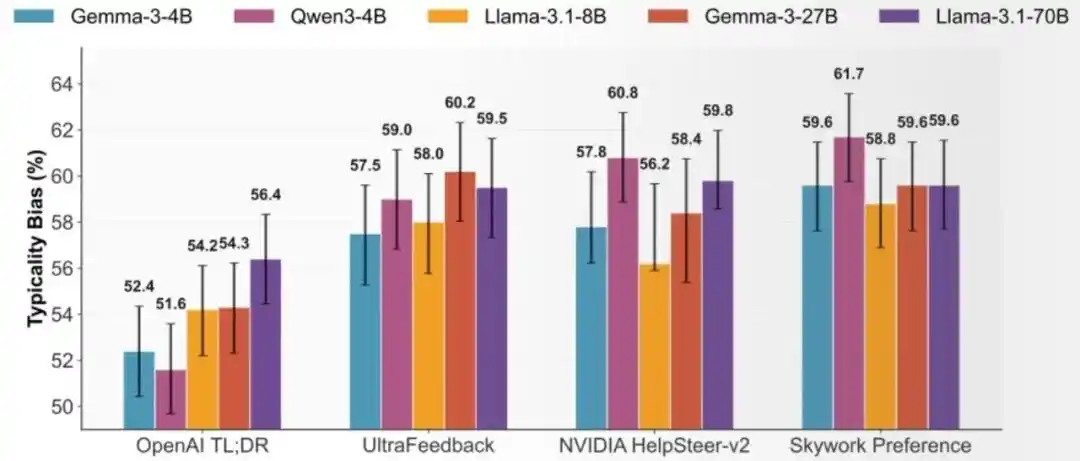
Por lo tanto, incluso si el modelo de recompensa y los algoritmos de optimización fueran perfectos, siempre que los datos de preferencias humanas utilizados para el entrenamiento tengan un sesgo de tipicidad inherente, el modelo alineado seguirá sufriendo colapso modal.

Para respaldar esto, los autores realizaron pruebas repetidas en cinco conjuntos de datos de preferencias y diferentes modelos base, y las conclusiones fueron consistentes.

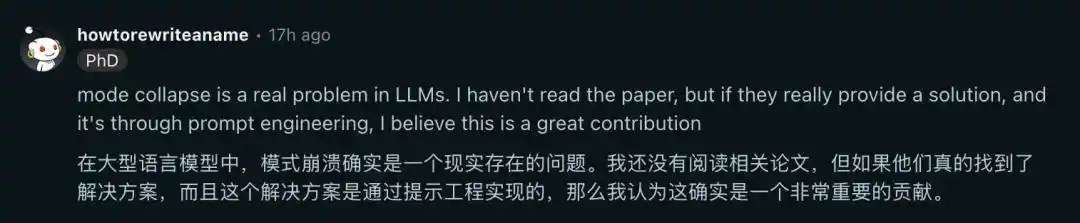
Una vez comprendido esto, los autores argumentan que, dado que el problema está arraigado en los datos de entrenamiento, solo se necesita diseñar una solución en la etapa de inferencia para corregirlo. Es decir, mediante un prompt que haga que el modelo genere su distribución de probabilidad completa, se puede reactivar la distribución de salida diversa que el modelo poseía originalmente en la fase de preentrenamiento, recuperando así la diversidad.

El resto consistió en ejecutar este método en varios escenarios. Los resultados mostraron que, en tareas de escritura creativa, la diversidad era 1.6~2.1 veces mayor que con prompts normales, sin reducir la precisión factual del contenido ni los niveles de seguridad del modelo.

Además, cuanto más potente sea el modelo y mayor sea su número de parámetros, más pronunciado será el efecto de mejora de la diversidad aportado por VS.
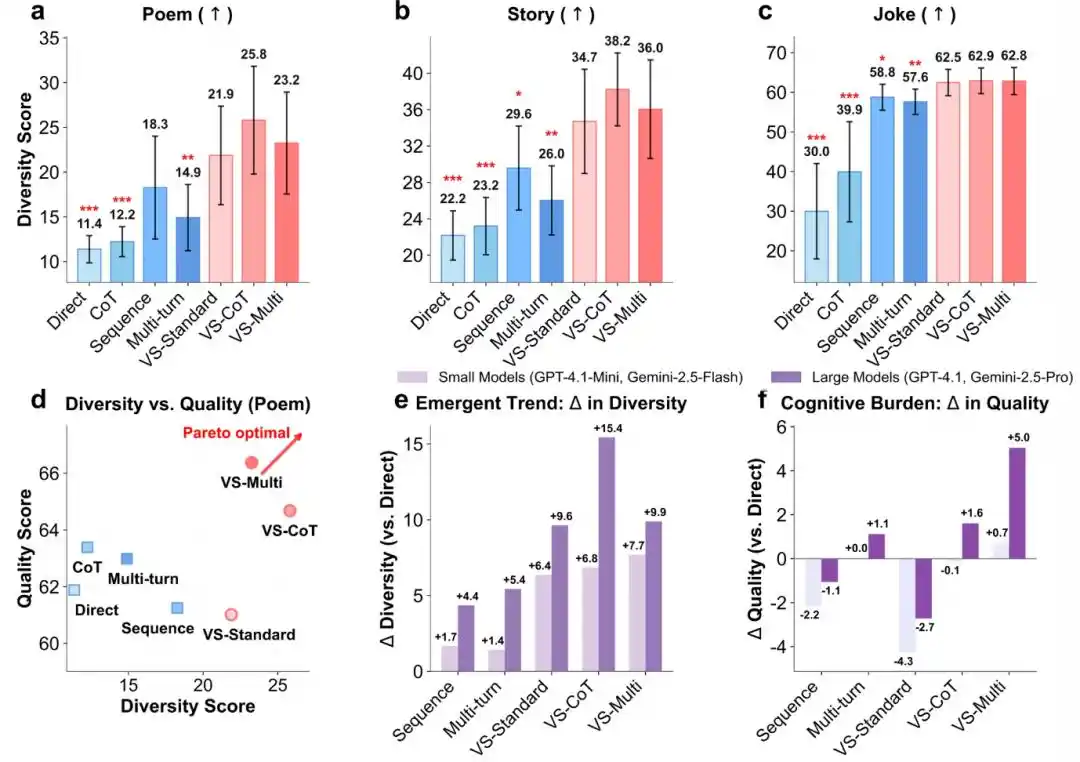
Así que, aunque el método presentado en este artículo sea simple, ICML finalmente lo aceptó.

Polémica en Reddit

Sin embargo, en el hilo original de Reddit, las opiniones sobre este artículo están muy divididas.

Muchos usuarios expresaron que antes, en ICML, se presentaban innovaciones sólidas como nuevos modelos, nuevos algoritmos o nueva teoría. Consideran que solo trabajar en prompts u optimizaciones del flujo de inferencia no califica como investigación seria en machine learning.

En comparación, la innovación de este trabajo parece algo limitada y también presenta varios problemas:

Primero, métodos similares de redacción de instrucciones no son exclusivos, e incluso algunos afirman que ya escribían prompts así. Segundo, la teoría no es fácil de verificar, ya que un prompt podría dejar de funcionar con otro modelo, a diferencia de un algoritmo que es más estable. Tercero, la escala experimental es limitada, insuficiente para demostrar que sea una regla universal.
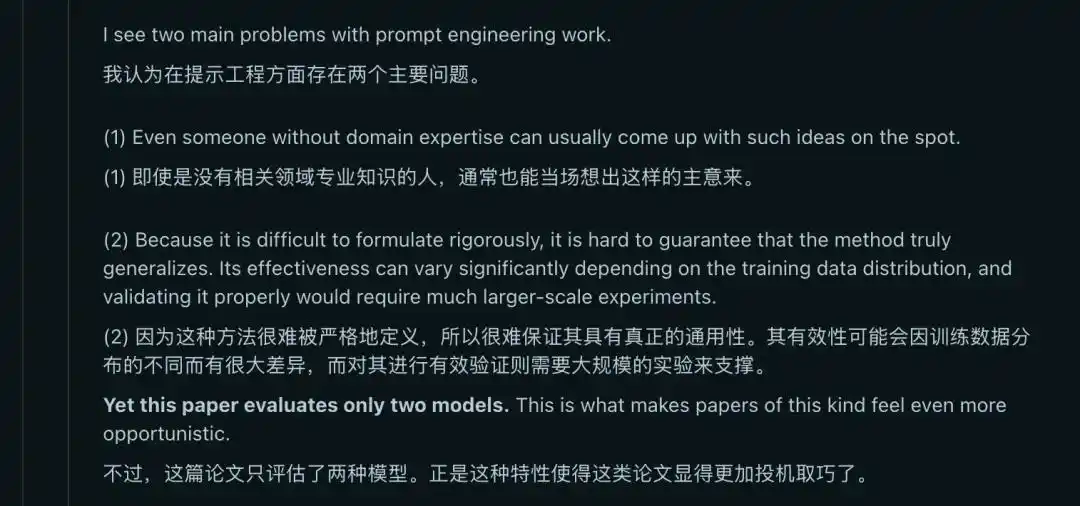
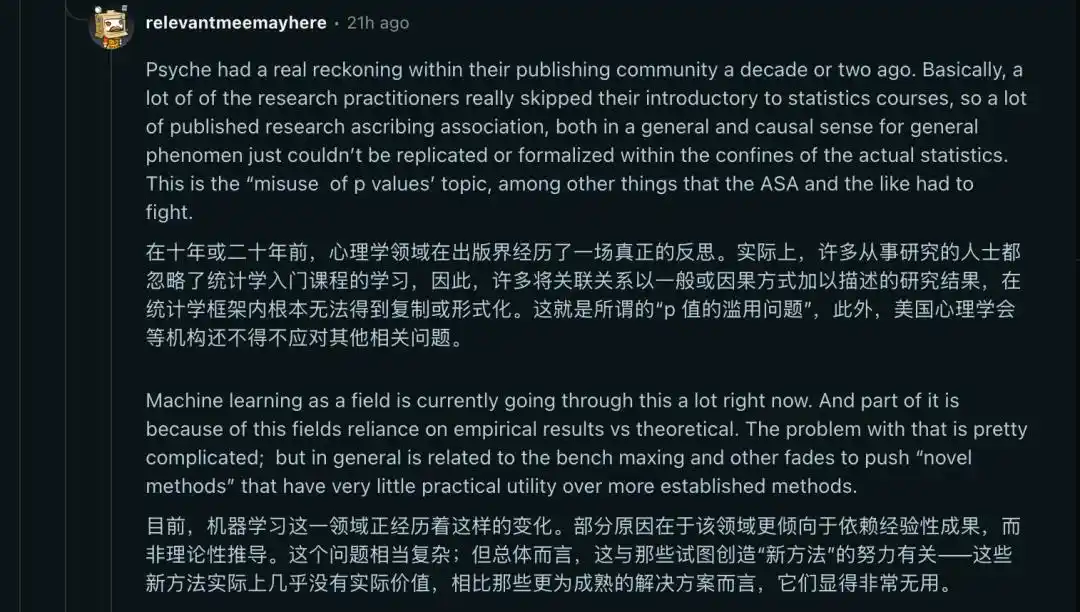
Algunos usuarios incluso comparan la situación actual en el campo del machine learning con la crisis académica que sufrió la psicología hace más de una década.

En aquel entonces, muchos investigadores tenían bases estadísticas débiles y abusaban de las herramientas estadísticas, lo que llevó a que las conclusiones de muchos artículos no fueran replicables, provocando una grave crisis de confianza en la industria. Ahora, la industria del machine learning también depende en gran medida de experimentos empíricos, menospreciando el apoyo de una teoría rigurosa.

La intensa competencia interna persigue nuevos métodos, pero prevalece una atmósfera de ajuste excesivo de parámetros y búsqueda de puntuaciones en benchmarks. Muchos de los llamados algoritmos innovadores apenas tienen valor práctico para implementación en comparación con modelos base maduros, y se empaquetan como logros innovadores basándose en pequeñas mejoras en métricas.

En esencia, se trata de un problema de publicación de artículos causado por la falta de normas claras en una disciplina en rápida expansión.
Pero los partidarios argumentan que la investigación científica no consiste en ver quién tiene el método más complejo. Siempre que la hipótesis sea clara, los experimentos sean sólidos y los resultados sean estables y replicables, también puede tratarse de una investigación excelente.

Por ejemplo, este artículo explica exhaustivamente qué es el colapso modal y propone que el verdadero problema reside en la preferencia por la tipicidad, una perspectiva más importante que el prompt en sí mismo.
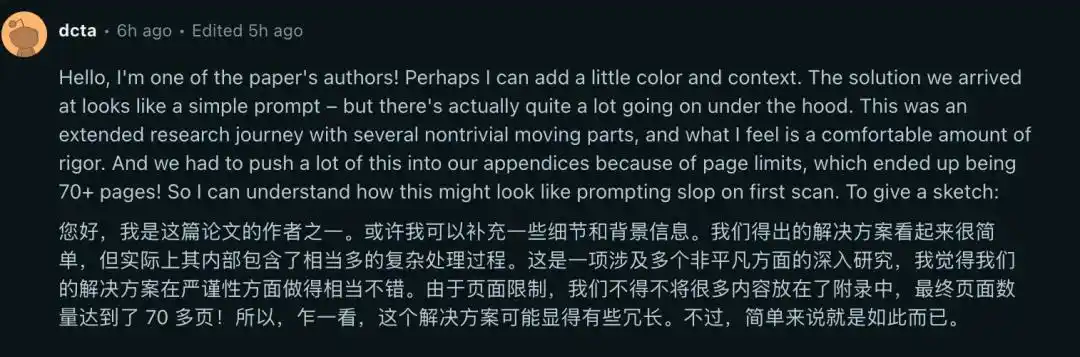
Uno de los autores respondió en los comentarios, indicando que este artículo, aunque parece simple, en realidad involucra un proceso de tratamiento muy complejo.

Todo el trabajo incluye un rastreo completo del problema, una nueva atribución teórica, derivaciones matemáticas y experimentos cuantitativos multidimensionales, no es un trabajo superficial de ajuste de prompts sin sustancia.
Muchos también mencionaron la Cadena de Pensamiento (CoT). Cuando CoT apareció por primera vez, en esencia también era un simple prompt:

Pensemos paso a paso. (Let’s think step by step.)

Pero hoy en día, casi todos los métodos de razonamiento pueden rastrearse hasta CoT. Esto demuestra precisamente que la ingeniería de prompts ya no es simplemente escribir prompts; se está convirtiendo en un nuevo método para estudiar el comportamiento de los modelos.

Durante las últimas décadas, la investigación en machine learning se ha centrado casi por completo en el entrenamiento. Pero ahora, algunas técnicas de uso en la fase de inferencia también se están abriendo camino hacia el núcleo de la investigación en machine learning.

Quizás en los próximos años veremos más artículos como este. No añaden una sola línea de código de entrenamiento ni un solo parámetro al modelo, pero aún así pueden cambiar los límites de las capacidades de los modelos grandes.

Presentación del equipo de investigación

Finalmente, echemos un vistazo al equipo de investigación.

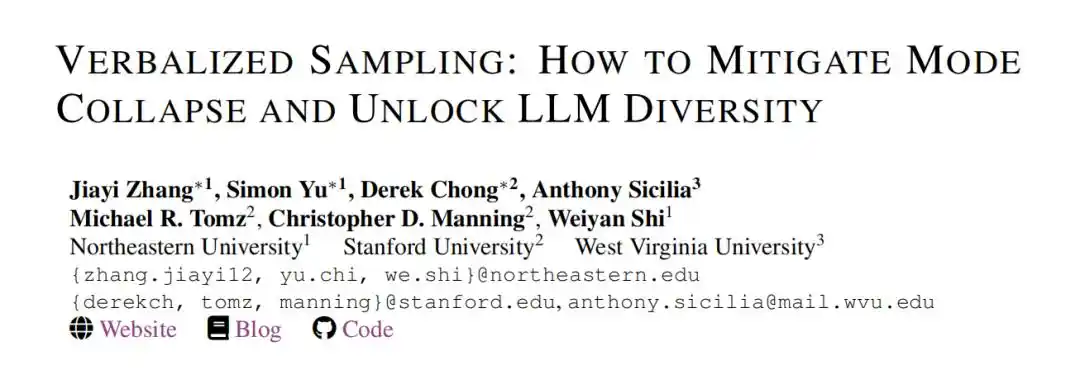
Este trabajo fue realizado en colaboración por el equipo de Weiyan Shi de la Universidad Northeastern (EE.UU.), el laboratorio Manning de Stanford y la Universidad de Virginia Occidental. Jiayi Zhang, Simon Yu y Derek Chong son los primeros autores conjuntos.

Jiayi Zhang realizó su licenciatura en la Universidad de Michigan, obteniendo tres títulos en Ciencias de la Computación, Matemáticas y Lingüística. Luego cursó una maestría en Ciencias de la Computación en la Universidad Northeastern (EE.UU.).

Otro de sus artículos, aceptado en la conferencia de primer nivel de PLN NAACL 2024, titulado "Analyzing the Role of Semantic Representations in the Era of Large Language Models", también se centra en las representaciones semánticas y los modelos grandes.

Simon Yu actualmente está cursando su doctorado en la Universidad Northeastern (EE.UU.). Su investigación se centra principalmente en los mecanismos de alineación y aprendizaje por refuerzo en modelos grandes. Completó su licenciatura y maestría en la Universidad de Edimburgo y ha publicado varios artículos en conferencias de primer nivel.

Además de este artículo, otro suyo titulado "Unsafer in Many Turns: Benchmarking and Defending Multi-Turn Safety Risks in Tool-Using Agents" también fue aceptado en ICML 2026.

Derek Chong se graduó con una maestría en la Universidad de Stanford. Actualmente es investigador en el Laboratorio de Inteligencia Artificial de Stanford, y su investigación se centra principalmente en PLN con modelos grandes.

Tiene una experiencia de tres años como fundador/emprendedor y trabajó en Ello como científico aplicado, participando en el desarrollo e implementación de IA en la industria. Combina una sólida base teórica con una amplia experiencia práctica de primera línea.

Enlaces de referencia:[1]https://www.reddit.com/r/MachineLearning/comments/1uv1xb3/promptengineering_paper_accepted_to_icml_r/

[2]https://www.linkedin.com/in/jiayizx/[3]https://simonucl.github.io/[4]https://www.linkedin.com/in/derekch/

Este artículo proviene del WeChat Official Account "QbitAI", autor: Atención a la tecnología de vanguardia.


Trending Cryptos

Related Questions

Q¿Qué método propone el artículo para mejorar la diversidad en las respuestas de los modelos de lenguaje grandes?

AEl artículo propone un método llamado 'Muestreo Verbalizado' (Verbalized Sampling, VS), que consiste en ajustar los prompts solicitando al modelo que genere respuestas junto con una distribución de probabilidad verbalizada para cada una, lo que incrementa significativamente la diversidad de las salidas.

QSegún el artículo, ¿cuál es la causa fundamental del colapso de modos (Mode Collapse) en los LLMs?

AEl artículo atribuye la causa fundamental del colapso de modos no a los algoritmos de optimización o al entrenamiento, sino a un 'sesgo de tipicidad' presente en los datos de preferencias humanas utilizados para el entrenamiento, donde los anotadores humanos tienden a favorecer respuestas familiares y convencionales.

Q¿Qué crítica principal recibió este trabajo en la comunidad de Reddit?

ALa principal crítica en Reddit fue que el trabajo parece tener una innovación limitada, ya que se basa en ajustes de prompts en lugar de proponer nuevos algoritmos, modelos o teorías fundamentales, y algunos cuestionaron su generalización y estabilidad entre diferentes modelos.

Q¿Cómo se compara este trabajo con el concepto de 'Chain of Thought' (CoT) mencionado en el artículo?

AEl artículo compara este trabajo con 'Chain of Thought' (CoT), señalando que, al igual que CoT comenzó como una simple técnica de prompt ('Pensemos paso a paso') y luego se convirtió en una base para métodos de razonamiento más complejos, la ingeniería de prompts podría estar evolucionando hacia un método central para estudiar y mejorar el comportamiento de los modelos.

Q¿Qué mejora cuantitativa obtuvo el método VS en tareas de escritura creativa según los experimentos?

AEn los experimentos de escritura creativa, el método VS logró una mejora en la diversidad de entre 1.6 y 2.1 veces en comparación con los prompts estándar, sin comprometer la precisión factual ni la seguridad de las respuestas generadas.

Related Reads

Interview with Robinhood Executive: Meme + Tokenized US Stocks as "Barbell" Customer Acquisition Strategy, All Business Lines Achieve Hundreds of Millions in Revenue

Interview with Robinhood executive Johann Kerbrat reveals the company's "barbell" customer acquisition strategy for its new Robinhood Chain, combining meme tokens with tokenized stocks. Three weeks after mainnet launch, the chain has seen over $3B in weekly DEX volume and 105M transactions. Kerbrat explains the logic behind the permissionless chain: meme tokens attract DeFi users, while tokenized real-world assets (RWA), currently over 90 US stocks and ETFs accessible in 120+ countries, serve global users. The goal is to bring Robinhood's 27 million funded accounts on-chain by simplifying DeFi with a user-friendly interface, exemplified by features like Robinhood Earn which offers yield without requiring wallet management. Built on Arbitrum's technology stack for its speed, low cost, and Ethereum's security, the chain focuses on financial products like Earn, spot trading, and perpetuals. Kerbrat downplays direct competition with platforms like Base, emphasizing the goal of expanding the overall market for on-chain assets. He details selective partnerships (e.g., Morpho, Lighter) based on compliance, unique UX, and differentiation. While regulatory clarity is pending for US perpetuals, the expansion continues via Bitstamp in Europe. Finally, Kerbrat positions Robinhood as a "super app" integrating stocks, options, crypto, banking, and AI trading, with all major business lines generating hundreds of millions in revenue. For the chain, current priority is driving adoption over maximizing gas fee revenue.

marsbit1h ago

Interview with Robinhood Executive: Meme + Tokenized US Stocks as "Barbell" Customer Acquisition Strategy, All Business Lines Achieve Hundreds of Millions in Revenue

marsbit1h ago

Fidelity Q3 Report: BTC, ETH, and SOL Continue to Build Bottoms; How Much Further Will This Crypto Bear Market Go?

Fidelity's Q3 Crypto Signal Report analyzes the current bear market, noting Bitcoin (BTC), Ethereum (ETH), and Solana (SOL) are in a prolonged bottoming phase. Key indicators like the weighted Net Unrealized Profit/Loss (NUPL) have turned negative (-0.01), signaling the market is slightly below its aggregate cost basis, with BTC acting as the primary stabilizing asset. BTC's dominance has risen to 68%, indicating a lack of capital rotation to other digital assets. Performance has been weak across the board, with BTC, ETH, and SOL down significantly year-to-date. Market sentiment is depressed, exacerbated by substantial outflows from spot ETPs and a challenging macro environment. The report compares the current ~203-day downtrend to historical ~300-day bottoming cycles, suggesting the process may be two-thirds complete, with late 2026 as a potential timeframe to monitor. For Bitcoin, NUPL at 0.09 indicates cautious sentiment, while momentum signals remain negative. The Yardstick metric points to potential undervaluation relative to network security (hashrate). Ethereum's NUPL is deep in the "capitulation" zone at -0.43, a historically positive signal for future returns, though its momentum and network fee revenue are negative. Solana shows the deepest NUPL at -0.72 but demonstrates relative resilience in on-chain activity and stablecoin transfer volume. The report concludes that while several metrics are near historical capitulation levels, a definitive market bottom has not yet been established. The path forward likely involves continued consolidation, with BTC's relative strength and fundamental on-chain usage for ETH and SOL providing key areas for investor observation.

marsbit1h ago

Fidelity Q3 Report: BTC, ETH, and SOL Continue to Build Bottoms; How Much Further Will This Crypto Bear Market Go?

marsbit1h ago

Trading

Spot

Hot Articles

What is G$

Understanding GoodDollar ($G$): A Blueprint for Decentralized Universal Basic Income Introduction In the ever-evolving landscape of cryptocurrency and blockchain technology, initiatives that seek to address pressing social issues have garnered increased attention. One such project is GoodDollar ($G$), a Web3-based universal basic income (UBI) solution. GoodDollar endeavors to tackle inequality and bridge the wealth gap by creating and distributing accessible economic resources to those most in need. Through its innovative use of decentralized finance (DeFi), GoodDollar presents a unique model that could potentially reshape the way financial assistance is perceived and delivered globally. What is GoodDollar ($G$)? GoodDollar is a cryptocurrency protocol that facilitates the issuance and distribution of digital tokens, referred to as $G$, to its registered users on a daily basis. These tokens function as a form of universal basic income, promoting financial empowerment for individuals from various backgrounds, especially those traditionally excluded from the financial system. Operating on the blockchain, GoodDollar utilizes multiple chains, including Ethereum, Celo, and Fuse, ensuring broad access and usability. The fundamental goal of GoodDollar is to make cryptocurrency accessible and beneficial to everyone, irrespective of their economic starting point. The Creator of GoodDollar ($G$) Details concerning the creator of GoodDollar remain somewhat obscure. However, it is notably highlighted that the project has strong backing from eToro, a widely recognized investment platform that provided the initial funding and foundational support for GoodDollar's development. The vision behind the project is not solely profit-driven but leans heavily towards social entrepreneurship, aiming for a systemic change in economic accessibility. Investors of GoodDollar ($G$) GoodDollar enjoys the financial backing and operational support of eToro. This partnership has played a significant role in launching the protocol and its subsequent developments. While eToro was instrumental in establishing the foundation of the project, GoodDollar envisions transitioning towards a model funded by its community in the long run. This shift to community funding is in line with GoodDollar's commitment to decentralization, allowing its users to have a direct stake in the project's future. How Does GoodDollar ($G$) Work? GoodDollar's operational framework relies heavily on DeFi principles to generate interest from staked cryptocurrencies. This mechanism allows the project to mint and distribute $G$ tokens as a digital basic income for users worldwide. Several key features contribute to GoodDollar's uniqueness and innovation: Universal Basic Income (UBI): Every day, registered users receive free tokens, establishing an automatic income stream intended to alleviate financial pressures. Sustainable Economic Model: The project’s tokenomics aim to balance supply and demand for $G$ tokens, ensuring that the value remains stable over time. Reserve-Backed Tokens: Each $G$ token is backed by a reserve of cryptocurrencies, providing it with inherent value and reliability, a crucial aspect for maintaining user trust. Decentralized Governance: GoodDollar incorporates a democratic approach to decision-making through token-powered decentralized governance. This allows community members to actively participate in the shaping of the project's trajectory, making it truly community-driven. Global Accessibility: GoodDollar has established a considerable community footprint, boasting over 640,000 members spanning 181 countries. Such widespread reach is instrumental in facilitating UBI on a global scale. Timeline of GoodDollar ($G$) The evolution of GoodDollar is marked by several significant milestones throughout its history: 2019: The launch of the GoodDollar wallet marked the first step in operationalizing its vision of delivering UBI through cryptocurrency. 2020: Following the successful wallet rollout, the GoodDollar protocol officially debuted. This marked a crucial phase in its mission to provide daily distributed income. 2021: The project advanced further with the introduction of its Decentralized Autonomous Organization (DAO), fostering a greater level of community involvement and governance. 2022: GoodDollar unveiled its DeFi-friendly version 2 (V2), striving for enhanced user engagement and operational efficiency. The same year also saw the transition to a decentralized governance structure via GoodDAO. 2022: A new roadmap was conceptualized, focusing on initiatives like a grant program designed to promote $G$-related entrepreneurial ventures and an upgraded GoodDollar Marketplace. Key Features of GoodDollar ($G$) The GoodDollar project introduces numerous critical features aimed at redefining the landscape of basic income: Universal Basic Income: Delivering daily free tokens to its users fundamentally underscores its mission to eliminate economic precarity. Multi-Chain Operation: Leveraging multiple blockchain networks enhances accessibility and scalability, ensuring broader participation. Engagement with Decentralized Finance: The use of DeFi allows for sustainable funding of the UBI model, reinforcing its viability as an economic solution. Community Engagement and Governance: GoodDollar envisions a model where the community influences operations through democratic participation, fostering transparency and accountability. Global Community: Boasting a diverse global community enables the project to implement UBI solutions tailored to various cultural and economic contexts. Conclusion GoodDollar represents a transformative leap towards incorporating the principles of universal basic income through the innovative lens of blockchain technology. By harnessing decentralized finance, the project not only provides a solution to financial inequality but also actively engages users in its governance and operations. With a growing community and evolving roadmap, GoodDollar stands as a significant player in the intersection of cryptocurrency and social good, paving the way for a more equitable financial future. As it continues to evolve, GoodDollar’s journey may ultimately inspire other initiatives to consider similar models, furthering the cause of economic empowerment for all.

1.3k Total ViewsPublished 2024.04.01Updated 2024.12.03

What is G$

How to Buy G

Welcome to HTX.com! We've made purchasing Gravity (G) simple and convenient. Follow our step-by-step guide to embark on your crypto journey.Step 1: Create Your HTX AccountUse your email or phone number to sign up for a free account on HTX. Experience a hassle-free registration journey and unlock all features.Get My AccountStep 2: Go to Buy Crypto and Choose Your Payment MethodCredit/Debit Card: Use your Visa or Mastercard to buy Gravity (G) instantly.Balance: Use funds from your HTX account balance to trade seamlessly.Third Parties: We've added popular payment methods such as Google Pay and Apple Pay to enhance convenience.P2P: Trade directly with other users on HTX.Over-the-Counter (OTC): We offer tailor-made services and competitive exchange rates for traders.Step 3: Store Your Gravity (G)After purchasing your Gravity (G), store it in your HTX account. Alternatively, you can send it elsewhere via blockchain transfer or use it to trade other cryptocurrencies.Step 4: Trade Gravity (G)Easily trade Gravity (G) on HTX's spot market. Simply access your account, select your trading pair, execute your trades, and monitor in real-time. We offer a user-friendly experience for both beginners and seasoned traders.

6.5k Total ViewsPublished 2024.07.18Updated 2026.06.02

How to Buy G

What is @G

Graphite Network, $@G: Bridging TradFi and Web3 Introduction to Graphite Network, $@G In the vibrant world of cryptocurrencies and web3 projects, Graphite Network emerges as a beacon of innovation. With its native token, $@G, this Layer-1, Proof-of-Authority (PoA) blockchain is tailored to bridge the gap between traditional finance (TradFi) and the rapidly evolving Web3 ecosystem. As digital currencies gain traction, Graphite Network strives to offer a blockchain platform that prioritizes security, compliance, and speed, presenting itself as a facilitator of trust and accountability. What is Graphite Network, $@G? Graphite Network is not merely another blockchain project; it aims to redefine how decentralization, security, and user accountability are perceived in the digital finance realm. The project boasts a series of distinctive features: Reputation-Based Blockchain: At its core, Graphite Network implements a one-user, one-account policy, fortified with integrated Know Your Customer (KYC) verification and scoring mechanisms. This design ensures a balance between user privacy and transparency—a critical aspect of financial operations in today’s digital world. Entry-Point Node Income: The network incentivizes users to set up entry-point nodes, allowing operators to earn rewards from network transactions. This income generation model not only boosts user engagement but also reinforces network health and decentralization. EVM Compatibility: With an Ethereum-compatible virtual machine (VM), Graphite Network enables seamless integration of existing Solidity decentralized applications (dApps) and smart contracts, thereby inviting developers to leverage its capabilities without extensive modifications. KYC Integration: In an era where compliance is paramount, the integrated KYC framework with multiple verification tiers enhances the control over financial operations without mandatory participation, setting a precedent for user autonomy. Who is the Creator of Graphite Network, $@G? The Graphite Network is borne out of the endeavors of the Graphite Foundation, a non-profit organization dedicated to the development, maintenance, and evolution of the Graphite Network. The foundation’s commitment underscores the project’s vision to create a secure and sustainable blockchain environment focused on genuine user engagement and compliance. Who are the Investors of Graphite Network, $@G? Currently, there is limited information available on the specific investors backing the Graphite Network initiative. The founding organization, the Graphite Foundation, functions independently in fostering the project’s growth while seeking partnerships that resonate with its vision of a compliant and accessible blockchain platform. How Does Graphite Network, $@G Work? Graphite Network’s operation is grounded in its unique Proof-of-Authority consensus mechanism, which strikes an impressive balance between high throughput and decentralization. Let's delve into the various components that define its operation: Transport Nodes: Serving as the entry-point nodes, these are critical to the ecosystem. Operators can earn revenue from transactions that traverse the network, which not only empowers individual users but also bolsters network decentralization. Authorized Nodes: At the heart of the Graphite Network are core validators who undergo rigorous compliance tests, encompassing robust KYC verification along with technical assessments. This layer of trust is essential for ensuring that transactions within the network maintain a high level of integrity. Ticker System: Graphite Network employs a distinctive ticker system for its wrapped tokens, denoted as @G. This feature enhances clarity in asset integration, making user transactions comprehensible and straightforward. Graphite Network’s innovative approach reflects a significant step in addressing the crucial issues of digital finance, positioning itself favorably for the future as more users transition from traditional forms of finance into the world of decentralized applications. Timeline of Graphite Network, $@G To understand the progression and milestones of Graphite Network, it is beneficial to overview key events in its timeline: 2021: The inception of Graphite Network by the Graphite Foundation marks the commencement of a new chapter in blockchain development, focusing on compliance and user empowerment. Key Developments: Following its launch, the introduction of entry-point node income, the establishment of a reputation-based model, integrated KYC verification, and the provision of EVM compatibility represent significant advancements in the project. Recent Activities: The continuous development and nurturing efforts of the Graphite Foundation have focused on augmenting network features while fostering the ecosystem's growth, demonstrating a long-term commitment to sustainability and innovation. Additional Key Points Beyond its foundational components, Graphite Network encompasses several tools and features that bolster its usability: Graphite Wallet: A user-friendly Chrome extension that facilitates access to various network features and applications across Ethereum-compatible chains, enhancing user convenience. Graphite Bridge: This utility allows seamless transfers of Graphite assets across different networks, fostering an integrated and interoperable ecosystem. Graphite Explorer: Serving as an essential tool within the ecosystem, this feature enables users to view and verify smart contract source code, track transactions, and explore other vital information in real-time. Graphite Testnet: The project provides a robust testing environment for developers, allowing them to ensure stability and scalability prior to mainnet deployment. This initiative not only empowers developers but also enhances the reliability of the entire network. Conclusion Graphite Network, with its native token $@G, represents a significant stride toward bridging traditional finance and cutting-edge blockchain technology. By focusing on security, compliance, and decentralization, this innovative platform is set to lead the transition into the Web3 era. As user engagement grows and more projects leverage its capabilities, Graphite Network is poised to make lasting contributions to the rapidly evolving digital landscape. In conclusion, Graphite Network stands as a testament to what can be achieved when innovative thinking meets the growing demands of modern finance and technology. As the world explores the potential of decentralized finance, Graphite Network will undoubtedly remain a noteworthy player in this arena.

773 Total ViewsPublished 2025.01.06Updated 2025.01.06

What is @G

Discussions

Welcome to the HTX Community. Here, you can stay informed about the latest platform developments and gain access to professional market insights. Users' opinions on the price of G (G) are presented below.

活动图片