Solana: How memecoins are driving the ‘SOL cycle’ narrative in H2

ambcryptoPublished on 2026-07-06Last updated on 2026-07-06

Abstract

The article discusses the growing narrative of a "Solana cycle" in the second half of the year, driven by a surge in bullish sentiment around SOL. While a predicted $1,000 price target is seen as a technical stretch, on-chain data supports optimism: the network added over 1.6 million new addresses in two weeks and saw significant SOL withdrawn from exchanges, reducing sell-side pressure. A key driver is Solana's divergence from the broader memecoin market downturn. As the overall memecoin sector weakens, activity on Solana-based memecoins like BONK is rising, with platforms like Pump.fun leading in DEX volume. This sustained, sector-specific demand and network growth bolster the "Solana cycle" thesis, making SOL a key altcoin to watch despite its current price being below $100.

Traders usually name a market cycle after an asset when bullish sentiment reaches an extreme.

Currently, that seems to be happening with Solana [SOL]. Several traders who were bearish on SOL just weeks ago have now flipped bullish. The sudden shift was so noticeable that it even fueled speculation on social media, with some users questioning whether Solana was paying analysts to push a pro-SOL narrative.

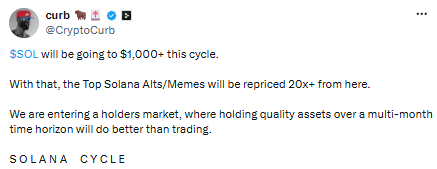
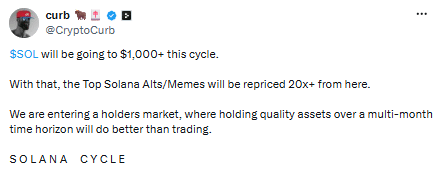
More recently, Ansem added to the buzz by calling SOL undervalued and arguing that it has the potential for a 100x move, citing the network’s ecosystem upgrades and continued growth. The biggest talking point, however, came from another analyst who predicted that SOL could hit $1,000 this cycle, calling the current market phase the “Solana cycle.”
Source: X

Technically, that target looks like a stretch.

Solana is still struggling to reclaim the $100 level, so a move to $1,000 this cycle remains a long shot. That said, the on-chain data is telling a different story. Over the past two weeks, the network has added more than 1.6 million new addresses, a sign that user activity continues to accelerate.

Meanwhile, around $120 million worth of SOL has been withdrawn from exchanges over the past week. Growing network activity combined with steady exchange outflows suggests demand is picking up while more holders are moving their tokens off trading platforms, reducing immediate sell-side pressure.

That said, Solana’s biggest growth catalyst may not be network expansion alone. Instead, the real momentum appears to be coming from sector-specific demand, making the idea of a “Solana cycle” heading into H2 less far-fetched than it first appears.

Memecoin demand strengthens Solana’s outlook

The memecoin market collapse is becoming a key driver of the 2026 cycle.

According to CoinMarketCap data, the total memecoin market cap has declined by over $10 billion so far this year and remains in the red, reflecting fading interest in meme-based tokens. Notably, this weakness is also visible in the data, with memecoin dominance falling sharply to 3.7%, its lowest level since February 2024.

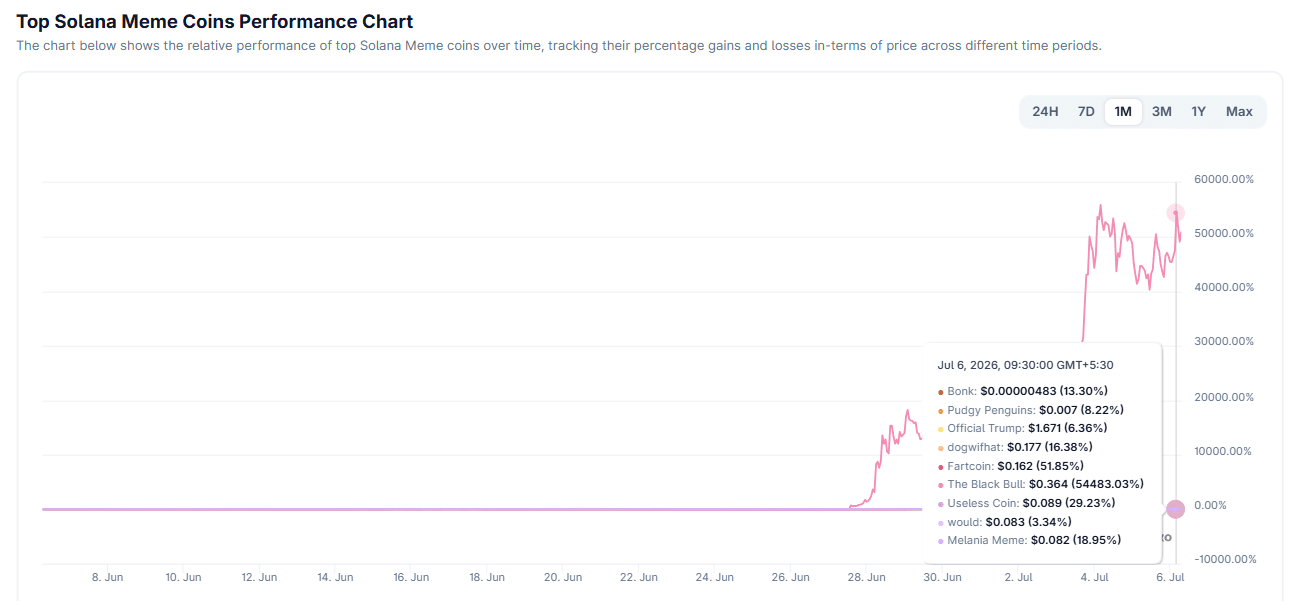
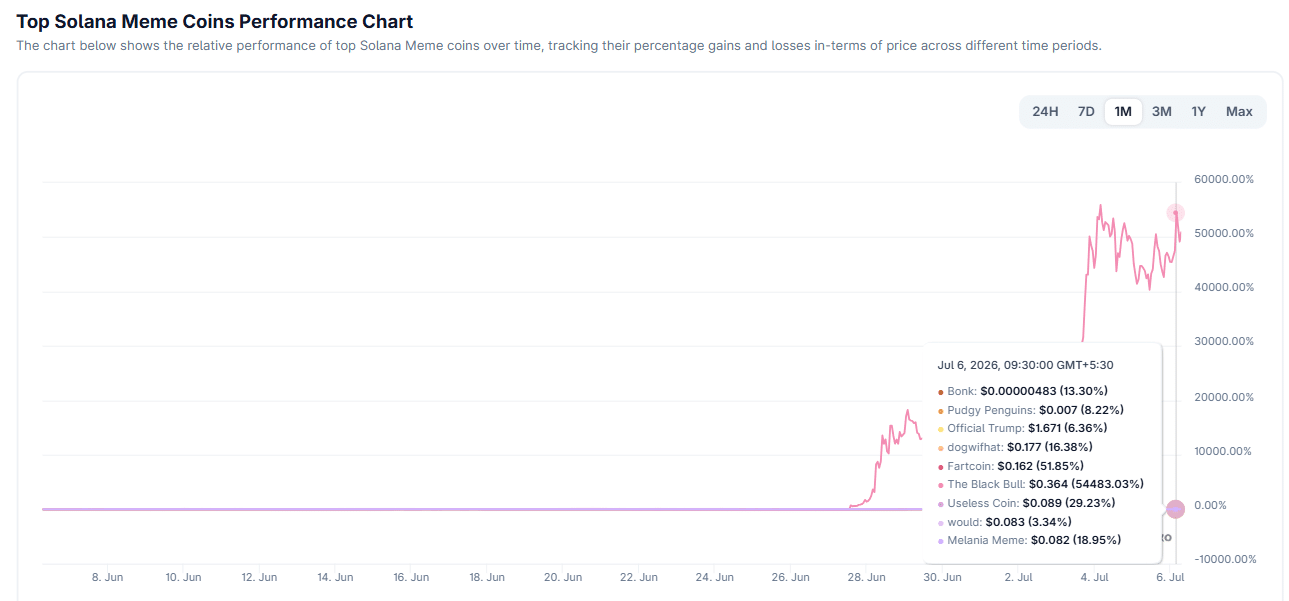
However, Solana is clearly diverging from the broader market trend. As the chart shows, Solana-based memecoins have been in a steady uptrend since June, with Bonk [BONK] leading the move with over 13%+ gains during the period. Meanwhile, Pump.fun has climbed to the top spot by 24-hour DEX volume, surpassing Uniswap, as memecoin trading activity on Solana picks up again.
Source: CoinGecko

In simple terms, Solana network usage isn’t just driven by spot demand.

Instead, growth in new addresses has lined up with strong memecoin momentum on the network, showing that interest in Solana-based memes remains firm even as the broader memecoin market cools. That gives SOL a clear edge in the current setup.

So, while SOL may still be far from a $1,000 rally from a technical standpoint, the underlying demand and activity still support the idea of a “Solana cycle.” That keeps SOL a key altcoin to watch heading into H2.


Final Summary

Trending Cryptos

Related Questions

QWhat is the primary factor driving the so-called 'Solana cycle' narrative according to the article?

AAccording to the article, the primary factor driving the 'Solana cycle' narrative is the sustained demand and momentum for memecoins on the Solana network, which contrasts with the broader cooling of the overall memecoin market.

QWhat are two key on-chain metrics mentioned that suggest growing demand and reduced sell-side pressure for SOL?

ATwo key on-chain metrics mentioned are: 1) The addition of over 1.6 million new Solana network addresses in the past two weeks, indicating accelerating user activity. 2) Approximately $120 million worth of SOL withdrawn from exchanges over the past week, suggesting holders are moving tokens off trading platforms.

QHow does the performance of Solana-based memecoins differ from the overall memecoin market trend?

AWhile the total memecoin market cap has declined significantly, Solana-based memecoins have been in a steady uptrend since June, with projects like Bonk (BONK) leading gains. This shows that interest in Solana-based memes remains firm as the broader sector cools.

QWhat is the analyst Ansem's view on Solana's (SOL) potential, as cited in the article?

AAnsem called SOL undervalued and argued that it has the potential for a 100x move, citing the network's ecosystem upgrades and continued growth.

QDespite the optimistic narrative, why does the article suggest a $1,000 price target for SOL this cycle is technically a stretch?

AThe article suggests a $1,000 price target is technically a stretch because Solana is still struggling to reclaim the $100 price level, making such a massive rally appear as a long shot from a current technical standpoint.

Related Reads

Unitree's IPO Frenzy: The Real Mystery is How It Will Spend the 42 Billion Raised

Unitree, a Chinese robotics company, is set for a public listing after its IPO registration was approved by regulators. The company, which started with quadruped robots and has expanded into humanoids, plans to raise approximately 4.2 billion yuan through its offering. The article traces Unitree's rapid growth from its founding in 2016 to its current status. It highlights key milestones like the 2021 CCTV Spring Festival Gala performance, the 2023 launch of its affordable Go2 robot dog and the H1 humanoid robot, and a series of subsequent product launches. By 2025, the company reported revenue of 1.71 billion yuan, profitability, and sales exceeding 5,500 humanoid robots. As the first publicly-listed humanoid robot company on China's STAR Market, Unitree's main challenges are sustaining growth and deploying its newly raised capital effectively. The humanoid robot sector in China is crowded, with over 140 companies. Competitors include UBTech (focusing on industrial and consumer markets), Fourier, and international players like Tesla Optimus and 1X NEO. The article outlines three critical challenges for Unitree: establishing a strong second product line beyond its quadruped robots, maintaining its price advantage while ensuring quality, and successfully advancing its embodied AI capabilities through partnerships like the one with NVIDIA for the H2 Plus platform. Unitree's likely strategy involves a "developer tools + industry benchmarks" approach: using low-cost models like the R1 and G1 to build developer adoption and volume, leveraging high-end platforms for AI training, and securing pilot projects in sectors like logistics and manufacturing to build case studies. The company's future success hinges on converting its current momentum in shipments and pilot programs into sustainable, large-scale commercial contracts as the broader market evolves.

marsbit13m ago

Unitree's IPO Frenzy: The Real Mystery is How It Will Spend the 42 Billion Raised

marsbit13m ago

Examining the Open USD Partner Lineup: Follow Who's Joining to See Where the Money Flows

**Title: Deciphering the Open USD Partner Roster: Following the Money** The launch of Open USD is notable less for the stablecoin itself and more for its expansive list of over 140 founding partners, which reads like a "who's who" of global finance and tech. This coalition, including asset managers like BlackRock, card networks Visa and Mastercard, banks (BNY Mellon, Standard Chartered, etc.), tech giants (Google, IBM), merchants (Shopify), and crypto firms (Coinbase, Ripple, Aave, MetaMask), signals a strategic shift. The diverse membership reveals that stablecoins are increasingly viewed not as products to compete over, but as shared infrastructure too critical to be left to any single entity. Each partner category has distinct motives. Asset managers like BlackRock seek to manage the large, sticky cash reserves, a lucrative fee-generating opportunity. Merchants like Shopify aim for lower-cost settlement and potential yield on balances. Banks join defensively to retain custody and settlement roles, fearing deposit outflows to stablecoins. Tech companies bet on programmable money for future machine-to-machine commerce. Crypto firms gain mainstream legitimacy and distribution channels. Remarkably, the consortium includes direct competitors (Visa vs. Mastercard, Coinbase vs. Ripple), indicating that the fear of exclusion from this emerging financial layer outweighs competitive rivalries. However, this shared governance could also lead to slow decision-making. The roster's composition is the real message: it represents a collective bet that a widely accepted, consortium-owned stablecoin is preferable to proprietary versions or having none at all. For incumbents like Circle and Tether, this alliance poses a significant threat, as potential clients have collectively chosen to build their own alternative. The absence of major U.S. retail banks (busy with their own tokenized deposit networks) is equally telling. In essence, the partner list maps where the industry believes value and risk will flow in a tokenized dollar future, marking stablecoin's evolution from a product to a utility.

Foresight News35m ago

Examining the Open USD Partner Lineup: Follow Who's Joining to See Where the Money Flows

Foresight News35m ago

IOSG: Q-Day Countdown, Will Quantum Computing End Cryptocurrency?

IOSG: The Q-Day Countdown – Will Quantum Computing End Cryptocurrency? This analysis explores the looming threat quantum computing poses to blockchain technology. Quantum computers, leveraging Shor's algorithm, could theoretically break the elliptic curve cryptography (ECC) underpinning cryptocurrencies like Bitcoin and Ethereum. The article outlines a hypothetical "Q-Day" scenario where exposed public keys from dormant assets are compromised, leading to fund theft and a deep governance crisis. The core risk is not the complete erasure of blockchains but a systemic reset of public-key cryptography. Bitcoin faces significant challenges due to its "code-is-law" ethos and the immense social consensus required for migration. Its primary vulnerability lies in legacy UTXOs with publicly exposed keys. Ethereum's path involves a more complex, full-stack cryptographic agility upgrade across execution, consensus, and data layers. The industry has a limited "engineering comfort window" of 5-8 years to coordinate a migration to post-quantum cryptography (PQC), such as lattice-based or hash-based signatures. While the existential threat is often overstated, the real bottleneck is the immense coordination required across protocol developers, node operators, wallet providers, exchanges, and custodians. Market repricing of crypto assets may occur well before an actual Q-Day if quantum hardware roadmaps accelerate or regulatory pressure mounts. The article concludes that quantum computing is not a doomsday weapon but a severe stress test for blockchain's foundational security model and governance structures.

marsbit1h ago

IOSG: Q-Day Countdown, Will Quantum Computing End Cryptocurrency?

marsbit1h ago

Trading

Spot

Hot Articles

Discussions

Welcome to the HTX Community. Here, you can stay informed about the latest platform developments and gain access to professional market insights. Users' opinions on the price of SOL (SOL) are presented below.

活动图片