Solana activity hits 1 billion milestone – Is a SOL price surge next?

ambcryptoPublished on 2026-07-07Last updated on 2026-07-07

Abstract

Solana achieved a milestone of 1 billion non-vote transactions in a week, demonstrating its high throughput and scalability. This performance is attributed to the Alpenglow upgrade, which reduced finality times significantly. Solana currently processes transactions much faster than Ethereum. However, the article notes that market efficiency and tokenomics are the next key challenges. While network fundamentals are strong, SOL's higher inflation rate compared to other major Layer 1s and the need for a more developed market layer to improve capital efficiency could impact its long-term valuation. The core question remains whether SOL's price will reflect these underlying technical strengths.

A network proves its strength by processing transactions efficiently.

Solana’s latest milestone reinforces that. With the Alpenglow upgrade, Solana reduced finality to 100–150 ms, allowing the network to confirm transactions instantly and move closer to Web2-level responsiveness.

Notably, those improvements are already translating into higher network activity.

As the chart below shows, Solana processed 1 billion non-vote transactions over the past week, marking the first time the network has crossed that threshold. The milestone underscores Solana’s ability to sustain high throughput at scale.
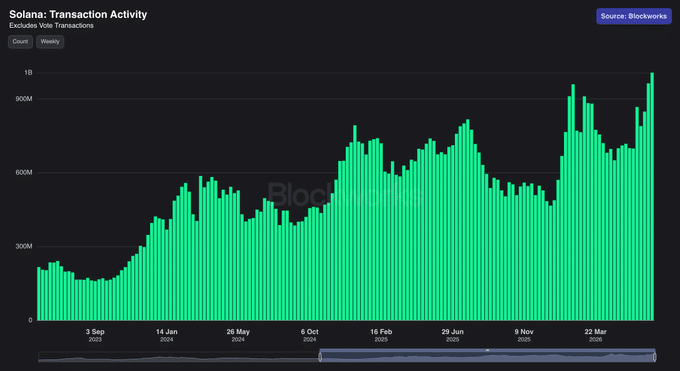
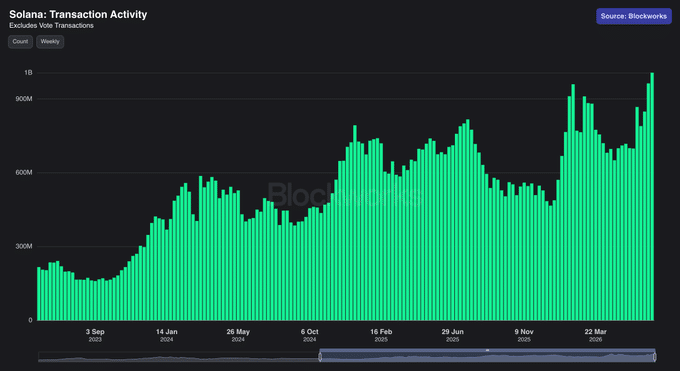
Source: Blockworks

To put the milestone into context, it’s worth comparing Solana’s [SOL] execution performance with other L1s.

According to Chainspect, Solana is currently processing nearly 1,500 transactions per second (1H average), roughly 41x Ethereum’s throughput.

Finality also remains significantly lower, with transactions settling in around 12.8 seconds versus 12 minutes 48 seconds on Ethereum, a 98.3% reduction in confirmation time.

Against this backdrop, Solana’s latest milestone of 1 billion non-vote transactions reinforces the network’s underlying execution strength and suggests that the Alpenglow upgrade is already translating into higher on-chain throughput.

Yet, the market still hasn’t priced in those network improvements, raising the question of whether Solana’s fundamentals remain undervalued.

After 1 billion transactions, Solana faces its next test

Solana no longer needs to prove it can scale. The next frontier is market efficiency.

As noted earlier, Solana already leads the L1 landscape in throughput, with the recent 1 billion non-vote transaction milestone reinforcing that in real time. The focus is now shifting to how efficiently capital moves across the network.

Projects like Jito are building the “market layer” to improve liquidity, transaction execution, and capital efficiency without changing the underlying execution layer.

Jito echoed this view in a recent post on X, arguing that Solana’s next growth phase will come less from higher throughput and more from a stronger market layer.

Circle has already minted more than $64 billion in USDC on Solana, highlighting the network’s growing role in stablecoin settlement. As liquidity continues to deepen, efficiently deploying that capital becomes just as important as processing transactions quickly.
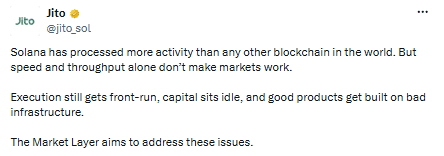
Source: X

At the same time, the conversation is also shifting toward Solana’s tokenomics.

Despite the network’s execution gains, SOL remains one of the more inflationary major Layer 1 assets.

According to on-chain data, Hyperliquid has an annualized supply growth rate of 0.14%, while Ethereum stands at 0.83%. Solana, meanwhile, remains higher at 3.76%. This puts SOL at a relative disadvantage, as higher token issuance continues to weigh on its tokenomics despite improving network fundamentals.

Therefore, while Solana’s 1 billion non-vote transaction milestone reinforces the network’s execution strength, its market layer and tokenomics still trail its infrastructure.

How quickly those two areas mature could determine whether SOL’s valuation begins to reflect the network’s underlying fundamentals.


Final Summary

  • Solana crossed 1 billion non-vote transactions, showing strong network growth and faster execution.
  • The next focus is improving market efficiency and tokenomics to support SOL’s long-term value.

Trending Cryptos

Related Questions

QWhat recent technical milestone did Solana achieve, and how was it made possible?

ASolana processed 1 billion non-vote transactions in a week, marking the first time it crossed that threshold. This milestone was facilitated by the Alpenglow upgrade, which reduced finality to 100–150 ms, enabling faster transaction confirmation and higher on-chain throughput.

QHow does Solana's current transaction processing speed compare to Ethereum's, according to the article?

AAccording to Chainspect data, Solana is processing nearly 1,500 transactions per second (1H average), which is roughly 41 times Ethereum's throughput. Furthermore, Solana's transaction finality time is around 12.8 seconds, a 98.3% reduction compared to Ethereum's 12 minutes 48 seconds.

QAccording to the article, what is the next major focus for Solana's growth after proving its scalability?

AThe next major focus is on improving market efficiency. This involves enhancing how capital moves across the network, including improving liquidity, transaction execution, and capital efficiency through projects like Jito, which is building a stronger 'market layer'.

QWhat potential challenge does the article identify regarding Solana's (SOL) tokenomics?

AThe article identifies that SOL has a relatively high annualized supply growth rate of 3.76%, which is higher than Ethereum's 0.83% and Hyperliquid's 0.14%. This inflationary tokenomics is seen as a relative disadvantage that weighs on its value despite the network's strong fundamentals.

QWhat question does the article raise about the current market valuation of Solana (SOL)?

AThe article raises the question of whether Solana's fundamentals remain undervalued, as the market hasn't yet priced in the recent network improvements. It suggests that how quickly the market layer and tokenomics mature could determine if SOL's valuation begins to reflect its underlying execution strength.

Related Reads

Unitree's IPO Frenzy: The Real Mystery is How It Will Spend the 42 Billion Raised

Unitree, a Chinese robotics company, is set for a public listing after its IPO registration was approved by regulators. The company, which started with quadruped robots and has expanded into humanoids, plans to raise approximately 4.2 billion yuan through its offering. The article traces Unitree's rapid growth from its founding in 2016 to its current status. It highlights key milestones like the 2021 CCTV Spring Festival Gala performance, the 2023 launch of its affordable Go2 robot dog and the H1 humanoid robot, and a series of subsequent product launches. By 2025, the company reported revenue of 1.71 billion yuan, profitability, and sales exceeding 5,500 humanoid robots. As the first publicly-listed humanoid robot company on China's STAR Market, Unitree's main challenges are sustaining growth and deploying its newly raised capital effectively. The humanoid robot sector in China is crowded, with over 140 companies. Competitors include UBTech (focusing on industrial and consumer markets), Fourier, and international players like Tesla Optimus and 1X NEO. The article outlines three critical challenges for Unitree: establishing a strong second product line beyond its quadruped robots, maintaining its price advantage while ensuring quality, and successfully advancing its embodied AI capabilities through partnerships like the one with NVIDIA for the H2 Plus platform. Unitree's likely strategy involves a "developer tools + industry benchmarks" approach: using low-cost models like the R1 and G1 to build developer adoption and volume, leveraging high-end platforms for AI training, and securing pilot projects in sectors like logistics and manufacturing to build case studies. The company's future success hinges on converting its current momentum in shipments and pilot programs into sustainable, large-scale commercial contracts as the broader market evolves.

marsbit38m ago

Unitree's IPO Frenzy: The Real Mystery is How It Will Spend the 42 Billion Raised

marsbit38m ago

Examining the Open USD Partner Lineup: Follow Who's Joining to See Where the Money Flows

**Title: Deciphering the Open USD Partner Roster: Following the Money** The launch of Open USD is notable less for the stablecoin itself and more for its expansive list of over 140 founding partners, which reads like a "who's who" of global finance and tech. This coalition, including asset managers like BlackRock, card networks Visa and Mastercard, banks (BNY Mellon, Standard Chartered, etc.), tech giants (Google, IBM), merchants (Shopify), and crypto firms (Coinbase, Ripple, Aave, MetaMask), signals a strategic shift. The diverse membership reveals that stablecoins are increasingly viewed not as products to compete over, but as shared infrastructure too critical to be left to any single entity. Each partner category has distinct motives. Asset managers like BlackRock seek to manage the large, sticky cash reserves, a lucrative fee-generating opportunity. Merchants like Shopify aim for lower-cost settlement and potential yield on balances. Banks join defensively to retain custody and settlement roles, fearing deposit outflows to stablecoins. Tech companies bet on programmable money for future machine-to-machine commerce. Crypto firms gain mainstream legitimacy and distribution channels. Remarkably, the consortium includes direct competitors (Visa vs. Mastercard, Coinbase vs. Ripple), indicating that the fear of exclusion from this emerging financial layer outweighs competitive rivalries. However, this shared governance could also lead to slow decision-making. The roster's composition is the real message: it represents a collective bet that a widely accepted, consortium-owned stablecoin is preferable to proprietary versions or having none at all. For incumbents like Circle and Tether, this alliance poses a significant threat, as potential clients have collectively chosen to build their own alternative. The absence of major U.S. retail banks (busy with their own tokenized deposit networks) is equally telling. In essence, the partner list maps where the industry believes value and risk will flow in a tokenized dollar future, marking stablecoin's evolution from a product to a utility.

Foresight News1h ago

Examining the Open USD Partner Lineup: Follow Who's Joining to See Where the Money Flows

Foresight News1h ago

IOSG: Q-Day Countdown, Will Quantum Computing End Cryptocurrency?

IOSG: The Q-Day Countdown – Will Quantum Computing End Cryptocurrency? This analysis explores the looming threat quantum computing poses to blockchain technology. Quantum computers, leveraging Shor's algorithm, could theoretically break the elliptic curve cryptography (ECC) underpinning cryptocurrencies like Bitcoin and Ethereum. The article outlines a hypothetical "Q-Day" scenario where exposed public keys from dormant assets are compromised, leading to fund theft and a deep governance crisis. The core risk is not the complete erasure of blockchains but a systemic reset of public-key cryptography. Bitcoin faces significant challenges due to its "code-is-law" ethos and the immense social consensus required for migration. Its primary vulnerability lies in legacy UTXOs with publicly exposed keys. Ethereum's path involves a more complex, full-stack cryptographic agility upgrade across execution, consensus, and data layers. The industry has a limited "engineering comfort window" of 5-8 years to coordinate a migration to post-quantum cryptography (PQC), such as lattice-based or hash-based signatures. While the existential threat is often overstated, the real bottleneck is the immense coordination required across protocol developers, node operators, wallet providers, exchanges, and custodians. Market repricing of crypto assets may occur well before an actual Q-Day if quantum hardware roadmaps accelerate or regulatory pressure mounts. The article concludes that quantum computing is not a doomsday weapon but a severe stress test for blockchain's foundational security model and governance structures.

marsbit1h ago

IOSG: Q-Day Countdown, Will Quantum Computing End Cryptocurrency?

marsbit1h ago

Trading

Spot

Hot Articles

Discussions

Welcome to the HTX Community. Here, you can stay informed about the latest platform developments and gain access to professional market insights. Users' opinions on the price of S (S) are presented below.

活动图片