Pendle peut-il maintenir sa progression de 12 % et franchir 1,45 $ ? Sinon, quelle est la prochaine étape ?

ambcryptoPublished on 2026-07-03Last updated on 2026-07-03

Abstract

Pendle (PENDLE) a affiché une hausse de 12% sur 24 heures, soutenue par un volume de trading en augmentation de plus de 50%. Le prix tente actuellement de franchir une résistance clé autour de 1,475 $. Un succès pourrait ouvrir la voie vers 1,53 $, tandis qu'un échec le maintiendrait dans sa fourchette de trading actuelle. Les indicateurs techniques sont optimistes : l'Indice de Flux Monétaire (MFI) signale une forte pression d'achat et le Parabolique SAR confirme la tendance haussière. Cependant, des conditions de surachat pourraient inciter à des prises de bénéfices. Fondamentalement, le protocole a renforcé son utilité via un partenariat avec Curvance, permettant aux détenteurs de PT-AUSD d'emprunter contre leurs actifs tout en continuant à percevoir des rendements. Cette annonce a boosté le sentiment de la communauté, 96% des participants attendant une poursuite de la hausse. En résumé, malgré des fondamentaux et une dynamique technique solides, la clé d'une poursuite durable du rallye réside dans la capacité du prix à surmonter la résistance proche.

Pendle [PENDLE] a montré des signes de prolongation de sa hausse après une progression de 12 % au cours des dernières 24 heures. Ce mouvement a été soutenu par le volume des échanges, qui a augmenté de plus de 50 % pour atteindre environ 47,7 millions de dollars, reflétant une participation plus forte du marché.

PENDLE peut-il franchir la prochaine résistance ?

La hausse reste confrontée à un test clé, la résistance à proximité étant susceptible de déterminer son prochain mouvement.

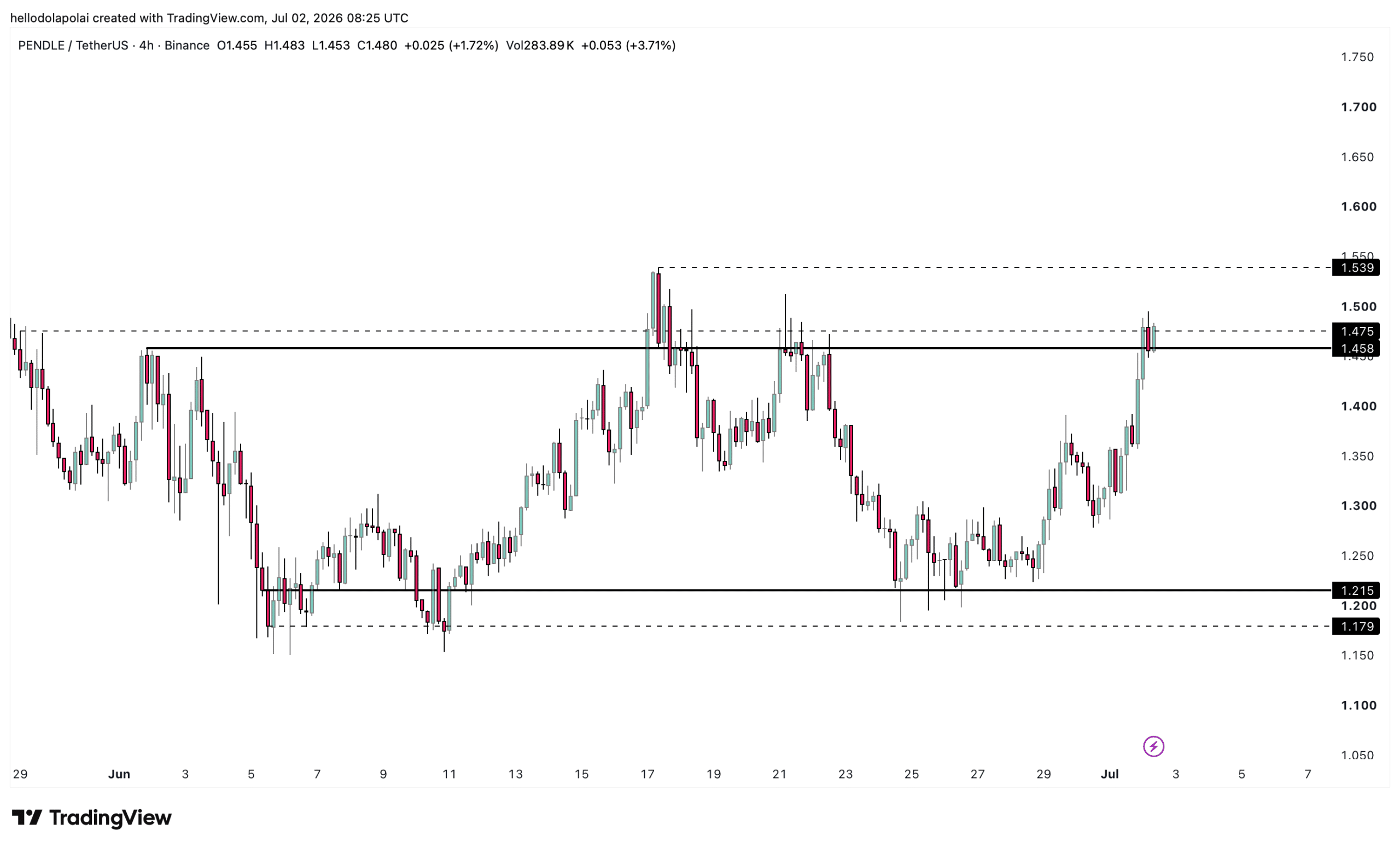
L'analyse graphique a montré que PENDLE évoluait dans un canal de support et de résistance formé vers la fin du mois de juin. Le token a tenté à deux reprises de franchir la fourchette avant de se replier.
Source : TradingView

Cette fois-ci, cependant, PENDLE a franchi la première résistance à 1,458 $ et s'est approché de la barrière suivante aux alentours de 1,475 $. Un mouvement soutenu au-dessus de ce niveau pourrait ouvrir la voie vers la zone des 1,53 $.

Sinon, le token pourrait rester dans sa fourchette actuelle jusqu'à l'émergence d'un momentum d'achat ou de vente plus fort.

Les indicateurs techniques soutiennent-ils une nouvelle hausse ?

Les indicateurs du graphique ont continué de pointer vers une amélioration du momentum.

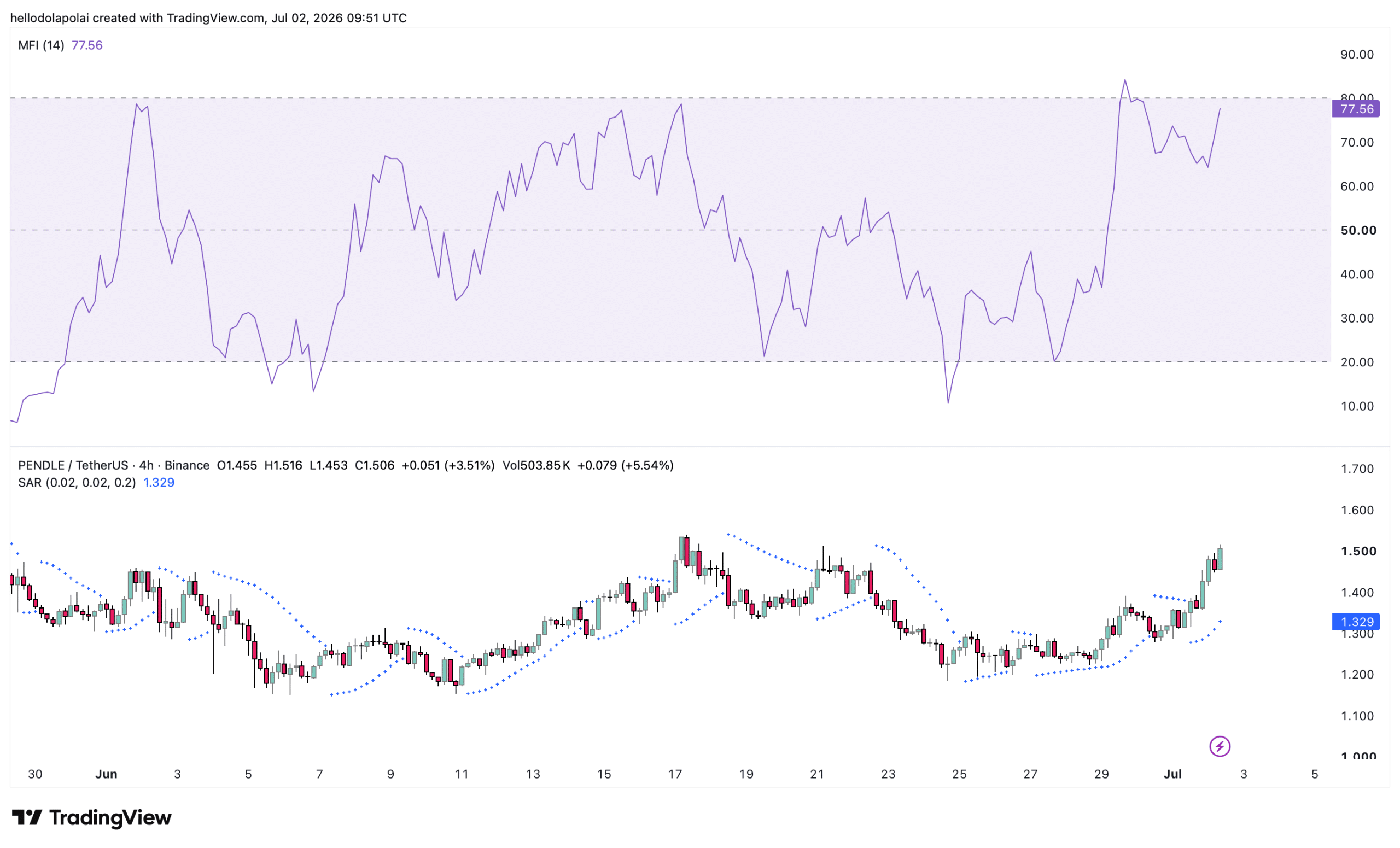
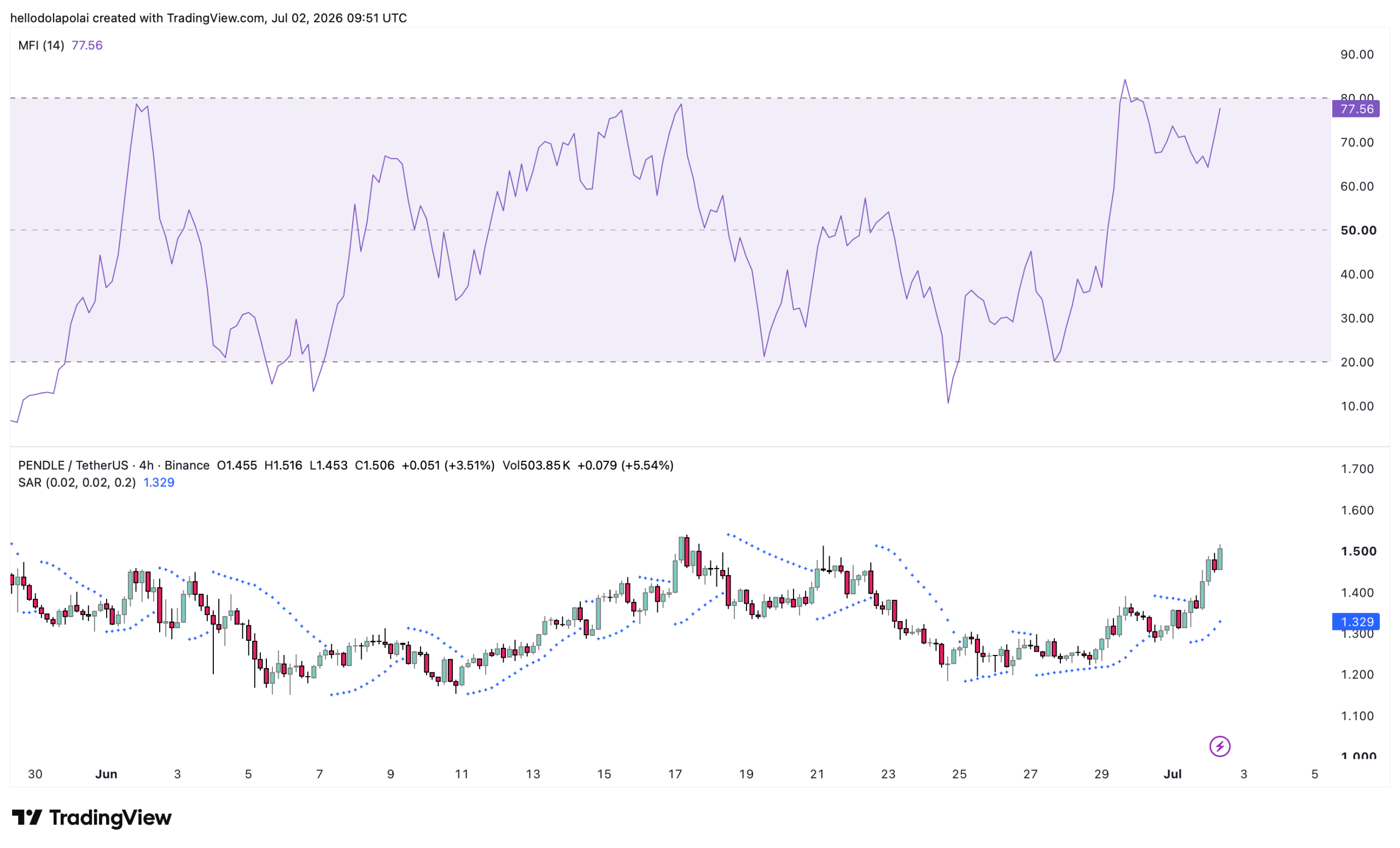
L'Indice de Flux Monétaire (MFI), qui suit les entrées et sorties de capitaux sur le token, est resté en territoire haussier. Généralement, une lecture du MFI supérieure à 50 indique que la pression acheteuse domine, tandis que des valeurs approchant 80 suggèrent des entrées de capitaux de plus en plus fortes.
Source : TradingView

Le MFI a continué de progresser vers la région de surachat au-dessus de 80. Cela reflète une demande qui se renforce, bien que des conditions de surachat puissent également déclencher des prises de bénéfices.

Le SAR Parabolique a renforcé la perspective haussière en affichant des points en dessous du prix, indiquant que la tendance haussière restait intacte. La poursuite des points sous le prix confirmerait cette tendance.

Une mise à jour du protocole débloque une nouvelle utilité

Au-delà de la configuration technique, le partenariat de Pendle avec Curvance a introduit une utilité supplémentaire pour PT-AUSD. Le protocole permet désormais aux détenteurs de PT-AUSD d'emprunter contre leurs positions sans les dénouer, permettant aux utilisateurs d'accéder à des liquidités tout en continuant de percevoir des rendements.

Le sentiment de la communauté s'est également renforcé après l'annonce, 96 % des plus de 36 000 participants s'attendant à ce que PENDLE maintienne son élan haussier.

Ensemble, la mise à jour du protocole et la structure technique en amélioration pourraient continuer à soutenir la demande. Même ainsi, les acheteurs doivent encore franchir la résistance à proximité pour confirmer une cassure plus large.


Résumé final

  • Un volume important a soutenu la hausse de PENDLE, mais la résistance détient toujours la clé de gains supplémentaires.
  • L'utilité s'est étendue au-delà du rendement. Des fondamentaux plus solides peuvent-ils désormais débloquer une cassure ?


Trending Cryptos

Related Questions

QQuels sont les facteurs qui ont soutenu la hausse de 12 % de PENDLE au cours des dernières 24 heures ?

ALa hausse a été soutenue par une augmentation de plus de 50 % du volume de négociation, atteignant environ 47,7 millions de dollars, ce qui reflète une participation accrue du marché.

QQuel est le niveau de résistance clé que PENDLE doit franchir pour confirmer une cassure haussière ?

ALe niveau de résistance clé suivant se situe près de 1,475 $. Un mouvement soutenu au-dessus de ce niveau pourrait ouvrir la voie vers la région des 1,53 $.

QQue suggèrent les indicateurs techniques, notamment le Money Flow Index (MFI), pour l'élan de PENDLE ?

AL'Indice de Flux Monétaire (MFI) se situe en territoire haussier, au-dessus de 50, et se dirige vers la région de surachat au-dessus de 80. Cela reflète une demande croissante, bien qu'un état de surachat puisse également déclencher des prises de bénéfices.

QQuelle mise à jour de protocole a récemment ajouté de l'utilité à Pendle et comment ?

ALe partenariat avec Curvance permet désormais aux détenteurs de PT-AUSD d'emprunter contre leurs positions sans les dénouer. Cela offre aux utilisateurs un accès à la liquidité tout en continuant à percevoir des rendements.

QSelon l'article, quel est le sentiment de la communauté après l'annonce de la mise à jour du protocole ?

ALe sentiment de la communauté s'est renforcé, avec 96 % des plus de 36 000 participants s'attendant à ce que PENDLE maintienne son élan haussier.

Related Reads

MSTR Discloses Sale of 3,588 Bitcoins, Stock Price Drops Over 5% at One Point During Trading

MicroStrategy, the world's largest corporate holder of Bitcoin, has significantly shifted its business model. Between June 29 and July 5, the company sold 3,588 bitcoins for approximately $216 million to fund quarterly dividends for its preferred stock. This marks its largest-ever Bitcoin sale and signals a strategic pivot: Bitcoin is transitioning from a "buy-and-hold" reserve asset to a liquidity management tool for the company. This move follows a recent authorization allowing Bitcoin sales when equity fundraising is less attractive. The announcement contributed to a more than 5% intraday drop in MicroStrategy's stock price, while Bitcoin fell to around $61,800—below the company's average holding cost of roughly $75,700. The sale represents a major departure from MicroStrategy's long-standing "never sell" commitment, which saw its first minor breach in May with a $2.5 million sale. The latest, hundred-times-larger transaction underscores growing financial pressures. Analysts note the company faces about $1.5 billion in annual preferred dividend obligations, far exceeding cash flow from its software business. As of July 5, MicroStrategy holds 843,775 bitcoins. Its current operational logic involves buying Bitcoin during favorable financing conditions and selling portions to cover dividends when needed, creating a flexible capital management cycle amidst a challenging market environment.

华尔街日报1h ago

MSTR Discloses Sale of 3,588 Bitcoins, Stock Price Drops Over 5% at One Point During Trading

华尔街日报1h ago

Q-Day Countdown: Will Quantum Computing End Cryptocurrencies?

Quantum Computing's Threat to Cryptocurrency: A Countdown to Q-Day Quantum computing, specifically Shor's algorithm, poses a fundamental threat to the public-key cryptography (e.g., ECDSA, RSA) that secures blockchain networks like Bitcoin and Ethereum. This critical juncture, known as Q-Day, is estimated to occur potentially within the next 5-15 years. The core vulnerability stems from the public and immutable nature of blockchains. Assets in addresses where the public key is already exposed on-chain (e.g., spent outputs) are at direct risk, as a sufficiently powerful quantum computer could derive the private key. This threatens the very trust model of cryptocurrencies. The response lies in Post-Quantum Cryptography (PQC)—algorithms like lattice-based ML-DSA and hash-based SLH-DSA, which are resistant to quantum attacks. NIST has standardized key PQC algorithms (FIPS 203, 204, 205), providing a migration path. However, the primary challenge is not technical but socio-economic and involves complex governance: * **Bitcoin's** path is constrained by its conservative ethos. Migrating requires a soft-fork to new address types, facing hurdles like significantly larger signature sizes and, most critically, the divisive governance question of how to handle at-risk legacy UTXOs without violating core principles. * **Ethereum** is pursuing a "cryptographic agility" strategy, with a multi-layered roadmap. It leverages account abstraction for user accounts and is developing compressed hash-based signatures (e.g., leanXMSS) for its consensus layer, aiming for a full-stack upgrade over time. In conclusion, quantum computing does not spell an instant end for cryptocurrency but initiates a critical countdown. The industry has a limited "engineering comfort window" to orchestrate a coordinated, ecosystem-wide migration to PQC. The ultimate bottlenecks are the immense coordination efforts and governance decisions required for this foundational transition.

marsbit2h ago

Q-Day Countdown: Will Quantum Computing End Cryptocurrencies?

marsbit2h ago

Trump, the President Who Knows Best How to 'Trade Stocks'

Former US President Donald Trump reported a record-breaking $2.2 billion in personal income for 2025, the highest annual income ever disclosed by a sitting president. This figure, from a 927-page government ethics filing, represented a 3.5-fold increase from his $600 million income in 2024 and boosted his net worth to $6.5 billion. The primary drivers were cryptocurrency (64% of income, approximately $1.4 billion) and real estate (26%, approximately $575 million). His crypto earnings stemmed largely from the launch of his personal meme coin, $TRUMP, generating over $600 million in licensing fees, and substantial profits from the WLFI token and its parent company. Despite a sluggish property market, his Mar-a-Lago resort and associated golf clubs saw revenue surges of 50% and 27%, respectively, attributed to their use as venues for presidential events. Trump's financial disclosure also revealed an unprecedented level of stock market activity, with over 22,000 trades executed in 2025, averaging 87 trades per market day. Media analyses noted several instances where significant trading coincided with major policy announcements, such as proposed tariffs, raising questions about potential conflicts of interest. While the White House stated these trades were handled by a family-managed trust fund and not Trump directly, critics highlighted this as a departure from the blind trusts traditionally used by presidents post-Watergate. The report has intensified debate over the commercialization of the presidency. Supporters view it as a success story of a businessman-president, while critics argue it demonstrates an unprecedented conversion of public influence into private wealth, with policy decisions potentially linked to personal financial gains. The controversy centers on whether Trump's earnings represent innovative entrepreneurship or a fundamental conflict of interest, sparking renewed calls for stricter ethics reforms in US governance.

marsbit2h ago

Trump, the President Who Knows Best How to 'Trade Stocks'

marsbit2h ago

Countdown to Q-Day: Will Quantum Computing End Cryptocurrencies?

The article explores the existential threat quantum computing poses to cryptocurrencies and the urgent need for "post-quantum" migration. It outlines that quantum computers, through Shor's algorithm, could break the elliptic-curve cryptography (ECC) underlying blockchain security, potentially allowing private keys to be derived from public keys. The core challenge is not a lack of post-quantum cryptography (PQC) standards—like NIST's ML-KEM and ML-DSA—but the immense complexity of upgrading entire ecosystems before "Q-Day" (when quantum computers become capable of such attacks, estimated around 2035-2045). Key points include: * **Bitcoin's** risk is concentrated in legacy UTXOs with exposed public keys (e.g., early P2PK outputs). Migration faces massive hurdles: PQC signatures are much larger, increasing transaction size and cost, and the governance dilemma of handling un-migrated assets threatens its "code is law" ethos. * **Ethereum's** strategy focuses on "cryptographic agility," using Account Abstraction for user accounts and developing compressed hash-based signatures (like leanXMSS with SNARK aggregation) for consensus. Its migration is a complex, full-stack overhaul of execution, consensus, and data layers. * The "security debt" is enormous. The comfortable engineering window for a coordinated, ecosystem-wide upgrade is only 5-8 years. High-value infrastructure (exchanges, bridges) may face pressure before mainnet protocols. In conclusion, quantum computing is not an instant "doomsday" event but a forcing function for systemic change. Bitcoin's ultimate test is social consensus and property rights governance, while Ethereum's is technical complexity. Failure to migrate in time could lead to a fundamental re-pricing of crypto assets.

链捕手2h ago

Countdown to Q-Day: Will Quantum Computing End Cryptocurrencies?

链捕手2h ago

Trading

Spot

Hot Articles

How to Buy GAIN

Welcome to HTX.com! We've made purchasing GriffinAI (GAIN) simple and convenient. Follow our step-by-step guide to embark on your crypto journey.Step 1: Create Your HTX AccountUse your email or phone number to sign up for a free account on HTX. Experience a hassle-free registration journey and unlock all features.Get My AccountStep 2: Go to Buy Crypto and Choose Your Payment MethodCredit/Debit Card: Use your Visa or Mastercard to buy GriffinAI (GAIN) instantly.Balance: Use funds from your HTX account balance to trade seamlessly.Third Parties: We've added popular payment methods such as Google Pay and Apple Pay to enhance convenience.P2P: Trade directly with other users on HTX.Over-the-Counter (OTC): We offer tailor-made services and competitive exchange rates for traders.Step 3: Store Your GriffinAI (GAIN)After purchasing your GriffinAI (GAIN), store it in your HTX account. Alternatively, you can send it elsewhere via blockchain transfer or use it to trade other cryptocurrencies.Step 4: Trade GriffinAI (GAIN)Easily trade GriffinAI (GAIN) on HTX's spot market. Simply access your account, select your trading pair, execute your trades, and monitor in real-time. We offer a user-friendly experience for both beginners and seasoned traders.

3.6k Total ViewsPublished 2025.09.24Updated 2026.06.02

How to Buy GAIN

Discussions

Welcome to the HTX Community. Here, you can stay informed about the latest platform developments and gain access to professional market insights. Users' opinions on the price of GAIN (GAIN) are presented below.

活动图片