Q2 Crypto Market Review: Did Bitcoin Rise for 'Nothing'? Did Money Flow to AI and On-Chain?

Foresight NewsDipublikasikan tanggal 2026-07-01Terakhir diperbarui pada 2026-07-01

Abstrak

Q2 2026 Crypto Market Recap: Bitcoin's Gains Erased Amid Shift to AI and On-Chain Activity The second quarter of 2026 saw a significant reversal for the cryptocurrency market. Bitcoin gave back all its April gains, ending Q2 down approximately 11%, while major stock indices posted strong gains. This divergence was driven by a hawkish shift in Fed rate expectations, capital rotation into AI stocks, and weakening liquidity channels into crypto. Key demand pillars deteriorated simultaneously. Spot Bitcoin ETFs recorded net outflows of $4.08 billion for the quarter, with outflows dominating June. Crypto treasury entity Strategy's bitcoin accumulation slowed markedly, and the total stablecoin market cap contracted by ~$4.2 billion. This created a tighter liquidity environment. Exchange data reflected the downturn. Spot trading volumes fell 28% quarter-over-quarter. The market underwent significant deleveraging, with $8.35 billion in long liquidations for BTC and ETH, primarily in late May/early June. Open interest and order book liquidity also declined. Despite the bearish price action, structural developments point to an expanding on-chain ecosystem. These include the rise of tokenized stocks with full legal rights, the growth of RWA (real-world asset) perpetual contracts for trading stocks and commodities 24/7, and the use of crypto markets for price discovery ahead of major events like the SpaceX IPO. On-chain vaults are also emerging as a core layer for institutional capit...


Author: Tanay Ved, Coin Metrics

Compiled by: Luffy, Foresight News


TL;DR:


  • Bitcoin gave back all of its April gains, falling approximately 11% in Q2 against a backdrop of shifting interest rate expectations, ETF outflows, and capital rotation into AI stocks.
  • Three major liquidity channels—ETFs, Treasury companies like Strategy, and stablecoins—all weakened in Q2, with spot Bitcoin ETFs alone seeing net outflows of $4.08 billion.
  • Total long liquidations for BTC and ETH reached $8.35 billion, leading to significant deleveraging in Q2, but the market entered Q3 in a more stable condition.


Market Overview


The crypto market entered Q2 2026 with strong momentum. After a difficult Q1, Bitcoin rebounded alongside equities in April, as geopolitical tensions eased briefly and institutional demand improved, climbing to around $82,000. However, this recovery did not last.


This reversal was driven by three forces: Brent crude prices hitting a high of $126.41 amid volatility from geopolitical negotiations, a hawkish shift in the Federal Reserve's interest rate outlook, and capital rotation into the AI trade.
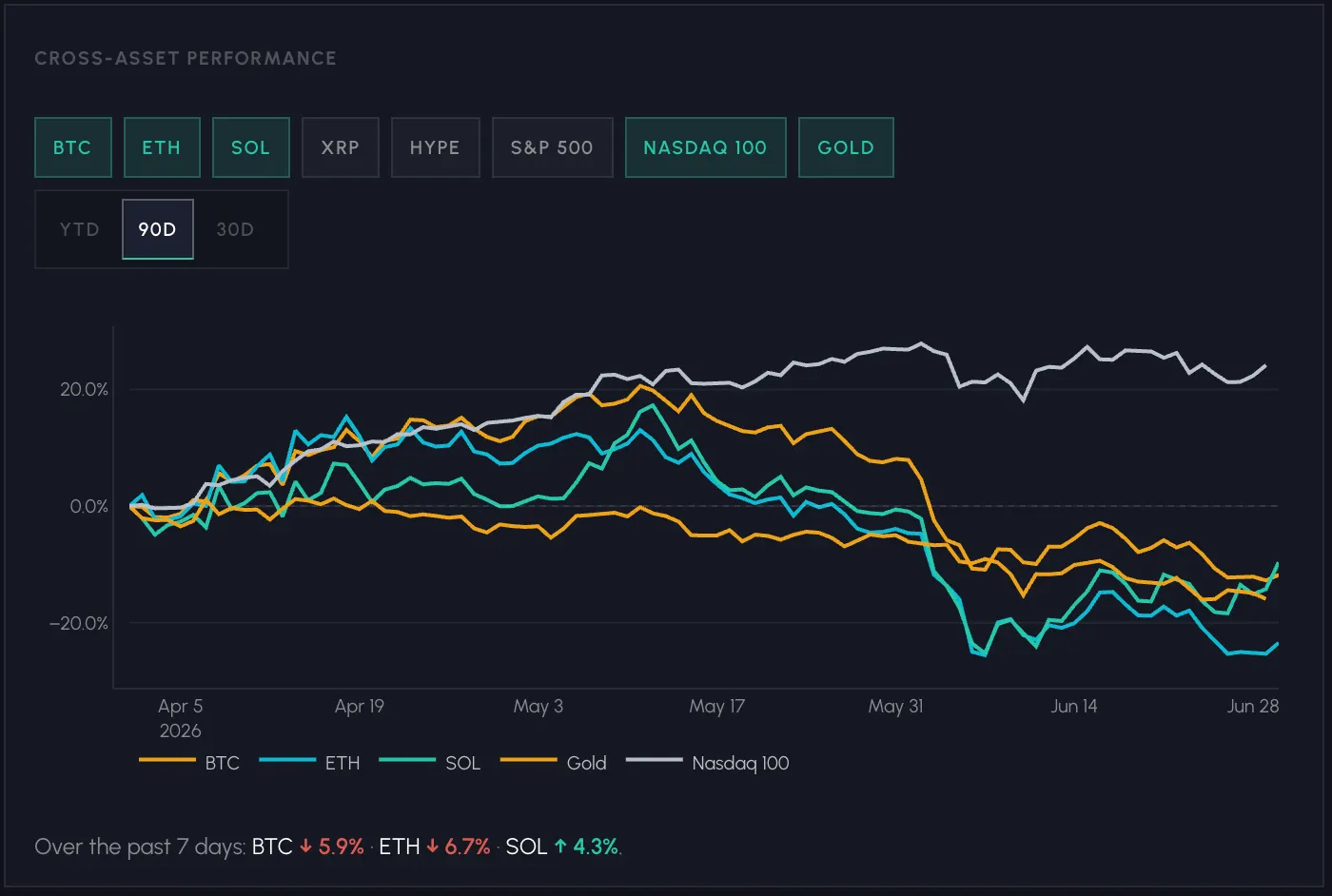


Until mid-May, cryptocurrencies and equities largely moved in sync, with both BTC and ETH rising about 20% from their early-April lows. The divergence came in late May when cryptocurrencies pulled back while equities held firm. Ultimately, the S&P 500 and Nasdaq 100 rose approximately 16% and 28% for the quarter, respectively, while BTC fell about 10%, ETH about 20%, and SOL about 13%.
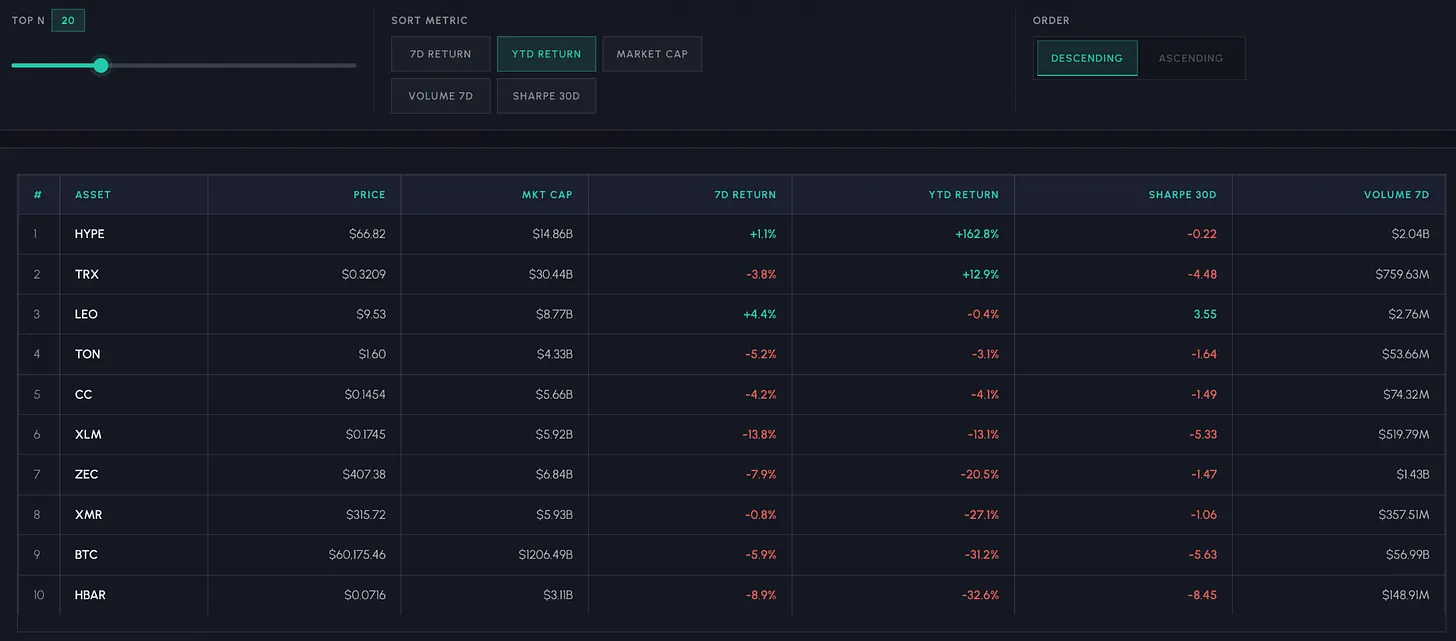


Bitcoin is currently trading around $60,000, down about 52% from its all-time high of $126,000 set in late 2025. Altcoin performance has been similar, with few gainers. Year-to-date, among the top 20 crypto assets by market cap, Hyperliquid (HYPE) remains the sole bright spot (up 142%), driven by strong demand for its on-chain trading of perpetual contracts for stocks and commodities.


Fund Flows


The weakness in Q2 was exacerbated by the deterioration of three key demand channels: spot ETFs, crypto asset treasuries like Strategy, and stablecoin supply.


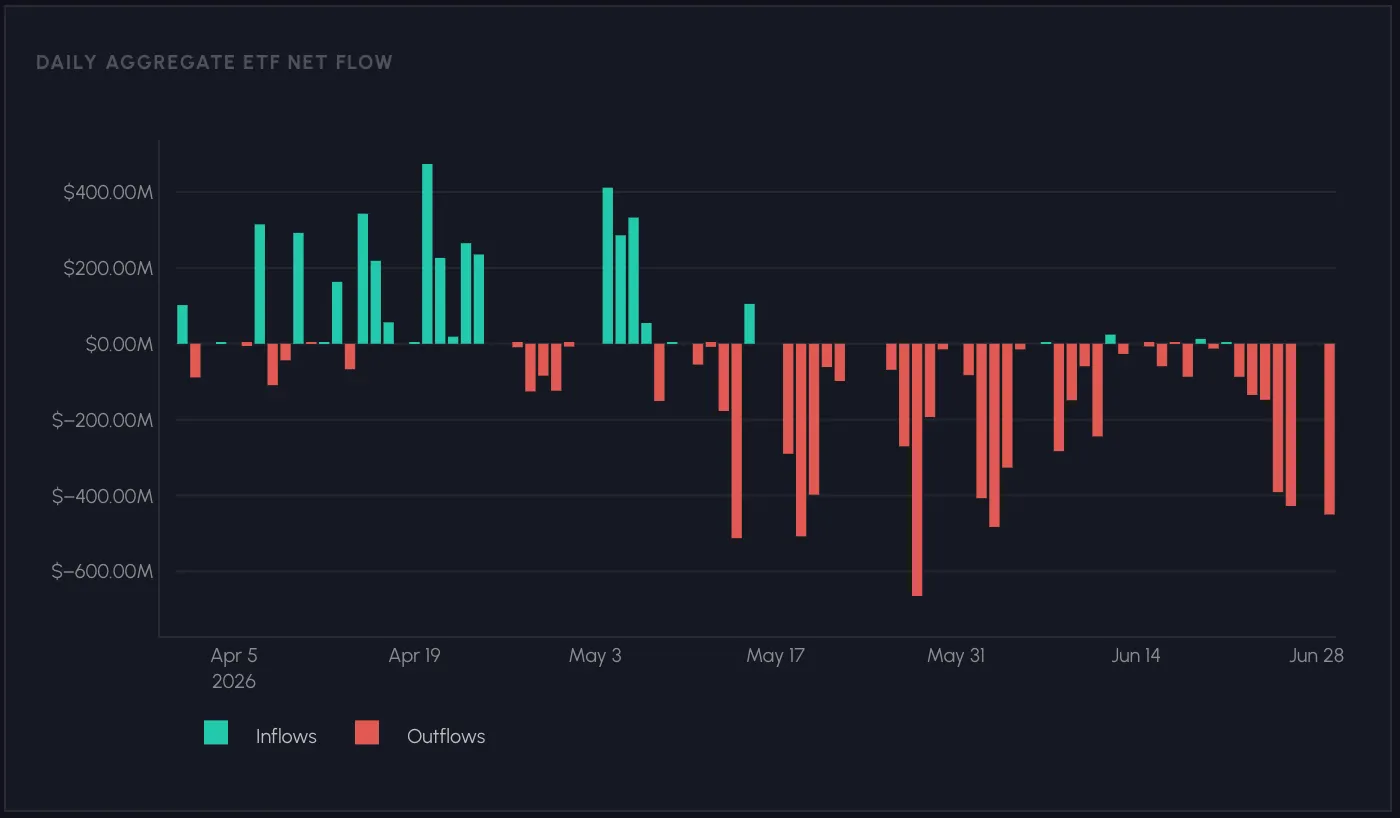
Spot Bitcoin ETFs: April started strong for spot Bitcoin ETFs, dominated by inflows. The peak single-day inflow of $474 million occurred on April 20th, after which flows reversed. Outflows dominated for the rest of the quarter, with 53 days of outflows compared to 30 days of inflows in Q2. June was the primary culprit, with net outflows reaching $3.84 billion for the month among tracked ETF issuers, accounting for the majority of the quarter's total net outflow of $4.08 billion.


Crypto Asset Treasuries (Strategy Companies): This quarter, Bitcoin accumulation by Strategy companies slowed significantly. Their preferred shares (STRC), designed to stabilize around $100, fell to a historic low of $74, while Strategy's market-to-net-asset-value ratio (mNAV) compressed close to 1.0, impacting the funding channels behind their accumulation. A surprise sale of 32 BTC in early June unsettled the market and broke the "never sell" sentiment. In response, Strategy established a new Digital Credit Capital framework, raising STRC dividends to 12%, authorizing the sale of up to $1.25 billion worth of BTC, and setting up a $2.55 billion USD reserve to cover approximately 17 months of debt.


Stablecoins: The total stablecoin market cap contracted by approximately $4.2 billion in Q2, reducing the funds underpinning on-chain activity and liquidity. USDT saw a modest increase of $1.8 billion, while USDC decreased by $3.4 billion. Ethena's USDe fell by $1.4 billion as risk-off sentiment dampened interest in yield-bearing stablecoin strategies.


With the three major demand channels weakening simultaneously, the liquidity environment heading into Q3 is markedly tighter than at the start of Q2. Whether this demand will return to crypto assets or continue flowing into AI stocks remains a dynamic to watch.


Exchange Activity & Derivatives


Total spot trading volume on exchanges fell 28% quarter-over-quarter to $2.32 trillion, continuing a downtrend that began in January. Futures volume fared slightly better at $12.32 trillion, down 11.6% QoQ, but the spot/futures ratio compressed from 0.23x to 0.19x, indicating an increase in derivative positioning rather than spot demand.


Hyperliquid stood out, with its futures trading volume market share growing to around 4.5%, as on-chain perpetuals continued to take market share from centralized exchanges.
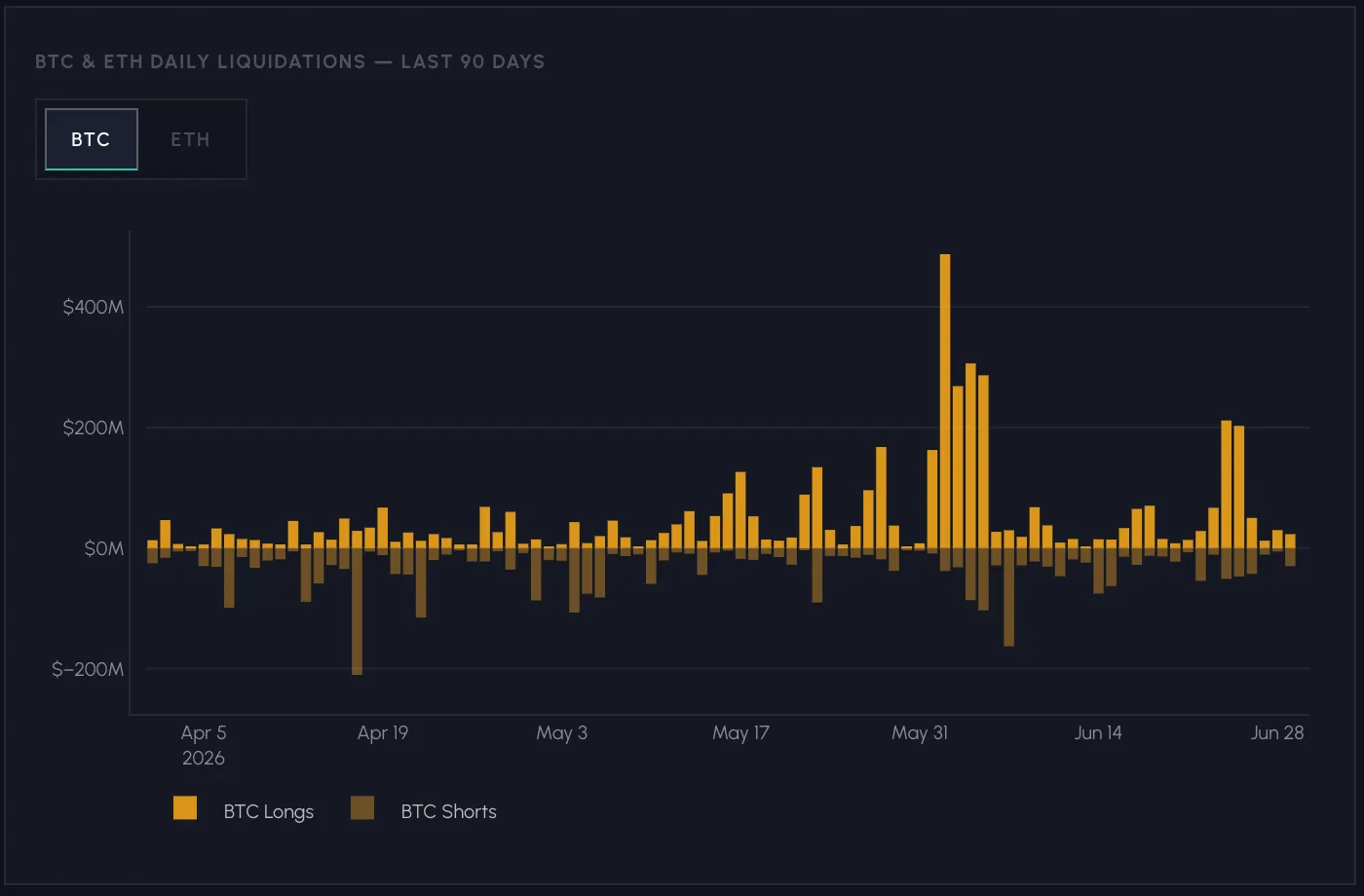


Open interest peaked before the May sell-off, reaching $49.2 billion for BTC and $27.2 billion for ETH. Currently, these figures have dropped to $33.5 billion (BTC) and $16.2 billion (ETH), down 32% and 40% from their peaks, respectively. Throughout Q2, total long liquidations for BTC and ETH reached $8.35 billion. More than half of these liquidations occurred between May 25th and June 7th, as over-leveraged long positions were wiped out. The market entered Q3 in a more deleveraged state.


Funding rates were volatile during Q2, swinging from deeply negative (annualized -16%) in mid-April to strongly positive (annualized +10%) in May as long positions increased. The subsequent sell-off pulled rates back to neutral levels, fluctuating around zero at quarter-end, reflecting cautious sentiment.


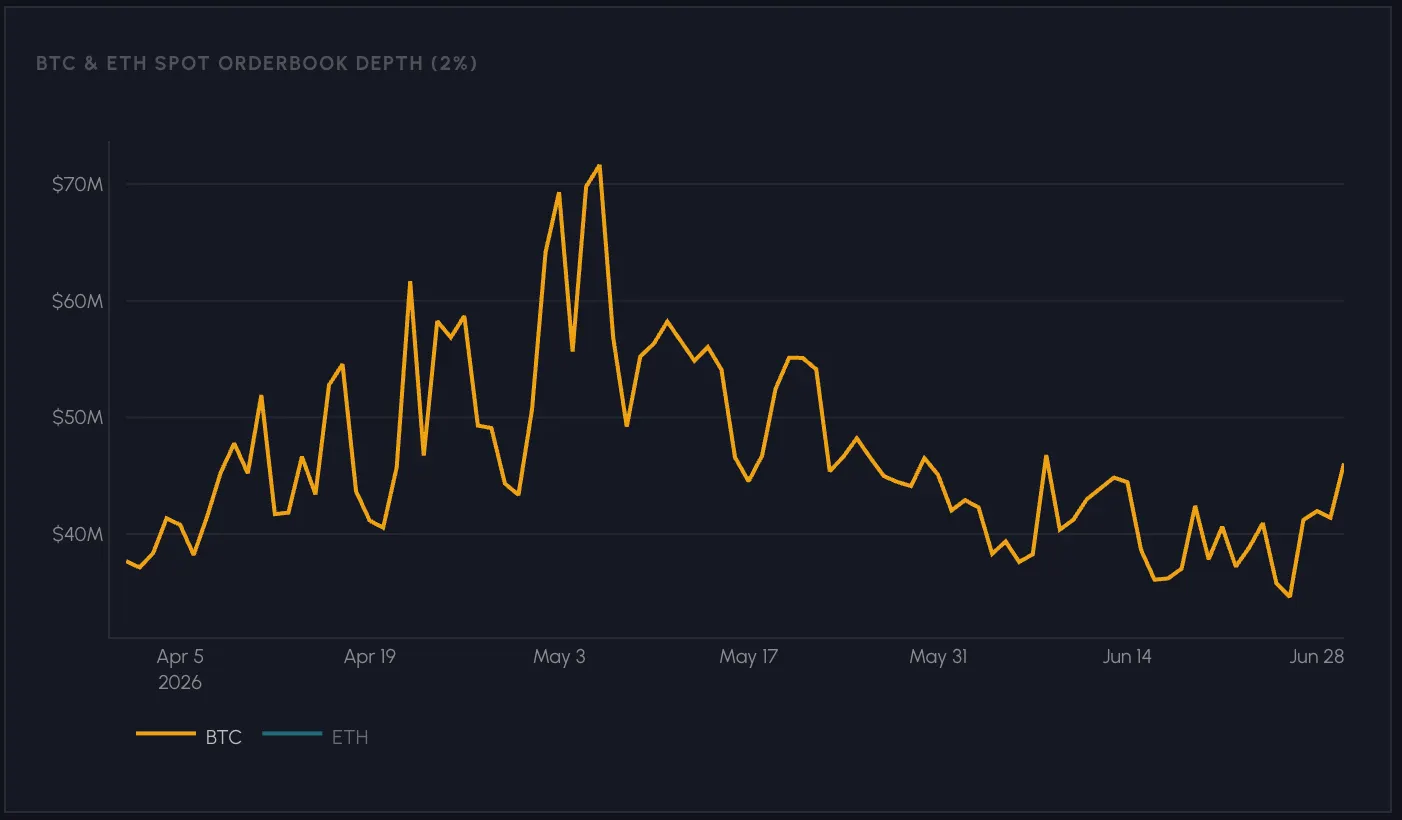
Liquidity also deteriorated in sync. The 2% order book depth for Bitcoin fell from a peak of around $70 million in early May to about $35-40 million by late June, indicating reduced market liquidity and a diminished ability to absorb selling pressure.


Key Themes to Watch Going Forward


Beyond Q2's price action, several structural developments point to the market's future direction, from new asset classes emerging on-chain to the infrastructure supporting them.


  • Tokenized Stocks: Coinbase announced the launch of 1:1 pegged, fully legally entitled tokenized stocks.
  • The Rise of RWA Perpetuals: On-chain trading and price discovery have moved beyond crypto, extending to stocks, indices, and commodities via Hyperliquid HIP-3 perpetuals and centralized exchanges offering 24/7 RWA perpetuals.
  • SpaceX IPO Priced On-Chain: The $1.7 trillion SpaceX IPO was priced on crypto rails ahead of its public listing, providing early price discovery signals for private companies.
  • Vaults & Lending Markets: On-chain vaults are becoming a core allocation layer for institutional capital, pooling deposits into curated lending strategies on protocols like Morpho and Aave. Infrastructure is maturing rapidly as traditional asset managers like Bitwise enter the vault management space.


Kripto yang Sedang Tren

Pertanyaan Terkait

QAccording to the article, what were the three main forces that drove the reversal in the cryptocurrency market's recovery in Q2 2026?

AAccording to the article, the three main forces were: 1) Brent crude oil prices hitting a high of $126.41 due to geopolitical negotiation volatility, 2) A shift towards a more hawkish Federal Reserve interest rate outlook, and 3) Capital rotation into the AI stock trading sector.

QWhat was the trend in net flows for spot Bitcoin ETFs during Q2 2026, and which month saw the largest net outflow?

AIn Q2 2026, net flows for spot Bitcoin ETFs reversed from initial strong inflows in April to consistent outflows for the rest of the quarter. The largest net outflow occurred in June, with a net outflow of $38.4 billion, accounting for most of the quarter's total net outflow of $40.8 billion.

QHow did the total stablecoin market capitalization change in Q2 2026, and what were the specific trends for USDT and USDC?

AIn Q2 2026, the total stablecoin market capitalization contracted by approximately $4.2 billion. Specifically, USDT saw a moderate increase of $1.8 billion, while USDC experienced a decrease of $3.4 billion.

QWhat does the article state about the performance of Hyperliquid (HYPE) and the reason behind it?

AThe article states that Hyperliquid (HYPE) was the only standout performer among the top 20 crypto assets by market capitalization year-to-date, with a gain of 142%. This performance was attributed to robust demand for its on-chain trading of stock and commodity perpetual contracts.

QWhat are some of the key structural developments mentioned in the article that signal the future direction of the market?

AKey structural developments mentioned include: 1) Tokenized stocks with full legal rights announced by Coinbase, 2) The rise of RWA perpetual contracts extending to stocks, indices, and commodities, 3) The SpaceX IPO being priced on-chain before public listing, and 4) The maturation of on-chain vaults as a core allocation layer for institutional capital, attracting traditional asset managers like Bitwise.

Bacaan Terkait

Bitcoin Melonjak Kembali ke $64.000, Ekspektasi Kenaikan Suku Bunga The Fed Turun Drastis?

Bitcoin memantul ke level US$64.000 didorong oleh penurunan ekspektasi kenaikan suku bunga dari Federal Reserve. Setelah sempat merosot tajam, pemulihan ini dipicu oleh data lapangan kerja AS bulan Juni yang lebih lemah dari perkiraan, dengan hanya 57.000 penambahan pekerjaan baru. Data upah yang tetap kuat (kenaikan 3,5% tahun-ke-tahun) menjadi perhatian, namun pasar menafsirkan laporan secara keseluruhan sebagai sinyal potensi pelonggaran kebijakan moneter. Analis memprediksi data Indeks Harga Konsumen (IHK) bulan Juni, yang dirilis 14 Juli, akan menjadi titik kunci. Penurunan harga bensin diperkirakan dapat menekan inflasi, sehingga memungkinkan Fed mempertahankan suku bunga dan tidak menaikkannya. Pernyataan dari Ketua Fed Kevin Warsh yang dianggap lebih lunak di konferensi bank sentral global turut mengurangi taruhan pasar pada pengencangan moneter. Sentimen pasar membaik karena biaya pinjaman yang lebih rendah diharapkan meningkatkan likuiditas dan mendukung aset berisiko seperti bitcoin. Beberapa investor mulai membangun posisi pada perdagangan "penurunan nilai dolar" yang mencakup emas dan kripto, mengantisipasi pergeseran kebijakan Fed di paruh kedua tahun ini. Namun, masa depan bitcoin tetap sangat bergantung pada tiga variabel: aliran dana ETF institusional, perkembangan geopolitik, dan yang terpenting, ekspektasi terhadap kebijakan suku bunga Fed.

Foresight News31m yang lalu

Bitcoin Melonjak Kembali ke $64.000, Ekspektasi Kenaikan Suku Bunga The Fed Turun Drastis?

Foresight News31m yang lalu

Perubahan Sepuluh Tahun: Jalan Menuju Kepunahan Startup Kripto

**Perjalanan Satu Dekade: Transformasi Ekosistem Startup Kripto dari Masa Inovasi Bebas Menuju Era Kendala Regulasi dan Konsolidasi** Era awal industri kripto (sekitar 2017-2018) ditandai dengan kemudahan memulai bisnis: modal rendah, regulasi minimal, dan kemunculan ICO yang memungkinkan tim kecil dengan ide bagus mengumpulkan dana dari publik secara langsung. Inovasi tumbuh subur, meski banyak proyek akhirnya gagal atau curang. Kini, pada tahun 2026, realitanya berubah total. Startup yang ingin beroperasi secara legal di pasar seperti AS, UE, atau Asia harus menghadapi biaya kepatuhan yang sangat tinggi (hingga jutaan dolar), persyaratan modal minimum, dan proses perizinan yang rumit dan panjang seperti BitLicense atau MiCA. Perubahan ini didorong oleh peristiwa seperti runtuhnya Terra dan FTX, yang mengubah pola pikir regulator dan investor ventura. Aliran modal ventura kini lebih terkonsentrasi pada perusahaan matang (putaran lanjutan/C+) dan infrastruktur inti seperti bursa dan layanan kelembagaan, sementara pendanaan untuk startup tahap awal (seed) menyusut drastis. Akibatnya, inovasi teknologi saja tidak lagi cukup. Kunci sukses kini terletak pada akses ke saluran distribusi, lisensi, kemitraan perbankan, dan kepercayaan institusional—aset yang lebih mudah diperoleh melalui akuisisi ("akuisisi jembatan") daripada dibangun dari nol. Contohnya adalah akuisisi Deribit oleh Coinbase untuk mendapatkan lisensi dan basis klien institusionalnya. Industri menjadi lebih stabil dan menarik bagi investor institusi, tetapi mengorbankan kemampuan pendatang baru tanpa sumber daya besar untuk berinovasi secara bebas. Industri kripto, yang lahir untuk mendemokratisasi keuangan, kini mengikuti kurva kematangan industri tradisional: konsolidasi, hambatan masuk tinggi, dan dominasi oleh pemain mapan yang memiliki sumber daya untuk memenuhi tuntutan regulasi yang ketat. Pertanyaan besarnya adalah apakah masih ada ruang bagi inovator tanpa dukungan besar untuk menciptakan sesuatu yang benar-benar baru.

Foresight News1j yang lalu

Perubahan Sepuluh Tahun: Jalan Menuju Kepunahan Startup Kripto

Foresight News1j yang lalu

Trading

Spot

Artikel Populer

Cara Membeli FLOW

Selamat datang di HTX.com! Kami telah membuat pembelian Flow (FLOW) menjadi mudah dan nyaman. Ikuti panduan langkah demi langkah kami untuk memulai perjalanan kripto Anda.Langkah 1: Buat Akun HTX AndaGunakan alamat email atau nomor ponsel Anda untuk mendaftar akun gratis di HTX. Rasakan perjalanan pendaftaran yang mudah dan buka semua fitur.Dapatkan Akun SayaLangkah 2: Buka Beli Kripto, lalu Pilih Metode Pembayaran AndaKartu Kredit/Debit: Gunakan Visa atau Mastercard Anda untuk membeli Flow (FLOW) secara instan.Saldo: Gunakan dana dari saldo akun HTX Anda untuk melakukan trading dengan lancar.Pihak Ketiga: Kami telah menambahkan metode pembayaran populer seperti Google Pay dan Apple Pay untuk meningkatkan kenyamanan.P2P: Lakukan trading langsung dengan pengguna lain di HTX.Over-the-Counter (OTC): Kami menawarkan layanan yang dibuat khusus dan kurs yang kompetitif bagi para trader.Langkah 3: Simpan Flow (FLOW) AndaSetelah melakukan pembelian, simpan Flow (FLOW) di akun HTX Anda. Selain itu, Anda dapat mengirimkannya ke tempat lain melalui transfer blockchain atau menggunakannya untuk memperdagangkan mata uang kripto lainnya.Langkah 4: Lakukan trading Flow (FLOW)Lakukan trading Flow (FLOW) dengan mudah di pasar spot HTX. Cukup akses akun Anda, pilih pasangan perdagangan, jalankan trading, lalu pantau secara real-time. Kami menawarkan pengalaman yang ramah pengguna baik untuk pemula maupun trader berpengalaman.

262 Total TayanganDipublikasikan pada 2024.12.10Diperbarui pada 2026.06.02

Cara Membeli FLOW

Diskusi

Selamat datang di Komunitas HTX. Di sini, Anda bisa terus mendapatkan informasi terbaru tentang perkembangan platform terkini dan mendapatkan akses ke wawasan pasar profesional. Pendapat pengguna mengenai harga FLOW (FLOW) disajikan di bawah ini.

活动图片