Le Bitcoin confronté au test des 58 000 $ alors que la demande américaine faiblit – Quel avenir pour le BTC ?

ambcryptoPublished on 2026-07-01Last updated on 2026-07-01

Abstract

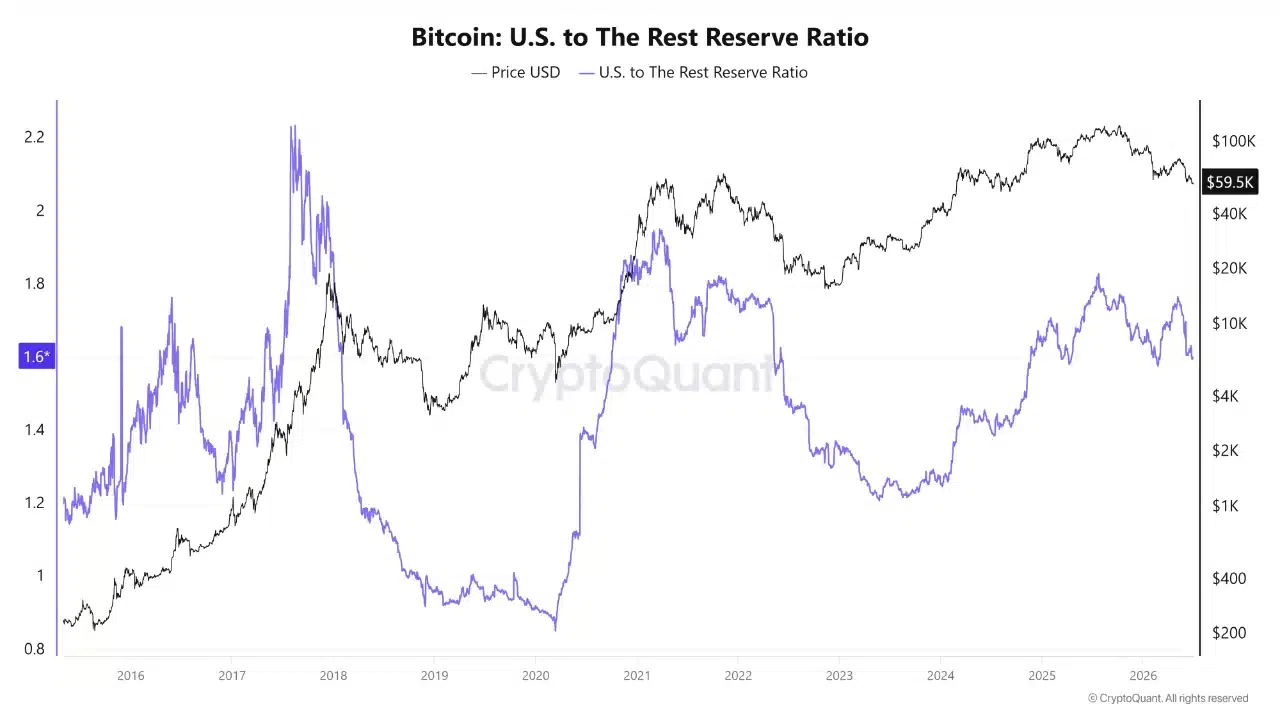
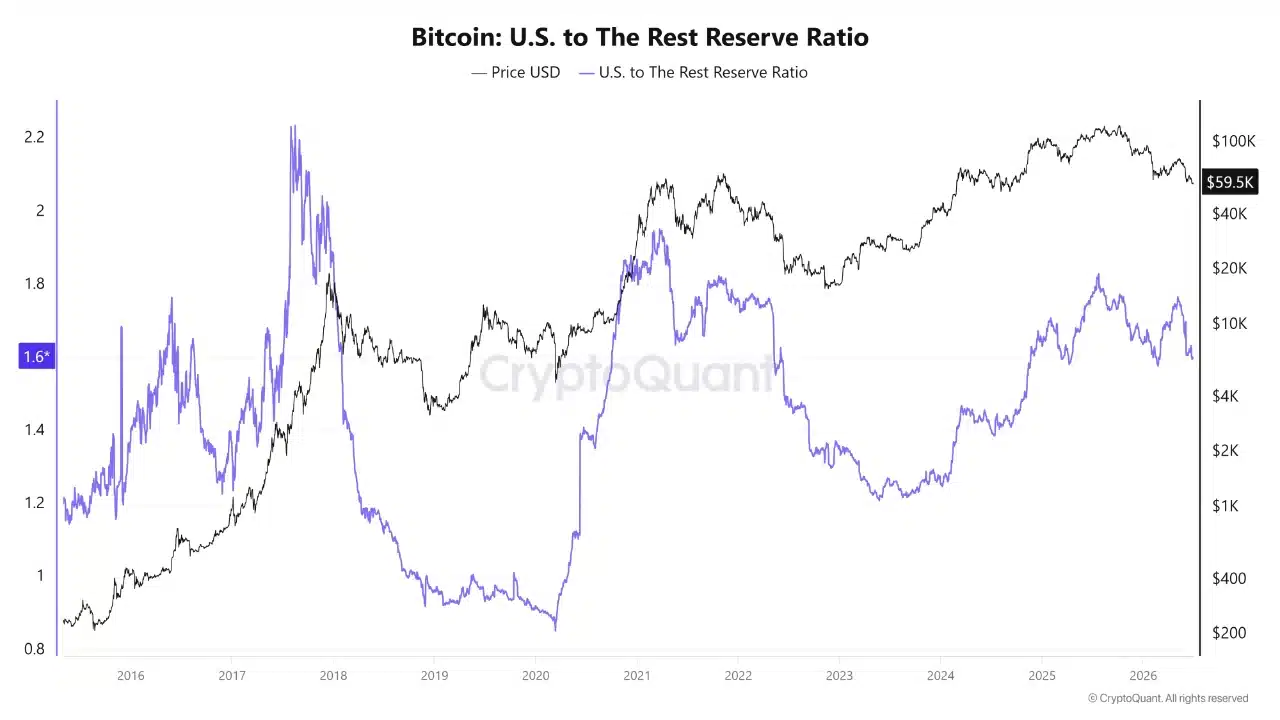
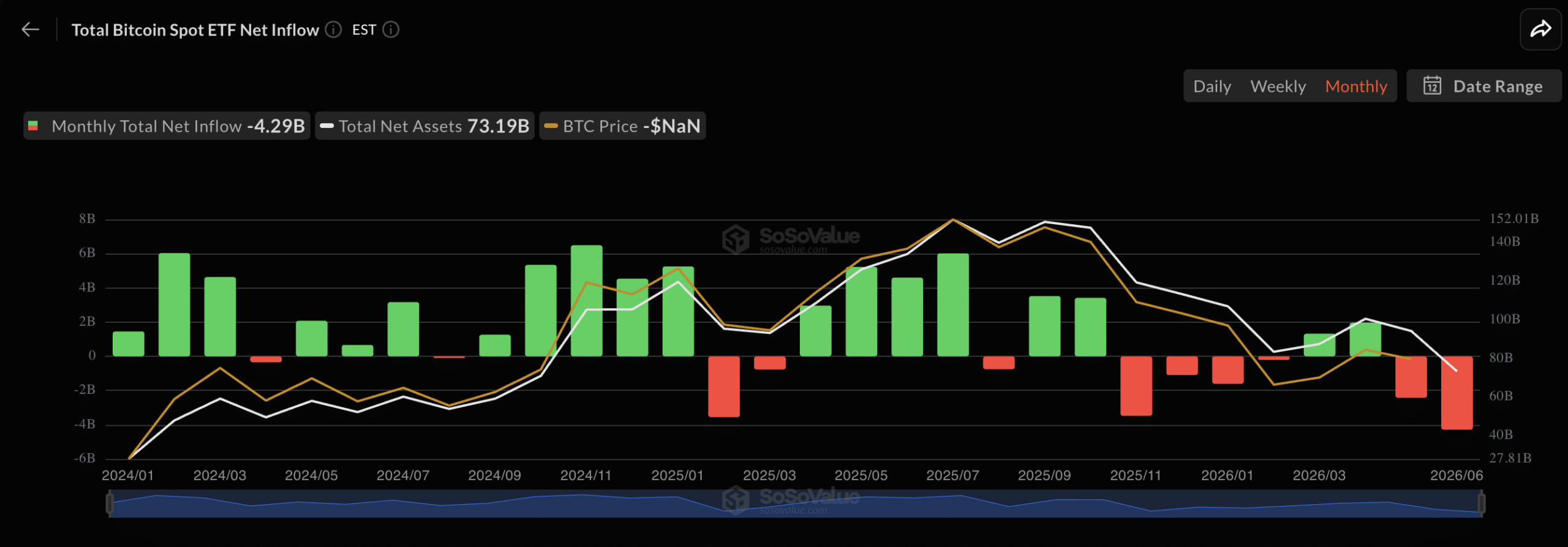
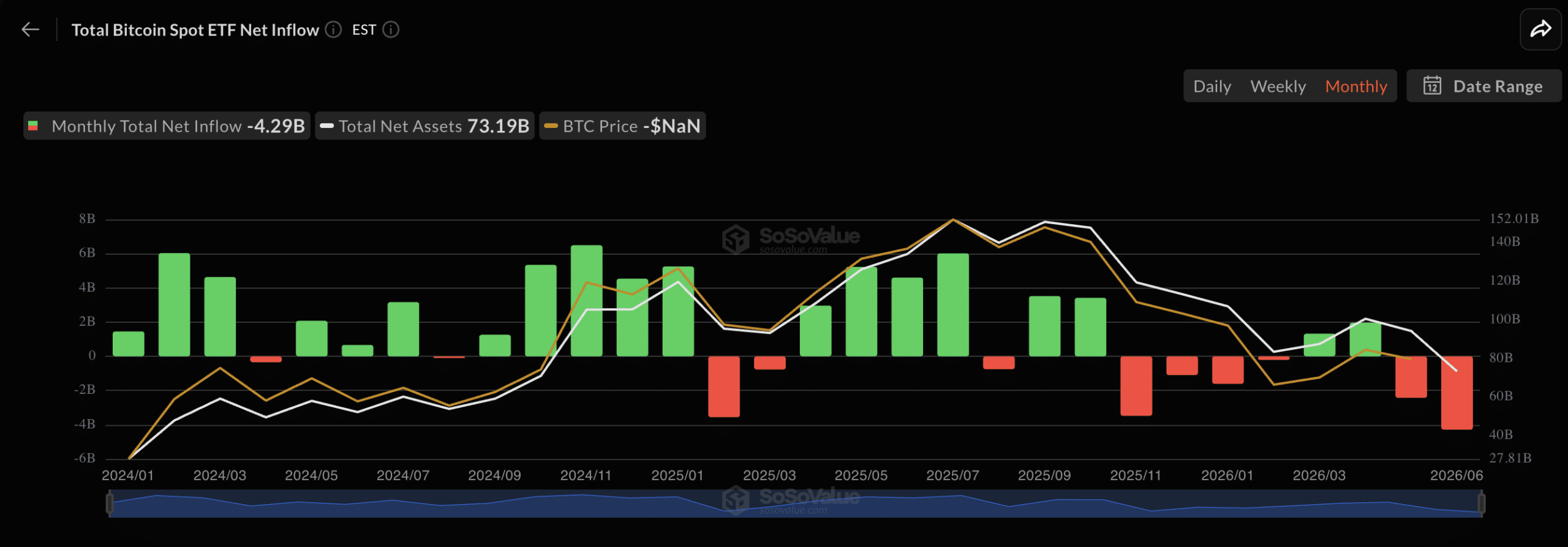
Le rallye du Bitcoin [BTC] perd de sa vigueur, notamment en raison d'un affaiblissement marqué de la demande américaine, traditionnellement un pilier majeur du marché. Le ratio de réserves entre les États-Unis et le reste du monde a chuté, passant d'un pic récent de 1,79 à environ 1,59, signalant un retrait des capitaux américains. Cette tendance est confirmée par les flux des ETF spot, qui ont enregistré des sorties nettes importantes d'environ 4,29 milliards de dollars sur le dernier mois, mettant fin à une longue période d'entrées positives. Cette inversion inquiète car les ETF étaient un indicateur clé de l'achat institutionnel. Conséquence directe, le prix du Bitcoin teste actuellement le niveau de support clé des 58 000 dollars, évoluant autour de 58 500 $. Les vendeurs dominent et le RSI se trouve en zone de survente, indiquant une pression à la baisse. Bien qu'un rebond technique limité soit possible, la tendance globale reste incertaine. Tant que le BTC ne parvient pas à se réétablir fermement au-dessus de la fourchette 60 000 - 62 000 dollars, le risque d'une chute vers des niveaux de support inférieurs persiste.

La hausse du Bitcoin [BTC] perd en intensité. Pendant une grande partie de son histoire, le capital américain a été l'un des principaux moteurs du BTC ; ce n'est désormais plus le cas.

Avec en plus la saignée des ETF, le marché est-il prêt pour le chaos ?

La demande américaine de Bitcoin perd en intensité

Un indicateur clé à surveiller est le ratio de réserves États-Unis / Reste du monde, qui compare le Bitcoin détenu par des entités américaines avec celui du reste du monde. Après s'être renforcé au cours de ce cycle, le ratio est maintenant tombé de son pic récent proche de 1,79 à environ 1,59.

Étant donné que le capital américain est une force majeure derrière la hausse du Bitcoin, le BTC a du mal à se maintenir lorsque cette demande baisse. Il est intéressant de noter que ce ratio s'affaiblissait avant même que le prix du BTC ne commence à le faire.
Source : CryptoQuant

La première cryptomonnaie rencontrera très certainement de la résistance et une pression à la baisse supplémentaire, à moins que la demande américaine ne commence à se redresser.

Les sorties des ETF au comptant confirment la chute

Après des mois de résultats positifs, la tendance des ETF s'est désormais inversée. Le dernier flux net mensuel a enregistré une énorme sortie d'environ 4,29 milliards de dollars. Considérant que les ETF étaient l'un des signes les plus clairs d'achats institutionnels pendant les hausses, ce constat est préoccupant.
Source : SoSoValue

Lorsque la demande pour les ETF était forte, le BTC trouvait un support stable. Mais maintenant, avec deux mois faibles, le marché semble nerveux.

Le prix teste le support des 58 000 $

Le Bitcoin est tombé sous la zone des 60 000 $ et s'échangeait près de 58 500 $ au moment de la rédaction. Les vendeurs étaient toujours très nettement aux commandes. Le RSI se trouvait près de la zone de survente, donc le marché est sous pression. Cependant, nous ne sommes pas encore prêts pour un rebond significatif.
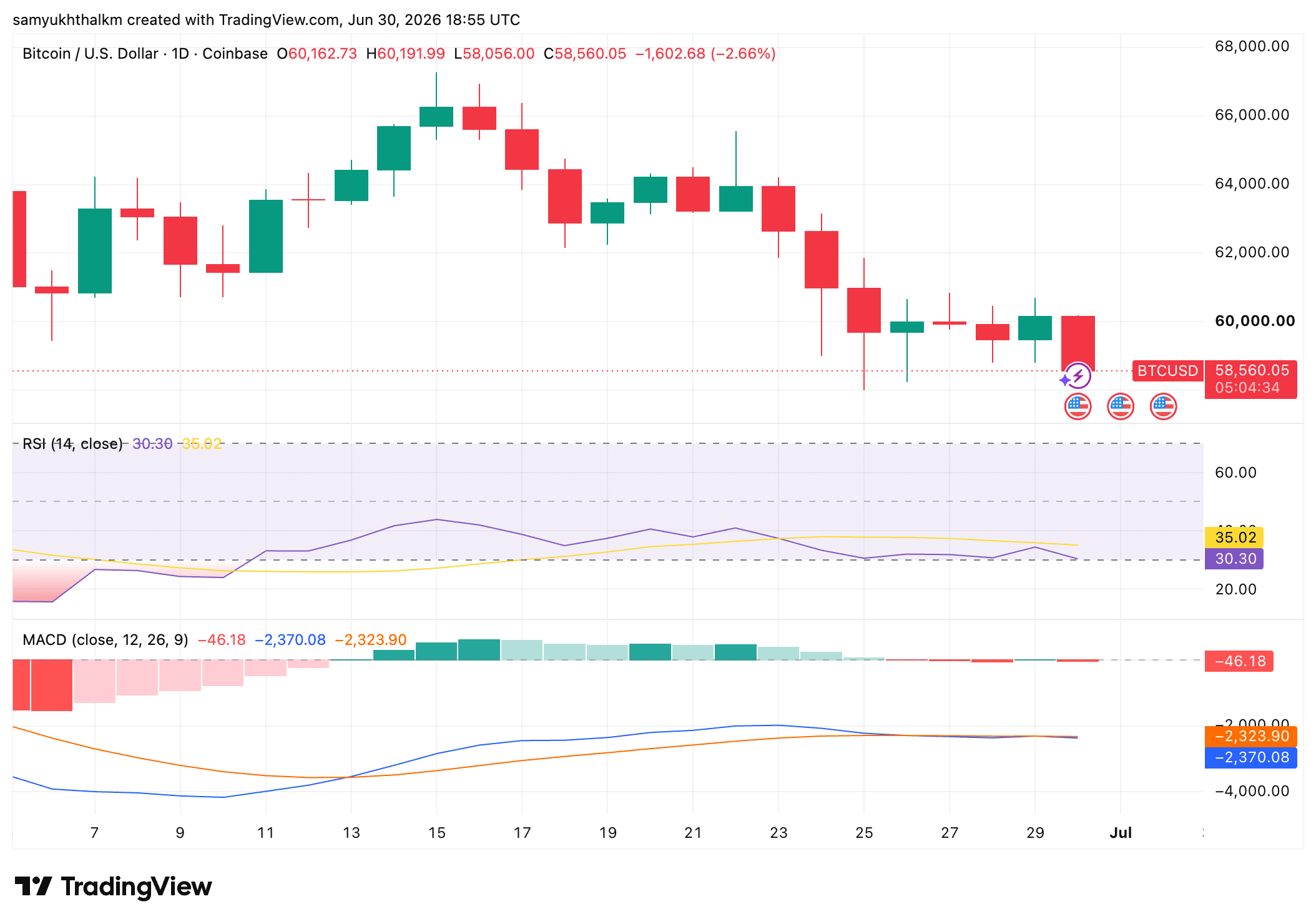
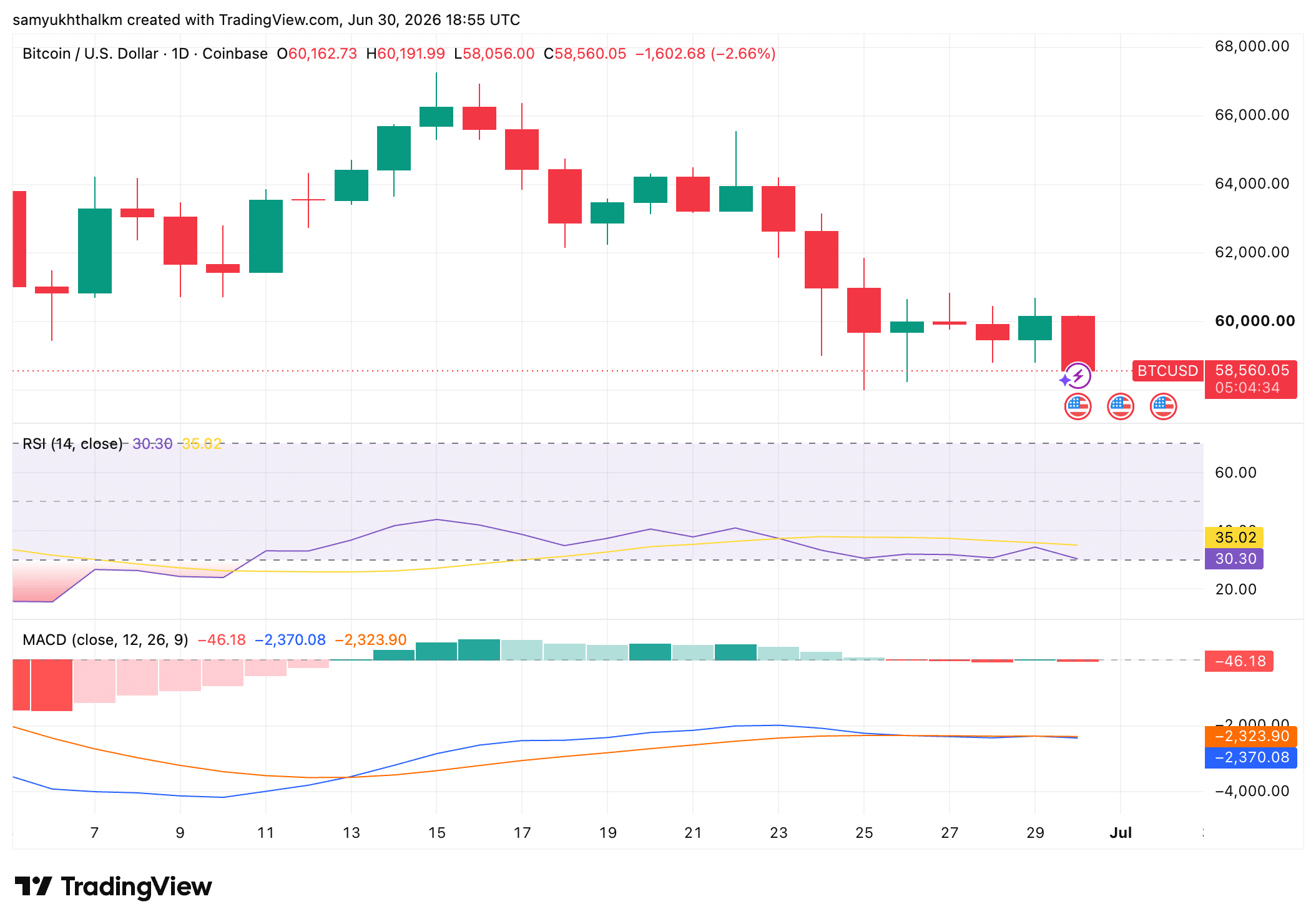
Source : TradingView

Le rythme n'est pas encore revenu en faveur des acheteurs. Un mouvement de soulagement à court terme est possible après cette baisse, mais la perspective générale reste incertaine. À moins que le BTC ne remonte dans la fourchette 60 000 $ - 62 000 $, une chute plus importante vers des niveaux de support inférieurs est possible.


Résumé final

  • La demande américaine de Bitcoin faiblit, avec des sorties des ETF au comptant atteignant 4,29 milliards de dollars. Cela signale une confiance réduite des investisseurs.
  • Le Bitcoin a du mal à maintenir la zone de support des 58 000 $, tandis que le ratio de réserves américaines est tombé à 1,59 – renforçant les risques de baisse.


Trending Cryptos

Related Questions

QQuel est l'impact principal de la baisse de la demande américaine sur le prix du Bitcoin selon l'article ?

ASelon l'article, le capital américain étant une force motrice majeure des rallyes du Bitcoin, le BTC a du mal à se maintenir lorsque cette demande faiblit. Le ratio de réserve américaine par rapport au reste du monde a chuté, ce qui exerce une pression à la baisse sur le prix.

QQue révèlent les flux nets mensuels des ETF sur Bitcoin pour l'investissement institutionnel ?

ALes derniers flux nets mensuels des ETF spot sur Bitcoin ont enregistré une importante sortie d'environ 4,29 milliards de dollars. Cela indique un renversement de tendance et est préoccupant, car les ETF étaient un signe clair d'achat institutionnel pendant les hausses.

QQuel niveau de support clé le Bitcoin testait-il au moment de la rédaction de l'article ?

AAu moment de la rédaction de l'article, le Bitcoin était tombé en dessous de la zone des 60 000 dollars et se négociait près des 58 500 dollars, testant ainsi le niveau de support des 58 000 dollars.

QQuel est l'état de l'indicateur RSI pour le Bitcoin selon l'analyse technique présentée ?

AL'indicateur RSI (Relative Strength Index) se trouvait près de la zone de survente, ce qui indique que le marché est sous pression vendeuse, mais ne suggère pas encore une reprise importante.

QSelon la conclusion de l'article, quelle condition est nécessaire pour éviter une chute plus importante du prix du Bitcoin ?

ASelon la conclusion de l'article, à moins que le Bitcoin ne parvienne à remonter dans la fourchette des 60 000 à 62 000 dollars, une chute plus importante vers des niveaux de support inférieurs est possible.

Related Reads

DeFi Enters a Moment of Value Reassessment: Risks and Opportunities Behind the $70 Billion TVL

DeFi Enters a Moment of Value Reassessment: Peril and Opportunity Behind $70 Billion TVL On July 1st, the total value locked (TVL) across all DeFi protocols fell below $70 billion to approximately $69.358 billion, hitting its lowest point since February 2024. This decline signals a significant contraction in DeFi liquidity and marks a new adjustment phase for the industry, far from its 2021 peak of over $180 billion. The primary drivers of this TVL drop are a general decrease in crypto market risk appetite, which leads capital to exit volatile sectors like DeFi first, and the fading effectiveness of the high-yield liquidity incentive models that fueled the initial DeFi boom. Many protocols' high TVL figures were built on temporary subsidy-driven capital rather than genuine demand. Furthermore, capital is migrating to newer narratives like AI, RWA, and modular infrastructure. This cooldown exposes DeFi's growth bottlenecks: innovation has slowed with rampant protocol copycats, real yields have normalized to single digits, and poor user experience continues to hinder mass adoption beyond crypto-natives. However, the TVL decline does not spell the end for DeFi. The metric itself is limited, as it fluctuates with underlying asset prices. The industry is shifting from capital accumulation to efficiency competition, leveraging Layer 2 solutions and modular architecture to do more with less locked value. Crucially, DeFi is expanding into real-world financial use cases like the tokenization of real-world assets (RWA) and the growth of the stablecoin ecosystem, moving its value proposition from speculative token subsidies to real cash flows. In conclusion, while short-term pressures from liquidity contraction and user growth stagnation persist, the sector is undergoing a necessary value reassessment. DeFi is transitioning from a subsidy-driven, hype-based era toward a more mature, rational, and efficiency-focused phase, with long-term growth hinging on meeting real-world financial needs through RWA, stablecoins, and robust infrastructure.

marsbit13m ago

DeFi Enters a Moment of Value Reassessment: Risks and Opportunities Behind the $70 Billion TVL

marsbit13m ago

Trading

Spot

Hot Articles

What is $BITCOIN

DIGITAL GOLD ($BITCOIN): A Comprehensive Analysis Introduction to DIGITAL GOLD ($BITCOIN) DIGITAL GOLD ($BITCOIN) is a blockchain-based project operating on the Solana network, which aims to combine the characteristics of traditional precious metals with the innovation of decentralized technologies. While it shares a name with Bitcoin, often referred to as “digital gold” due to its perception as a store of value, DIGITAL GOLD is a separate token designed to create a unique ecosystem within the Web3 landscape. Its goal is to position itself as a viable alternative digital asset, although specifics regarding its applications and functionalities are still developing. What is DIGITAL GOLD ($BITCOIN)? DIGITAL GOLD ($BITCOIN) is a cryptocurrency token explicitly designed for use on the Solana blockchain. In contrast to Bitcoin, which provides a widely recognized value storage role, this token appears to focus on broader applications and characteristics. Notable aspects include: Blockchain Infrastructure: The token is built on the Solana blockchain, known for its capacity to handle high-speed and low-cost transactions. Supply Dynamics: DIGITAL GOLD has a maximum supply capped at 100 quadrillion tokens (100P $BITCOIN), although details regarding its circulating supply are currently undisclosed. Utility: While precise functionalities are not explicitly outlined, there are indications that the token could be utilized for various applications, potentially involving decentralized applications (dApps) or asset tokenization strategies. Who is the Creator of DIGITAL GOLD ($BITCOIN)? At present, the identity of the creators and development team behind DIGITAL GOLD ($BITCOIN) remains unknown. This situation is typical among many innovative projects within the blockchain space, particularly those aligning with decentralized finance and meme coin phenomena. While such anonymity may foster a community-driven culture, it intensifies concerns about governance and accountability. Who are the Investors of DIGITAL GOLD ($BITCOIN)? The available information indicates that DIGITAL GOLD ($BITCOIN) does not have any known institutional backers or prominent venture capital investments. The project seems to operate on a peer-to-peer model focused on community support and adoption rather than traditional funding routes. Its activity and liquidity are primarily situated on decentralized exchanges (DEXs), such as PumpSwap, rather than established centralized trading platforms, further highlighting its grassroots approach. How DIGITAL GOLD ($BITCOIN) Works The operational mechanics of DIGITAL GOLD ($BITCOIN) can be elaborated on based on its blockchain design and network attributes: Consensus Mechanism: By leveraging Solana’s unique proof-of-history (PoH) combined with a proof-of-stake (PoS) model, the project ensures efficient transaction validation contributing to the network's high performance. Tokenomics: While specific deflationary mechanisms have not been extensively detailed, the vast maximum token supply implies that it may cater to microtransactions or niche use cases that are still to be defined. Interoperability: There exists the potential for integration with Solana’s broader ecosystem, including various decentralized finance (DeFi) platforms. However, the details regarding specific integrations remain unspecified. Timeline of Key Events Here is a timeline that highlights significant milestones concerning DIGITAL GOLD ($BITCOIN): 2023: The initial deployment of the token occurs on the Solana blockchain, marked by its contract address. 2024: DIGITAL GOLD gains visibility as it becomes available for trading on decentralized exchanges like PumpSwap, allowing users to trade it against SOL. 2025: The project witnesses sporadic trading activity and potential interest in community-led engagements, although no noteworthy partnerships or technical advancements have been documented as of yet. Critical Analysis Strengths Scalability: The underlying Solana infrastructure supports high transaction volumes, which could enhance the utility of $BITCOIN in various transaction scenarios. Accessibility: The potential low trading price per token could attract retail investors, facilitating wider participation due to fractional ownership opportunities. Risks Lack of Transparency: The absence of publicly known backers, developers, or an audit process may yield skepticism regarding the project's sustainability and trustworthiness. Market Volatility: The trading activity is heavily reliant on speculative behavior, which can result in significant price volatility and uncertainty for investors. Conclusion DIGITAL GOLD ($BITCOIN) emerges as an intriguing yet ambiguous project within the rapidly evolving Solana ecosystem. While it attempts to leverage the “digital gold” narrative, its departure from Bitcoin's established role as a store of value underscores the need for a clearer differentiation of its intended utility and governance structure. Future acceptance and adoption will likely depend on addressing the current opacity and defining its operational and economic strategies more explicitly. Note: This report encompasses synthesised information available as of October 2023, and developments may have transpired beyond the research period.

552 Total ViewsPublished 2025.05.13Updated 2025.05.13

What is $BITCOIN

Discussions

Welcome to the HTX Community. Here, you can stay informed about the latest platform developments and gain access to professional market insights. Users' opinions on the price of BTC (BTC) are presented below.

活动图片