The First Prediction Market Stock Has Emerged!

marsbitDipublikasikan tanggal 2026-06-15Terakhir diperbarui pada 2026-06-15

Abstrak

"Prediction Market Unicorn Emerges!" While the World Cup drives record trading volumes in prediction markets, the industry leader Kalshi faces a new threat from a former key ally. In March 2025, Kalshi partnered with online broker Robinhood to offer prediction market services, allowing users to bet on events. This deal was mutually beneficial: Kalshi gained access to Robinhood's massive retail user base, with an estimated 25-35% of its volume coming through this channel, while Robinhood earned significant fees, reporting a 320% year-over-year increase in "other transaction revenue" to $147 million in Q1 2026, largely fueled by prediction markets. However, Robinhood's ambitions have grown. Recognizing that its user base and distribution power are the scarcest resources, it initiated a plan to bring operations in-house. In late 2025, Robinhood partnered with Susquehanna to acquire CFTC-regulated exchange MIAXdx, renaming it Rothera Exchange. By June 2026, Robinhood launched its own prediction market product on Rothera, strategically using the World Cup as a launchpad. Initial data shows Rothera processing tens of millions of contracts within days, directly siphoning volume away from Kalshi. This shift marks a pivotal moment: control is moving from the market infrastructure provider (Kalshi) to the entity controlling user distribution (Robinhood). The story illustrates a recurring internet era dynamic: "He who controls distribution controls everything." As more platforms with...

Author | Azuma (@Azuma_eth)

The flames of the World Cup have ignited, and the total global trading volume of prediction markets continues to hit new highs. However, as the industry leader, Kalshi may not be in the best mood at the moment.

The reason is not a fluctuation in Kalshi's own business data, but because Kalshi now "suddenly" faces another formidable rival after Polymarket, and this opponent was once its most important ally.
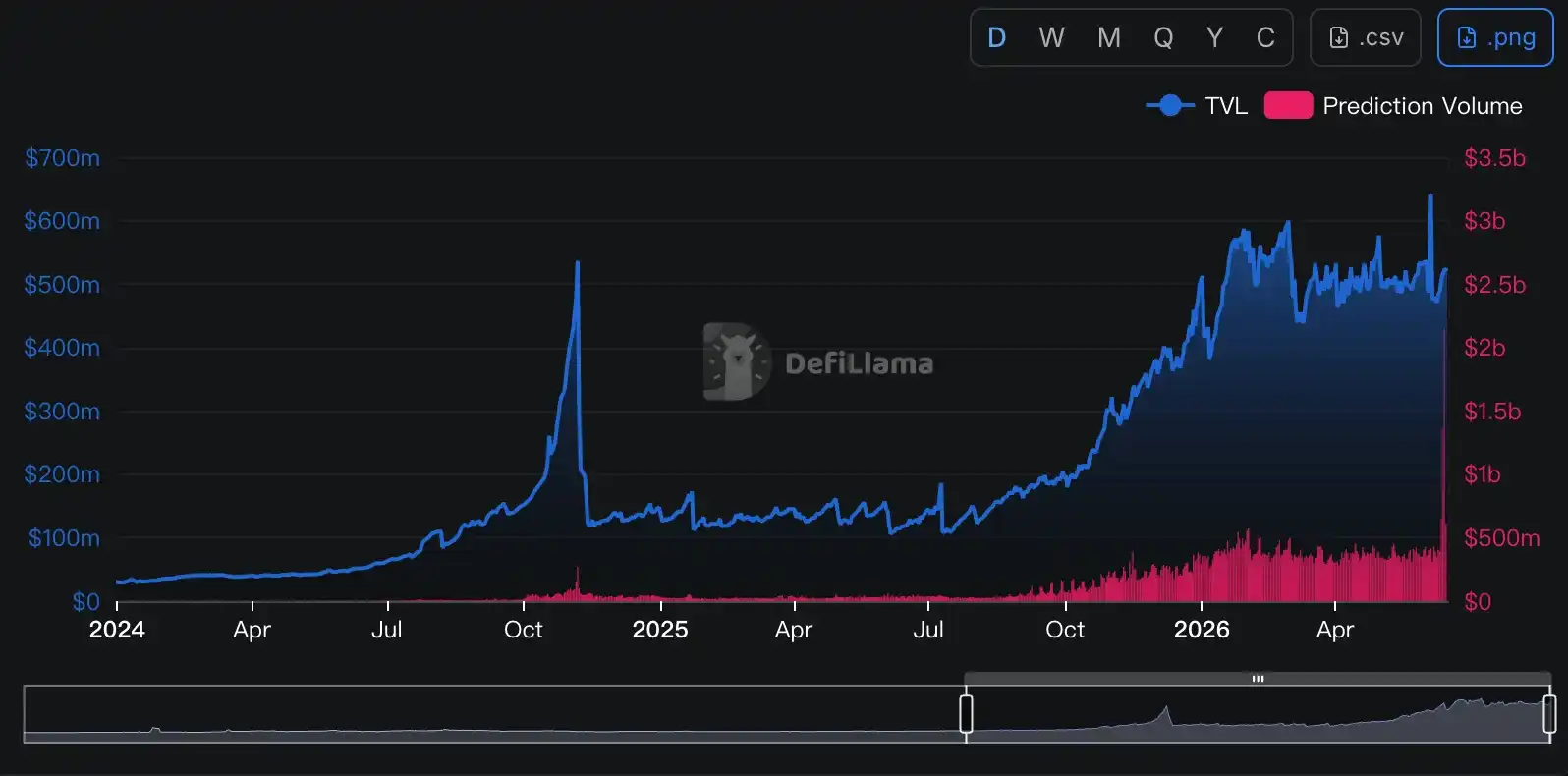
  • Odaily Note: Data sourced from Defillama.

Kalshi's Most Important Traffic Channel — Robinhood

Rewind to March 2025. At that time, Kalshi announced a partnership with the US online brokerage Robinhood. The latter would use Kalshi's services to provide its users with prediction market trading, allowing users to place bets on political, economic, sports, and other events.

From a business model perspective, this was a classic case of "mutual benefit" — Robinhood, responsible for user access and order flow distribution, could directly utilize Kalshi's mature product; Kalshi, responsible for the underlying market, matching, clearing, and regulatory compliance systems, could access Robinhood's massive pool of retail traffic.

The subsequent story proved the "win-win" outcome of this collaboration. Through Robinhood's channel distribution, Kalshi indirectly gained a massive amount of users and transaction volume. Piper Sandler analysts once estimated that "transactions completed through the Robinhood channel accounted for about 25%-35% of Kalshi's total trading volume." These orders ultimately translated into revenue for both parties — Robinhood charges an independent fee for all Kalshi event contracts traded through this channel, $0.01 per contract per side, and then shares the revenue with Kalshi (the specific split was not disclosed).
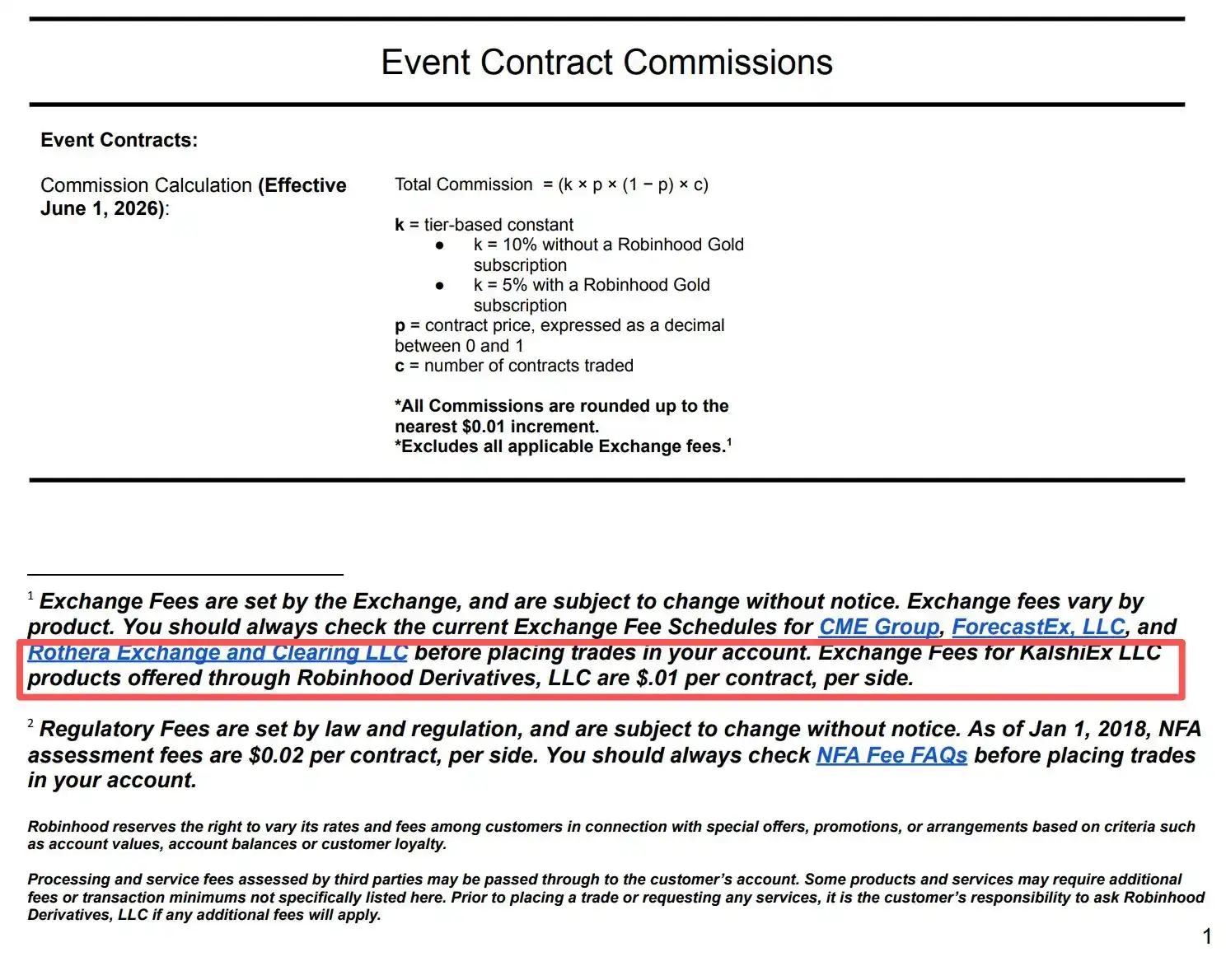
The Q1 financial report released at the end of April this year showed that Robinhood achieved trading of 8.8 billion event contracts in Q1, driving "other transaction revenue" to grow 320% year-over-year, reaching $147 million. Prediction markets have become the most eye-catching new growth engine in Robinhood's product line.

But recently, this relationship has undergone some subtle changes.

Robinhood's Ambition: Reclaiming the Cake Shared with Kalshi

As countless episodes in internet history have proven, when a channel gains sufficient influence, it is no longer content with just being a channel. Robinhood is no exception.

Although the cooperation with Kalshi also brought Robinhood considerable revenue, with prediction markets becoming one of the fastest-growing new businesses on the platform, Robinhood was no longer satisfied with the current revenue-sharing arrangement.

In their partnership model, Kalshi provided the market and infrastructure, while Robinhood provided the users and order flow. However, as the cooperation deepened, Robinhood gradually realized that what was truly scarce might not be the market itself, but the user access point it firmly controlled. After all, for most Robinhood users, they don't care whether their orders are ultimately executed on Kalshi or another platform — users only see a trading entry point within the Robinhood app, not the underlying infrastructure provider.

In other words, Robinhood always controlled one of the most critical resources in prediction markets — distribution power. If the users belong to Robinhood, why should the orders flow to someone else?

In fact, while Robinhood was quickly validating the demand for prediction markets with Kalshi, another Plan B was launched shortly after.

In November 2025, Robinhood announced the establishment of a joint venture with Wall Street quantitative trading giant Susquehanna, planning to acquire the CFTC-regulated derivatives exchange MIAXdx. According to the official statement, the joint venture would operate an independent futures and derivatives exchange and clearing agency in the future, with prediction markets being one of its key focuses. At the time, the outside world mostly viewed this as an infrastructure investment. However, with subsequent information disclosures, people gradually realized that Robinhood's goal was far beyond just finding a new partner for prediction markets.

In January 2026, the deal was officially completed. Robinhood and Susquehanna gained 90% control of MIAXdx, simultaneously acquiring a complete CFTC regulatory framework, including Designated Contract Market (DCM) and Derivatives Clearing Organization (DCO) qualifications. Subsequently, MIAXdx was renamed Rothera Exchange, and its clearing agency was renamed Rothera Clearing.

Thus, Robinhood now possessed the core elements needed to independently operate a prediction market. The only thing lacking was a mature product comparable to Kalshi's, but for Robinhood, with its rich experience in internet product development, this was clearly not a difficult task.

Rothera's Opportunity: The World Cup

In June 2026, after about six months of accelerated development, the Rothera product took shape, and Robinhood finally made the move that was almost destined to happen — gradually shifting orders that originally flowed to Kalshi into its own controlled system.

Robinhood specifically chose an excellent launch battleground for Rothera — the World Cup. For prediction markets, the World Cup is undoubtedly one of the most traffic-generating trading themes. Whether it's match outcomes, qualification results, or the ultimate champion, related markets can attract a large number of new users to trade in a short period. For Rothera's nascent platform, there is no better scenario for a cold start than the World Cup.

According to Robinhood's official disclosure, during this World Cup, which comprises a total of 104 matches, part of the event contracts will be directed to Rothera for matching and clearing, including markets for single World Cup match results, the ultimate World Cup champion, total goals in a single match, etc. Compared to the previous model that completely relied on Kalshi, this marks the first time Robinhood has directed prediction market orders into its own trading system on a large scale.
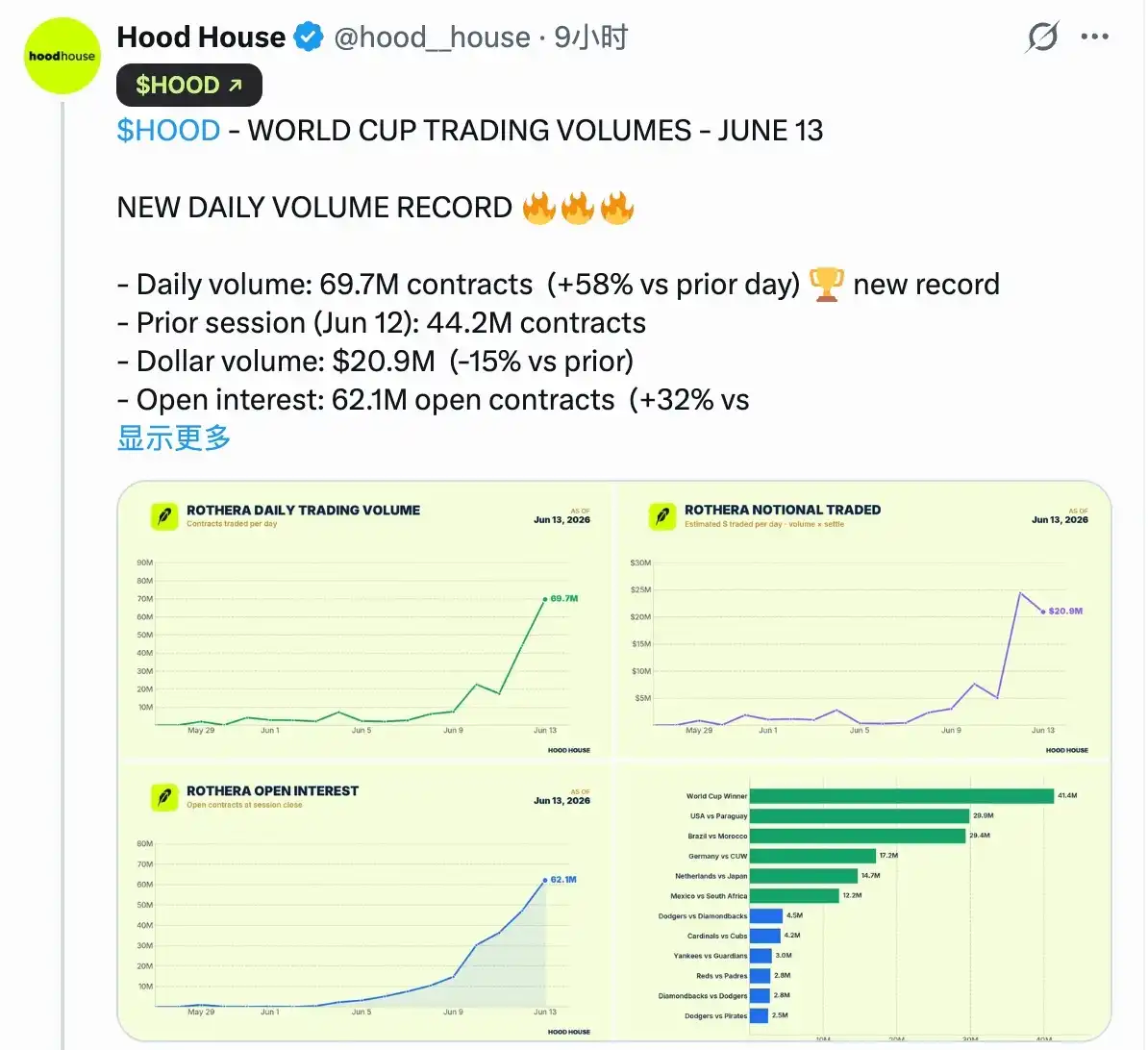
Judging by the results, Rothera clearly seized this opportunity. According to data disclosed by Hood House, a research-focused自媒体 tracking Robinhood's activities, on June 12th, Rothera completed 44.2 million contract trades, corresponding to approximately $24.4 million in dollar trading volume; on June 13th, Rothera completed 69.7 million contract trades, corresponding to approximately $20.9 million in dollar trading volume... Although these figures still lag behind Kalshi's popular markets, which often see hundreds of millions or even billions of dollars in volume, considering that Rothera has literally just launched a few days ago, this performance is sufficiently successful.

For both Robinhood and Kalshi, this means the balance of cooperation between them has begun to tilt. From Robinhood's perspective, the transaction fee revenue that previously had to be shared with Kalshi can now be retained more within its own ecosystem; from Kalshi's perspective, this means that one of its former most important growth engines has begun to show signs of weakening.

And the World Cup is clearly just the beginning of Rothera's encroachment on Kalshi. Looking further into the future, Robinhood will inevitably expand Rothera's coverage to more sports events, as well as economic and political themes. Those orders that originally flowed to Kalshi will then be intercepted one by one by Rothera.

Since Robinhood and Kalshi have never publicly disclosed their revenue-sharing ratio, we cannot know the exact value of this interception. However, considering that Robinhood alone generated $147 million in prediction market-related revenue in Q1, and with the World Cup in Q2 and the midterm elections later expected to bring even larger-scale trading activities, the annual value of this interception could reach billions of dollars.

Who Controls Distribution, Controls Everything

The drama of Robinhood and Kalshi moving from allies to rivals once again illustrates a logic repeatedly verified in the internet market — products are easy to build, traffic is hard to find; whoever controls distribution controls everything.

Over the past few years, the market generally believed that Kalshi's core moat came from regulatory licenses, exchange qualifications, and clearing capabilities. Therefore, whether it was brokerages like Robinhood or various media outlets, communities, and traffic platforms, they were essentially just Kalshi's channels and traffic inlets. However, the emergence of Rothera proves one thing: in today's market where products are highly homogenized, the product itself might not be the most important element. What remains truly scarce is always the users.

Where the users are, the liquidity is; where the liquidity is, the market will be. When Robinhood controls the access point to tens of millions of retail users, it has the full ability to direct these users to any trading venue. For users, they don't care whether their orders are ultimately executed on Kalshi or Rothera. As long as the experience isn't significantly different, it doesn't matter who is behind the matching and clearing.

If the theme of the prediction market industry in the past few years was the market competition between Polymarket and Kalshi, then the theme for the coming years might become a channel war. Robinhood incubating Rothera is, in essence, a reverse integration launched by the channel side towards the market layer. As more and more platforms with traffic inlets begin to recognize the strategic value of prediction markets, similar stories are likely to continue. Whether they are exchanges, brokerages, social platforms, or media platforms, all could become new gateways to prediction markets.

And when inlets begin to control markets, and channels begin to possess pricing power, the ultimate winner in the prediction market industry might no longer be the platform responsible for matching orders, but the one closest to the users, the one that best controls distribution.

It was true in the internet era, and it was true in the mobile internet era. This time, there are no exceptions either.


Pertanyaan Terkait

QWhy is the article titled 'The First Stock of the Prediction Market Concept Has Appeared!'?

AThe title refers to the financial markets potentially viewing 'Robinhood' (HOOD), a publicly traded brokerage platform, as a stock heavily exposed to and benefiting from the growth of the prediction market industry. The article details how Robinhood, initially a distributor for Kalshi, has now built its own prediction market infrastructure (Rothera), positioning itself as a major player and capturing more value from this high-growth segment.

QWhat was the nature of the initial partnership between Robinhood and Kalshi, and why did it break down?

AThe initial partnership (March 2025) was symbiotic: Kalshi provided the regulated prediction market platform (licenses, matching, clearing), while Robinhood provided its massive retail user base and distribution. It broke down because Robinhood realized the scarcity and strategic value of its user access point. As prediction markets became a key growth driver, Robinhood wanted to capture more of the revenue by bringing the trading infrastructure in-house, leading it to develop its own platform, Rothera.

QHow did Robinhood build its own prediction market platform, Rothera?

ARobinhood built Rothera through a strategic acquisition. In November 2025, it announced a joint venture with Susquehanna to acquire MIAXdx, a CFTC-regulated derivatives exchange. The deal closed in January 2026, giving them a Designated Contract Market (DCM) and Derivatives Clearing Organization (DCO) license. MIAXdx was renamed Rothera Exchange/Rothera Clearing, providing Robinhood with the core regulated infrastructure to independently operate a prediction market.

QWhy did Robinhood choose the 2026 FIFA World Cup to launch Rothera?

ARobinhood chose the 2026 FIFA World Cup as the launchpad for Rothera because it is a premier, high-traffic event for prediction markets. Sports events, especially the World Cup, naturally attract a large volume of speculative trading on outcomes like match winners and champions. This provided Rothera with a perfect 'cold start' scenario to attract a surge of new users and generate immediate trading volume, proving the viability of their new platform.

QWhat is the core argument the article makes about the future of the prediction market industry?

AThe article argues that the future competitive landscape of prediction markets will shift from a 'market war' (between platforms like Polymarket and Kalshi) to a 'channel war.' The core thesis is that 'who controls distribution, controls everything.' The ultimate winners may not be the companies that build the trading engines (like Kalshi), but rather the entities (like Robinhood) that own the user interface, the customer relationships, and the primary access points, as they hold the power to direct traffic and capture value.

Bacaan Terkait

Dialog dengan Kepala Strategi Digital Morgan Stanley: Bitcoin Mencapai Satu Juta Dolar Bukan Tidak Mungkin, Tapi Saya Harap Perlahan

Morgan Stanley mengelola triliunan dolar aset dan sekarang membawa Bitcoin ke klien mereka. Amy Oldenburg, Kepala Strategi Aset Digital di Morgan Stanley, membagikan wawasannya tentang perjalanan Bitcoin. Ia menyoroti kontras antara ETF Bitcoin (MSBT) yang mencetak rekor peluncuran hari pertama di bank tersebut, dengan sebagian besar penasihat keuangan yang masih enggan merekomendasikannya karena harga Bitcoin cenderung stagnan sejak rekomendasi resmi bank. Oldenburg berpendapat bahwa adopsi Bitcoin selanjutnya mungkin memerlukan katalis berupa peristiwa yang mengganggu sistem keuangan tradisional. Ia tidak terkejut jika Bitcoin mencapai satu juta dolar dalam lima tahun, tetapi berharap kenaikan tersebut terjadi secara perlahan untuk stabilitas aset. Dia menekankan pentingnya pendidikan dalam mengatasi kesenjangan pemahaman, termasuk perbedaan mendasar antara memegang Bitcoin secara langsung dan melalui ETP, serta perbedaan antara berbagai aset kripto. Meskipun institusi keuangan besar seperti Morgan Stanley menawarkan layanan terpusat yang memudahkan likuiditas dan perencanaan warisan, Oldenburg menghargai dan berharap semangat 'cypherpunk' dan kedaulatan diri dalam ekosistem Bitcoin tetap hidup. Menurutnya, perjalanan aset digital masih sangat panjang dan akan terus berkembang seiring dengan kemajuan teknologi.

marsbit14m yang lalu

Dialog dengan Kepala Strategi Digital Morgan Stanley: Bitcoin Mencapai Satu Juta Dolar Bukan Tidak Mungkin, Tapi Saya Harap Perlahan

marsbit14m yang lalu

"Tujuh Raksasa" Tidak Cukup Lagi? IPO SpaceX Diborong Retail, Wall Street Sajikan "Sepuluh Raksasa AI & Teknologi"

SpaceX meluncurkan IPO pada hari Jumat dengan sukses besar, menarik investasi ritel bersih sebesar $117 juta pada hari pertama, atau 56% dari semua pembelian saham ritel AS hari itu. Menanggapi fenomena ini, lembaga riset Vanda Research mengusulkan konsep baru "FAB 10" (Frontier AI & Big Tech 10) untuk menggantikan grup "Tujuh Raksasa" yang lama. Konsep ini mencakup sepuluh perusahaan teknologi dan AI terdepan, dengan menambahkan SpaceX, OpenAI, dan Anthropic ke dalam tujuh raksasa yang ada. OpenAI dan Anthropic diharapkan akan go public akhir tahun ini dengan valuasi yang sangat tinggi. Analis Vanda berpendapat bahwa perusahaan-perusahaan ini mewakili arah industri teknologi dan AI untuk dekade mendatang. Namun, antusiasme investor ritel terhadap SpaceX berpotensi mengalihkan modal dari sektor lain seperti saham semikonduktor, yang sebelumnya populer. Sementara itu, Bank of America memiliki versi lain yang disebut "AI Big 10", yang lebih berfokus pada perusahaan perangkat keras semikonduktor seperti Broadcom, AMD, dan Micron. Perbedaan ini mencerminkan taruhan berbeda tentang pemain kunci masa depan. Analis memperingatkan bahwa valuasi di sektor teknologi secara keseluruhan mulai menunjukkan tanda-tanda gelembung. Keberlanjutan optimisme pasar, terutama mengingat valuasi SpaceX yang mencapai $1,75 triliun, masih harus diuji oleh waktu.

marsbit19m yang lalu

"Tujuh Raksasa" Tidak Cukup Lagi? IPO SpaceX Diborong Retail, Wall Street Sajikan "Sepuluh Raksasa AI & Teknologi"

marsbit19m yang lalu

Peta Ekosistem Privasi Solana: Tumpukan Privasi Lengkap dari Komputasi ke AI

**Ringkasan: Peta Ekosistem Privasi Solana, dari Komputasi hingga AI** Ekosistem privasi Solana masih dalam tahap awal. Untuk menciptakan tumpukan privasi yang matang dan dapat dikomposisikan, elemen-elemen seperti verifikasi formal, tanpa komite, kekekalan, dan kode sumber terbuka diperlukan. Arsitektur unik Solana memungkinkan skalabilitas tanpa bergantung pada rollup yang persisten. Dua bidang utama pengembangan privasi di Solana adalah Neobanks dan Private DeFi. Dari segi teknologi, solusi akhir kemungkinan akan menggabungkan FHE (Fully Homomorphic Encryption) dan ZK (Zero-Knowledge Proofs). **Komputasi Privasi (Private Compute):** * **Arcium:** Menyediakan komputasi privasi melalui MPC (Multi-Party Computation), dengan data diproses di MXEs (Multi-Party eXecution Environments) dan diselesaikan di Solana. Mereka juga membangun standar token Confidential SPL (C-SPL) untuk transaksi rahasia. * **Magic Block:** Menggunakan TEE (Trusted Execution Environment) untuk membuat lingkungan eksekusi pribadi (Private Ephemeral Rollup) yang menjaga kerahasiaan, skalabilitas, dan komposabilitas. Kedua infrastruktur ini mendukung pembuatan buku order privat, kolam gelap (dark pool), dan aplikasi DeFi privat. **Transfer dan Saldo Privasi:** * **Umbra:** Dibangun di atas Arcium, memperkenalkan Encrypted Token Accounts (ETAs) yang menyembunyikan jumlah transaksi, saldo, dan menghubungkan pengirim dengan penerima melalui pool pencampur dan bukti ZK. Juga menawarkan fitur kepatuhan. * **Privacy Cash & Hush:** Menggunakan pool pencampur seperti Tornado untuk SOL. Hush mengintegrasikan yield staking (jitoSOL) dan penukaran privat melalui Jupiter. **Tanpa Jejak di Chain (No Onchain Trail):** Solusi untuk melindungi strategi perdagangan dari front-running dan MEV: * **encifherio:** Antarmuka DeFi privat yang merutekan transaksi melalui Jupiter sambil mengenkripsi detailnya menggunakan ElGamal. Pemrosesan terjadi di TEE. * **VanishTrade:** Infrastruktur yang merutekan transaksi melalui likuiditas terselubung untuk melindungi strategi. * **Darklake:** Membangun infrastruktur likuiditas native-ZK dan kolam gelap, termasuk zk-AMM yang menyembunyikan data slippage sebelum eksekusi untuk mencegah serangan sandwich. **Pasar Prediksi Privasi (Private Prediction Markets):** Protokol seperti **Melee Markets** memanfaatkan infrastruktur MPC Arcium untuk mengenkripsi buku order di pasar prediksi, memungkinkan peserta bertaruh tanpa mengungkapkan posisi mereka secara publik hingga penyelesaian. **AI Privasi (Private AI):** Sebagai agen AI semakin banyak beroperasi di on-chain, **Loyal** membangun protokol cerdas yang terdesentralisasi dan anti-sensor. Dengan memanfaatkan rollup sementara Magic Block dan komputasi terenkripsi Arcium, Loyal menyimpan data pengguna (percakapan, preferensi) dalam bentuk terenkripsi di Solana, dengan aturan akses ketat. Pengguna memiliki dan dapat mengelola data mereka, sekaligus melakukan transaksi dan manajemen dana secara privat.

Foresight News37m yang lalu

Peta Ekosistem Privasi Solana: Tumpukan Privasi Lengkap dari Komputasi ke AI

Foresight News37m yang lalu

Trading

Spot
Futures

Artikel Populer

Cara Membeli T

Selamat datang di HTX.com! Kami telah membuat pembelian Threshold Network Token (T) menjadi mudah dan nyaman. Ikuti panduan langkah demi langkah kami untuk memulai perjalanan kripto Anda.Langkah 1: Buat Akun HTX AndaGunakan alamat email atau nomor ponsel Anda untuk mendaftar akun gratis di HTX. Rasakan perjalanan pendaftaran yang mudah dan buka semua fitur.Dapatkan Akun SayaLangkah 2: Buka Beli Kripto, lalu Pilih Metode Pembayaran AndaKartu Kredit/Debit: Gunakan Visa atau Mastercard Anda untuk membeli Threshold Network Token (T) secara instan.Saldo: Gunakan dana dari saldo akun HTX Anda untuk melakukan trading dengan lancar.Pihak Ketiga: Kami telah menambahkan metode pembayaran populer seperti Google Pay dan Apple Pay untuk meningkatkan kenyamanan.P2P: Lakukan trading langsung dengan pengguna lain di HTX.Over-the-Counter (OTC): Kami menawarkan layanan yang dibuat khusus dan kurs yang kompetitif bagi para trader.Langkah 3: Simpan Threshold Network Token (T) AndaSetelah melakukan pembelian, simpan Threshold Network Token (T) di akun HTX Anda. Selain itu, Anda dapat mengirimkannya ke tempat lain melalui transfer blockchain atau menggunakannya untuk memperdagangkan mata uang kripto lainnya.Langkah 4: Lakukan trading Threshold Network Token (T)Lakukan trading Threshold Network Token (T) dengan mudah di pasar spot HTX. Cukup akses akun Anda, pilih pasangan perdagangan, jalankan trading, lalu pantau secara real-time. Kami menawarkan pengalaman yang ramah pengguna baik untuk pemula maupun trader berpengalaman.

894 Total TayanganDipublikasikan pada 2024.12.10Diperbarui pada 2026.06.02

Cara Membeli T

Diskusi

Selamat datang di Komunitas HTX. Di sini, Anda bisa terus mendapatkan informasi terbaru tentang perkembangan platform terkini dan mendapatkan akses ke wawasan pasar profesional. Pendapat pengguna mengenai harga T (T) disajikan di bawah ini.

活动图片