Trump Signs Executive Order, Kraken, Coinbase and Others May Gain Access to Fed Payment Channels

marsbitPublished on 2026-05-21Last updated on 2026-05-21

Abstract

President Trump has signed an executive order, "Incorporating Financial Technology Innovation into the Regulatory Framework," pressuring the Federal Reserve to reassess its rules on granting non-bank financial companies—including crypto and fintech firms—access to its payment systems, specifically master accounts that connect to the Fedwire settlement system. Currently, such accounts are primarily reserved for depository institutions. The order mandates a review to determine if broader access is permissible and to establish an application process. This move, supported by figures like Senator Cynthia Lummis, aims to reduce barriers to innovation and lower public payment costs by fostering fairer competition. It does not grant immediate access but could pave the way for companies like Kraken, Coinbase, Ripple, and Circle to reduce reliance on intermediary banks, lowering costs and speeding up settlements. A key precedent is the Kansas City Fed granting Kraken's parent company a restricted master account in March, offering limited payment services without interest or credit privileges. This model is seen as a potential template for allowing controlled access while mitigating systemic risk. Other firms like Anchorage, Paxos, and BitGo, which hold specialized banking charters, are also well-positioned to apply. The banking industry, represented by the American Bankers Association, opposes easing access, arguing any institution handling bank-like payments must meet the same stri...

Written by: Oluwapelumi Adejumo

Compiled by: Luffy, Foresight News

U.S. President Trump has formally pressured the Federal Reserve to re-evaluate the highly controversial access rules within the U.S. financial sector, escalating the industry battle over whether crypto firms and fintech companies can directly connect to the central bank's payment systems.

On May 19, Trump signed an executive order directing the Federal Reserve to assess its policies regarding granting payment account access to nonbank financial companies, including those engaged in digital assets, blockchain services, and other fintech businesses.

Titled "Modernizing the Regulatory Framework to Facilitate Financial Innovation," the order requires major federal regulatory agencies to review existing rules and eliminate redundant regulatory provisions that hinder financial innovation.

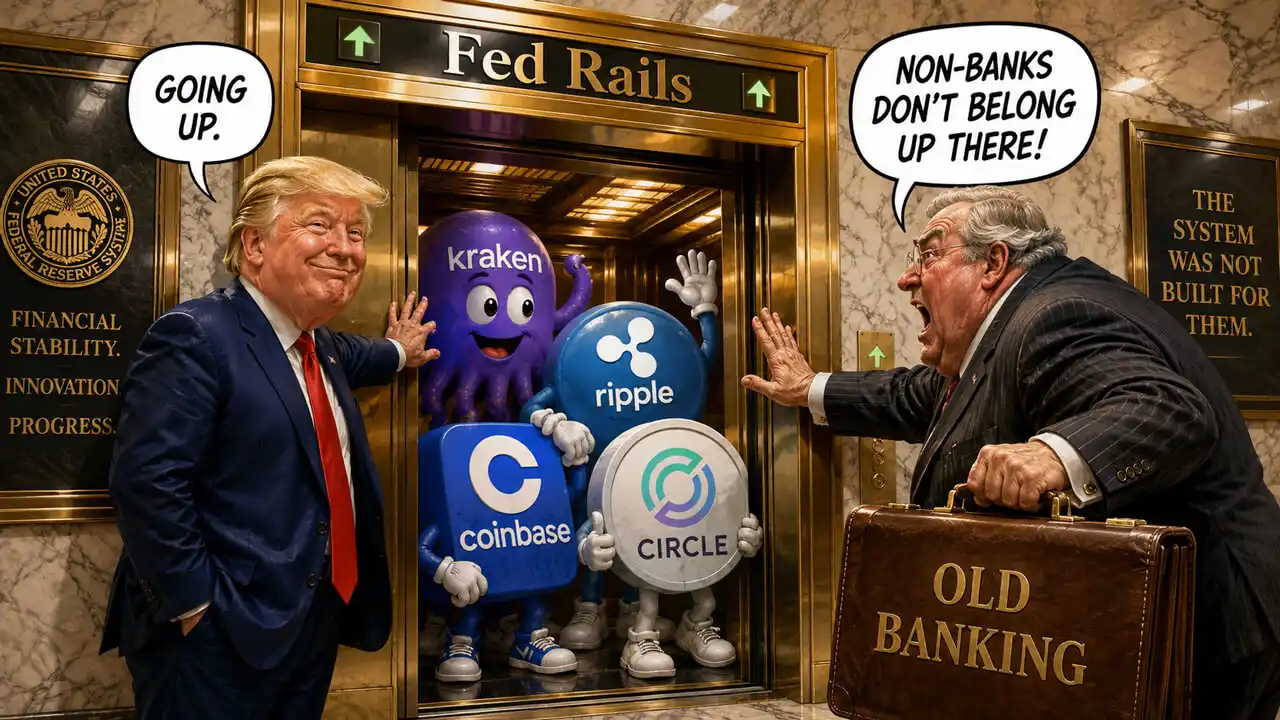
This order does not immediately grant crypto firms direct access to Federal Reserve payment channels. However, it explicitly authorizes the Federal Reserve to examine whether existing laws permit broader access and, if so, to clarify the application process.

The outcome of this review is crucial, as it will directly determine whether companies like Kraken, Ripple, Coinbase, Circle, Anchorage, Wise, Paxos, and BitGo can reduce their reliance on intermediary banks and move closer to core U.S. dollar wholesale clearing financial infrastructure.
Policy Shift for Fed Master Account Access

The core focus of this executive order is the Federal Reserve master account. Institutions holding such an account gain direct access to the full suite of Federal Reserve payment services, including the interbank large-dollar U.S. funds transfer system, Fedwire.

Under current Fed rules, such accounts are, in principle, only open to depository banking institutions. Consequently, many crypto firms have had to pursue special-purpose banking charters or national trust bank charters in their quest for direct connection eligibility.

Trump's order now requires the Federal Reserve to comprehensively review the access rules for central bank payment accounts, while also clarifying whether the 12 regional Federal Reserve Banks have the statutory authority to independently approve or reject institution account applications.

In March of this year, the Federal Reserve Bank of Kansas City took the lead by approving a restricted master account for Kraken's parent company, Payward, setting the industry's first precedent and making this issue of access increasingly urgent.

In addition, the order instructs regulators to conduct a comprehensive review of barriers to the development of the fintech industry, covering charter licensing rules, third-party risk management guidance, and policies restricting cross-border collaboration between banks and tech companies.

U.S. Senator Cynthia Lummis stated that this new policy corrects the long-standing restricted access situation for the fintech industry. Traditional legacy financial institutions have monopolized core payment channel resources, while emerging tech companies have long been excluded. This order aims to create a level playing field, stimulate industry vitality, and reduce payment costs for the public.

Coinbase Chief Legal Officer Paul Grewal also expressed support for the move. He argued that current payment access rules and third-party risk control guidelines are outdated, favoring traditional financial giants and suppressing innovation, and that regulatory rules urgently need renewal.

This echoes a common demand within the crypto industry: access to the central bank's core payment network has become a competitive barrier. Firms unable to connect directly must rely on bank intermediaries, which not only increases operational costs and slows settlement efficiency but also imposes the additional operational risks of their partner banks.
Kraken Provides a Feasible Model for Crypto Companies

Kraken has provided a practical example for the industry to expand access. In March, the Kansas City Fed granted a master account to its financial entity, Kraken Financial, allowing access to the core U.S. dollar large-value clearing payment channels. This enables the platform to handle institutional user deposits and withdrawals more efficiently, particularly facilitating rapid transfers of large funds between the trading platform, custodians, and partner banks.

However, this account comes with clear limitations: it does not offer the full range of financial services available to regular insured banks, does not earn interest on reserve balances, and cannot access Federal Reserve credit facilities.

This restricted design can reduce central bank systemic risk while allowing crypto firms moderate access to mainstream payment infrastructure. It is likely to become a universal template promoted by regulators in the future—granting firms U.S. dollar transfer and clearing permissions while strictly prohibiting access to high-sensitivity financial privileges like overdraft lending, reserve interest, and emergency liquidity assistance.

Custodia Bank CEO Caitlin Long welcomed the new policy. Her institution has sought access to the Federal Reserve system for years but was rejected in 2023, with the Fed ruling that its crypto-focused business model did not meet statutory access requirements, highlighting the extreme difficulty licensed crypto institutions previously faced in gaining full access.

The implementation of Kraken's restricted account has fundamentally shifted the regulatory stance. Regulators no longer have only the options of "full access" or "complete rejection." Through a tiered permission model, they can gradually guide crypto firms into the mainstream payment system while firmly maintaining risk control bottom lines.

Ripple, Coinbase, and Circle are Prepared for the Next Phase

Ripple, Coinbase, and Circle are among the most direct beneficiaries of this policy relaxation. Ripple has already applied for a Federal Reserve master account and actively supports implementing a lightweight restricted account mechanism that allows non-bank institutions to conveniently use basic payment services without touching the Fed's core financial privileges.

Once successfully implemented, this would significantly boost its RLUSD stablecoin business, enabling efficient reserve fund transfers and user redemption operations. For stablecoin issuers, the efficiency of reserve clearing and fund redemption stability directly determine market confidence. Direct or restricted access to a Federal Reserve account would greatly reduce reliance on bank intermediaries, allowing more flexible U.S. dollar liquidity management during periods of concentrated redemptions or market volatility.

Coinbase and Circle, through their USDC stablecoin businesses and own payment ecosystems, also have strong needs for access. Both institutions have established federal trust bank structures, which not only further integrate them into the federal unified regulatory system but also pave the way for applying for Federal Reserve payment accounts.

Meanwhile, other companies are also waiting in line. Anchorage Digital is already a federally chartered crypto bank; Paxos, BitGo, and Fidelity Digital Assets have successively obtained national trust bank-related approvals from the Office of the Comptroller of the Currency. While such qualifications do not directly translate into Federal Reserve payment account access, they significantly narrow the gap between these firms and compliance standards.

Industry demands are clear: crypto exchanges seek fast fiat currency settlement, stablecoin issuers want autonomous control over reserve funds, asset custodians aim to optimize institutional client fund flow efficiency, and payment companies are eager to reduce heavy reliance on cross-border clearing banks.

Galaxy Digital Head of Research Alex Thorn stated bluntly that it is not only deposit-taking and lending banking institutions that are qualified to conduct wire transfer business; this is a threshold set by modern regulation, not an immutable rule of the financial industry. With multiple forces now competing, traditional banks are actually fighting to maintain their monopoly in the payments industry. The prevailing industry view is that payment channel access eligibility should be determined based on a firm's business attributes, compliance and regulatory rigor, and risk management capabilities, rather than rigidly adhering to traditional banking business models.

Traditional Banks Warn: Access Must Meet Bank-Level Standards

Facing calls for industry openness, the American Bankers Association has clearly expressed opposition. The association believes that any institution conducting bank-like business must be subject to the same stringent regulatory standards and consumer protection rules as traditional banks.

ABA President and CEO Rob Nichols stated publicly: "Without full industry-wide high-standard regulation, the entire financial system and ordinary consumers will face direct risks. Regarding this White House financial innovation executive order, we urge regulatory agencies to uphold the bottom line of safety and soundness of the financial system while promoting innovation, and not to lower access thresholds."

This is the core concern of the banking industry. Direct access to the Federal Reserve payment system is not merely a business privilege; it comes with a suite of high-intensity regulations, including deposit insurance systems, capital adequacy assessments, liquidity controls, and regular business reviews. From the banks' perspective, allowing crypto firms with lightweight licenses and limited business scopes, which lack equivalent compliance obligations and risk management capabilities, to connect to the core payment network could easily sow the seeds of systemic risk.

The Fedwire system is the core hub for global U.S. dollar clearing. Any cyber-attacks, operational failures, compliance breaches, or liquidity crises at an接入 institution could cause settlement disruptions with impacts far beyond the firm's own business scope. Simultaneously, banks invest heavily in compliance areas such as anti-money laundering, customer fund monitoring, and suspicious transaction reporting. Regulators also need to confirm that crypto firms possess equivalent compliance capabilities before allowing them to engage in diverse businesses like trading, asset custody, stablecoin issuance, and payments.

Liquidity diversion is another key concern for banks. If stablecoin issuers and fintech firms can efficiently hold and transfer funds through the Federal Reserve system, they will likely divert existing funds from the traditional banking system.

The restricted account rules proposed by the Fed, by removing benefits like interest and credit, somewhat alleviate this concern, but the banking industry will not readily acquiesce to this shift in the industry landscape.

Although specialized restricted accounts can avoid most risks through permission demarcation, they also raise new regulatory questions: At what point does the level of payment business access granted to a non-bank institution make its operations equivalent to those of a formal bank? This will become a core point of contention for regulators in defining future access boundaries.

Related Questions

QWhat was the main objective of the executive order signed by former President Trump regarding financial innovation and cryptocurrency companies?

AThe executive order aimed to pressure the Federal Reserve to reassess its policies on granting payment account access to non-bank financial companies, including those in digital assets, blockchain, and fintech. It required federal regulators to review existing rules to eliminate redundant regulations hindering financial innovation and to clarify whether broader access to the Federal Reserve's payment systems is legally permissible for such companies.

QHow does the Federal Reserve's Master Account benefit financial institutions, and what was the previous limitation for crypto companies?

AA Federal Reserve Master Account allows institutions direct access to the Fed's full suite of payment services, including the Fedwire system for large-scale dollar transfers between banks. Previously, such accounts were typically restricted to depository banking institutions, forcing crypto companies to seek special-purpose banking charters or national trust bank licenses to qualify for direct access.

QWhat precedent did the Federal Reserve Bank of Kansas City set for crypto companies in March, and what were the limitations of this account?

AIn March, the Federal Reserve Bank of Kansas City approved a restricted master account for Payward, Inc., the parent company of Kraken. This account, granted to its special-purpose depository institution Kraken Financial, allowed direct access to core dollar payment channels but with key limitations: it did not grant full banking services, did not pay interest on reserves, and did not provide access to Federal Reserve credit facilities.

QWhy are companies like Ripple, Coinbase, and Circle particularly interested in gaining access to Federal Reserve payment channels?

ACompanies like Ripple, Coinbase, and Circle are keen to access Federal Reserve payment channels to reduce reliance on intermediary banks. This would lower operational costs, speed up settlement times, and mitigate risks associated with partner banks. For stablecoin issuers like Circle (USDC) and Ripple (RLUSD), direct access would enhance the efficiency of managing reserve funds and processing redemptions, which is crucial for maintaining market confidence, especially during periods of high volatility or concentrated withdrawals.

QWhat are the primary concerns raised by traditional banks, as represented by the American Bankers Association, regarding expanding access to the Federal Reserve's payment systems?

ATraditional banks, through the American Bankers Association, argue that any institution performing bank-like activities must be subject to the same stringent regulatory standards as traditional banks, including robust consumer protection rules, capital requirements, liquidity management, and anti-money laundering compliance. They warn that allowing crypto firms with lighter regulatory burdens to connect to core payment networks like Fedwire could introduce systemic risks, such as operational failures or compliance gaps, and potentially drain liquidity from the traditional banking system.

Related Reads

2029 Finale Prediction: When Cryptocurrency Completely "Vanishes", Who Can Remain in This Financial Upheaval?

By 2029, the crypto industry will have transformed into a largely invisible but foundational layer for traditional finance. This timeline outlines the key shifts from now until then. By mid-2026, the most sought-after assets on-chain will not be traditional tokens, but synthetic perpetual contracts for private, high-growth companies (like SpaceX, OpenAI). These become primary price discovery tools, highlighting the market's craving for real-world asset value. Most altcoins enter a sustained bear market as their fundamental lack of asset-backed value is exposed. In late 2026, the "AI + Crypto" narrative largely fades as AI giants prove they don't need crypto infrastructure, except for prediction markets betting on model performance. Simultaneously, a quiet but significant wave of tokenization for institutional assets (money market funds, private credit) begins. The industry splits into a noisy speculative economy and a silent institutional one. Throughout 2027, major public blockchain foundations pivot decisively to serve institutional clients, building compliance toolkits and sales teams. However, key sectors hit growth ceilings: private perpetual contracts are legally restricted from public promotion, stable币 growth is capped by looming political uncertainty, and tokenization projects remain cautious. In 2028, following a U.S. election assumed to maintain a regulatory (not prohibitive) stance, a pivotal change occurs. After a major liquidation crisis exposes the flaws of synthetic contracts lacking a real-asset anchor, new regulations allow the *public solicitation* of private security sales (secondary market shares) to accredited investors. This creates a legitimate, direct on-ramp for retail capital into previously illiquid private equity. By 2029, the resulting bull market is driven by trading in real, innovative company shares (biotech, robotics, AI labs), not speculative tokens. "Crypto" as a distinct asset class recedes; it becomes the mundane, unseen plumbing for this new global private markets infrastructure. Tokens that survive are those capturing real cash flows from this infrastructure. Speculation persists but is marginalized. The core questions posed at the start are answered: token value is tied to legally enforceable claims on real assets, frontier tech adoption happens via private market channels, and crypto's absorption into traditional finance is marked by its becoming boring and invisible. The key validation for this entire thesis is whether, by late 2028, a legal pathway exists for ordinary accredited investors to access private assets directly.

marsbit41m ago

2029 Finale Prediction: When Cryptocurrency Completely "Vanishes", Who Can Remain in This Financial Upheaval?

marsbit41m ago

After the U.S. Banned Fable 5, Zhipu's Stock Soared 47%

On June 15, Chinese AI company Zhipu's stock surged up to 47.6% in Hong Kong, closing with a 32.82% gain. This sharp rise followed two key industry events. On June 12, Anthropic was compelled by a U.S. government export control order to suspend global access to its latest flagship models, Claude Fable 5 and Claude Mythos 5, impacting developers and businesses reliant on them. The next day, Zhipu announced it was opening access to its new open-source flagship model, GLM-5.2, for all Coding Plan users, with API and model weights (under the MIT license) to follow. The Anthropic incident highlighted a critical shift in the AI industry: beyond raw capability, the stability, continuous accessibility, and control over AI models are becoming equally vital, especially as AI integrates deeper into business workflows. Zhipu's move, emphasizing that "frontier intelligence should not belong to a few nor be subject to arbitrary revocation," positioned its open, accessible model as an alternative. GLM-5.2 focuses on "Long Horizon Tasks" with a 1M context window, aiming for consistency in complex, extended projects. Market analysts suggest this event exposes the risk of dependency on closed-source models subject to single jurisdiction policies, potentially accelerating a shift toward domestic base models and localized deployments. The investment response indicates a new valuation metric is emerging—prioritizing which companies can provide AI capabilities that are not only advanced but also reliably and sustainably accessible.

marsbit42m ago

After the U.S. Banned Fable 5, Zhipu's Stock Soared 47%

marsbit42m ago

PANews Column Registration and Article Submission Guide

"PANews Column Registration and Submission Guide" provides instructions for users to register as columnists and publish articles on the PANews platform. Key application requirements are emphasized: content should focus on in-depth analysis within Crypto, Web3, blockchain, data, and viewpoints. Content primarily for brand/product introductions will not be approved, and heavily AI-generated content will be rejected. Promotional (PR/soft) content is directed to the business channel. **Registration Process:** * **Web:** Go to the official website footer, click "Apply for Column," and register with a phone number or email (login via verification code, no password). Fill in the column name, description, upload an avatar, and submit links to previously published work. * **Mobile:** Navigate to "My" -> "Contribute & Create" and complete the form. **Article Submission Tutorial:** 1. Log in to the PANews website. 2. Access the "Creator Center" from your personal homepage. 3. Use the editor to create and publish articles. **Video Upload:** The platform supports embedding videos from third-party sites (e.g., Bilibili). Copy the embed code from the source video, use the editor's "Insert/Edit media" button, paste the code under the "Embed" tab, and adjust the display size (recommended: width 100%, height 560px). **PANews Skills (AI Agent Tool):** PANews offers an official AI Agent skill set called PANews Skills, enabling AI tools to query platform content, track trends, and publish column articles directly. It includes three main skills: 1. `panews`: For tracking daily must-read lists, popular articles, and funding news. 2. `panews-creator`: For managing columns, publishing articles, and uploading images. 3. `panews-web-viewer`: For parsing PANews webpages into Markdown. These skills are compatible with various AI Agent tools (OpenClaw, Cursor, Claude Code, ChatGPT, Gemini, etc.). To use the `panews-creator` skill, users must obtain a specific authentication value from the PANews website after logging into their columnist account.

marsbit53m ago

PANews Column Registration and Article Submission Guide

marsbit53m ago

I Built Myself an Investment Workbench Using AI

For the past two weeks, I've been immersed in Vibe Coding—using AI to write code from natural language descriptions. This process has enabled me to quickly build functional tools that address long-standing personal ideas. Previously, I had many concepts but found execution too cumbersome. Key ideas included a unified dashboard for assets across US stocks, Crypto, HK stocks, and A-shares; a real-time alert system for price movements; an investment map visualizing sector relationships; and a tool to correlate prediction market bets with news and market data. Traditional development hurdles meant these often remained unrealized. Using AI (Codex, Claude Code, and DeepSeek API), I built four initial tools: 1. A **Cross-Market Asset Dashboard** showing total assets, daily P&L, and holdings by market, with added features for alerts and sector mapping. It's deployed locally for privacy. 2. A **Prediction Market (PM) Monitor** tracking bets on events (e.g., company valuations) and correlating probability shifts with news and market movements. I categorize bets by conviction to filter noise. 3. A **Simple Operations Backend** for managing my writing workflow (topics, progress, publishing). It's cloud-deployed for mobile access. 4. A **One-Click Formatting Tool** that automates converting drafts into various platform-specific formats, saving manual effort. While these tools are basic, they represent a significant shift: AI lowers the barrier to creating personalized systems. I believe individual investors can now feasibly build core systems for: * **Asset Observation** (tracking holdings and changes) * **Signal Monitoring** (watching for key market shifts) * **Sector Mapping** (understanding network relationships within a sector) * **Performance Review** (documenting rationale and outcomes) The power of Vibe Coding is its fast feedback loop. Ideas can be implemented, tested, and iterated on rapidly, turning "want-to-do" into "done." This marks the start of my new phase, where I'll share investment thoughts, tool tests, on-chain operations, and educational Web3 content.

marsbit1h ago

I Built Myself an Investment Workbench Using AI

marsbit1h ago

Trading

Spot
Futures

Hot Articles

What is an order book?

An order book is one of the first things you see on the HTX trading interface.

981 Total ViewsPublished 2022.12.01Updated 2024.01.25

What is an order book?

How to Buy ORDER

Welcome to HTX.com! We've made purchasing Orderly (ORDER) simple and convenient. Follow our step-by-step guide to embark on your crypto journey.Step 1: Create Your HTX AccountUse your email or phone number to sign up for a free account on HTX. Experience a hassle-free registration journey and unlock all features.Get My AccountStep 2: Go to Buy Crypto and Choose Your Payment MethodCredit/Debit Card: Use your Visa or Mastercard to buy Orderly (ORDER) instantly.Balance: Use funds from your HTX account balance to trade seamlessly.Third Parties: We've added popular payment methods such as Google Pay and Apple Pay to enhance convenience.P2P: Trade directly with other users on HTX.Over-the-Counter (OTC): We offer tailor-made services and competitive exchange rates for traders.Step 3: Store Your Orderly (ORDER)After purchasing your Orderly (ORDER), store it in your HTX account. Alternatively, you can send it elsewhere via blockchain transfer or use it to trade other cryptocurrencies.Step 4: Trade Orderly (ORDER)Easily trade Orderly (ORDER) on HTX's spot market. Simply access your account, select your trading pair, execute your trades, and monitor in real-time. We offer a user-friendly experience for both beginners and seasoned traders.

3.6k Total ViewsPublished 2024.08.25Updated 2026.06.02

How to Buy ORDER

Discussions

Welcome to the HTX Community. Here, you can stay informed about the latest platform developments and gain access to professional market insights. Users' opinions on the price of ORDER (ORDER) are presented below.

活动图片