比特币在周线收盘时守住 8万美元,交易员称 BTC 价格回调尚未结束

Cointelegraph中文Published on 2026-05-11Last updated on 2026-05-11

Abstract

比特币避免了周末下跌,8万美元关口保持不变,但交易员看到 BTC 价格走势一度跌破该水平后又继续走高。

比特币(BTC)在周日周线收盘前瞄准81000美元,交易员则在等待新的支撑位回测。

要点:

比特币在周末守住80000美元,但交易员正等待一次回调,以重新测试一个熟悉的图表位置。

后续继续上行仍是市场的整体共识。

美国CPI数据即将公布,比特币已在“计价”这一结果。

比特币交易员:下一步或回测80000美元下方

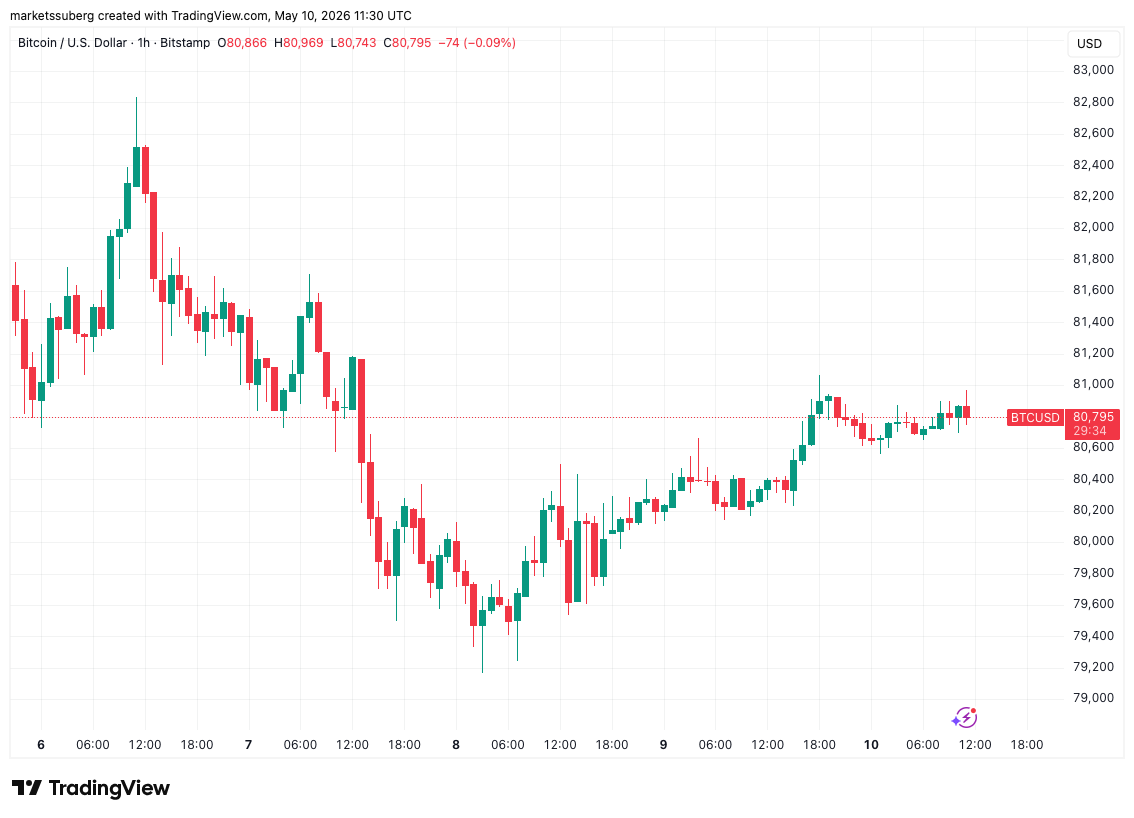
TradingView数据显示,比特币价格在周末大致横盘后转为上行,避免了重新跌破80000美元。

BTC/USD一小时图。来源:Cointelegraph/TradingView

不过,在周中一度逼近83000美元后未能守住,交易员认为BTC/USD有必要回测支撑位——而他们现在再次重申了这一判断。

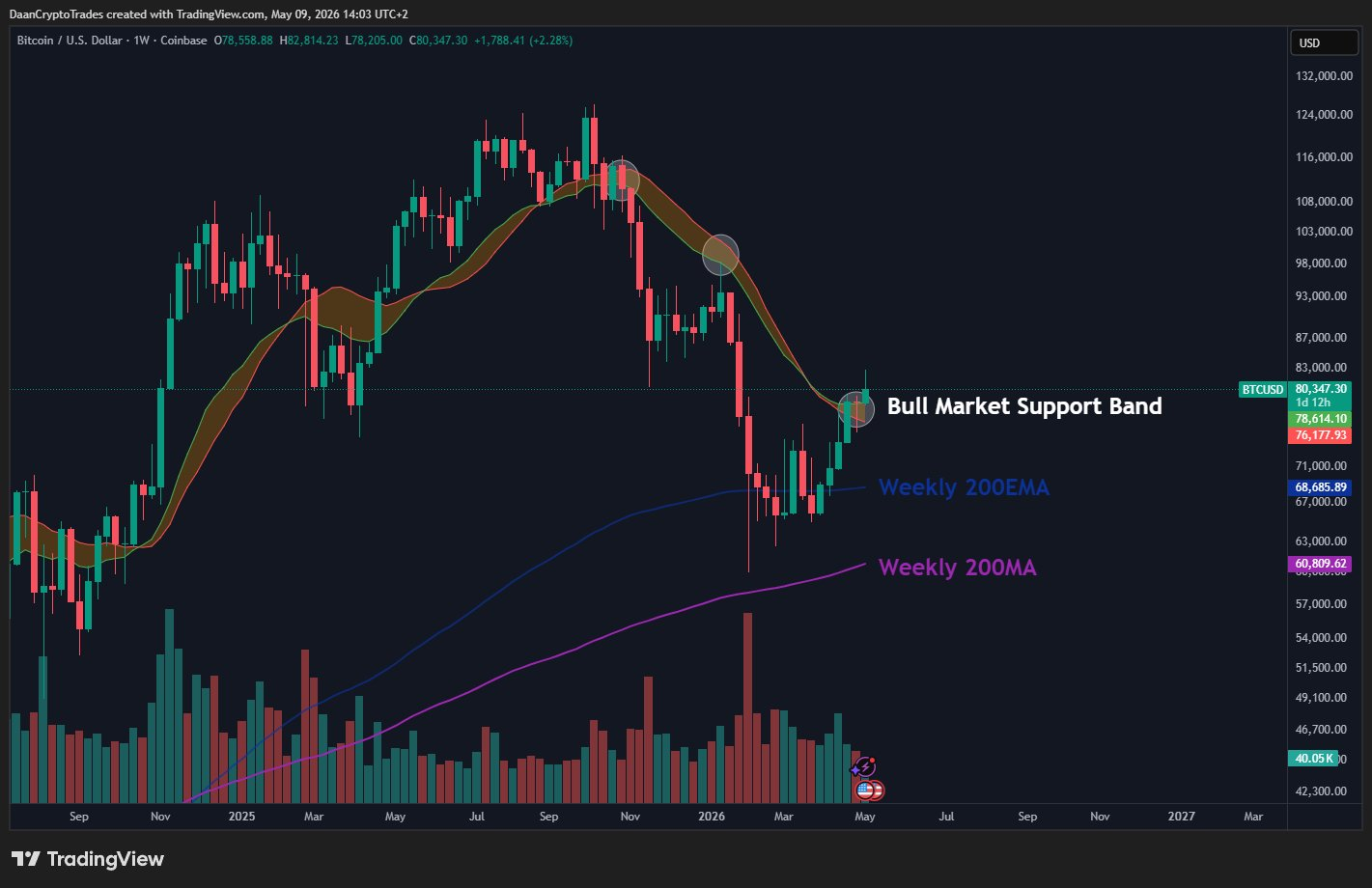
其中尤受关注的是牛市支撑带——位于80000美元关口下方的两条移动平均线。

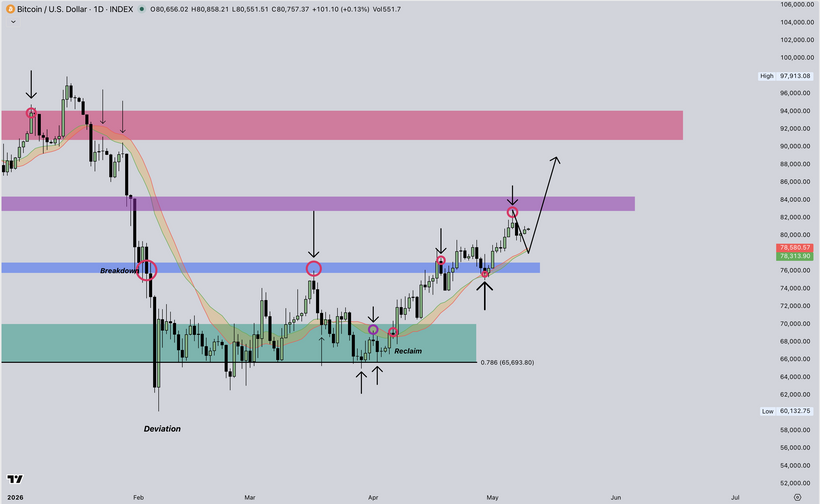
“在低时间框架上,在紫色标注的高时间框架阻力区遭到拒绝后,我认为最可能的结果是短期回落至2日牛市支撑带,这一区域在过去几个月一直是强劲的反转区,”分析账号 Cryptic Trades 在其X最新帖子中配图写道。

“只要价格继续守在支撑带上方,以及蓝色标注、位于75000美元附近的更大高时间框架支撑区之上,而这一区域与2025年4月的筑底形态相吻合,我认为最可能的结果仍是进一步上行。”

交易员 Daan Crypto Trades 也表示认同,称最初突破支撑带的走势“并不干净利落”。

“我希望看到价格至少突破低8万美元区间附近那个黏性区域,并在那里维持一到两周,”他告诉X关注者。

CPI已被BTC“计价”

在下周美国最新通胀数据公布前,交易员 Killa 警告称,BTC价格强势可能重新面临阻力。

定于周二公布的4月消费者价格指数(CPI)预计将显示持续影响美国与伊朗战争及油价上涨对经济的冲击。

“已经计价了,”Killa在X上写道。

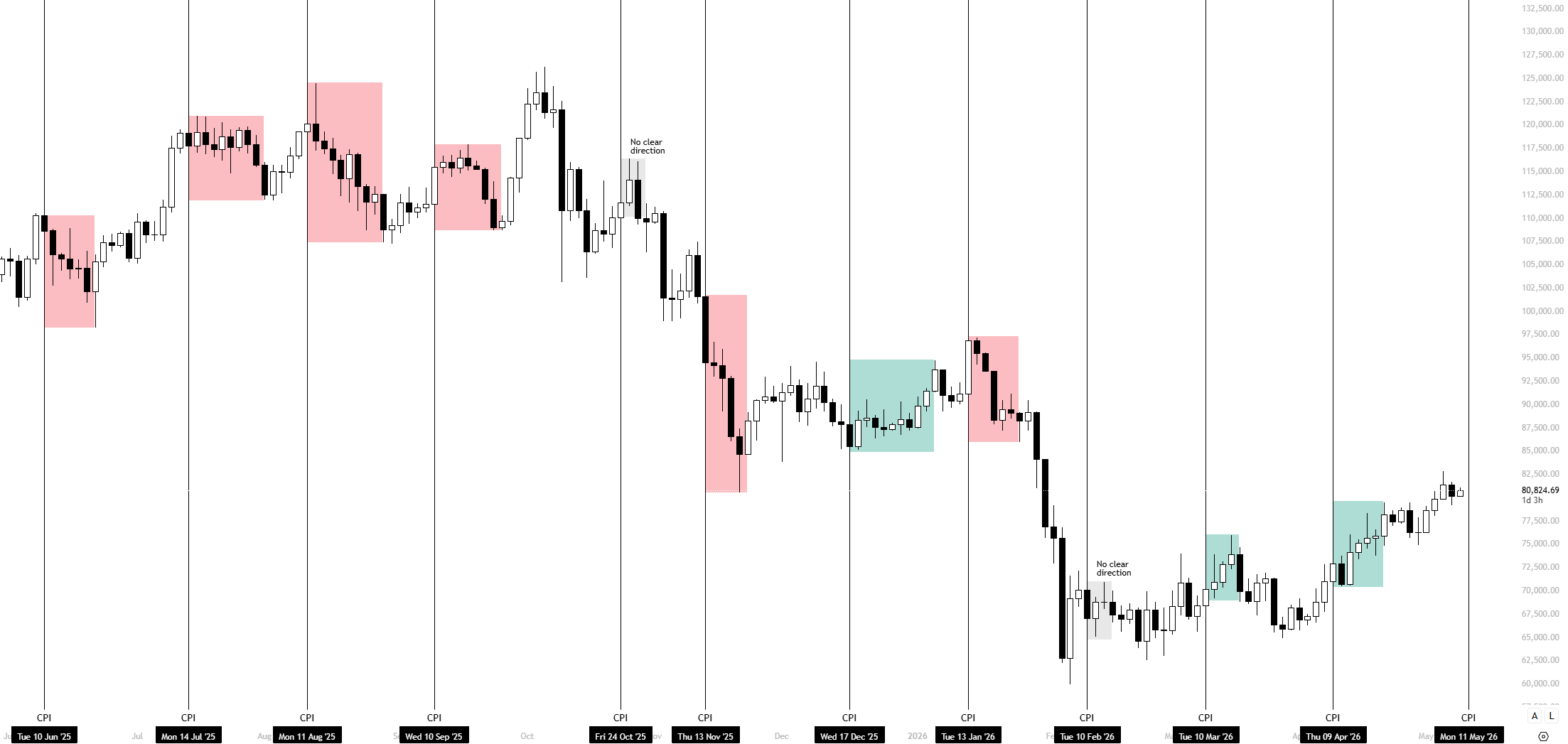
“BTC在过去两次CPI公布后都出现了上涨。不过,如果我们沿着2025年CPI公布后的价格走势来看,可能会看到更大的参与者在事件前围绕逆向叙事开始去风险。”

需要关注的支撑位还包括牛市支撑带附近区域,若失守,74000美元将进入视野。

“我会关注这一枢轴位附近的流动性扫单,以判断下一步走势,”Killa补充道。

Trending Cryptos

Related Reads

The Return of NFT Summer: Which Projects on Robinhood Chain Are Worth Focusing On?

**Summary: "NFT Summer Returns – Which Robinhood Chain Projects Deserve Attention?"** Following the meme coin trend, NFTs are emerging as the new speculative focus on Robinhood Chain. The recent NFT surge gained traction with **StonkBrokers**, a pixel-style "stockbroker" PFP collection of 4,444 NFTs, whose floor price briefly surpassed 13 ETH. The hype significantly amplified with the launch of **Spritehood Wisps** by former Pudgy Penguins co-founder Cole Villemain. This 44,444-item fantasy RPG-inspired collection sold out in under an hour, generating approximately $1.28 million. The article highlights key projects driving this wave: **Already Minted Projects:** * **StonkBrokers**: ERC-6551 NFTs pre-loaded with tokenized stocks, offering rewards based on activation levels with its native token, $STONKBROKER. Floor: ~11.98 ETH. * **Spritehood Wisps**: "Wisp" NFTs that can later be burned to summon customizable Sprite characters. Floor: ~0.0125 ETH. * **Cash Cats**: A 10k PFP collection capitalizing on the popularity of the $CASHCAT meme coin. Floor: ~0.26 ETH. * **Chain Mancers**: A 5k PFP project where each NFT is tied to 500k $MANCER tokens, offering a share of protocol fees. Floor: ~0.9 ETH. **Upcoming Projects (Not Yet Minted):** * **The Saudis**: A revival of a popular 2022 pixel-art project, planning a 5,555-item collection on Robinhood Chain. Whitelist requires holding an original NFT. * **bolds**: A potential "pure art" PFP collection from artist boldleonidas, emphasizing "no utility, anti-hype." * **Chog**: The mascot of the Monad ecosystem, planning a free NFT mint on Robinhood Chain this month, with whitelist tied to holding $CHOG tokens. * **Pizza Ninjas**: An established Bitcoin Ordinals project hinting at a potential new series on Robinhood Chain. The trend underscores renewed creator and investor interest in NFTs, fueled by Robinhood Chain's growing ecosystem.

Odaily星球日报6m ago

The Return of NFT Summer: Which Projects on Robinhood Chain Are Worth Focusing On?

Odaily星球日报6m ago

Unitree is Not Worth Its Current Valuation

Unitree's recent IPO pricing at 150.80 yuan per share, valuing the company at 60.99 billion yuan, has sparked intense market speculation. The valuation metrics appear stretched, with a P/E ratio of 219.23x—nearly six times the industry average—earning it the nickname "dream valuation." Off-exchange platforms like Hyperliquid have seen even more extreme pre-market prices, implying valuations up to four times the IPO level. The core concern is the mismatch between this valuation and the company's current business reality. Unitree's revenue breakdown reveals that over 73% of its humanoid robot sales in the first nine months of 2025 came from research and education, with another 17% from commercial exhibitions. Only 9% was classified as industrial application, and within that small slice, approximately 70% was for enterprise tours and guest reception—essentially advanced display items. Consequently, revenue from actual industrial tasks like manufacturing, inspection, and logistics accounted for less than 3% of total humanoid robot sales. Financially, growth is showing signs of strain. While Q1 2026 revenue grew 68.49% year-over-year, this represents a sharp slowdown from the 332.64% growth seen in Q1 2025. More notably, net profit (non-GAAP) halved, dropping 52.55%, attributed to surging R&D and marketing expenses. The company has also updated its risk disclosures, highlighting the threat of competition from Tesla's Optimus, which plans mass production. Analysts and institutional investors express caution. Some point out that current industry orders are largely for validation, not scalable commercial deployment. One estimate suggests only about 250 of Unitree's 2025 shipments were for genuine industrial use. The high valuation is seen as fueled by global humanoid robot hype and retail investor frenzy. For it to be sustained, Unitree must achieve explosive growth in industrial demand, maintain market share against powerful rivals, and preserve its high gross margins—a challenging set of conditions. While short-term structural factors might support the stock price, the consensus is that the valuation will eventually need to reconcile with fundamental business performance.

Odaily星球日报26m ago

Unitree is Not Worth Its Current Valuation

Odaily星球日报26m ago

Stablecoins and Agentic Commerce Can't Make It into Visa's Earnings Report

**Title: Stablecoins and Agentic – Not Yet on Visa's Financial Statements** **Summary:** On July 16, Visa announced the Visa Stablecoin Platform (VSP), a platform for managing stablecoin issuance and movement, starting with OpenUSD. However, 12 days later, in its FY2026 Q3 earnings call, CEO Ryan McInerney detailed VSP but mentioned no revenue model, timing, or clients. CFO Christopher Suh's financial report did not mention VSP. Analysts' questions largely ignored stablecoins, focusing instead on cross-border growth and core metrics. The article examines Visa's business model using a "highway" analogy: Visa builds the payment network (the road), sets rules, and collects "tolls." Its revenue comes from four main streams: Service Revenue, Data Processing Revenue, International Transaction Revenue, and Other Revenue. After client incentives, Visa's net take-rate has remained stable at ~29 basis points. Currently, Visa's only meaningful revenue from stablecoins comes from "U Cards" – cards linked to stablecoin wallets. In these transactions, stablecoins are converted to fiat *before* entering Visa's network, so they are processed as regular card transactions, contributing to the standard 29 bps fee. Visa's other stablecoin initiatives—settlement pilots (converting *Visa's own* net obligations to stablecoins) and the new VSP platform—do not yet generate revenue; they are operational improvements or future commercial offerings. Regarding Agentic Commerce, Visa's products (Agent Score, Token Assurance Framework) are "devices" allowing AI agents to use the *existing* payment network. They are billed as value-added services. Visa views agentic commerce primarily as AI agents acting on behalf of humans in traditional commerce (replacement), not the potentially new market of machine-to-machine transactions (creation). Strategically, CEO McInerney listed stablecoins and agentic as a *fourth-tier* investment priority, behind core areas like consumer payments and value-added services. They are components within existing strategies, not standalone growth engines with defined addressable markets. In contrast, Mastercard took a different approach by acquiring BVNK for ~$1.8B to gain immediate scale in stablecoin payment processing. Visa's strategy appears conservative: building optionality without major bets. Its core moat is its decades-old dispute resolution and consumer protection infrastructure. The market values Visa for its current robust consumer spending, growing value-added services, and share buybacks—not for its stablecoin or AI agent initiatives. The narrative hype around these topics exceeds their current financial significance for the company.

marsbit37m ago

Stablecoins and Agentic Commerce Can't Make It into Visa's Earnings Report

marsbit37m ago

Trading

Spot

Hot Articles

What is $BITCOIN

DIGITAL GOLD ($BITCOIN): A Comprehensive Analysis Introduction to DIGITAL GOLD ($BITCOIN) DIGITAL GOLD ($BITCOIN) is a blockchain-based project operating on the Solana network, which aims to combine the characteristics of traditional precious metals with the innovation of decentralized technologies. While it shares a name with Bitcoin, often referred to as “digital gold” due to its perception as a store of value, DIGITAL GOLD is a separate token designed to create a unique ecosystem within the Web3 landscape. Its goal is to position itself as a viable alternative digital asset, although specifics regarding its applications and functionalities are still developing. What is DIGITAL GOLD ($BITCOIN)? DIGITAL GOLD ($BITCOIN) is a cryptocurrency token explicitly designed for use on the Solana blockchain. In contrast to Bitcoin, which provides a widely recognized value storage role, this token appears to focus on broader applications and characteristics. Notable aspects include: Blockchain Infrastructure: The token is built on the Solana blockchain, known for its capacity to handle high-speed and low-cost transactions. Supply Dynamics: DIGITAL GOLD has a maximum supply capped at 100 quadrillion tokens (100P $BITCOIN), although details regarding its circulating supply are currently undisclosed. Utility: While precise functionalities are not explicitly outlined, there are indications that the token could be utilized for various applications, potentially involving decentralized applications (dApps) or asset tokenization strategies. Who is the Creator of DIGITAL GOLD ($BITCOIN)? At present, the identity of the creators and development team behind DIGITAL GOLD ($BITCOIN) remains unknown. This situation is typical among many innovative projects within the blockchain space, particularly those aligning with decentralized finance and meme coin phenomena. While such anonymity may foster a community-driven culture, it intensifies concerns about governance and accountability. Who are the Investors of DIGITAL GOLD ($BITCOIN)? The available information indicates that DIGITAL GOLD ($BITCOIN) does not have any known institutional backers or prominent venture capital investments. The project seems to operate on a peer-to-peer model focused on community support and adoption rather than traditional funding routes. Its activity and liquidity are primarily situated on decentralized exchanges (DEXs), such as PumpSwap, rather than established centralized trading platforms, further highlighting its grassroots approach. How DIGITAL GOLD ($BITCOIN) Works The operational mechanics of DIGITAL GOLD ($BITCOIN) can be elaborated on based on its blockchain design and network attributes: Consensus Mechanism: By leveraging Solana’s unique proof-of-history (PoH) combined with a proof-of-stake (PoS) model, the project ensures efficient transaction validation contributing to the network's high performance. Tokenomics: While specific deflationary mechanisms have not been extensively detailed, the vast maximum token supply implies that it may cater to microtransactions or niche use cases that are still to be defined. Interoperability: There exists the potential for integration with Solana’s broader ecosystem, including various decentralized finance (DeFi) platforms. However, the details regarding specific integrations remain unspecified. Timeline of Key Events Here is a timeline that highlights significant milestones concerning DIGITAL GOLD ($BITCOIN): 2023: The initial deployment of the token occurs on the Solana blockchain, marked by its contract address. 2024: DIGITAL GOLD gains visibility as it becomes available for trading on decentralized exchanges like PumpSwap, allowing users to trade it against SOL. 2025: The project witnesses sporadic trading activity and potential interest in community-led engagements, although no noteworthy partnerships or technical advancements have been documented as of yet. Critical Analysis Strengths Scalability: The underlying Solana infrastructure supports high transaction volumes, which could enhance the utility of $BITCOIN in various transaction scenarios. Accessibility: The potential low trading price per token could attract retail investors, facilitating wider participation due to fractional ownership opportunities. Risks Lack of Transparency: The absence of publicly known backers, developers, or an audit process may yield skepticism regarding the project's sustainability and trustworthiness. Market Volatility: The trading activity is heavily reliant on speculative behavior, which can result in significant price volatility and uncertainty for investors. Conclusion DIGITAL GOLD ($BITCOIN) emerges as an intriguing yet ambiguous project within the rapidly evolving Solana ecosystem. While it attempts to leverage the “digital gold” narrative, its departure from Bitcoin's established role as a store of value underscores the need for a clearer differentiation of its intended utility and governance structure. Future acceptance and adoption will likely depend on addressing the current opacity and defining its operational and economic strategies more explicitly. Note: This report encompasses synthesised information available as of October 2023, and developments may have transpired beyond the research period.

1.8k Total ViewsPublished 2025.05.13Updated 2025.05.13
What is $BITCOIN

Discussions

Welcome to the HTX Community. Here, you can stay informed about the latest platform developments and gain access to professional market insights. Users' opinions on the price of BTC (BTC) are presented below.

活动图片