Vitalik Buterin Makes Shocking Warning About Ethereum’s Future

bitcoinistPublished on 2026-03-05Last updated on 2026-03-05

Abstract

Ethereum co-founder Vitalik Buterin warns that Ethereum risks betraying its original mission if it remains narrowly focused on DeFi, yield farming, and political meme coins. He argues that while financial freedom is important, it alone cannot address major global threats like government surveillance, wars, and corporate control. Buterin calls for Ethereum to evolve into a broader ecosystem of "sanctuary technologies" that empower people with censorship-resistant tools for communication, coordination, and identity—not just finance. He emphasizes the need for technologies that enable cooperation without central control, citing real-world examples like crypto aiding citizens in Venezuela and Iran against hyperinflation and authoritarianism. Ethereum’s future relevance, he concludes, depends on expanding beyond finance to tackle deeper societal challenges.

Ethereum co-founder, Vitalik Buterin, has issued one of his starkest warnings yet: if the network continues to limit itself to DeFi, obsessing over yields and political meme coins, it will betray Ethereum’s original mission.

Ethereum Beyond DeFi

In a post on social network X on March 3, Buterin shared an essay‐like reflection on how his worries, and the worries of people around him, highlight the fact that Ethereum is not doing enough to be an active force for change amid world‐class threats such as “government control and surveillance, wars, corporate power and surveillance.”

He argues that Ethereum seems largely absent from meaningfully improving the lives of people subject to these forces, even on the dimensions the ecosystem claims to care most about: freedom, privacy, the security of digital life, and community self‐organization. Buterin states:

Ethereum seems to be absent from meaningfully improving the lives of people subject to these things, even on the dimensions we deeply care about (eg. freedom, privacy, security of digital life, community self-organization).

Buterin stresses that his critique is not aimed at DeFi itself. On one hand, he warns against the narrow culture that has grown around it, made of hollow trends that turn politics and real‐world concerns into spectacle through political meme coins and “various zero‐sum gambling applications.”

On the other, he laments that if Ethereum continues to “laser‐focus” on finance, its impact on improving people’s lives will remain minimal, a striking contrast with what he calls “liberating technologies” like Starlink or Signal, which are already reshaping the balance of power in the real world. He acknowledges the importance of financial freedom, but argues that it is no longer enough. Buterin added:

Financial freedom and security is critical. But it seems obvious that, while adding a perfectly free and open and sovereign and debasement-proof financial system would fix some things, but it would leave the bulk of our deep worries about the world unaddressed. It’s okay for individuals to laser-focus on finance, but we need to be part of some greater whole that has things to say about the other problems too.

The Path To Sanctuary Technologies

Understanding that “Ethereum cannot fix the world”, Buterin proposes that what Ethereum should do is to think itself as “being part of an ecosystem building ‘sanctuary technologies’”. This means tools that give people a place to communicate, organize, and hold value where states and corporations cannot easily surveil, censor, or confiscate.

The Goal Is De-Totalization

The ambitious and holistic approach suggested by Buterin seeks one main objective: “to enable interdependence that cannot be weaponized”, the opposite to remaking the world in Ethereum’s shape. Summing up, Buterin states that this interdependence stands on four pillars: finances (ETH, stablecoins, DeFi), communication (encrypted messaging, censorship‐resistant social), coordination (DAOs, crowdfunding, mutual aid) and identity (non‐custodial IDs and reputation). In Buterin words:

Ethereum’s role is to create “digital space” where different entities can cooperate and interact.

When Crypto Becomes Survival Tech

Crypto has already shown what it looks like when blockchains become survival tools rather than trading venues. In places like Venezuela, families use stablecoins and Bitcoin to route remittances around capital controls, protect savings from hyperinflation, and move money when local banks either collapse or become instruments of state control and beyond. Activists and dissidents lean on censorship‐resistant rails to receive support, fund legal defenses, and simply stay connected to a global economy that their governments are trying to cut them off from.

According to an article posted on our sister website NewsBTC, crypto has become a financial lifeline for ordinary Iranian households amidst the political unrest and economic collapse. For ordinary users, crypto remains a lifeline of hope against capital control and inflation.

Whether Ethereum lives up to Vitalik Buterin’s promise will define not just its market cap, but its relevance in a world where financial censorship and digital authoritarianism are no longer hypotheticals.

ETH's price trends to the upside on the daily chart. Source: ETHUSD on Tradingview

Cover image from ChatGPT, ETHUSD chart from Tradingview

Related Questions

QWhat is Vitalik Buterin's main warning about Ethereum's future according to the article?

AVitalik Buterin warns that if Ethereum continues to limit itself primarily to DeFi, focusing on yields and political meme coins, it will betray its original mission of being a force for positive change against global threats like government control, surveillance, and wars.

QWhat does Buterin propose as an alternative focus for Ethereum beyond DeFi?

AButerin proposes that Ethereum should think of itself as part of an ecosystem building 'sanctuary technologies'—tools that provide a place for people to communicate, organize, and hold value where states and corporations cannot easily surveil, censor, or confiscate.

QWhat are the four pillars of interdependence that Buterin outlines for Ethereum ecosystem?

AThe four pillars are: finances (ETH, stablecoins, DeFi), communication (encrypted messaging, censorship-resistant social), coordination (DAOs, crowdfunding, mutual aid), and identity (non-custodial IDs and reputation).

QHow has cryptocurrency already served as a 'survival tool' in some countries, as mentioned in the article?

AIn countries like Venezuela and Iran, crypto has been used as a survival tool for routing remittances around capital controls, protecting savings from hyperinflation, and allowing activists to receive support and stay connected to the global economy despite government attempts to isolate them.

QWhat is the ultimate goal of the holistic approach suggested by Buterin for Ethereum?

AThe ultimate goal is 'de-totalization'—to enable interdependence that cannot be weaponized, creating a digital space where different entities can cooperate and interact freely without the risk of censorship or control.

Related Reads

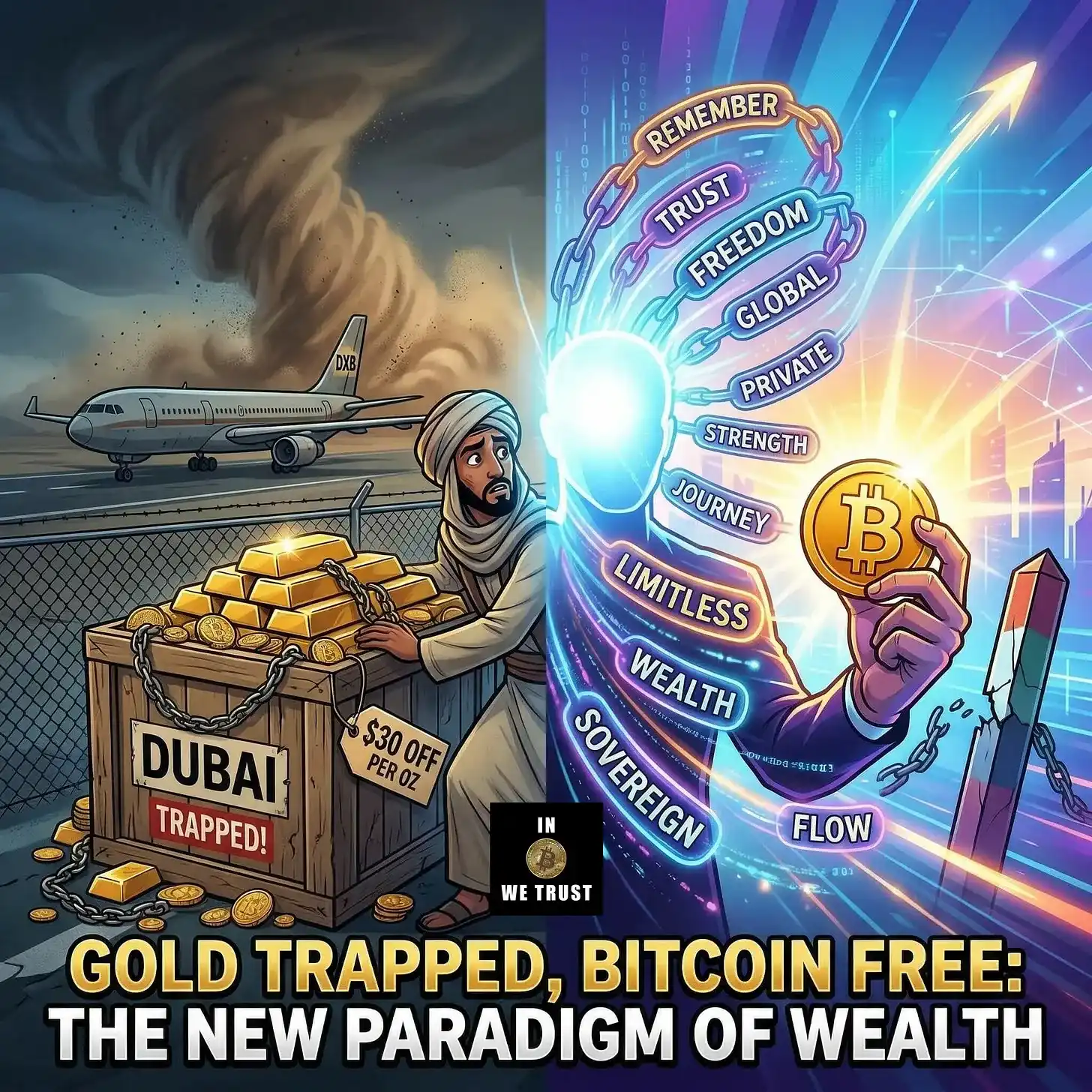
Gold Trapped in the Desert, Borderless Bitcoin: The New Paradigm of Wealth in an Era of War

Title: Gold Trapped in the Desert, Borderless Bitcoin: A New Paradigm of Wealth in Times of War The recent escalation of geopolitical tensions in the Middle East, particularly involving the U.S., Israel, and Iran, has led to a severe disruption at Dubai International Airport—a critical global hub for trade and logistics. This crisis has exposed a significant vulnerability in the traditional financial system: the complete paralysis of physical gold transportation. Gold, often regarded as the ultimate safe-haven asset, relies on an intricate and high-security logistics network, including specialized transport, armed guards, and multi-million-dollar insurance policies. However, during times of war, this system collapses. Flights are grounded, airspace becomes unsafe, and gold suppliers are unable to move their inventories. As a result, gold traders in Dubai are forced to sell at discounts of up to $30 per ounce to avoid mounting storage costs, insurance premiums, and opportunity costs—highlighting the irony of a避险资产 becoming a financial burden. In contrast, Bitcoin demonstrates unparalleled resilience in such crises. While its price may experience volatility during geopolitical turmoil, its true value lies in its non-physical, censorship-resistant nature. Unlike gold, Bitcoin does not require physical transport, is not subject to confiscation at borders, and can be transferred across the globe instantly with just a 12- or 24-word seed phrase. This makes it an ideal store of value for individuals and businesses caught in conflict zones, where traditional financial systems and physical assets fail. The Dubai gold crisis underscores a broader shift in the paradigm of wealth preservation. Physical gold, despite its historical prestige, is constrained by its materiality and dependence on centralized infrastructure. Bitcoin, as a decentralized digital asset, offers a solution that transcends borders, governments, and physical limitations. In an era of increasing geopolitical instability, the ability to carry one’s wealth seamlessly and securely—without the constraints of weight, logistics, or censorship—positions Bitcoin as the modern embodiment of financial sovereignty.

marsbit29m ago

Gold Trapped in the Desert, Borderless Bitcoin: The New Paradigm of Wealth in an Era of War

marsbit29m ago

Trading

Spot
Futures

Hot Articles

Discussions

Welcome to the HTX Community. Here, you can stay informed about the latest platform developments and gain access to professional market insights. Users' opinions on the price of ETH (ETH) are presented below.

活动图片