12月23行情分析:今日为何下跌?BTC、ETH、BNB、SOL、LUMIA、PORTAL、ASR、ME山寨币操作建议

金色财经Published on 2025-12-23Last updated on 2025-12-23

Abstract

加密货币市场24小时内下跌1.25%,主要受避险情绪和年底流动性收紧影响。下跌原因包括约40万台比特币矿机关机导致约8700万美元的比特币清算压力、期货交易量激增121%加剧跌势,以及资金轮动至比特币(其市占率升至58.98%)。全网24小时爆仓额达2.63亿美元,多头损失1.85亿美元。 比特币关键位为88800美元,站稳方可结束调整,压力位89600-91355,支撑位87720-85220。以太坊需守稳3010美元,压力位3043-3115,支撑位2970-2906。BNB分水岭为861美元,SOL需突破126美元。 市场总市值3.07万亿美元,恐惧指数为25。黄金创新高、美联储降息推迟至2026加剧避险情绪。涨幅前三代币为LUMIA(+36%)、PORTAL(+17%)、TST(+10%);跌幅前三为ASR(-16%)、ME(-12%)、AT(-11%)。

?过去24小时内,加密货币市场下跌了1.25%。这一跌幅与整体避险趋势和年底流动性限制相符。

1.矿场关闭——约 40 万台比特币矿机离线,导致超过 8700 万美元的比特币清算和抛售压力。

2.衍生品波动性——期货交易量增长了 121%,进一步巩固了下降趋势。

3.恐惧驱动的轮动——比特币市场份额上升至 58.98%;投资者抛售其他加密货币。

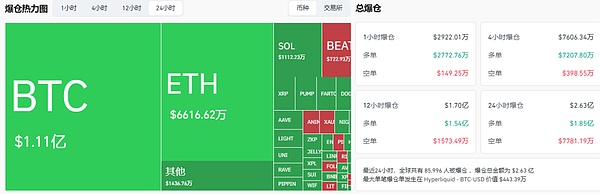
?爆仓警报:

24小时全网共有85,980人被被爆仓,总额2.63亿美元,其中多头惨遭血洗($1.85亿),空头也难幸免($7779.20万)。
? 主流币表现:

1.比特币(BTC):价格约87313,24小时跌1.82%

比特币今天盯紧 88800 生命线!能稳稳站在这个数上方,这波 4 小时小调整才算彻底结束,行情才能接着往上冲。上方压力位看89600、90585、91355,一步一步突破才靠

要是今天收盘站不上 88800,那这波小反弹就是 “花架子”,接下来大概率得往下踩支撑,重点盯 87720、86650、85220 这三道防线!

2.以太坊(ETH):价格约2957,24小时跌2.33%

以太坊今日关键位锁定 3010!站稳这个数,调整直接收尾,行情才有上行的底气。上方压力看3043、3078、3115,逐个攻克才能涨不停!

要是收盘没摸到3010,说明反弹没力气,下方支撑位2970、2943、2906 接住它!

3.BNB:价格约848,24小时跌1.27%

BNB今天的分水岭就是 861!能站上去,调整就画上句号,后续可以安心看涨~ 上方压力位871、878、892,压力层层递进,突破需谨慎!

要是收盘站不上 861,这波反弹就是 “虚晃一枪”,下方支撑盯紧 852、844、833,守住才算稳!

4.SOL:价格约124,24小时跌1.30%

SOL今日盯死 126 这个关键位!站稳脚跟,调整直接拜拜,行情开启上行模式~ 上方压力看128、131、134,冲关成功才有肉吃!

要是收盘没站上 126,反弹就是 “纸老虎”,接下来看支撑位 123、120、117 兜底,别让行情跌穿咯!

?️市场情绪:

今日,加密货币总市值约为3.07万亿美元,24 小时总交易量约为1100亿美元。

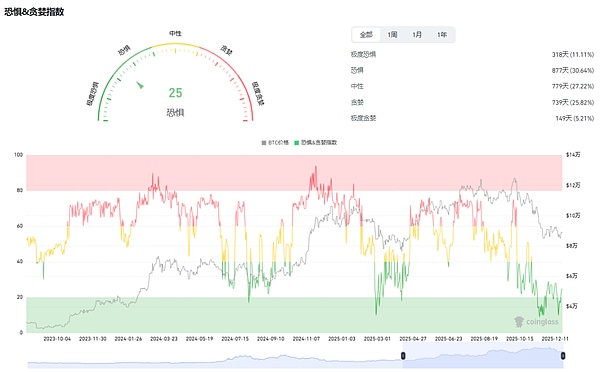
当前市场情绪为25(恐惧),流动性低迷叠加宏观经济不稳,黄金价格创了历史新高,美联储降息预期也拖到了 2026 年,投资者都更愿意抱紧比特币。衍生品交易量在涨,可恐惧与贪婪指数却没动静,这意味着市场波动要变大了。
今日加密涨跌榜?

? 涨幅TOP3:

1.LUMIA:价格 $0.132,24小时涨36%

2.PORTAL:价格 $0.0247,24小时涨17%

3.TST:价格 $0.01800,24小时涨10%

? 跌幅TOP3:

1.ASR:价格 $1.628,24小时跌16%

2.ME:价格 $0.1972,24小时跌12%

3.AT:价格 $0.0893,24小时跌11%

其他主流币表现:

狗狗币 (DOGE):价格 $0.13056,24小时跌1.02%

波场 (TRX):价格 $0.2838,24小时跌1.25%

艾达币 (ADA):价格 $0.3647,24小时跌0.60%

Hyperliquid (HYPE):价格 $24.403,24小时涨3.54跌2.23%

Avalanche (AVAX):价格 $12.18,24小时涨0.08%

恒星币 (XLM):价格 $0.2170,24小时跌0.32%

Sui (SUI):价格 $1.4379,24小时跌0.83%

Chainlink (LINK):价格 $12.31,24小时跌1.91%

Hedera (HBAR):价格 $0.11132,24小时跌1.04%

比特现金 (BCH):价格 $580.8,24小时涨0.33%

Shiba Inu (SHIB):价格 $0.00000715,24小时跌1.52%

莱特币 (LTC):价格 $76.77,24小时跌1.07%

Pepe hiba Inu (PEPE):价格 $0.00000395,24小时跌1.74%

Toncoin (TON):价格 $1.451,24小时跌0.34%

Related Questions

Q12月23日加密货币市场下跌的主要原因有哪些?

A主要原因包括:1. 约40万台比特币矿机关闭导致清算和抛售压力,涉及超过8700万美元比特币;2. 期货交易量增长121%加剧市场波动;3. 投资者因避险情绪抛售山寨币,转向比特币,使其市场份额升至58.98%。

Q比特币(BTC)当前的关键支撑位和压力位分别是多少?

A比特币关键支撑位为87720、86650、85220美元;压力位为89600、90585、91355美元。若收盘价无法站上88800美元,可能进一步下跌测试支撑。

Q以太坊(ETH)的短期行情判断依据是什么?

A以太坊需站稳3010美元才能结束调整并开启上行,压力位为3043、3078、3115美元;若未能站上3010美元,则可能测试下方2970、2943、2906美元支撑位。

Q当日涨幅和跌幅最大的三种山寨币分别是哪些?

A涨幅TOP3:LUMIA(涨36%)、PORTAL(涨17%)、TST(涨10%);跌幅TOP3:ASR(跌16%)、ME(跌12%)、AT(跌11%)。

Q当前市场情绪指数和总交易量如何?

A市场情绪指数为25(恐惧),总市值约3.07万亿美元,24小时总交易量约为1100亿美元。流动性低迷和宏观经济不确定性导致投资者偏好比特币。

Related Reads

Uncovering the Truth About Agent Commerce, Payments, and Infrastructure

Decoding Agent Commerce, Payments, and Infrastructure: The Reality Over the past year, I've been building infrastructure for the Agent economy, engaging with major players like Stripe, Visa, Coinbase, Google, and dozens of startups. A clear conclusion emerges: true, large-scale demand does not yet exist. Startups face structural challenges. Data points illustrate this gap. Stripe's Agent commerce platform has over 1,000 merchants but only single-digit transacting agents. Visa's Agent payment token requires 9-month KYC and a $250M revenue threshold, accessible only to giants like Amazon. On-chain analysis reveals actual daily Agent transaction volume is around $17k, half of which are test transactions. The article analyzes four potential markets: **1. Agent-to-Merchant (A2M):** Current AI shopping UX is often inferior to traditional e-commerce for visual, comparison-heavy purchases (clothing, electronics). Chat interfaces are a step back. Real merchant interest is defensive "Agent Engine Optimization," fearing future obsolescence, not current demand. Potential exists in high-frequency, low-decision purchases (e.g., food delivery) or simplifying terrible UX (complex checkouts, non-native shoppers), but these require massive consumer distribution channels dominated by giants like DoorDash and Amazon. **2. Agent-to-API (A2A):** Developers already have subscriptions and billing for core APIs (compute, data). The argument for micro-payments via crypto for sub-dollar API calls is addressed by pre-paid balances today. The deeper issue is supplier resistance; major SaaS firms rely on enterprise contracts, not fractional cent pricing. Opportunity lies in the long tail of niche services, but this is a smaller market catering to developers, a historically low-paying group. **3. Agent-to-Agent (A2A):** This remains a theoretical long-term vision with near-zero current transaction volume. It involves unique challenges: discovery, trust, negotiation, dispute resolution. When it materializes, it will require a fundamentally new settlement infrastructure for high-speed, variable-value, multi-party transactions. It's a real long-term bet, but not the current market. **4. Agent-to-Finance (A2F):** This is the only category with existing, paying demand. Integrating AI into financial workflows (trading, portfolio management) is a natural evolution and enables new capabilities like autonomous rebalancing. However, competition favors incumbents with regulatory licenses, compliance infrastructure, and existing client relationships. **The Real Issue:** Why is infrastructure still being built? Incumbents can afford long-term bets, and payment companies see every problem as a nail for their payment hammer. However, payment is just one piece. The core challenge is *coordination*—orchestrating work between Agents and humans, verifying outcomes, and settling results. Payment is part of settlement, which is part of coordination. Companies that solve the coordination problem will subsume payments, not the other way around. Startups lack the infinite runway of giants and must find today's real market, which, after a year of exploration, lies outside these four categories—in an area with real, growing, and underserved activity.

marsbit1h ago

Uncovering the Truth About Agent Commerce, Payments, and Infrastructure

marsbit1h ago

Kalshi, MTS, and a16z's Ambition

The article "Kalshi, MTS, and a16z's Ambition" explores prediction markets as a focal point of excitement in 2025 for investors, crypto enthusiasts, and media. It traces their intellectual lineage from Friedrich Hayek's ideas on dispersed knowledge and market coordination to Robin Hanson's Logarithmic Market Scoring Rule (LMSR), which incentivizes truthful information sharing. The piece argues that a16z's significant investment in prediction market platform Kalshi (valued at $220B) transcends mere financial speculation. a16z frames prediction markets as a new form of "media" that provides "presence"—a way for individuals to actively engage with and influence world events through financial stakes, countering postmodern detachment. By wagering on outcomes, users become "super observers," and the market's aggregated probabilities gain authoritative power to define event truth and importance. The article uses media company MTS ("Monitoring The Situation") as a case study of a16z's "new media" strategy: rapidly producing high-intensity, multi-format content to "take over the timeline." However, prediction markets like Kalshi are presented as the ultimate piece in this media empire. Their real-money, crowd-sourced probabilities possess a unique "reality distortion field" and perceived objectivity, potentially swaying public opinion and granting a private company unprecedented interpretive power over reality. Ultimately, Kalshi's immense valuation is attributed not just to its exchange model, but to its role as a foundational component in a16z's envisioned new media landscape, where prediction markets define narrative and truth.

链捕手1h ago

Kalshi, MTS, and a16z's Ambition

链捕手1h ago

Trading

Spot
Futures

Hot Articles

What is $BITCOIN

DIGITAL GOLD ($BITCOIN): A Comprehensive Analysis Introduction to DIGITAL GOLD ($BITCOIN) DIGITAL GOLD ($BITCOIN) is a blockchain-based project operating on the Solana network, which aims to combine the characteristics of traditional precious metals with the innovation of decentralized technologies. While it shares a name with Bitcoin, often referred to as “digital gold” due to its perception as a store of value, DIGITAL GOLD is a separate token designed to create a unique ecosystem within the Web3 landscape. Its goal is to position itself as a viable alternative digital asset, although specifics regarding its applications and functionalities are still developing. What is DIGITAL GOLD ($BITCOIN)? DIGITAL GOLD ($BITCOIN) is a cryptocurrency token explicitly designed for use on the Solana blockchain. In contrast to Bitcoin, which provides a widely recognized value storage role, this token appears to focus on broader applications and characteristics. Notable aspects include: Blockchain Infrastructure: The token is built on the Solana blockchain, known for its capacity to handle high-speed and low-cost transactions. Supply Dynamics: DIGITAL GOLD has a maximum supply capped at 100 quadrillion tokens (100P $BITCOIN), although details regarding its circulating supply are currently undisclosed. Utility: While precise functionalities are not explicitly outlined, there are indications that the token could be utilized for various applications, potentially involving decentralized applications (dApps) or asset tokenization strategies. Who is the Creator of DIGITAL GOLD ($BITCOIN)? At present, the identity of the creators and development team behind DIGITAL GOLD ($BITCOIN) remains unknown. This situation is typical among many innovative projects within the blockchain space, particularly those aligning with decentralized finance and meme coin phenomena. While such anonymity may foster a community-driven culture, it intensifies concerns about governance and accountability. Who are the Investors of DIGITAL GOLD ($BITCOIN)? The available information indicates that DIGITAL GOLD ($BITCOIN) does not have any known institutional backers or prominent venture capital investments. The project seems to operate on a peer-to-peer model focused on community support and adoption rather than traditional funding routes. Its activity and liquidity are primarily situated on decentralized exchanges (DEXs), such as PumpSwap, rather than established centralized trading platforms, further highlighting its grassroots approach. How DIGITAL GOLD ($BITCOIN) Works The operational mechanics of DIGITAL GOLD ($BITCOIN) can be elaborated on based on its blockchain design and network attributes: Consensus Mechanism: By leveraging Solana’s unique proof-of-history (PoH) combined with a proof-of-stake (PoS) model, the project ensures efficient transaction validation contributing to the network's high performance. Tokenomics: While specific deflationary mechanisms have not been extensively detailed, the vast maximum token supply implies that it may cater to microtransactions or niche use cases that are still to be defined. Interoperability: There exists the potential for integration with Solana’s broader ecosystem, including various decentralized finance (DeFi) platforms. However, the details regarding specific integrations remain unspecified. Timeline of Key Events Here is a timeline that highlights significant milestones concerning DIGITAL GOLD ($BITCOIN): 2023: The initial deployment of the token occurs on the Solana blockchain, marked by its contract address. 2024: DIGITAL GOLD gains visibility as it becomes available for trading on decentralized exchanges like PumpSwap, allowing users to trade it against SOL. 2025: The project witnesses sporadic trading activity and potential interest in community-led engagements, although no noteworthy partnerships or technical advancements have been documented as of yet. Critical Analysis Strengths Scalability: The underlying Solana infrastructure supports high transaction volumes, which could enhance the utility of $BITCOIN in various transaction scenarios. Accessibility: The potential low trading price per token could attract retail investors, facilitating wider participation due to fractional ownership opportunities. Risks Lack of Transparency: The absence of publicly known backers, developers, or an audit process may yield skepticism regarding the project's sustainability and trustworthiness. Market Volatility: The trading activity is heavily reliant on speculative behavior, which can result in significant price volatility and uncertainty for investors. Conclusion DIGITAL GOLD ($BITCOIN) emerges as an intriguing yet ambiguous project within the rapidly evolving Solana ecosystem. While it attempts to leverage the “digital gold” narrative, its departure from Bitcoin's established role as a store of value underscores the need for a clearer differentiation of its intended utility and governance structure. Future acceptance and adoption will likely depend on addressing the current opacity and defining its operational and economic strategies more explicitly. Note: This report encompasses synthesised information available as of October 2023, and developments may have transpired beyond the research period.

363 Total ViewsPublished 2025.05.13Updated 2025.05.13

What is $BITCOIN

Discussions

Welcome to the HTX Community. Here, you can stay informed about the latest platform developments and gain access to professional market insights. Users' opinions on the price of BTC (BTC) are presented below.

活动图片














