Galaxy predice que las stablecoins superarán el volumen de transacciones ACH en 2026

cointelegraphPublished on 2025-12-19Last updated on 2025-12-19

Abstract

Según un pronóstico de Galaxy Research, las stablecoins podrían superar el volumen de transacciones del sistema ACH de EE.UU. en 2026, impulsadas por la claridad regulatoria y una mayor adopción. Actualmente, las transacciones con stablecoins ya superan a las de redes como Visa y alcanzan la mitad del volumen del ACH. El suministro de stablecoins crece a una tasa anual del 30-40%, y se espera que la implementación de la Ley GENIUS a principios de 2026 acelere aún más su uso. Además, Galaxy proyecta que Bitcoin podría alcanzar los $250,000 para fines de 2027. El mercado de stablecoins, valorado en $309 mil millones, está dominado por USDT y USDC, pero nuevas entradas como Western Union, Sony Bank y SoFi Technologies están lanzando sus propias stablecoins. Se anticipa una consolidación en 2026, donde los usuarios probablemente adoptarán solo una o dos stablecoins con la mayor aceptación.

Las stablecoins podrían procesar más volumen de transacciones que el sistema estadounidense de Automated Clearing House (ACH) en 2026, a medida que la claridad regulatoria y la creciente adopción amplíen su uso, según un nuevo pronóstico.

Galaxy Research, el brazo de investigación de la compañía de activos digitales Galaxy Digital, señaló los datos de transacciones existentes y los desarrollos regulatorios para respaldar su predicción, destacando que "las transacciones con stablecoins ya eclipsan a las principales redes de tarjetas de crédito como Visa y ahora procesan aproximadamente la mitad del volumen de transacciones del sistema de cámaras de compensación automatizadas (ACH)".

Thad Pinakiewicz, vicepresidente de investigación, dijo que la oferta de stablecoins ha seguido creciendo a una tasa de crecimiento anual compuesto del 30% al 40%, con volúmenes de transacción aumentando junto con la emisión. Galaxy también citó la implementación esperada de las definiciones bajo la Ley GENIUS a principios de 2026 como un factor que respalda un mayor crecimiento en el uso de stablecoins.
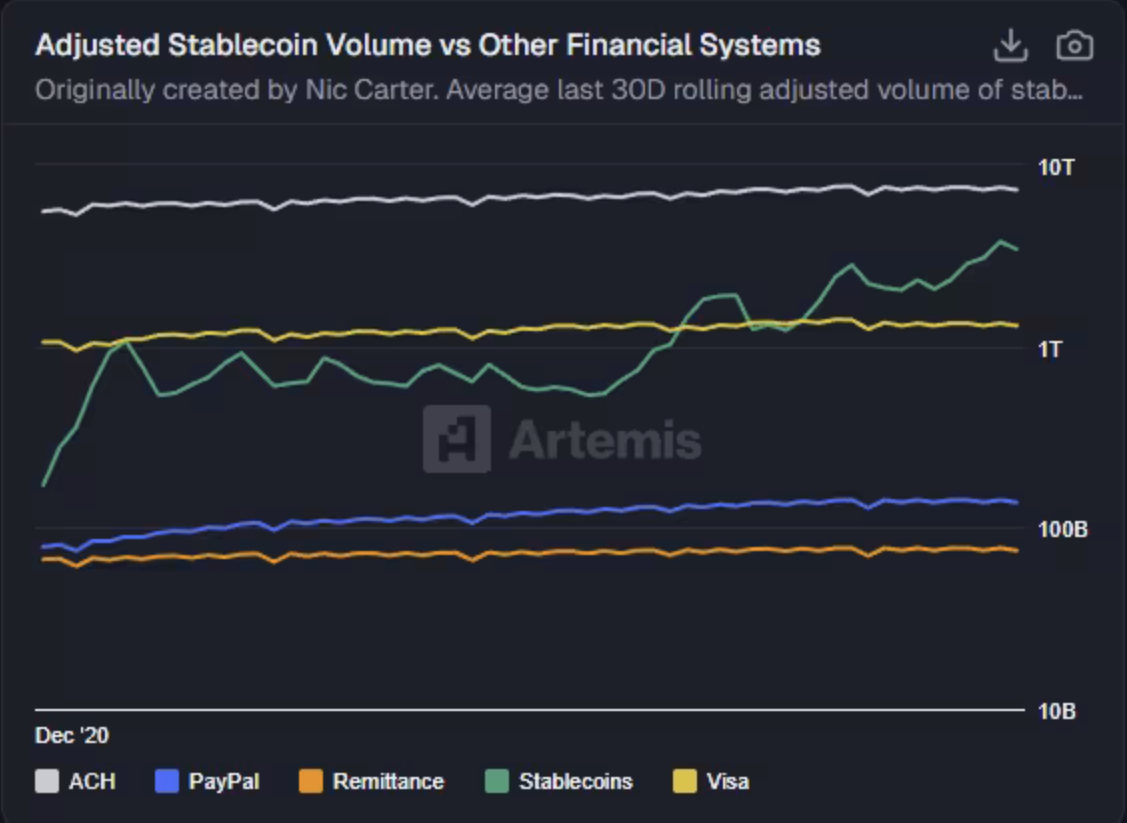
Volumen de stablecoins vs. otros sistemas financieros. Fuente: Galaxy Digital

El documento también incluye predicciones para el precio de Bitcoin (BTC), escribiendo que podría alcanzar los $250,000 para fines de 2027. Según Alex Thorn, jefe de investigación de Galaxy Research, 2026 es "demasiado caótico para predecir, aunque que Bitcoin alcance nuevos máximos históricos en 2026 sigue siendo posible".

Relacionado: Coinbase es ‘cautelosamente optimista’ para 2026 a medida que las criptomonedas se acercan a un punto de inflexión institucional

El mercado de stablecoins vinculadas al dólar se expande

Según datos de DefiLlama, la capitalización de mercado de las stablecoins actualmente se sitúa en alrededor de $309 mil millones. Si bien USDt (USDT) de Tether y USDC (USDC) de Circle continúan dominando, un número creciente de instituciones financieras y empresas de pagos han ingresado a la carrera de las stablecoins en los últimos meses.
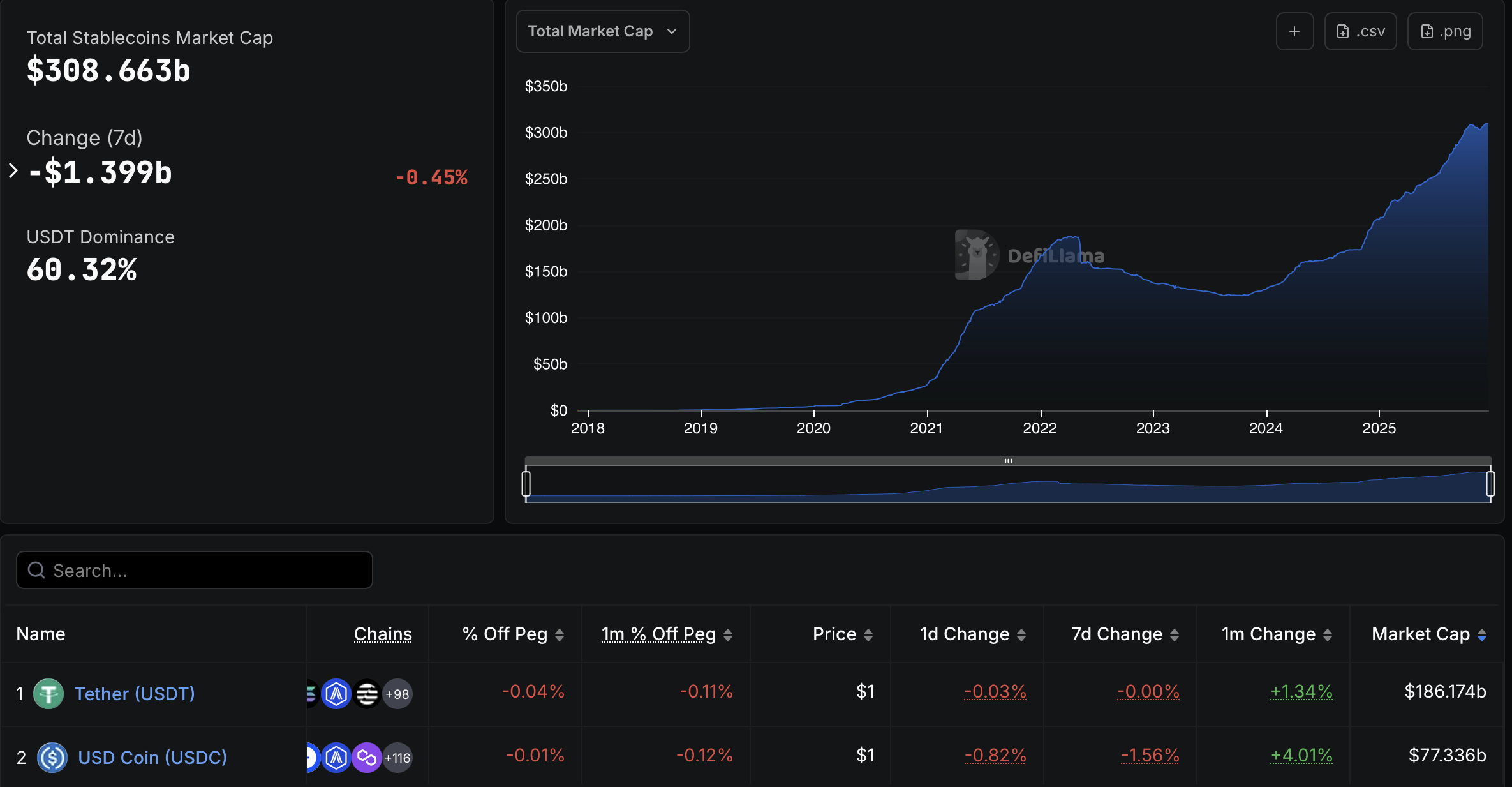
Capitalización de mercado de stablecoins. Fuente: DefiLlama

En octubre, Western Union anunció planes para lanzar su propia stablecoin vinculada al dólar estadounidense, el US Dollar Payment Token, que se construirá en la blockchain de Solana y será emitida por Anchorage Digital Bank como parte de una red de liquidación de activos digitales más amplia.

Se informó que Sony Bank estaba preparando una stablecoin vinculada al dólar estadounidense para su uso en el ecosistema estadounidense de Sony, incluidos juegos de PlayStation, suscripciones y contenido de anime. Se espera que la stablecoin se lance en 2026.

El jueves, SoFi Technologies lanzó SoFiUSD, una stablecoin de dólar estadounidense totalmente respaldada emitida por su subsidiaria bancaria, SoFi Bank. La compañía dijo que el token debutará en Ethereum y está diseñado para respaldar liquidaciones de bajo costo para bancos, fintechs y plataformas empresariales.

Jianing Wu, asociada de Galaxy Research, dijo que espera que las stablecoins asociadas con TradFi se consoliden en 2026, ya que es poco probable que los usuarios y comerciantes adopten una larga lista de dólares digitales y, en cambio, favorecerán uno o dos con la "aceptación más amplia".

Revista: Atacar Bitcoin con computación cuántica sería una pérdida de tiempo: Kevin O’Leary

Trending Cryptos

Related Questions

Q¿Qué predice Galaxy Research sobre el volumen de transacciones de stablecoins en comparación con el sistema ACH para 2026?

AGalaxy Research predice que las stablecoins procesarán más volumen de transacciones que el sistema ACH de EE. UU. en 2026, impulsado por la claridad regulatoria y la creciente adopción.

Q¿Cuál es la tasa de crecimiento anual compuesto de la oferta de stablecoins según Thad Pinakiewicz?

AThad Pinakiewicz, vicepresidente de investigación, señaló que la oferta de stablecoins ha crecido a una tasa anual compuesta del 30% al 40%.

Q¿Qué precio podría alcanzar Bitcoin (BTC) para fines de 2027 según Galaxy Research?

ASegún Galaxy Research, Bitcoin (BTC) podría alcanzar los $250,000 para fines de 2027.

Q¿Qué empresas han lanzado o planean lanzar stablecoins vinculados al dólar según el artículo?

AEmpresas como Western Union, Sony Bank y SoFi Technologies han lanzado o planean lanzar stablecoins vinculados al dólar, como el US Dollar Payment Token de Western Union y SoFiUSD de SoFi.

Q¿Qué espera Jianing Wu de Galaxy Research respecto a las stablecoins asociadas con TradFi en 2026?

AJianing Wu espera que las stablecoins asociadas con TradFi se consoliden en 2026, ya que usuarios y comerciantes probablemente adoptarán una o dos con la 'aceptación más amplia' en lugar de una larga variedad.

Related Reads

Mysterious "Ox Alpha" Large Model Goes Viral with Limited-Time Free Access

A mysterious anonymous AI model named "Ox Alpha," nicknamed "Cow is Coming" by Chinese netizens, has appeared on OpenRouter, sparking widespread speculation. The model offers a 1 million token context, supports text, image, and video inputs, can call tools, and is currently free. Its standout feature is strong coding ability. Initial tests on the DeepSWE benchmark, which evaluates real-world software engineering tasks, showed an 80% pass rate on a subset of tasks, reportedly nearing top-tier code models. However, follow-up tests yielded a 63% score, with variations attributed to different task sets and configurations. The model's true developer is a major topic of debate. The prevailing theory points to Zhipu AI's unreleased GLM-5.3 Flash or its multimodal variant. Evidence cited includes identical visual token consumption patterns with GLM-5V-Turbo for videos, a consistent offset in text token counts compared to GLM-5.3, and similar behavioral traits like refusing audio processing. Zhipu has a precedent of anonymous testing. Simultaneously, another anonymous model, "korrine," appeared on Code Arena, with guesses ranging from Moonshot's Kimi K3.1 to models from Qwen or MiMo, adding to the industry's guessing game. This trend of anonymous "undercover" testing allows for unbiased performance evaluation in platforms like Arena and provides real-world, high-pressure testing through tools like OpenRouter before official release. It also serves as an effective marketing tactic, prolonging discussion through suspense. If Ox Alpha is indeed a "Flash" model, its performance raises expectations for the full-scale version's potential.

marsbit2h ago

Mysterious "Ox Alpha" Large Model Goes Viral with Limited-Time Free Access

marsbit2h ago

Breaking News: DeepSeek Announces All-Day Off-Peak Pricing on Weekends, Making Weekend Work More Cost-Effective?

DeepSeek has announced a significant change to its API pricing model, effective August 23. The new policy removes peak/off-peak distinctions on weekends (Saturdays and Sundays), charging the lower off-peak rate for the entire two-day period. This adjustment has sparked mixed reactions within the developer and professional communities. For developers and businesses heavily reliant on DeepSeek's V4-Flash and V4-Pro APIs, this is welcome news. It allows them to schedule bulk processing tasks on weekends without the higher peak-hour costs, potentially halving their API bills for such workloads. Some users have celebrated the move for making weekend work more cost-effective. However, the announcement has also raised concerns among employees. There is apprehension that companies, particularly in cost-sensitive sectors like AI-powered short drama production, might reorganize work schedules to align with these new cost incentives. Instances are already emerging where teams schedule high-token tasks during cheaper nighttime hours or adjust staff shifts. This has led to worries about a potential shift towards weekend workdays and weekday time-off, prioritizing cost savings over traditional work-life balance. Debate has ensued regarding the practicality of such schedule changes, with questions about increased communication overhead and overall efficiency. Speculation about DeepSeek's motives for the change includes theories that peak pricing correlates with internal model training schedules, though others counter that training is largely automated. The new pricing structure is now in effect, prompting users to reconsider their task scheduling strategies.

marsbit3h ago

Breaking News: DeepSeek Announces All-Day Off-Peak Pricing on Weekends, Making Weekend Work More Cost-Effective?

marsbit3h ago

Just Now, The World's First Human vs. Robot Tennis Match Begins, Robot's Desperate Save Leaves Zheng Jie Astonished

Just now, the world's first human vs. robot tennis match began, featuring stunning robotic saves that left tennis star Zheng Jie in awe. This historic event, part of the second World Humanoid Robot Games and broadcast live globally by China Media Group, marked a pivotal moment in Chinese technological innovation and embodied artificial intelligence. The match featured both mixed human-robot doubles and a groundbreaking singles match between Zheng Jie and the "Galaxy Xingzai" humanoid robot developed by Galaxy General. The robot demonstrated impressive skills including serving, forehands, backhands, and strategic court movement, with serves exceeding 100 km/h. It exhibited remarkable adaptability, recovering from a fall to continue play and handling slices and spins. The doubles match highlighted its ability to coordinate dynamically with a human partner. The event's significance extends far beyond a novelty match. Tennis represents an ultimate pressure test for embodied AI, demanding real-time integration of perception, decision-making, full-body motion control, and live博弈 within fractions of a second—a stark contrast to the discrete, contemplative environment of board games like Go mastered by AlphaGo. It directly confronts Moravec's paradox, showcasing AI's move from digital cognition to physical execution. This capability is powered by Galaxy General's proprietary "Galaxy Star Brain" (AstraBrain) model. Its key innovation is a unified architecture that integrates high-level task understanding/tactical decision-making ("brain") and dynamic whole-body motion control ("cerebellum") into a single model, eliminating latency and information loss between separate modules. The model was trained using a two-step process via the "Galaxy Star Workshop" platform. First, it learned foundational movement priors from "imperfect" human motion data (both amateur and professional). Second, it underwent massive-scale evolution in a virtual tennis simulator where multiple AI agents played millions of games against each other. Through this adversarial training, skills like极限救球and recovery from falls emerged autonomously without explicit programming, before being transferred to the physical robot. This "AstraTennis" moment symbolizes a major leap: a decade after AlphaGo conquered the digital world, embodied AI from China has now demonstrated it can operate under the extreme, unpredictable physical pressures of real-world competition.

marsbit3h ago

Just Now, The World's First Human vs. Robot Tennis Match Begins, Robot's Desperate Save Leaves Zheng Jie Astonished

marsbit3h ago

Trading

Spot

Hot Articles

How to Buy ACH

Welcome to HTX.com! We've made purchasing Alchemy Pay (ACH) simple and convenient. Follow our step-by-step guide to embark on your crypto journey.Step 1: Create Your HTX AccountUse your email or phone number to sign up for a free account on HTX. Experience a hassle-free registration journey and unlock all features.Get My AccountStep 2: Go to Buy Crypto and Choose Your Payment MethodCredit/Debit Card: Use your Visa or Mastercard to buy Alchemy Pay (ACH) instantly.Balance: Use funds from your HTX account balance to trade seamlessly.Third Parties: We've added popular payment methods such as Google Pay and Apple Pay to enhance convenience.P2P: Trade directly with other users on HTX.Over-the-Counter (OTC): We offer tailor-made services and competitive exchange rates for traders.Step 3: Store Your Alchemy Pay (ACH)After purchasing your Alchemy Pay (ACH), store it in your HTX account. Alternatively, you can send it elsewhere via blockchain transfer or use it to trade other cryptocurrencies.Step 4: Trade Alchemy Pay (ACH)Easily trade Alchemy Pay (ACH) on HTX's spot market. Simply access your account, select your trading pair, execute your trades, and monitor in real-time. We offer a user-friendly experience for both beginners and seasoned traders.

4.2k Total ViewsPublished 2024.03.29Updated 2026.06.02

How to Buy ACH

Discussions

Welcome to the HTX Community. Here, you can stay informed about the latest platform developments and gain access to professional market insights. Users' opinions on the price of ACH (ACH) are presented below.

活动图片