Wall Street fait des vagues dans un accord explosif de 500 millions de dollars

bitcoinistPublished on 2025-12-09Last updated on 2025-12-09

Abstract

Ripple a conclu un tour de table explosif de 500 millions de dollars avec des géants de Wall Street comme Citadel Securities et Fortress Investment, portant sa valorisation à environ 40 milliards. Les investisseurs ont obtenu des protections substantielles : un put option garantissant un rendement annualisé de 10% après 3-4 ans en l'absence d'introduction en bourse, et une priorité de liquidation. Près de 90% de la valeur de Ripple reste liée à ses réserves de XRP, évaluées à des dizaines de milliards malgré la récente baisse du cours. La société doit également financer d'importantes acquisitions tout en gérant ces nouvelles obligations financières, faisant de cette opération un nouveau référentiel en matière de risque de crédit dans la crypto.

Ripple est devenu le pari le plus agressivement structuré dans le crypto de premier ordre après qu'un groupe de grandes firmes de Wall Street a viré environ 500 millions de dollars dans l'entreprise en novembre, portant sa valorisation à environ 40 milliards de dollars et en faisant l'un des acteurs privés les plus valorisés du secteur. Bloomberg a rapporté que la vente d'actions de Ripple a attiré certains des plus grands noms de Wall Street, mais seulement après que les investisseurs ont obtenu une série de protections contre les baisses.

Wall Street mise tout sur Ripple

La liste des investisseurs ressemble à un who's who de la structure moderne du marché : Citadel Securities, Fortress Investment Group, Marshall Wace, des véhicules liés à Brevan Howard, Galaxy Digital et Pantera Capital ont tous participé, traitant le tour de table autant comme une opération de crédit structuré que comme un pari de capital-risque.

Selon de multiples comptes-rendus de l'accord, plusieurs fonds ont souscrit à Ripple essentiellement comme une exposition concentrée au XRP lui-même. Le reportage de Bloomberg indique que de nombreux investisseurs ont conclu qu'au moins 90% de la valeur nette d'actifs de Ripple était liée au XRP, l'entreprise contrôlant environ 124 milliards de dollars du jeton aux prix du marché en juillet.

Ce coussin de XRP a déjà été testé. Le XRP a chuté d'environ 40% depuis son pic de mi-juillet et d'environ 15-16% depuis fin octobre, mais même après cette baisse, les estimations dans la couverture de l'accord placent toujours le trésor de XRP de l'entreprise à plusieurs dizaines de milliards de dollars, une grande partie étant bloquée en séquestre et libérée progressivement dans le temps.

La protection sur laquelle Wall Street a insisté est devenue la caractéristique déterminante de l'accord. Les investisseurs ont obtenu le droit de revendre leurs actions à Ripple après trois ou quatre ans avec un rendement annualisé garanti de 10%, sauf si la société est devenue publique d'ici là.

Ripple, à l'inverse, ne peut forcer un rachat dans ces mêmes fenêtres qu'en offrant environ 25% annuellement. En plus de cela, les fonds ont négocié une préférence de liquidation, leur donnant la priorité sur les actionnaires existants en cas de vente ou d'insolvabilité.

Les chiffres en jeu ne sont pas anodins. FinTech Weekly estime que si l'option de vente était exercée en totalité au bout de quatre ans, la dépense en espèces de Ripple approcherait 700 à 730 millions de dollars, indépendamment des performances opérationnelles ou des prix des jetons à ce moment-là. Ces obligations s'ajoutent à un agenda de capital déjà lourd : Ripple a accepté d'acheter la plateforme de prime brokerage Hidden Road pour environ 1,3 milliard de dollars et le spécialiste de la trésorerie d'entreprise GTreasury pour environ 1 milliard de dollars, tout en confirmant avoir racheté plus de 25% de ses actions en circulation.

Les banques et les desks de trading traitent désormais le tour de table de novembre comme un nouveau point de référence pour le risque de crédit crypto. FinTech Weekly rapporte que "ces termes façonnent désormais la manière dont les banques, les fonds et les desks de trading évaluent le bilan de Ripple, le risque de sortie et la liquidité future", les fenêtres de sortie de trois et quatre ans étant explicitement modélisées aux côtés des scénarios de prix du XRP et des courbes de taux.

La direction de Ripple maintient qu'il n'y a "aucun plan, aucun calendrier" pour une introduction en bourse, mais la structure de l'accord date effectivement son capital privé : soit l'entreprise s'introduit en bourse ou trouve de nouvelles liquidités à des conditions favorables avant l'ouverture des fenêtres de vente, soit elle doit financer une sortie sécurisée à rendement fixe pour certains des acteurs les plus sophistiqués de Wall Street.

Au moment de la rédaction, le XRP s'échangeait à 2,0498 $.
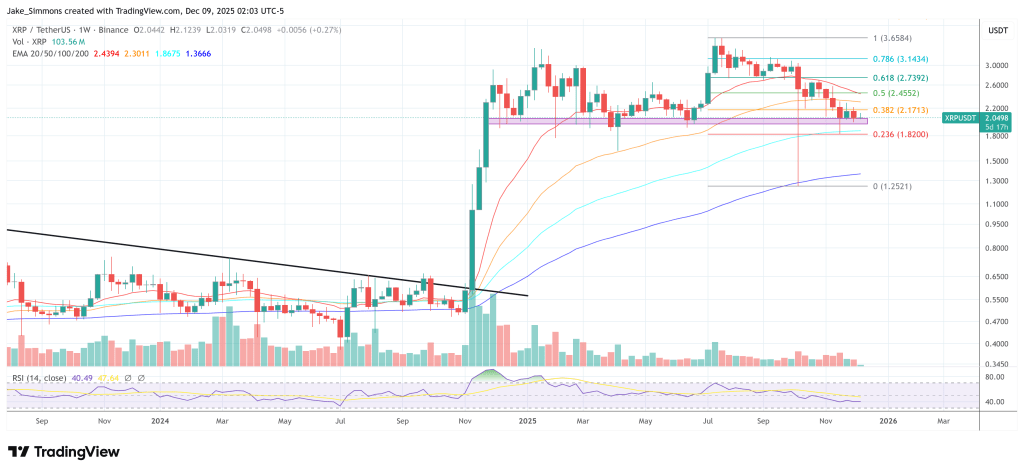
Le XRP se maintient au-dessus d'un support clé, graphique hebdomadaire | Source : XRPUSDT sur TradingView.com

Trending Cryptos

Related Questions

QQuelle est la valorisation de Ripple après l'investissement de 500 millions de dollars de Wall Street ?

ALa valorisation de Ripple a été portée à environ 40 milliards de dollars après l'investissement.

QQuels sont certains des grands noms de Wall Street qui ont participé à cette levée de fonds ?

ACitadel Securities, Fortress Investment Group, Marshall Wace, des véhicules liés à Brevan Howard, Galaxy Digital et Pantera Capital ont tous participé à la levée de fonds.

QQuelle protection les investisseurs ont-ils obtenue dans cet accord ?

ALes investisseurs ont obtenu le droit de revendre leurs actions à Ripple après trois ou quatre ans avec un rendement annualisé garanti de 10%, à moins que la société ne soit devenue publique d'ici là.

QQuelle part de la valeur nette de Ripple est liée au XRP selon les investisseurs ?

APlusieurs investisseurs ont conclu qu'au moins 90% de la valeur nette de Ripple était liée au XRP.

QQuelles acquisitions Ripple a-t-elle convenu de faire parallèlement à cet investissement ?

ARipple a convenu d'acquérir la plateforme de prime brokerage Hidden Road pour environ 1,3 milliard de dollars et le spécialiste de la trésorerie d'entreprise GTreasury pour environ 1 milliard de dollars.

Related Reads

Jensen Huang's Daughter: From Chef to an $8 Million Annual Salary

Madison Huang, daughter of NVIDIA founder Jensen Huang, recently made a rare public appearance in Beijing during the 2026 World Robot Conference. As the Senior Director of Product and Technology Marketing for NVIDIA's Physical AI Platform, with an annual salary of approximately $1.2 million, her visit focused on evaluating leading Chinese robotics companies like UBTech, Unitree, and others. This highlights NVIDIA's strategic interest in the burgeoning Chinese robotics ecosystem, a key battleground for the development of Physical AI—technology that enables machines to understand and interact with the physical world. Huang's career path is unconventional. Initially pursuing her passion, she studied culinary arts, worked as a chef, and later held a marketing role at LVMH. She joined NVIDIA as an intern in 2020 after completing an MBA, quickly rising through the ranks. Her brother, Spencer Huang, followed a similar path, closing a cocktail bar he co-founded to also join NVIDIA, where he now works on robotics software. Jensen Huang has publicly addressed nepotism concerns, humorously noting that some "second-generation" employees outperform their parents. The conference itself underscored China's vibrant robotics sector, marked by Unitree's recent blockbuster IPO and a pipeline of companies preparing to go public. While hardware development and manufacturing are advancing rapidly, industry leaders like Wang Xingxing of Unitree point to the next critical challenge: developing the "brain" or AI that allows robots to perform diverse, unseen tasks based on simple instructions. With massive manufacturing scale and diverse real-world testing scenarios, China is positioned as a central player in the global race to define the future of robotics.

marsbit40m ago

Jensen Huang's Daughter: From Chef to an $8 Million Annual Salary

marsbit40m ago

He Gave Wang Xingxing the First 2 Million, Now Serves as Chairman for the Next 'Unitree'

On August 19, 2024, Unitree Robotics, China's "first humanoid robotics stock," went public. Its founder, Wang Xingxing, started a decade ago with his self-developed XDog. In 2016, at a critical funding juncture, he received his first angel investment of 2 million RMB from Yin Fangming. This bet has since yielded a return of over 140 times. Yin Fangming is more than just a key investor. He was a co-founder of the AI robotics company ROOBO, whose own venture ultimately struggled. This firsthand experience with the hardware challenges in robotics gave him unique insight when backing Unitree, a company renowned for its hardware R&D and cost control. While his own company faltered, Yin continued investing shrewdly. He partially cashed out some Unitree shares early, reinvesting the proceeds into sectors like energy (e.g., solid-state battery firm TaiLan) and commercial aerospace (e.g., small launch vehicle developer XianDeng Aerospace). However, his most significant move after Unitree is his deep involvement with Galaxy General, a leading embodied AI unicorn. In July 2024, Yin stepped from behind the scenes to officially become its Chairman, indicating a role far beyond a typical investor. This comes as Galaxy General is viewed as preparing for future capital moves. Yin's career has consistently been ahead of the curve—from mobile internet to AI and robotics. Known for his foresight and low profile, he declined an interview for this story, offering only a statement encouraging support for visionary entrepreneurs like Wang Xingxing.

marsbit54m ago

He Gave Wang Xingxing the First 2 Million, Now Serves as Chairman for the Next 'Unitree'

marsbit54m ago

Coldcard Theft Reflection: Source Code Visibility Does Not Equal Security

The article examines the open-source vs. closed-source debate in crypto, prompted by a theft of over $100M in Bitcoin from Coldcard hardware wallets. It clarifies key terminology: true "Free and Open Source Software" (FOSS) grants four essential freedoms (use, study, share, modify), while "source available" code, like Coldcard's firmware, may have usage restrictions. The piece argues that visible source code alone does not guarantee security; actual safety depends on the economic incentives for thorough, ongoing review by skilled individuals. Using Bitcoin Core as a model, the article describes a successful, transparent open-source development culture built on public review and consensus. It contrasts this with the Coldcard case, where a critical bug in a lightly-reviewed, source-available library went undetected for years, highlighting a "tragedy of the commons" scenario where assumed but absent scrutiny creates vulnerability. The economics of licensing are crucial: restrictive licenses can limit the pool of motivated commercial reviewers. Finally, the article explores AI's impact. It cites the Bitcoin Red Team's use of AI to rapidly audit codebases and find vulnerabilities at scale, demonstrating a powerful new tool for security. However, AI also floods projects with low-quality code, straining maintainers. The piece concludes that in high-stakes crypto, only well-audited projects—whether open or closed-source—can withstand evolving threats, with AI both challenging and aiding security practices.

marsbit1h ago

Coldcard Theft Reflection: Source Code Visibility Does Not Equal Security

marsbit1h ago

Trading

Spot

Hot Articles

What is VRJAM(BLUE)

VRJAM(BLUE): Revolutionizing Live Experiences in the Virtual World Introduction to VRJAM(BLUE), $vrjam(blue) In an age where virtual experiences are becoming increasingly prevalent, VRJAM(BLUE), represented by the token $vrjam(blue), emerges as a pioneering project within the cryptocurrency space. Launched in 2022, VRJAM(BLUE) seeks to transform how live events are conducted in the digital realm by utilizing the power of blockchain technology and the Hedera Hashgraph platform. As a unique blend of immersive social gaming and interactive virtual events, VRJAM(BLUE) strives to create a comprehensive, engaging experience that resonates with users worldwide. What is VRJAM(BLUE), $vrjam(blue)? At its core, VRJAM(BLUE) is a live experience platform harnessing blockchain to facilitate immersive interactions during virtual events. It stands out as a futuristic solution that allows users to engage with one another in real time, bridging the gap between the physical and digital worlds. The platform leverages advanced technologies, including AI-powered virtual humans, which introduce customizable digital representations of users. These entities serve as avatars that enhance the social dynamics of virtual gatherings. Coupling these virtual beings with the use of non-fungible tokens (NFTs) introduces a layer of security and authenticity, ensuring that unique digital assets can be traded and valued properly within the platform's ecosystem. Moreover, VRJAM(BLUE) integrates a native cryptocurrency, the VRJAM Coin, which acts as the medium of exchange within its virtual world. This digital currency facilitates transactions for services, content, and assets while enabling users to participate seamlessly in live events and interactive experiences. Creator of VRJAM(BLUE), $vrjam(blue) The specific identity of the creator of VRJAM(BLUE) remains undisclosed, though the project is under the leadership of CEO Sam Speaight. His vision for the platform aims at leveraging innovative technology and strategic partnerships to expand the reach and impact of VRJAM(BLUE) in the rapidly evolving web3 ecosystem. Investors of VRJAM(BLUE), $vrjam(blue) VRJAM(BLUE) has garnered considerable interest from various investors and funding rounds, successfully raising a total of $5.34 million throughout 12 funding events. These various initiatives, including Initial DEX Offerings (IDO) and token launches, have provided the necessary capital to propel the project forward. However, specific details regarding the individual investors or organizations backing VRJAM(BLUE) have not been disclosed. How Does VRJAM(BLUE), $vrjam(blue) Work? The innovative approach of VRJAM(BLUE) revolves around multiple cutting-edge technologies, notably artificial intelligence, virtual reality, and blockchain. AI-Powered Virtual Humans A distinguishing feature of VRJAM(BLUE) is its integration of AI-powered virtual humans. These customizable characters respond dynamically to user interactions, enriching the overall experience of virtual events. This personalization allows users to create unique identities and facilitating more meaningful connections within the community. NFT Technology By incorporating NFT technology into its framework, VRJAM(BLUE) provides users with enhanced security and ownership of digital assets. Users can purchase, sell, or trade NFTs that represent virtual tickets, memorabilia, or other digital creations linked to live events, ensuring that ownership is verifiable and protected. Native Cryptocurrency The VRJAM Coin serves as the platform's native currency, allowing users to transact seamlessly within the virtual environment. This cryptocurrency not only supports traditional user activities but also bolsters a larger economic ecosystem tailored to the needs of VRJAM’s community. DeFi Solutions The project also embraces decentralized finance (DeFi) by incorporating trustless protocols. These solutions aim to stabilize token prices and enhance liquidity, allowing users to engage in financial transactions without intermediary restrictions. Timeline of VRJAM(BLUE), $vrjam(blue) To fully understand the evolution of VRJAM(BLUE), it's essential to take a closer look at its timeline: 2022: Launch of VRJAM(BLUE) – The platform made its debut, ushering in a new era for virtual event experiences. November 30, 2022: Completion of the Token Generation Event (TGE) – This marked a significant milestone, as the platform's native cryptocurrency became available for investor engagement. Post-TGE: Following the TGE, the distribution of tokens initiated, featuring a 20% immediate release, followed by a linear vesting phase of the remaining 80% over a period of six months. Key Features and Partnerships The success of VRJAM(BLUE) can also be attributed to its strategic partnerships and innovative features. Partnerships In its quest to bring life to the metaverse, VRJAM(BLUE) has formed alliances with prominent entities in the industry. Notably, its collaboration with Polygon aims to enhance the efficiency and reach of live events. Additional partnerships with organizations such as Agora and Enjin further bolster content distribution and the utilization of NFT technology. These collaborations are enhancing VRJAM(BLUE)'s capabilities and expanding its influence in the web3 ecosystem. Token Liquidity Protocol Operating on the Hedera Hashgraph, VRJAM(BLUE) employs a token liquidity protocol that aggregates liquidity across various trading platforms. This initiative is designed to unify token pricing, thus enhancing user confidence in the VRJAM Coin and promoting stability within the ecosystem. Web3 Economy With the overarching aim of fostering a sustainable web3 economy, VRJAM(BLUE) is diligently working on its DeFi product suite. By providing users with tools for financial engagement, such as yield farming or staking, the project is paving the way for broader participation in its virtual economy. Conclusion VRJAM(BLUE), with its token $vrjam(blue), stands at the forefront of the revolution in virtual experiences and live interactions within the digital space. By intertwining advanced technologies such as AI, virtual reality, and blockchain, the project has developed a platform that not only facilitates immersive experiences but also builds a vibrant, interactive community. As the landscape of the crypto and web3 industries continues to evolve, VRJAM(BLUE) aims to play a critical role in shaping the future of virtual events and experiences. With its commitment to innovation and community engagement, VRJAM(BLUE) is well-positioned to pave a prosperous path for digital interactions in the years to come.

1.2k Total ViewsPublished 2024.12.03Updated 2024.12.03

What is VRJAM(BLUE)

How to Buy BLUE

Welcome to HTX.com! We've made purchasing Bluefin (BLUE) simple and convenient. Follow our step-by-step guide to embark on your crypto journey.Step 1: Create Your HTX AccountUse your email or phone number to sign up for a free account on HTX. Experience a hassle-free registration journey and unlock all features.Get My AccountStep 2: Go to Buy Crypto and Choose Your Payment MethodCredit/Debit Card: Use your Visa or Mastercard to buy Bluefin (BLUE) instantly.Balance: Use funds from your HTX account balance to trade seamlessly.Third Parties: We've added popular payment methods such as Google Pay and Apple Pay to enhance convenience.P2P: Trade directly with other users on HTX.Over-the-Counter (OTC): We offer tailor-made services and competitive exchange rates for traders.Step 3: Store Your Bluefin (BLUE)After purchasing your Bluefin (BLUE), store it in your HTX account. Alternatively, you can send it elsewhere via blockchain transfer or use it to trade other cryptocurrencies.Step 4: Trade Bluefin (BLUE)Easily trade Bluefin (BLUE) on HTX's spot market. Simply access your account, select your trading pair, execute your trades, and monitor in real-time. We offer a user-friendly experience for both beginners and seasoned traders.

5.0k Total ViewsPublished 2024.12.11Updated 2026.08.21

How to Buy BLUE

Discussions

Welcome to the HTX Community. Here, you can stay informed about the latest platform developments and gain access to professional market insights. Users' opinions on the price of BLUE (BLUE) are presented below.

活动图片