Ethereum [ETH]: Analyzing how this resistance level can furnish an opportunity for investors

AmbcryptoPublished on 2022-07-09Last updated on 2022-07-09

Abstract

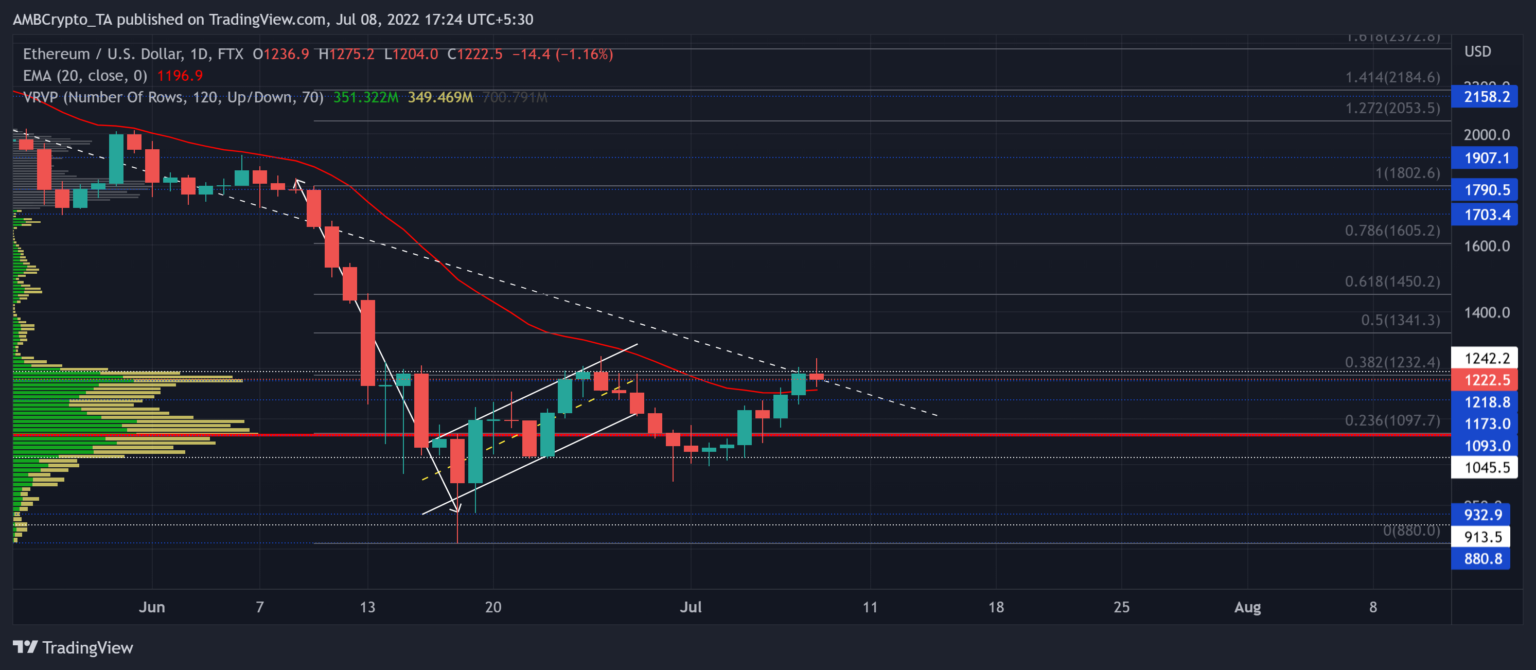
Over the last few days, Ethereum [ETH] saw an expected breakdown from its bearish flag pattern. Also, the trendline resistance (white, dashed) has kept the alt’s peaks under bearish control for over three months.

The 38.2% Fibonacci resistance has significantly impaired the buying efforts over the last three weeks. Over the last few days, Ethereum [ETH] saw an expected breakdown from its bearish flag pattern. Also, the trendline resistance (white, dashed) has kept the alt’s peaks under bearish control for over three months.

Should the current candlestick see a robust close below the 38.2% level, ETH could eye a further downside in the coming sessions. At press time, the alt was trading at $1,222.5, up by 3.47% in the last 24 hours.

ETH Daily Chart
Source: TradingView, ETH/USD

ETH’s three-month trendline resistance has delineated a steep plunge in the daily timeframe. To top it up, the 20 EMA (red) has undermined most of the bullish recovery efforts until recently.

The breakdown from the $2,700 zone has aggravated the selling power whilst the bulls strived to hold the $1,000-mark support. ETH lost nearly 70% of its value over the last few months (since early May). As a result, the alt gravitated toward its 17-month low on 18 June.

Should the 38.2% resistance inflict selling pressure, ETH could see a pullback toward the Point of Control (POC, red). In this case, potential shorting targets would rest near the $1,045 support.

Also, with the trendline resistance standing sturdy, the buyers could face a tough time overturning the $1,200 zone. A decline below the 20 EMA would expose ETH to a potential downside. Any bearish invalidations could aid the buyers in provoking a rather short-lived rally until the 50.2% level.

Rationale
Source: TradingView, ETH/USD

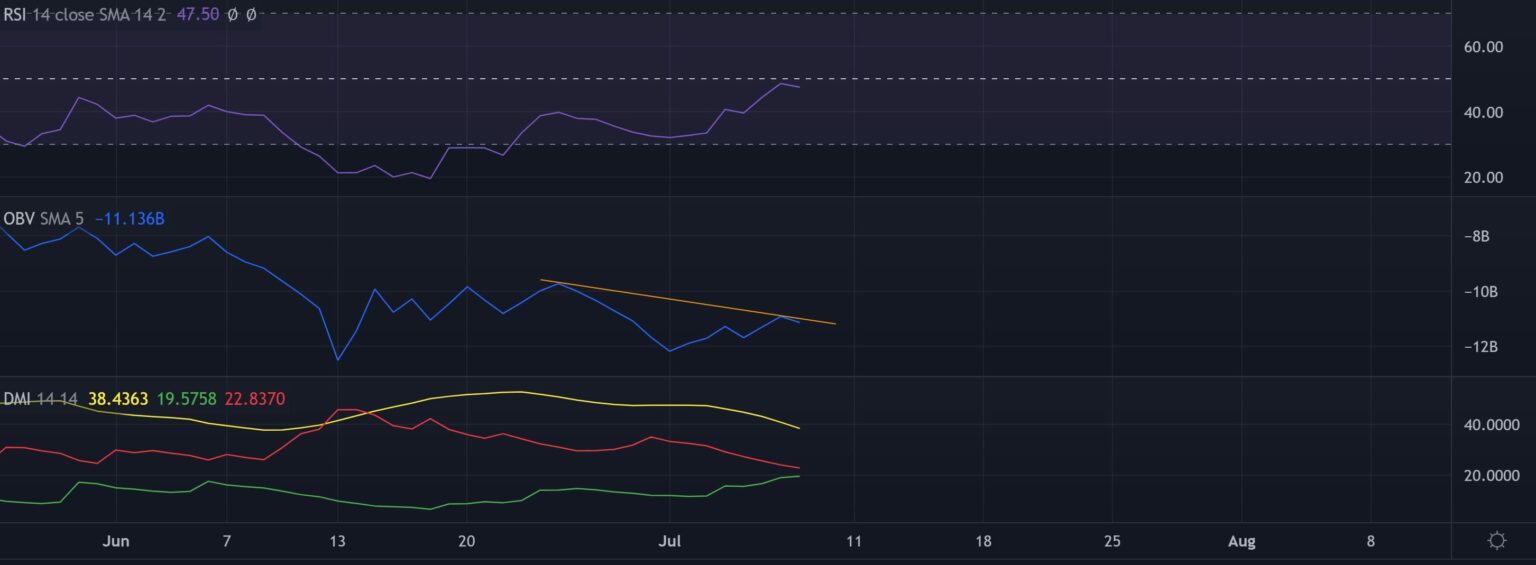
The Relative Strength Index (RSI) was yet to cross above the midline whilst depicting a relatively neutral stance. Its inability to find a close above the 50-mark could encourage the ongoing drawdowns on the chart. Traders should watch for a close above the midline to confirm higher chances of a bearish invalidation.

Further, the On-Balance Volume (OBV) saw lower peaks and revealed a slight decrease in the buying pressure over the last two weeks. Finally, any bullish crossover on the Directional Movement Index (DMI) could be detrimental for the short-sellers.

Conclusion

The bulls needed to ramp up the buying volumes near the 20 EMA to prevent a downside risk of nearly 14%. The traders/investors must be wary of the caveats laid forth by the indicators as discussed above.

Also, investors/traders need to watch out for Bitcoin’s movement. This is because ETH shares a whopping 98% 30-day correlation with the king coin.


Related Reads

Why Is the World Nervous About Japan Raising Interest Rates?

In June 2026, the Bank of Japan raised its policy rate to 1%, marking its first hike to this level since 1995. While this rate remains low compared to global peers like the US and Europe, the move signals a profound shift for a nation that has been a global source of ultra-cheap funding for decades. Japan's long-standing near-zero or negative interest rates had facilitated massive "yen carry trades," where international investors borrowed low-cost yen to invest in higher-yielding assets worldwide, such as US tech stocks and emerging market bonds. This made Japan a critical, often overlooked, source of global liquidity. Japan's ultra-loose policy stemmed from structural challenges post-1990s asset bubble: aging demographics, chronic low inflation/deflation, and high public debt. Recent shifts, including sustained wage growth (exceeding 5% in recent years) and inflation consistently above the 2% target, have created a "wage-price spiral" possibility, prompting the policy normalization. The global market's concern lies not in the absolute rate but in the potential unwinding of the yen carry trade. As Japanese borrowing costs rise, the economics of these leveraged global investments change, potentially triggering deleveraging and capital outflows from risk assets. Market anxiety focuses on the end of a thirty-year consensus that Japan would perpetually provide cheap funding. Ultimately, the global impact will depend on the interplay with US monetary policy. While Japan is tightening, the significant interest rate differential with the US remains. The key future dynamic is whether simultaneous Japanese hikes and eventual US rate cuts will narrow this gap, forcing a major recalibration of global capital flows and asset pricing built on an era of abundant, cheap yen liquidity.

marsbit3h ago

Why Is the World Nervous About Japan Raising Interest Rates?

marsbit3h ago

Research Report Analysis: MRVL's Optical AI Booming, Why High Valuation Keeps Morgan Stanley's Star Analyst Sidelined?

Report Recap: MRVL Optical AI Boom - Why High Valuation Led Morgan Stanley's Star Analyst to Stay Neutral? Morgan Stanley analyst Joseph Moore maintained an "Equal-weight" (Neutral) rating on Marvell Technology (MRVL) on May 28, raising the price target from $172 to $195, below the trading price. This stance comes despite Marvell reporting a record quarter and significantly raising its full-year outlook (FY27 revenue ~$11.5B, up ~40%). Moore's neutral view is based on valuation. The $195 target implies ~40x CY2027 P/E. He contrasts MRVL with NVDA: both trade near ~$200, but Nvidia's forward EPS is more than double Marvell's. For MRVL's valuation to hold, it needs consistent earnings upgrades, proof of networking market share gains, or certainty on large-scale custom AI chip shipments—none of which are confirmed yet. Growth is driven by two pillars: **1) Optical Interconnect** (the faster runner): Moore raised FY27 growth expectations to >70%, with the optical module product line nearing a $1B annualized run rate. **2) Custom AI Chips** (the climber): Confidence in FY28 is growing, but a major new customer project only ramps in FY28, with no current revenue visibility. Key risks are the underperforming Storage, Enterprise, and legacy Networking segments. Moore acknowledges the real AI opportunity but believes the current price already reflects it. For the stock to work from here, investors need to see the optical business hit its targets, custom chips ramp as planned, and a recovery in the weaker business units.

marsbit4h ago

Research Report Analysis: MRVL's Optical AI Booming, Why High Valuation Keeps Morgan Stanley's Star Analyst Sidelined?

marsbit4h ago

Trading

Spot
Futures
活动图片