New Bitcoin Improvement Proposal Aims To Improve Privacy: Here’s How

bitcoinistPublished on 2025-10-24Last updated on 2025-10-24

Abstract

A new Bitcoin Improvement Proposal titled “Chain Code Delegation for Private Collaborative Custody” has been opened on the Bitcoin BIPs...

Trusted Editorial content, reviewed by leading industry experts and seasoned editors. Ad Disclosure

A new Bitcoin Improvement Proposal titled “Chain Code Delegation for Private Collaborative Custody” has been opened on the Bitcoin BIPs repository, targeting a long-standing privacy leak in multisig collaborations that rely on shared extended public keys.

The technique, authored by Bitkey engineers and collaborators, with a public explainer from Bitkey, proposes withholding BIP32 chain codes from non-privileged participants so that cosigners can help with recovery and policy enforcement without gaining sweeping visibility into a user’s balances and transaction history. Bitkey says it plans to implement the scheme first if it becomes an accepted standard.

How The BIP Enhances Bitcoin Privacy

The crux of the privacy problem is well known to wallet engineers and custodial partners: in typical collaborative or assisted multisig, the cosigner is handed an xpub plus chain code, which lets them deterministically derive the addresses in a user’s wallet and, by scanning the blockchain, infer balances and flows.

Bitkey’s post frames the status quo plainly: sharing a key with a third party has “traditionally meant giving that party visibility into a user’s wallet balance and transaction history.” The new approach, they argue, “aims to remove that tradeoff” by withholding chain codes entirely and revealing only what is minimally necessary at spend time.

The proposed BIP’s abstract is crisp about the change in trust boundaries: “We propose a new BIP for Chain Code Delegation, a collaborative custody technique that involves privileged participants (delegatee) withholding BIP32 chain codes at key setup time from a delegator, and sharing only enough information for non-privileged participants to provide their signature.”

In the non-blinded flow, “the delegatee derives a per-spend scalar tweak t from the (withheld) chain code, the delegator computes the child key (x+t, P+tG), and produces a standard signature over the transaction’s sighash.” The blinded flow layers Schnorr blind signing on top so that the cosigner remains oblivious to the final message while still enforcing the per-spend tweak, leveraging the linearity of Schnorr for correctness.

Functionally, the technique narrows what a cosigner can learn and when. Rather than permanent, global observability over all derived addresses, the cosigner only sees per-spend data as needed. The Bitkey explainer translates this into a user-facing promise: cosigners can assist with recovery or spend policies “without learning anything about unrelated transactions or overall balances.”

If widely adopted, that shift would make collaborative custody wallets more comparable to DIY multisig on privacy, while preserving the operational benefits that have made assisted models attractive to mainstream and enterprise users.

The design has been incubating in the open. A technical discussion thread on Delving Bitcoin over the summer summarized two key benefits that extend beyond privacy: limiting the “security blast radius” because, without the chain code or undisclosed tweaks, a custodian’s key is effectively unspendable for UTXOs they haven’t been explicitly delegated for; and tightly scoping what gets revealed at the moment of spend, often just before those outputs are consumed. That thread foreshadowed the BIP now filed and offers useful context for reviewers tracing how the proposal hardened through feedback.

Bitkey positions itself as the first mover on implementation once the standard is vetted. “Bitkey plans to be the first to implement Chain Code Delegation in production,” the company wrote, arguing that it will enable “a private collaborative wallet—something that hasn’t been possible until now.” The explicit intention is for the technique to be an “open, community-vetted standard that any wallet or custody provider can adopt,” not a vendor-locked feature.

Prominent industry accounts amplified the announcement on X. Principal executive officer and chairman of Block, Inc Jack Dorsey highlighted Bitkey’s focus on pushing privacy improvements from product to protocol.

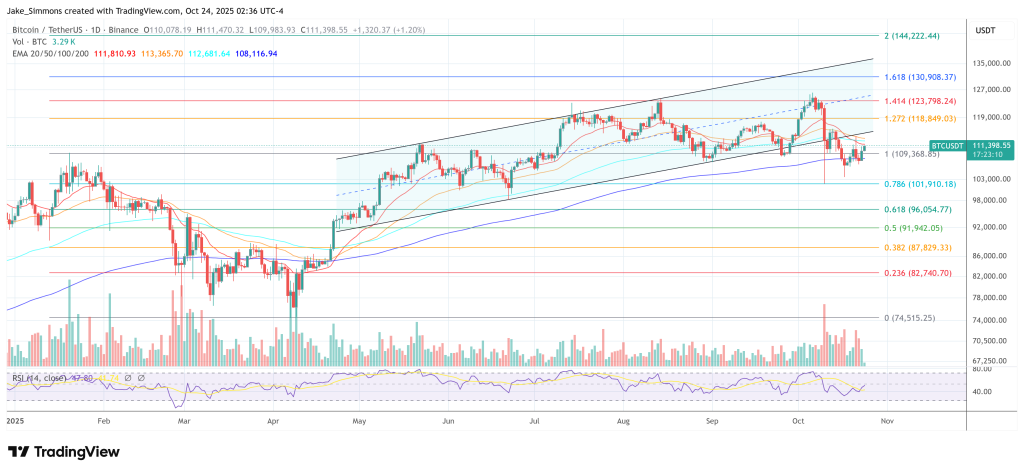
At press time, Bitcoin traded at $111,398.
Bitcoin price
Bitcoin faces the EMA20 and EMA50, 1-day chart | Source: BTCUSDT on TradingView.com
Featured image created with DALL.E, chart from TradingView.com
Editorial Process for bitcoinist is centered on delivering thoroughly researched, accurate, and unbiased content. We uphold strict sourcing standards, and each page undergoes diligent review by our team of top technology experts and seasoned editors. This process ensures the integrity, relevance, and value of our content for our readers.

Jake Simmons has been a Bitcoin enthusiast since 2016. Ever since he heard about Bitcoin, he has been studying the topic every day and trying to share his knowledge with others. His goal is to contribute to Bitcoin's financial revolution, which will replace the fiat money system. Besides BTC and crypto, Jake studied Business Informatics at a university. After graduation in 2017, he has been working in the blockchain and crypto sector. You can follow Jake on Twitter at @realJakeSimmons.

Trending Cryptos

Related Reads

Latest: Korean QFI Has Bought Changxin Technology

Latest Data Shows Korean QFI Has Purchased Changxin Technology According to data from SEIBro (under Korea Securities Depository, KSD), Korean investors, acting as Qualified Foreign Investors (QFI), have been actively purchasing shares of Changxin Technology (stock code 688825), a company recently listed on China's Sci-Tech Innovation Board (STAR Market). Over the past month until August 18, they made a net purchase of this stock worth approximately $45.32 million (around CNY 307 million), making it the top A-share by net purchase volume for Korean investors during that period. This activity has significantly boosted overall Korean net buying in A-shares. As Changxin Technology is not yet included in the Stock Connect schemes, QFI is currently the only channel for overseas investors like these Koreans to access its shares. SEIBro data indicates Korean buying began as early as July 28, the stock's second trading day. The stock appeared in Korean investor purchase lists using a temporary virtual ISIN code in settlement instructions, as its official international code had not yet been assigned. The listing has garnered significant international attention. On its first trading day (July 27), the actively managed U.S. ETF Tema Memory ETF (DISK) swiftly added Changxin Technology to its portfolio, giving it a substantial 10.56% weighting. Another active ETF, Roundhill Memory ETF (DRAM), also quickly included the stock. Furthermore, global index provider MSCI has added Changxin Technology to its MSCI China All Shares Index, prompting passive fund inflows. Analysts highlight Changxin Technology's unique position to serve China's rapidly growing AI ecosystem amid a global semiconductor memory supply shortage driven by AI demand. Besides Changxin Technology, other A-shares heavily bought by Korean investors recently include Weichai Power, Demingli, Changdian Technology, and CSOP China STAR Chip ETF.

marsbit39m ago

Latest: Korean QFI Has Bought Changxin Technology

marsbit39m ago

China Pinches the Vital Point of CPO

The article "China Grips the Achilles' Heel of CPO" details how China holds a strategic position in the global indium phosphide (InP) supply chain, a critical material for high-speed optical modules and CPO (Co-Packaged Optics) technology used in AI data centers. China controls over 70% of global indium reserves and produces more than half of the world's primary indium, primarily as a by-product of zinc/tin smelting. It further refines 70-80% of the globe's refined indium. This upstream dominance is compounded by the fact that key InP wafer producer AXT operates its primary production through its Chinese subsidiary, Beijing Tongmei. Adding to this leverage are China's export controls, first on InP products and later extending to high-purity indium (6N+ grade). These restrictions have created supply bottlenecks and uncertainty, straining foreign manufacturers like Japan's Sumitomo and Dowa, who rely heavily on Chinese materials. The resulting shortage has led to intense demand, with industry figures like Lumentum's CEO warning of severe constraints and companies like Coherent seeking direct assurances from China. This situation benefits Chinese InP supply chain companies. Firms like Yunnan Chihong Zinc & Germanium (a leading domestic InP wafer producer) and Zhuzhou Keneng (high-purity indium) report surging domestic revenues and orders. They are also making progress in high-end product validation and capacity expansion. However, challenges remain, including lengthy customer qualification cycles and a significant capacity gap compared to foreign leaders. The article frames the current AI-driven demand surge as a pivotal moment for China's InP industry. It references a historical lesson where China, despite controlling indium resources, once ceded value-add and pricing power to Japanese processors. The current scenario is seen as an opportunity to leverage upstream resource control to develop advanced manufacturing capabilities and secure greater influence in the global semiconductor materials market.

marsbit49m ago

China Pinches the Vital Point of CPO

marsbit49m ago

Russian Suspected of Stealing Cryptocurrency from Cold Wallet Worth Almost 10 Million Rubles

Russian authorities are investigating a suspect accused of stealing nearly 10 million rubles worth of cryptocurrency from a cold wallet. According to investigators, the wallet belonged to an unnamed commercial company executive's assistant. In March, the suspect allegedly gained access to the victim's wallet by "an unidentified method" and transferred the digital assets to another address. During a search of the suspect's home, police seized three computers and three mobile phones for forensic examination, as they may contain important digital evidence. The case is being investigated as grand larceny under the Russian Criminal Code, carrying a potential sentence of up to ten years in prison. Police are also checking the suspect's possible involvement in other cryptocurrency thefts and identifying potential accomplices. The article notes that while cold wallets (hardware wallets storing private keys offline) are considered more secure against remote hacking, they remain vulnerable if a perpetrator gains physical or direct access to the keys. In a related case earlier in June, a court in Tomsk sentenced two men to 8 and 9.5 years in a strict-regime colony for a robbery and cryptocurrency theft. They forced an acquaintance at knifepoint to log into a crypto exchange account and transfer over 85 bitcoins, valued at approximately $5.1 million at the time.

cryptonews.ru1h ago

Russian Suspected of Stealing Cryptocurrency from Cold Wallet Worth Almost 10 Million Rubles

cryptonews.ru1h ago

Trading

Spot

Hot Articles

Discussions

Welcome to the HTX Community. Here, you can stay informed about the latest platform developments and gain access to professional market insights. Users' opinions on the price of S (S) are presented below.

活动图片