В CryptoQuant назвали «биткоин-дельфинов» новым драйвером роста рынка

cryptonews.ruPublished on 2025-10-23Last updated on 2025-10-24

Высокая концентрация первой криптовалюты на адресах «дельфинов» (100-1000 BTC) делает их активность ключевым фактором, определяющим направление рынка на поздней стадии бычьей фазы, отметили аналитики CryptoQuant.

По наблюдениям специалистов, подобные адреса контролируют крупнейшую долю предложения цифрового золота — около 26% (5,16 млн BTC).

«Исторически рост накоплений в этом сегменте совпадал с бычьими импульсами, в то время как замедление нередко предшествовало фазам распределения и коррекций. В 2025 году “дельфины” увеличили запасы на 681 000 BTC, тогда как остальные группы сократили их – это подтверждает доминирование институциональных игроков», – написали аналитики.
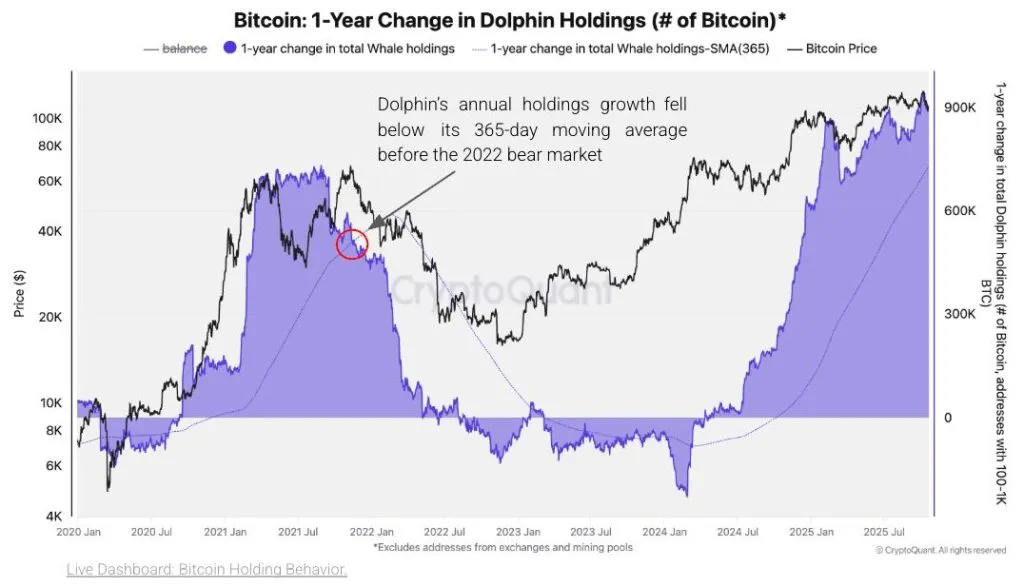
Динамика накопления цифрового золота «биткоин-дельфинами». Источник: CryptoQuant.

Они также отметили ослабление краткосрочного ценового импульса биткоина при сохранении долгосрочного спроса:

«Цикл роста демонстрирует признаки зрелости, а не завершения».

К «дельфинам» в CryptoQuant относят в первую очередь ETF, корпорации и прочих крупных держателей. Аналитики убеждены, что в ближайшие недели активность этой группы станет решающей: если темпы накопления ускорятся, биткоин сможет обновить максимум, если нет — коррекция углубится.

Бычья фаза не завершена

Эксперты отметили, что темпы накопления цифрового золота остаются положительными — прирост в годовом выражении составляет 907 000 BTC против 365-дневного среднего уровня в 730 000 BTC. Это свидетельствует о том, что бычья фаза еще не завершена.

В таких условиях ослабление краткосрочного импульса обычно указывает на предстоящую фазу консолидации или умеренную коррекцию в рамках текущего тренда.

«Для возврата к $126 000 необходимо возобновление покупок, — подчеркнули аналитики. — Для выхода на новые исторические максимумы темпы накопления на месячном горизонте должны вновь ускориться».

В краткосрочной перспективе рынок остается в фазе коррекции. Уровень сопротивления находится у отметки $115 000, поддержки — в районе $100 000.

«Провал уровня $100 000 может спровоцировать более глубокое снижение вплоть до $75 000», — предупредили в CryptoQuant.

В свою очередь, аналитики Glassnode на основе данных опционов отметили «концентрацию продаж» в диапазоне $109 000-115 000.
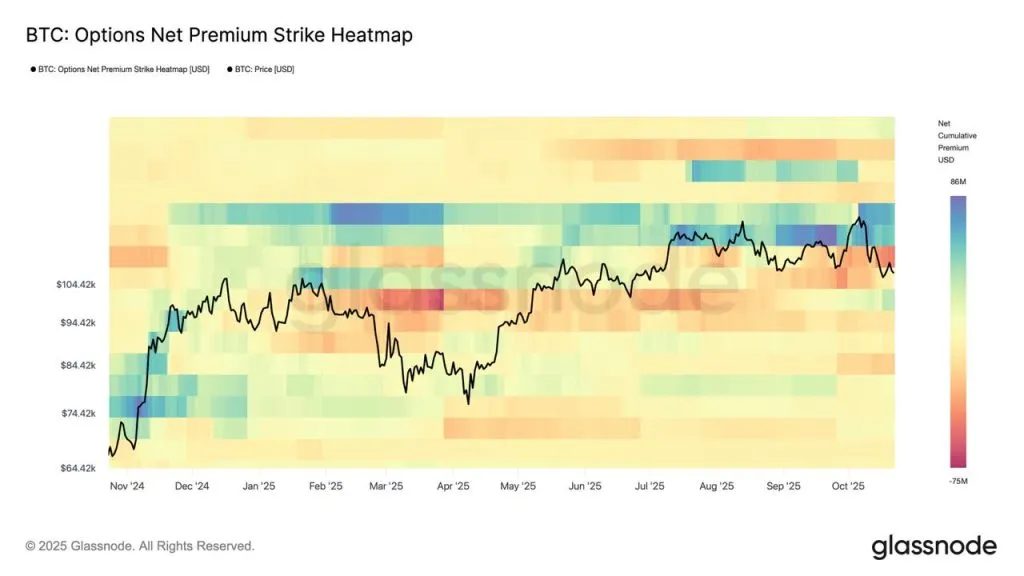
«Тепловая карта» премий по биткоин-опционам. Источник: Glassnode.

Текущая ситуация на рынке этих деривативов «указывает на использование недавнего роста для хеджирования».

«Трейдеры занимают оборонительные позиции на фоне консолидации рынка», — пояснили исследователи.

Напомним, аналитик Аксель Адлер — младший предупредил о переходе биткоина в позднюю фазу цикла.

Standard Chartered спрогнозировал падение биткоина ниже $100 000

Trending Cryptos

Related Reads

Short-Lived Meme Mania: Can It Be the Icebreaker for Robinhood's RWA Narrative?

Robinhood recently launched its own Layer 2 network, Robinhood Chain, built on Arbitrum and focusing on tokenized stocks, RWA, DeFi, and AI finance. Shortly after launch, a meme coin called CASHCAT, named after an early unused Robinhood brand, surged in popularity, achieving a market cap near $150 million and high daily trading volume. It gained traction through third-party DEXs and launchpads like Uniswap and Noxa.fun, bypassing Robinhood's official listing process. This highlights a key feature of the permissionless chain: even assets not officially approved can achieve significant liquidity and trading activity. While CASHCAT currently dominates the chain's meme coin sector, its high turnover indicates speculative trading. The rapid proliferation of new meme coins risks dispersing liquidity. Meanwhile, the chain's core RWA sector remains relatively small at $12.5 million. CEO Vlad Tenev has expressed that the chain is well-suited for both RWA and meme coins. In the optimistic scenario, meme-driven activity could bootstrap the chain's user base and liquidity for its long-term RWA vision. However, if the meme frenzy fades quickly, the RWA narrative may struggle to gain traction independently. The incident demonstrates that on a permissionless platform, the market itself can create major assets, offering Robinhood a potential new growth avenue beyond its core crypto business as it navigates the long-term development of the tokenized asset market.

Foresight News4m ago

Short-Lived Meme Mania: Can It Be the Icebreaker for Robinhood's RWA Narrative?

Foresight News4m ago

The Fall of Zapper: An Act of God or a Human Error?

The Fall of Zapper: A Post-Mortem of a DeFi Pioneer In July 2026, Zapper, a once-dominant DeFi portfolio tracker, announced its shutdown. Born in 2020 from a merger, Zapper capitalized on the DeFi Summer boom, reaching 2 million monthly users and processing over $13B in transactions, backed by $16.5M in funding from investors like Framework Ventures and Coinbase Ventures. Its core "Zap" feature simplified complex multi-step DeFi operations. Despite its early success, Zapper failed to build a sustainable business model. Revenue from DEX aggregation was minimal due to fierce competition, while maintaining its multi-chain data infrastructure was costly. Furthermore, the DeFi landscape shifted: capital consolidated around top protocols, reducing the need for complex portfolio tracking across numerous platforms. Zapper's user base and core demand eroded. The company attempted multiple pivots, including an NFT-based points system, a social app (Chainchat), and plans for a ZAP token protocol. However, these initiatives—often focused on creating new, speculative C端需求 rather than solving existing pain points—ultimately failed. Critics argue Zapper remained trapped in a "blockchain purist" mindset, prioritizing costly, non-revenue-generating features over its competitive DEX aggregator. Unlike competitor DeBank, which successfully pivoted to its Rabby Wallet, Zapper lacked a diversified revenue stream. Its closure highlights the peril for tooling projects that fail to adapt to market shifts and monetize effectively, serving as a cautionary tale for the industry.

Foresight News43m ago

The Fall of Zapper: An Act of God or a Human Error?

Foresight News43m ago

Trading

Spot

Hot Articles

What is $BITCOIN

DIGITAL GOLD ($BITCOIN): A Comprehensive Analysis Introduction to DIGITAL GOLD ($BITCOIN) DIGITAL GOLD ($BITCOIN) is a blockchain-based project operating on the Solana network, which aims to combine the characteristics of traditional precious metals with the innovation of decentralized technologies. While it shares a name with Bitcoin, often referred to as “digital gold” due to its perception as a store of value, DIGITAL GOLD is a separate token designed to create a unique ecosystem within the Web3 landscape. Its goal is to position itself as a viable alternative digital asset, although specifics regarding its applications and functionalities are still developing. What is DIGITAL GOLD ($BITCOIN)? DIGITAL GOLD ($BITCOIN) is a cryptocurrency token explicitly designed for use on the Solana blockchain. In contrast to Bitcoin, which provides a widely recognized value storage role, this token appears to focus on broader applications and characteristics. Notable aspects include: Blockchain Infrastructure: The token is built on the Solana blockchain, known for its capacity to handle high-speed and low-cost transactions. Supply Dynamics: DIGITAL GOLD has a maximum supply capped at 100 quadrillion tokens (100P $BITCOIN), although details regarding its circulating supply are currently undisclosed. Utility: While precise functionalities are not explicitly outlined, there are indications that the token could be utilized for various applications, potentially involving decentralized applications (dApps) or asset tokenization strategies. Who is the Creator of DIGITAL GOLD ($BITCOIN)? At present, the identity of the creators and development team behind DIGITAL GOLD ($BITCOIN) remains unknown. This situation is typical among many innovative projects within the blockchain space, particularly those aligning with decentralized finance and meme coin phenomena. While such anonymity may foster a community-driven culture, it intensifies concerns about governance and accountability. Who are the Investors of DIGITAL GOLD ($BITCOIN)? The available information indicates that DIGITAL GOLD ($BITCOIN) does not have any known institutional backers or prominent venture capital investments. The project seems to operate on a peer-to-peer model focused on community support and adoption rather than traditional funding routes. Its activity and liquidity are primarily situated on decentralized exchanges (DEXs), such as PumpSwap, rather than established centralized trading platforms, further highlighting its grassroots approach. How DIGITAL GOLD ($BITCOIN) Works The operational mechanics of DIGITAL GOLD ($BITCOIN) can be elaborated on based on its blockchain design and network attributes: Consensus Mechanism: By leveraging Solana’s unique proof-of-history (PoH) combined with a proof-of-stake (PoS) model, the project ensures efficient transaction validation contributing to the network's high performance. Tokenomics: While specific deflationary mechanisms have not been extensively detailed, the vast maximum token supply implies that it may cater to microtransactions or niche use cases that are still to be defined. Interoperability: There exists the potential for integration with Solana’s broader ecosystem, including various decentralized finance (DeFi) platforms. However, the details regarding specific integrations remain unspecified. Timeline of Key Events Here is a timeline that highlights significant milestones concerning DIGITAL GOLD ($BITCOIN): 2023: The initial deployment of the token occurs on the Solana blockchain, marked by its contract address. 2024: DIGITAL GOLD gains visibility as it becomes available for trading on decentralized exchanges like PumpSwap, allowing users to trade it against SOL. 2025: The project witnesses sporadic trading activity and potential interest in community-led engagements, although no noteworthy partnerships or technical advancements have been documented as of yet. Critical Analysis Strengths Scalability: The underlying Solana infrastructure supports high transaction volumes, which could enhance the utility of $BITCOIN in various transaction scenarios. Accessibility: The potential low trading price per token could attract retail investors, facilitating wider participation due to fractional ownership opportunities. Risks Lack of Transparency: The absence of publicly known backers, developers, or an audit process may yield skepticism regarding the project's sustainability and trustworthiness. Market Volatility: The trading activity is heavily reliant on speculative behavior, which can result in significant price volatility and uncertainty for investors. Conclusion DIGITAL GOLD ($BITCOIN) emerges as an intriguing yet ambiguous project within the rapidly evolving Solana ecosystem. While it attempts to leverage the “digital gold” narrative, its departure from Bitcoin's established role as a store of value underscores the need for a clearer differentiation of its intended utility and governance structure. Future acceptance and adoption will likely depend on addressing the current opacity and defining its operational and economic strategies more explicitly. Note: This report encompasses synthesised information available as of October 2023, and developments may have transpired beyond the research period.

699 Total ViewsPublished 2025.05.13Updated 2025.05.13

What is $BITCOIN

Discussions

Welcome to the HTX Community. Here, you can stay informed about the latest platform developments and gain access to professional market insights. Users' opinions on the price of BTC (BTC) are presented below.

活动图片