Short-Lived Meme Mania: Can It Be the Icebreaker for Robinhood's RWA Narrative?

Foresight NewsPublished on 2026-07-10Last updated on 2026-07-10

Abstract

Robinhood recently launched its own Layer 2 network, Robinhood Chain, built on Arbitrum and focusing on tokenized stocks, RWA, DeFi, and AI finance. Shortly after launch, a meme coin called CASHCAT, named after an early unused Robinhood brand, surged in popularity, achieving a market cap near $150 million and high daily trading volume. It gained traction through third-party DEXs and launchpads like Uniswap and Noxa.fun, bypassing Robinhood's official listing process. This highlights a key feature of the permissionless chain: even assets not officially approved can achieve significant liquidity and trading activity. While CASHCAT currently dominates the chain's meme coin sector, its high turnover indicates speculative trading. The rapid proliferation of new meme coins risks dispersing liquidity. Meanwhile, the chain's core RWA sector remains relatively small at $12.5 million. CEO Vlad Tenev has expressed that the chain is well-suited for both RWA and meme coins. In the optimistic scenario, meme-driven activity could bootstrap the chain's user base and liquidity for its long-term RWA vision. However, if the meme frenzy fades quickly, the RWA narrative may struggle to gain traction independently. The incident demonstrates that on a permissionless platform, the market itself can create major assets, offering Robinhood a potential new growth avenue beyond its core crypto business as it navigates the long-term development of the tokenized asset market.


Written by: Gino Matos

Compiled by: Saoirse, Foresight News


Robinhood officially launched the Robinhood Chain mainnet this month. This chain is built on Arbitrum, is a permissionless Layer2, and focuses on tokenized stocks, real-world assets (RWA), DeFi lending, and native AI financial scenarios.


Within just one week of launch, the highest-volume retail trading activity on the entire chain has been driven by CASHCAT. This meme coin, named after the early, discarded Robinhood brand name 'CashCat', saw its market capitalization approach $150 million at one point, with a 24-hour trading volume exceeding $159 million.


CASHCAT did not go through Robinhood's internal application listing process. Instead, it leveraged the Uniswap V3 liquidity pool, paired with third-party launch and routing infrastructure like Noxa.fun and Pump.fun to gain liquidity, price display pages, and market attention.
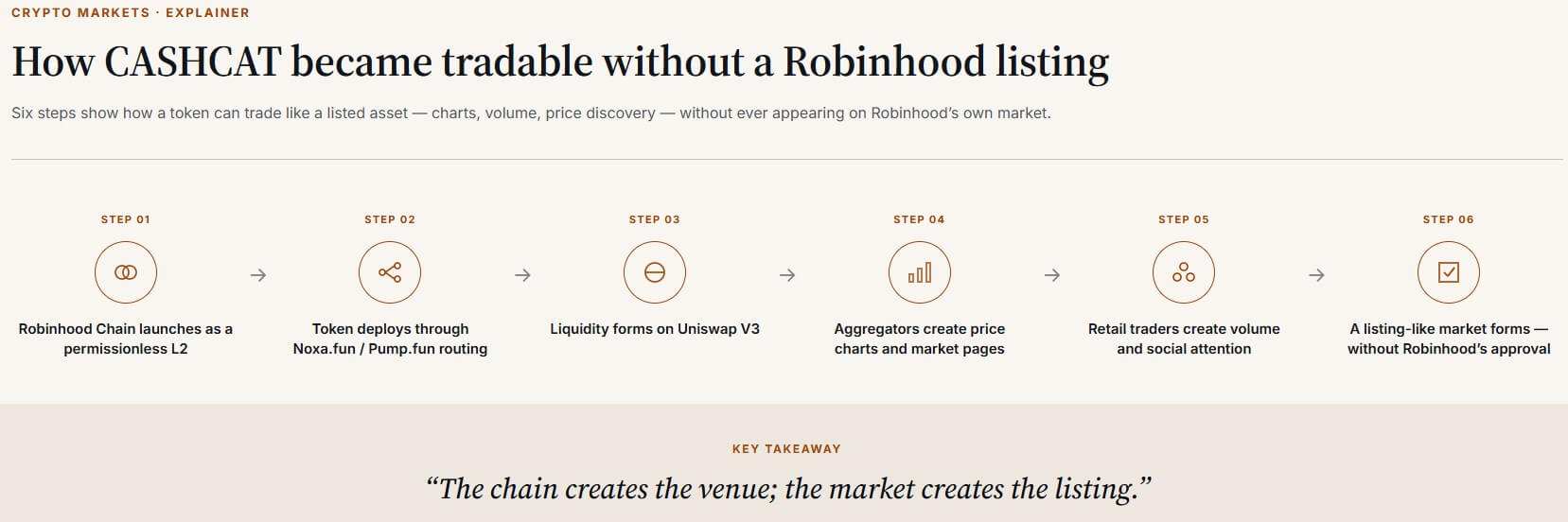

A chart detailing six key steps clearly shows how CASHCAT achieved trading, liquidity accumulation, and volume on the Robinhood Chain without official listing approval.


Behind the "Listing" Without Official Permission


Upon launch, Robinhood Chain integrated with partners like Uniswap and connected Robinhood's own on-chain wallet users. This open architecture, originally designed for tokenized securities and RWA-collateralized assets, simultaneously provided all tokens deployed on the chain access to external decentralized exchange liquidity and price aggregation pages — even tokens that haven't passed Robinhood's app-level review process can obtain near-formal listing trading conditions.


Vlad Tenev (Robinhood co-founder and CEO) and Baiju Bhatt (Robinhood co-founder and Chief Creative Officer) had named the company CashCat before settling on Robinhood; the name came from Baiju's fondness for cats. This piece of corporate history gave an anonymous developer the narrative source for creating a meme coin.


A dashboard created by user Adam_tehc on Dune shows that among the top 25 meme coins by market cap on Robinhood Chain, CASHCAT accounts for nearly 79% of the total market capitalization and 74% of the trading volume; the second largest by size, Dog In Hood, is only one-sixteenth its size.


The same dashboard shows a rapid increase in on-chain trading activity: approximately 1.2 million daily transactions on July 7th, soaring to nearly 2.8 million on July 8th, a single-day increase of 133%. During the same period, the number of tokens launched via Noxa.fun grew from 1,858 to 6,675, a 259% increase.
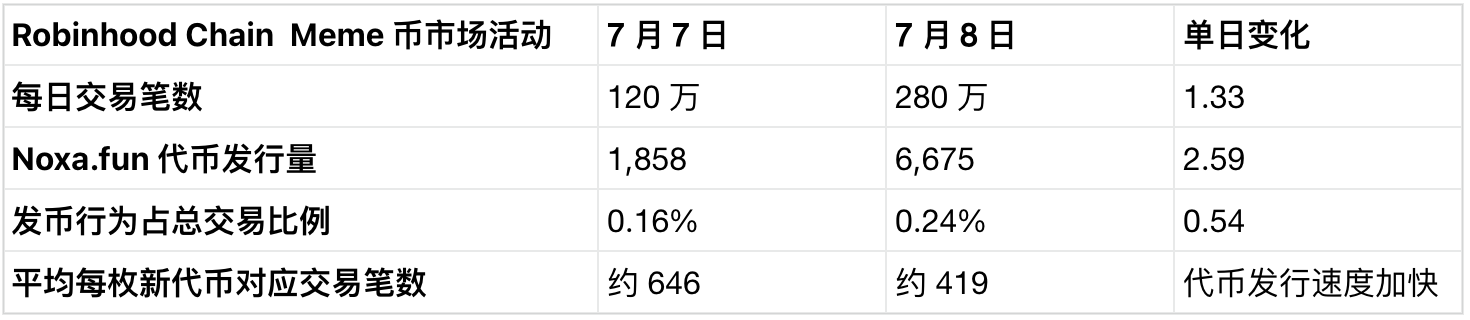


As of July 8th, the growth rate of new token launches has already surpassed the overall trading volume growth rate. Noxa.fun launch-related transactions accounted for only 0.155% of all transactions on July 7th, rising to 0.238% the next day. Sustained high-speed token launches mean a large number of new projects competing for market attention, making it difficult to concentrate liquidity to nurture quality assets and instead potentially causing capital fragmentation.


DefiLlama data shows the chain's total value locked is approximately $107.8 million; the total stablecoin market capitalization is close to $246.8 million, while the market cap of the RWA sector currently being implemented is only $12.5 million.


CASHCAT has an extremely high ratio of trading volume to market capitalization, with capital characterized by high intraday turnover, leaning more towards high-frequency speculative trading rather than long-term asset holding.


Risks Lurk Beneath the Soaring Market


In a July 2nd interview with CNBC, Vlad Tenev stated that the future of the crypto industry belongs to real-world assets (RWA). Just a few days later, he posted that Robinhood Chain is committed to building the optimal RWA public chain, while adding that the chain "also works great for hosting meme coins."


This statement reflects the nature of permissionless infrastructure: once Robinhood opens public chain access to all developers, the market will autonomously select breakout assets. CASHCAT was born from Robinhood's early history, even pulling the founders into a meme narrative that the company cannot control.


A large number of copycat tokens and social media accounts impersonating official ones have already appeared in the market; CASHCAT's liquidity is concentrated in a single decentralized trading pair, making it highly susceptible to slippage and severe price spikes (wicking).


A 2026 academic study analyzed 34,988 meme coins on Ethereum, BNB Chain, Solana, and Base, showing that 1,801 of them (5.15%) completely lost trading liquidity within 24 hours of launch.


Although CASHCAT's current scale far exceeds these short-lived tokens, the same permissionless channels that support it also accommodate thousands of projects that will likely quickly go to zero.


Two Possible Development Scenarios for the Next 60 Days


Optimistic Scenario


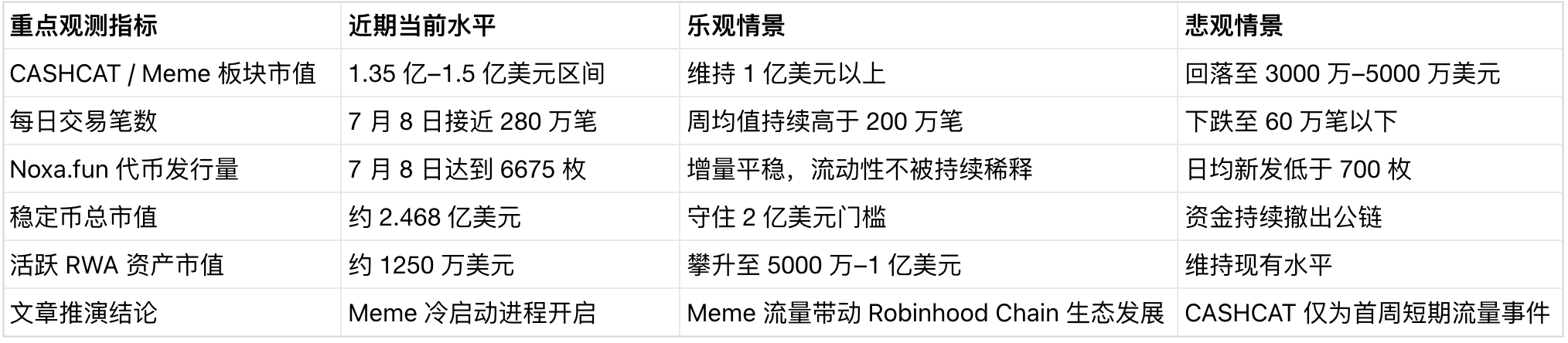
CASHCAT or the overall meme sector market cap remains above $100 million, weekly on-chain transactions stabilize above 2 million, the total stablecoin market cap holds the $200 million mark, and the RWA sector market cap gradually moves towards the $50–100 million range.


If the market evolves along this path, the liquidity brought by memes will become the catalyst for Robinhood Chain's cold start, accumulating wallet users and stablecoin capital for the RWA narrative Robinhood has been promoting since July 1st.


Pessimistic Scenario


CASHCAT's market cap falls back to the $30–50 million range, daily on-chain transactions drop below 600,000, Noxa.fun's daily token launches fall to less than 700, and the RWA sector market cap stagnates at current levels.


In this scenario, CASHCAT would only be a short-term traffic spike upon the chain's launch. After the hype fades, Robinhood Chain's RWA vision would need to attract users from scratch.


Citi's 2026 Tokenized Assets Research Report points out: The current global tokenized asset market size is approximately $17 billion; under a base case scenario, the size is expected to reach $5.5 trillion by 2030, with tokenized stocks and U.S. Treasuries becoming early mainstream applications. The report estimates that if 10% of U.S. retail investors shift to on-chain solutions by 2030, the tokenized U.S. stock sector alone could generate $2.6 trillion in demand.


Robinhood's Q1 2026 crypto business revenue fell 47% year-over-year to $134 million; the company's total net revenue for the same period grew 15% year-over-year to $1.07 billion, with assets under custody on the platform at $307 billion.


This Layer2 chain can accommodate trading demand beyond the platform's official listing inventory, effectively opening a second growth curve for Robinhood's crypto business. Ecosystem development is no longer completely tied to the fate of a single meme coin.


However, Robinhood Chain's RWA vision heavily relies on institutional adoption over several years, as indicated by Citi's prediction—asset tokenization is a long-term endeavor spanning a decade.


The CASHCAT incident has already confirmed one fact: once permissionless infrastructure officially launches, the market can autonomously incubate popular assets with market capitalizations in the hundreds of millions of dollars, regardless of platform approval.


Trending Cryptos

Related Questions

QWhat is the main purpose of Robinhood Chain as described in the article, and what initially drove its user activity?

AThe main purpose of Robinhood Chain is to serve as a platform for tokenized stocks, real-world assets (RWA), DeFi lending, and native AI finance scenarios. However, initially, user activity on the chain was largely driven by the meme coin CASHCAT, which was not officially approved by Robinhood but gained significant trading volume and market cap.

QHow did the meme coin CASHCAT achieve significant trading volume and liquidity on Robinhood Chain without official approval?

ACASHCAT achieved significant trading volume and liquidity by utilizing external decentralized infrastructure, primarily the Uniswap V3 liquidity pool. It leveraged third-party platforms like Noxa.fun and Pump.fun for its launch, routing, and market visibility. This was possible due to the open, permissionless architecture of Robinhood Chain, which allows any deployed token to access external DEX liquidity and price aggregators, even without passing Robinhood's internal listing process.

QAccording to the article, what are the two potential development scenarios for Robinhood Chain in the next 60 days?

AThe article outlines two potential scenarios: an optimistic one and a pessimistic one. In the optimistic scenario, the meme coin market cap remains above $100 million, weekly transactions stay high, stablecoin market cap holds, and the RWA sector grows significantly. In the pessimistic scenario, the meme coin hype fades, transaction volume drops, and the RWA sector's growth stalls, forcing Robinhood to rebuild user interest for its core RWA vision.

QWhat does the 2026 Citigroup research report cited in the article predict about the tokenized asset market?

AThe 2026 Citigroup research report predicts that the global tokenized asset market, currently around $17 billion, could grow to $5.5 trillion by 2030 in a baseline scenario. It identifies tokenized stocks and U.S. Treasuries as early mainstream applications and estimates that if 10% of U.S. retail investors shift to on-chain solutions by 2030, it could generate $2.6 trillion in demand from tokenized U.S. stocks alone.

QWhat risk associated with meme coins like CASHCAT does the article highlight, supported by an academic study?

AThe article highlights the risk of rapid failure and loss of liquidity. It cites a 2026 academic study of 34,988 meme coins across several blockchains, which found that 1,801 (or 5.15%) lost all their trading liquidity within 24 hours of launch. While CASHCAT is currently larger, the same permissionless channels that enabled its rise also host thousands of other projects likely to fail quickly.

Related Reads

From 2 Million Monthly Active Users to Zero: Zapper's Demise in the "Maturation" of DeFi

From 2M MAU to Zero: The Demise of Zapper in a Maturing DeFi Landscape On July 8, 2026, Zapper co-founder Seb Audet announced the platform's full shutdown. Once a DeFi star with 2 million monthly active users, $13B in processed transactions, and $16.5M in funding, Zapper's journey ends. Born in 2020 from the merger of DeFiZap and DeFiSnap, Zapper rode the "DeFi Summer" wave. It became essential for users to track complex, multi-protocol yield farming positions across chains. At its peak, it supported 14 chains, 450+ protocols, and 7000+ tokens, with its signature "Zap" feature simplifying multi-step DeFi actions. However, sustainable revenue never materialized. Its primary model—taking small fees from DEX aggregation—faced fierce competition and squeezed margins. Meanwhile, maintaining its extensive, real-time data indexing system was costly. Crucially, the DeFi ecosystem matured, with activity and liquidity concentrating in fewer top protocols. The core demand for a complex, multi-protocol dashboard waned as user behavior simplified. Zapper attempted multiple pivots that failed to gain traction: an NFT-based points system (2021), a social app called Chainchat (2023), and plans for a ZAP token and open protocol (2024). These efforts reflected a persistent "blockchain-native" mindset focused on creating new C端 (consumer) needs rather than addressing existing pain points or bolstering its revenue-generating products. The article contrasts Zapper with DeBank, which successfully narrowed its asset-tracking focus while developing Rabby Wallet—a revenue-stabilizing, competitive product. Zapper's story serves as a cautionary tale for tooling projects: over-immersion in a purist vision, coupled with an inability to adapt business models to market shifts—like the consolidation of DeFi activity—can be fatal, even for once-dominant platforms.

marsbit11m ago

From 2 Million Monthly Active Users to Zero: Zapper's Demise in the "Maturation" of DeFi

marsbit11m ago

Goldman Sachs Bans It, Google Bans It Too: The Gray Zone of Prediction Markets Is Shrinking Fast

Goldman Sachs has updated its personal trading policy, prohibiting employees from trading event contracts on prediction markets involving specific companies (including whether Goldman itself might restructure or initiate acquisitions in a quarter), election outcomes, financial market performance (including Bitcoin prices), macroeconomic data, geopolitical events, and regulatory results for pending M&A deals. Sports and entertainment bets remain allowed. Violations can lead to dismissal or account closure, and the firm may reclaim profits over $200 or donate them to charity. This follows a CFTC case against a Google engineer who allegedly used non-public data to profit $1.2 million on Polymarket. Simultaneously, Google's Chrome Web Store updated its policy, banning extensions that facilitate real-money trading on prediction market outcomes, effective August 1, 2026. While not affecting platforms' websites or mobile apps directly, this restricts a key user access channel. These actions occur amid growing regulatory pressure on prediction markets. The CFTC is investigating Polymarket for alleged misconduct, and a consumer group has filed a lawsuit. Over 30 countries, including Argentina, have blocked access. Despite this, trading volume has hit record highs, and major investments continue, such as ICE's $2 billion stake in Polymarket. The core debate remains whether prediction markets are financial instruments or gambling. CFTC argues for federal oversight as derivatives, while some states seek to regulate them under gambling laws. Multiple fronts—federal probes, political pressure, internal corporate bans, and platform restrictions—are narrowing the operational space for these markets.

Foresight News17m ago

Goldman Sachs Bans It, Google Bans It Too: The Gray Zone of Prediction Markets Is Shrinking Fast

Foresight News17m ago

Tsinghua AI Mathematician Emerges: From Intuition to Theorem, Contributing to an 84-Page Quantum Algorithm Paper

Tsinghua University’s Intelligent Industry Research Institute (AIR) has developed an AI mathematician agent named AIM, designed not just to solve math problems but to actively participate in early-stage research. In a recent study, researchers collaborated with AIM to develop "Sign Embedding Quantum Algorithms," resulting in an 84-page paper on quantum algorithms for matrix equations and functions. The research began with a human researcher's intuition: can rational approximation serve as a design principle for quantum algorithms? AIM helped expand this idea into multiple candidate research directions. Human researchers then filtered and focused on the most promising path. AIM assisted in organizing theorems, generating proof drafts, and performing complexity analysis, while humans maintained oversight, auditing assumptions and refining derivations. This case illustrates a human-AI collaborative workflow: AI rapidly explores and expands research avenues, generates draft materials, and aids in checking derivations; human researchers provide critical judgment on direction, value, and validity. The process emphasizes "high-throughput candidate generation + human value gating + AI-assisted audit and repair + human final integration." The resulting quantum algorithm framework offers a unified approach to several matrix problems, advancing quantum linear algebra under more general conditions. This work suggests AI's role in theoretical research is evolving from task-specific assistance to supporting the entire research lifecycle—enhancing exploration and efficiency while keeping human expertise central to guiding inquiry and ensuring rigor. *Paper & System Links:* - AIM application report: https://arxiv.org/abs/2606.24899 - Quantum algorithm paper: https://arxiv.org/abs/2604.25333 - AIM repository: https://github.com/TheoryFoundry/AIMv2

marsbit1h ago

Tsinghua AI Mathematician Emerges: From Intuition to Theorem, Contributing to an 84-Page Quantum Algorithm Paper

marsbit1h ago

The Fall of Zapper: An Act of God or a Human Error?

The Fall of Zapper: A Post-Mortem of a DeFi Pioneer In July 2026, Zapper, a once-dominant DeFi portfolio tracker, announced its shutdown. Born in 2020 from a merger, Zapper capitalized on the DeFi Summer boom, reaching 2 million monthly users and processing over $13B in transactions, backed by $16.5M in funding from investors like Framework Ventures and Coinbase Ventures. Its core "Zap" feature simplified complex multi-step DeFi operations. Despite its early success, Zapper failed to build a sustainable business model. Revenue from DEX aggregation was minimal due to fierce competition, while maintaining its multi-chain data infrastructure was costly. Furthermore, the DeFi landscape shifted: capital consolidated around top protocols, reducing the need for complex portfolio tracking across numerous platforms. Zapper's user base and core demand eroded. The company attempted multiple pivots, including an NFT-based points system, a social app (Chainchat), and plans for a ZAP token protocol. However, these initiatives—often focused on creating new, speculative C端需求 rather than solving existing pain points—ultimately failed. Critics argue Zapper remained trapped in a "blockchain purist" mindset, prioritizing costly, non-revenue-generating features over its competitive DEX aggregator. Unlike competitor DeBank, which successfully pivoted to its Rabby Wallet, Zapper lacked a diversified revenue stream. Its closure highlights the peril for tooling projects that fail to adapt to market shifts and monetize effectively, serving as a cautionary tale for the industry.

Foresight News1h ago

The Fall of Zapper: An Act of God or a Human Error?

Foresight News1h ago

Trading

Spot

Hot Articles

Discussions

Welcome to the HTX Community. Here, you can stay informed about the latest platform developments and gain access to professional market insights. Users' opinions on the price of S (S) are presented below.

活动图片