Bitcoin Price Drops From $116K as $125M Liquidations Hit Traders: Analysts Call It a Buy Signal

bitcoinistPublished on 2025-10-15Last updated on 2025-10-15

Abstract

The Bitcoin price slipped after a failed push above $116,000, triggering roughly $125 million in liquidations and a fresh bout...

Trusted Editorial content, reviewed by leading industry experts and seasoned editors. Ad Disclosure

The Bitcoin price slipped after a failed push above $116,000, triggering roughly $125 million in liquidations and a fresh bout of risk-off across altcoins.

The pullback follows last week’s tariff-driven shock and Monday’s fade from resistance, with traders eyeing whether the dip sets up the next leg higher, or a deeper test of support.

Bitcoin Price Rejected at $116K, Liquidations Flush Leverage

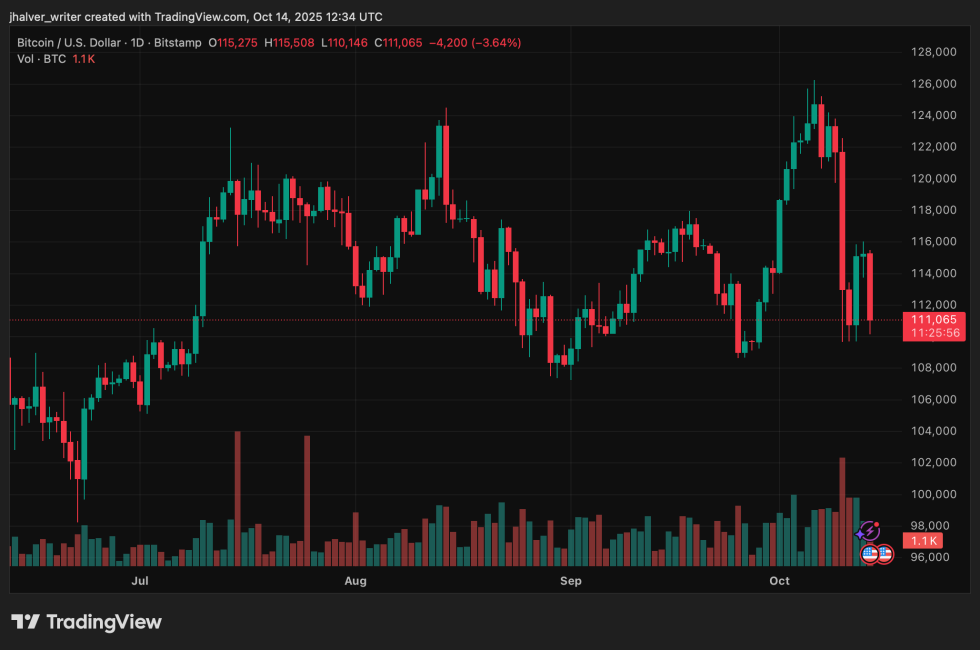
After rebounding more than $15,000 off the weekend low, the Bitcoin price stalled near $111,500, a level that’s repeatedly attracted seller interest and profit-taking. As price rolled over, a wave of long liquidations swept through derivatives venues, wiping out overleveraged positions and cooling overheated funding.
crypto citi bitcoin BTC BTCUSD

BTC's price trends to the downside on the daily chart. Source: BTCUSD on Tradingview

Short-term, $111,000 has emerged as an initial demand zone, with deeper supports clustered near $110,000 and the psychological $105,000–$108,000 band. A decisive daily close back above $116,000 would reassert bullish control and put the prior high back in focus.

Macro headlines continue to frame intraday swings. Tariff uncertainty recently amplified volatility across risk assets, though a softer tone from both Washington and Beijing has tempered worst-case fears. That shift helped stabilize crypto broadly, but BTC’s latest rejection shows bulls still need a clean catalyst to reclaim the trend.

Sentiment Capitulation: “Buy-the-Fear” Signal?

On-chain and social gauges flash a familiar pattern: retail FUD peaked into the drop while “smart money” accumulated, according to market analysts.

Santiment’s Brian Q. noted that spikes in negative retail sentiment have repeatedly preceded short-term reversals this cycle, from spring tariff scares to summer geopolitical headlines.

Several technicians also highlight a bullish MACD cross on higher time frames, a setup that appeared before previous alt-season advances, even as near-term chop persists.

Strategists point to improving market structure after the liquidation sweep: lower funding, cleansed leverage, and still-elevated spot participation. That mix often precedes range rebuilds and trend continuation, provided key supports hold and macro rhetoric doesn’t re-ignite broad de-risking.

What to Watch Next

Key technical levels remain clear for traders. Immediate support is seen between $110,500–$111,000, followed by a deeper cushion at $110,000. A decisive close above $116,000 would confirm renewed bullish momentum, while a drop below $110,000 could expose Bitcoin to the $105,000–$108,000 range.

Beyond Bitcoin price action, attention turns to Bitcoin ETF net flows and stablecoin liquidity, which signal broader market participation. Sustained inflows would strengthen the buy-the-dip narrative, while macro factors, such as tariff headlines or surprise data, could still trigger volatility.

Cover image from ChatGPT, BTCUSD chart from Tradingview

Editorial Process for bitcoinist is centered on delivering thoroughly researched, accurate, and unbiased content. We uphold strict sourcing standards, and each page undergoes diligent review by our team of top technology experts and seasoned editors. This process ensures the integrity, relevance, and value of our content for our readers.

Related Reads

Apple Re-invented Image Compression with AI: Same Quality, One-Third the File Size

Apple’s PICO: An AI-Powered Image Codec That Cuts File Size by Two-Thirds at Equal Perceived Quality In 2025, JPEG AI became the first international standard for learned image compression. However, it, like most codecs, still prioritizes mathematical metrics like PSNR over true perceptual quality—what the human eye finds pleasing. Apple researchers have introduced PICO (Perceptual Image Codec), a neural codec designed to optimize for human perception. It tackles key practical challenges: 1) Speed: A novel "one-shot context model" accelerates entropy encoding without sacrificing compression efficiency. 2) Artifacts: A dedicated TextFidelity loss preserves text clarity, and a TilingArtifact loss eliminates color seams between image tiles processed in parallel. 3) Control: It avoids the "hallucinations" common in GAN-based perceptual models. In a large-scale human evaluation (74,925 comparisons), PICO achieved the same perceived quality as standards like AV1, VVC, and JPEG AI while using only 30-43% of the bitrate. It also outperforms other learned perceptual codecs by 20-40%. Remarkably, it runs in 230ms (encode) and 150ms (decode) on an iPhone 17 Pro Max. While less efficient on synthetic graphics, PICO represents a significant shift from optimizing mathematical scores to directly targeting human visual experience, making high-quality perceptual compression practical for consumer devices. The work builds on expertise from WaveOne, whose team joined Apple and previously advanced neural video compression.

marsbit2m ago

Apple Re-invented Image Compression with AI: Same Quality, One-Third the File Size

marsbit2m ago

Shanghai's Leading Large Model Company Initiates A-Share Listing

Shanghai-based AI large language model leader MiniMax has initiated the process for an A-share listing in China, having filed a pre-IPO tutoring report with the Shanghai Securities Regulatory Bureau on May 29. This move positions it to compete with Zhipu AI for the title of the first major domestic LLM company to list on the A-share market. Having already completed an IPO in Hong Kong in January 2026, MiniMax's stock price has surged approximately 409% since its debut, with its market capitalization reaching around HK$263.45 billion (approximately RMB 227.55 billion) as of May 29. The company's rapid growth is supported by strong business performance. Its Annual Recurring Revenue (ARR) has grown over 100% in the past two months and now exceeds $300 million. It serves over one million global enterprise and developer clients and has around 300 million users worldwide. For the full year 2025, MiniMax reported revenue of $79.038 million, with a gross margin of 25.4%. While it reported an adjusted net loss of $250 million, the loss rate has narrowed significantly year-over-year. On the product front, MiniMax has released several flagship models this year, including MiniMax-M2.5, M2.6, and M2.7, with the first and last being open-sourced. Its models gained significant traction earlier in the year, briefly becoming the top model provider by usage share on the OpenRouter platform in February. The company has also upgraded its AI agent product, now named Mavis, and is preparing to launch its next-generation MiniMax-M3 model. Technical previews indicate M3 will feature a novel "MiniMax Sparse Attention" mechanism, promising substantial improvements in inference speed. MiniMax's push for an A-share listing reflects a broader trend among China's leading AI firms, including Zhipu AI, Moonshot AI, StepFun, and 01.AI, to seek public listings. This strategy aims to secure broader financing channels to support the immense computational costs and ongoing commercialization efforts inherent in developing advanced large language models.

marsbit5m ago

Shanghai's Leading Large Model Company Initiates A-Share Listing

marsbit5m ago

Trading

Spot
Futures
活动图片